
Sep 05, 2026
Market Forecast
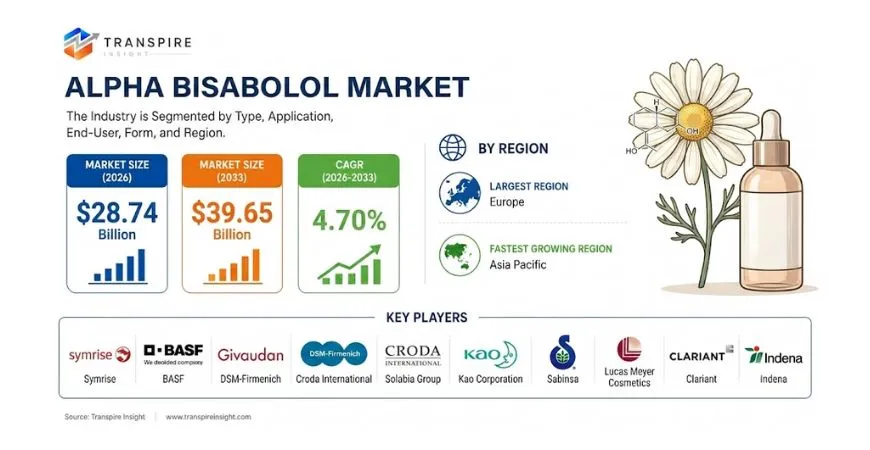
The global alpha bisabolol market was valued at USD 27.45 billion in 2025 and is projected to grow from USD 28.74 billion in 2026 to USD 39.65 billion by 2033, at a CAGR of 4.70% through the forecast period, according to a new report by Transpire Insights.
Alpha bisabolol is one of the most widely used skin-soothing and anti-inflammatory activities in prestige and mass-market skincare, with a well-established safety and efficacy profile that continues to attract formulation interest from cosmetic brands responding to consumer demand for gentle, science-backed ingredients. The ingredient's versatility across product formats, its compatibility with sensitive skin positioning, and the growth of both natural-origin and organic certification demand are all supporting sustained market expansion.
Alpha Bisabolol Market Growth & Trends
Consumer demand for calming and barrier-supporting skincare has grown substantially, driven by increased awareness of skin sensitivity, microbiome disruption, and the limitations of harsh active ingredient protocols popularised through social media. Alpha bisabolol's dual function as both a soothing agent and a penetration enhancer facilitating the delivery of other actives gives it a formulation utility that single-function ingredients cannot match, sustaining its specification across product categories from rosacea-targeting serums to everyday moisturisers.
The clean beauty and natural formulation trend is creating bifurcation in the alpha bisabolol market between natural-origin material from German chamomile or Candeia tree extraction and synthetic bisabolol manufactured by chemical synthesis. Natural-origin bisabolol commands a premium in formulations positioned around plant-derived ingredient sourcing, while synthetic bisabolol identical in molecular structure and function serves cost-sensitive formulations and markets where clean beauty claims are less commercially critical. Both segments are growing, with natural-origin products growing faster as clean beauty penetrates mainstream retail.
Emerging Economies & Technology
Asia Pacific is the fastest-growing regional market for alpha bisabolol, driven by the rapid expansion of K-beauty and J-beauty inspired skincare formulation trends that emphasise skin barrier support, gentle actives, and multi-step routine formats. South Korean and Japanese skincare brands have been early and sophisticated adopters of bisabolol in their calming and sensitive skin product ranges, and Chinese cosmetic manufacturers are following these formulation trends as domestic brands invest in ingredient quality to compete with imported prestige skincare.
Biotechnology routes to alpha bisabolol production using microbial fermentation of biosynthetic precursors rather than either plant extraction or petroleum-based synthesis are emerging as a third supply pathway that could offer better yield predictability and lower environmental impact than conventional routes. Companies including Givaudan and DSM-Firmenich are investing in fermentation-based ingredient production that could provide natural-identical bisabolol with a supply chain less dependent on botanical extraction variability.
Skincare Products Segment
Skincare products account for 57% of the global alpha bisabolol market, the dominant application category. Facial moisturisers, serums, toners, eye creams, and targeted treatment products are the highest-volume end uses, where bisabolol's combination of soothing, brightening, and penetration-enhancing properties give it multi-functional value in formulations targeting sensitive, reactive, or compromised skin. The ingredient's well-documented tolerability supported by decades of clinical and cosmetic use data makes it a default specification for brands developing products for dermatologically sensitive skin claims.
Minimalist formulation trends emphasizing fewer, higher-quality ingredients rather than complex multi-active compositions are benefiting alpha bisabolol, which performs well as a primary active in clean, simple formulations rather than only as a supporting ingredient in complex blends. Brands that have built their identity around single hero ingredients are among the most active new adopters of bisabolol-led formulation concepts.
Organic Bisabolol: Fastest-Growing Segment
Organic bisabolol is growing at a CAGR of 10.6% the fastest rate in the market. Demand from cosmetic brands seeking COSMOS, ECOCERT, and USDA Organic certified formulations is driving investment in certified organic Candeia tree extraction and organic-compliant synthesis routes. The premium price that organic-certified products command in natural beauty retail and the growing share of total skincare sales that natural and organic channels represent provides commercial justification for the cost premium of certified organic bisabolol over conventional natural or synthetic material.
Supply chain transparency requirements are intensifying for organic bisabolol, with major cosmetic brands requiring supplier documentation of sustainable sourcing practices alongside organic certification. The Candeia tree, which is the primary natural source of alpha bisabolol in Brazil, has faced sustainability concerns related to overharvesting, and certified sustainable sourcing programmes from suppliers including Beraca are becoming a commercial prerequisite for brands with serious ethical sourcing commitments.
Europe – Largest Regional Market
Europe holds 36% of the global alpha bisabolol market, the largest regional share. Germany has a particular connection with this ingredient given bisabolol's primary natural source in German chamomile, and European cosmetic formulators known for their rigorous ingredient evaluation standards and strong preference for well-documented actives have been sophisticated long-term users of bisabolol across prestige and dermo-cosmetic product ranges. BASF and Symrise, both German-headquartered, are among the world's largest bisabolol suppliers, with production capability spanning both natural-origin and synthetic products.
The European regulatory framework under the EU Cosmetics Regulation provides a stable environment for bisabolol specification, with the ingredient's well-established safety dossier facilitating formulation across all cosmetic product categories including rinse-off and leave-on formats for all age groups including infants. This regulatory clarity is particularly valuable for brands developing products for sensitive and paediatric skin segments where ingredient substantiation is closely scrutinised.
Asia Pacific – Fastest-Growing Region
Asia Pacific is advancing at a CAGR of 11.4% the highest regional rate in this market. The region's cosmetic manufacturing base is rapidly scaling premium formulation capability, and alpha bisabolol is among the well-evidenced actives that domestic Chinese, South Korean, and Indian brands are incorporating into products positioned to compete with European and US prestige imports. South Korea's globally influential beauty industry positions bisabolol in its established calming and barrier-repair product tradition.
Indian personal care and cosmetics manufacturing is at an earlier stage of premium active ingredient adoption, but the growth of domestic skin care brands targeting the premium and natural segments is creating new demand for cosmetic-grade bisabolol. Regulatory clarity under India's cosmetics framework and improving supply chain access through established ingredient distributors are supporting adoption among Indian formulators building internationally positioned brands.
What Are the Recent Developments in the Alpha Bisabolol Market?
Q4 2024 – Symrise: Launched a new line of certified organic alpha bisabolol from sustainably managed Candeia tree cultivation in Brazil, providing cosmetic brands with documented chain-of-custody certification from plantation through extraction to finished ingredient delivery.
Q4 2024 – BASF: Introduced a high-purity synthetic alpha bisabolol grade for pharmaceutical topical formulation, meeting the USP and Ph. Eur. monograph standards required for therapeutic skincare and wound care applications in regulated pharmaceutical markets.
Q1 2025 – Givaudan: Announced the commercial launch of a fermentation-derived alpha bisabolol produced through its biotech ingredient platform, providing cosmetic brands with a natural-identical bisabolol supply option with a fully traceable and non-botanical supply chain.
Q2 2025 – Croda International: Received COSMOS certification for its EcoBisabolol product, enabling cosmetic brands using Croda bisabolol to make certified organic formulation claims without separate ingredient re-certification in their product registration documentation.
Q2 2025 – DSM-Firmenich: Published new clinical data supporting alpha bisabolol's efficacy in reducing transepidermal water loss in compromised skin barrier conditions, strengthening the ingredient's clinical substantiation for barrier-repair skincare formulations.
Q3 2025 – Beraca: Expanded its sustainable Candeia extraction programme in Brazil with a new supply agreement covering forest community management rights, extending its certified sustainable bisabolol supply capacity to meet growing demand from European and North American clean beauty brands.
About Transpire Insight
Turning Complex Data into Clear, Actionable Market Intelligence
In today’s hyper-competitive and fast-moving economy, guessing isn’t a business strategy. To lead your industry, launch game-changing products, or scale into new geographies, you need precise, reliable market intelligence, not just high-level noise.
At Transpire Insight, we are a full-service market research, data analytics, and strategic consulting firm. We help corporate leaders, innovators, and investors navigate complex market shifts with absolute confidence.
By combining rigorous primary research, deep statistical modeling, and hands-on domain expertise, we convert raw data into high-impact strategic roadmaps that drive measurable growth.
What Drives Us
Markets don’t stand still, and neither do we. Our core mission is simple: to empower organizations with verified, technology-enabled insights that remove guesswork from strategic planning.
Whether you are evaluating a niche technological shift, assessing supply chain dynamics, or looking for high-growth target segments, our intelligence gives you a decisive competitive edge.
Why Leading Enterprises Trust Transpire Insight
We don't offer one-size-fits-all research. Our analysts specialize in dedicated verticals—from Biotechnology and Semiconductors to Advanced Automotive, Clean Energy, and Industrial Manufacturing. We speak your industry's language and understand the specific nuances, regulatory shifts, and economic drivers shaping your market.
Syndicated Market Reports: In-depth, turn-key research studies covering market size, share, competitive benchmarking, and multi-year forecasts.
Customized Market Intelligence: Tailored research engagements built around your exact business questions, specific product lines, or targeted regional dynamics.
Strategic Consulting: On-demand analytical support, entry-strategy planning, and direct consultation to help you act on data with speed and accuracy.
Reliable forecasts demand ground-truth data. Our research process combines comprehensive desk research with extensive primary interviews across key industry stakeholders including C-suite executives, supply chain leaders, procurement heads, and subject matter experts. Every report undergoes strict validation to ensure maximum precision and relevance.
Our Core Sectors
We provide continuous tracking and deep-dive analytical coverage across high-impact industries:
Manufacturing and Construction
Let’s Shape Your Growth Strategy Together
Whether you are preparing for your next fiscal cycle, analyzing market entry barriers, or looking for deep-dive quantitative data, Transpire Insight is your trusted intelligence partner.
Ready to gain a clearer view of your market?
Email Us: [email protected]
Speak to Our Analyst: +91 7666513636
Want to dive deeper? Head over to www.transpireinsight.com or join our community on Twitter, LinkedIn, and Facebook for the latest updates

 [email protected]
 APAC:+91 7666513636
 Address


