
Aug 07, 2026
Market Forecast
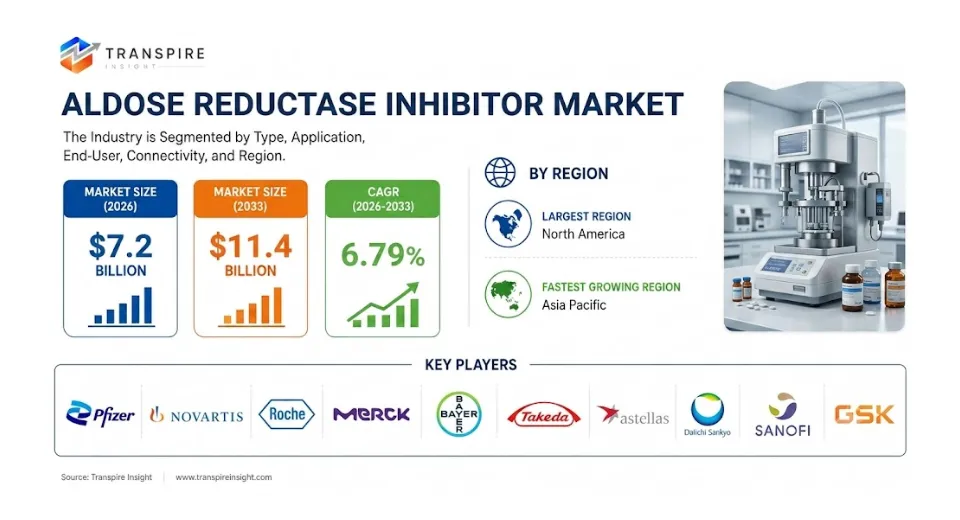
The aldose reductase inhibitor market had a value of $6.76 billion in 2025 - and it's expected to grow from $7.2 billion in 2026 to $11.4 billion by 2033, at a CAGR of 6.79% over the forecast period, says a new report by Transpire Insights.
The diabetes epidemic really drives this market forward. Since the number of diabetics keeps increasing - with the International Diabetes Federation estimating more than 537 million adults now affected - the long-term impact of diabetic complications, especially neuropathy, retinopathy, and nephropathy, creates ongoing clinical demand for treatments focusing on the polyol pathway involved in tissue damage itself. Aldose reductase inhibitors actually target this mechanism head-on, and their use is becoming more widespread as there's more clinical proof of their neurological benefits accumulating.
Aldose Reductase Inhibitor Market Growth & Trends
Diabetic peripheral neuropathy represents one of the most prevalent - and disabling - long-term consequences of diabetes, affecting around half of all diabetic patients over time. Presently available treatments for the actual nerve damage - as opposed to symptomatically managing the pain - are quite limited, making aldose reductase inhibitors a pharmacologically distinct intervention. Within markets where the class has been approved and reimbursed, neurologists and diabetologists are increasingly integrating these agents into their management plans for patients showing early signs of neuropathy.
Recognition of diabetic complications is really increasing within our healthcare systems - even in developing markets where diabetes was previously undermanaged. National diabetic care initiatives in India, China, and Southeast Asia are greatly expanding screenings for problems like neuropathy and nephropathy, drawing many more patients into our treatment pathways. This mix of wider diagnosis and a larger number of treated individuals is pushing the market forward well beyond its traditional base in established markets.
Emerging Economies & Technology
The Asia Pacific region represents the fastest-growing market for aldose reductase inhibitors - and it's very closely related to the area's massive diabetes problem. India and China alone hold a significant proportion of the world's diabetic patients, and both markets continue to grow in terms of specialized diabetes care infrastructure. Epalrestat, already approved and commonly used in India, Japan, and China, is getting even more attention since generic versions have improved accessibility at lower prices and government health plans have extended reimbursement coverage to many more patients.
Research investment in next-generation aldose reductase inhibitors is moving forward rapidly, with ranirestat and fidarestat in various stages of clinical testing for diabetic neuropathy and retinopathy indications. Improved selectivity profiles and much better tolerability data when compared to earlier-generation compounds are really supporting renewed interest from clinicians. Academic neurology centers and pharmaceutical research organizations are also researching combination approaches that combine aldose reductase inhibition with additional neuroprotective mechanisms - which could greatly expand the clinical value and market potential for the entire class.
Epalrestat Segment
Epalrestat now occupies 44% of the world's aldose reductase inhibitor market - still the number one product by revenue. This is the sole aldose reductase inhibitor with very wide commercial availability and regulatory approval across many major markets like India, Japan, China, and quite a few more Asian countries. Its oral form, well-established safety profile, and decades of actual clinical use really make it the go-to option for diabetic neuropathy management when drugs of this class are prescribed.
Generic competition has greatly increased access to epalrestat in India and China - places where sensitive healthcare systems value lower-cost formulations just as much as their efficacy. Brand-name products continue to be found in hospitals and among specialist prescribers, yet the availability of affordable generics is really what's driving the rapid increase in volume sales all over the Asia-Pacific area over the past few years.
Ranirestat: The Rapidly Growing Segment
Ranirestat is expanding at a CAGR of 12. 6% - the highest growth rate amongst all types of medications in this market. It is considered a new-generation aldose reductase inhibitor holding a much stronger potency profile compared to epalrestat, meaning it can effectively inhibit at much lower doses. Clinical trials have demonstrated some benefits in diabetic neuropathy and early-stage retinopathy, and the compound is actually under regulatory review or actively being developed in several major markets right now.
The business opportunity for ranirestat stretches far beyond just replacing epalrestat - its increased potency makes it possible to treat patients who didn't respond well enough to earlier-generation inhibitors. If wider regulatory approvals come along the lines of the ongoing clinical development path, ranirestat stands out as highly likely to secure a significant part of the prescription market among specialist diabetologists and ophthalmologists managing really complex diabetic complications.
North America – Largest Regional Market
North America is home to 39% of the world's aldose reductase inhibitor market. The US has a very large and well-understood diabetic population - with extremely high rates of long-term complication-related issues - and the specialist diabetes and neurology communities are really interested in emerging evidence about aldose reductase inhibition. Ongoing research funding from NIH and private organizations continues to back clinical studies on the role of the mechanism in diabetic neuropathy and retinopathy - thereby keeping the therapeutic class right in the center of ongoing scientific and clinical discussion.
US reimbursement dynamics are quite crucial. As approved drugs within this class gather more convincing clinical data and get regulatory approval in specific diabetic complication indications, insurance company coverage decisions will play a major part in determining market expansion. Large pharmaceutical companies like Pfizer, Eli Lilly, and AstraZeneca all hold significant interests in diabetes portfolios that intersect with the complication management market itself.
Asia Pacific - The Fastest-Growing Region
Asia Pacific is expanding at a CAGR of 14. 2% - the highest regional growth rate in this market indeed. Japan has had the longest history of prescribing aldose reductase inhibitors, with epalrestat approved and commonly used in managing diabetic neuropathy for many years already. China and India are becoming the main drivers of growth, driven by their truly massive diabetic populations, continuously expanding pharmacy and hospital networks, and increasing knowledge among doctors and patients alike of diabetic complication management strategies.
India's government diabetes initiatives - such as the National Programme for Prevention and Control of Cancer, Diabetes, Cardiovascular Disease, and Stroke - are helping even more patients get into structured care pathways that include screening and treating complications. As this infrastructure becomes even stronger, we'll see more patients reaching specialist neurology and ophthalmology care with late-stage complication diagnoses - thus greatly expanding the target market for aldose reductase inhibitors itself.
What Are the Recent Developments in the Aldose Reductase Inhibitor Market?
Q4 2024 - Daiichi Sankyo: Released phase three data for ranirestat in diabetic peripheral neuropathy showing statistically significant improvement in nerve conduction speed over a placebo, really backing up ongoing regulatory submission plans in Asian and European markets.
Q4 2024 - Teva: Introduced a brand-new, generic epalrestat formulation to three Southeast Asian countries after patents had expired, greatly increasing access to this class of drugs for very budget-conscious patient groups in the area itself.
Q1 2025 - Eli Lilly: Started a phase two investigator-sponsored study looking into the combination of aldose reductase inhibition with its well-established diabetes treatments in patients with very early-stage diabetic retinopathy at top academic medical centers in India and Japan.
Q2 2025 - Novartis: Announced a research partnership with a Japanese academic organization to check out fidarestat's potential role in preventing progression of diabetic nephropathy in patients who have type 2 diabetes and very early-stage chronic kidney disease itself.
Q2 2025 - AstraZeneca: Actually added aldose reductase pathway studies into its much broader plan for managing diabetic complications, focusing on combining pathway inhibition with SGLT2-inhibitor-based therapy in patients already experiencing neuropathy itself.
Q3 2025 - Astellas: Got an expanded prescription approval in Japan for epalrestat that now covers very early-stage diabetic retinopathy along with its current neuropathy indication, making the drug accessible to a whole lot more potential patients in its biggest market ever.
About Transpire Insight
Turning Complex Data into Clear, Actionable Market Intelligence
In today’s hyper-competitive and fast-moving economy, guessing isn’t a business strategy. To lead your industry, launch game-changing products, or scale into new geographies, you need precise, reliable market intelligence, not just high-level noise.
At Transpire Insight, we are a full-service market research, data analytics, and strategic consulting firm. We help corporate leaders, innovators, and investors navigate complex market shifts with absolute confidence.
By combining rigorous primary research, deep statistical modeling, and hands-on domain expertise, we convert raw data into high-impact strategic roadmaps that drive measurable growth.
What Drives Us
Markets don’t stand still, and neither do we. Our core mission is simple: to empower organizations with verified, technology-enabled insights that remove guesswork from strategic planning.
Whether you are evaluating a niche technological shift, assessing supply chain dynamics, or looking for high-growth target segments, our intelligence gives you a decisive competitive edge.
Why Leading Enterprises Trust Transpire Insight
We don't offer one-size-fits-all research. Our analysts specialize in dedicated verticals—from Biotechnology and Semiconductors to Advanced Automotive, Clean Energy, and Industrial Manufacturing. We speak your industry's language and understand the specific nuances, regulatory shifts, and economic drivers shaping your market.
Syndicated Market Reports: In-depth, turn-key research studies covering market size, share, competitive benchmarking, and multi-year forecasts.
Customized Market Intelligence: Tailored research engagements built around your exact business questions, specific product lines, or targeted regional dynamics.
Strategic Consulting: On-demand analytical support, entry-strategy planning, and direct consultation to help you act on data with speed and accuracy.
Reliable forecasts demand ground-truth data. Our research process combines comprehensive desk research with extensive primary interviews across key industry stakeholders including C-suite executives, supply chain leaders, procurement heads, and subject matter experts. Every report undergoes strict validation to ensure maximum precision and relevance.
Our Core Sectors
We provide continuous tracking and deep-dive analytical coverage across high-impact industries:
Manufacturing and Construction
Let’s Shape Your Growth Strategy Together
Whether you are preparing for your next fiscal cycle, analyzing market entry barriers, or looking for deep-dive quantitative data, Transpire Insight is your trusted intelligence partner.
Ready to gain a clearer view of your market?
Email Us: [email protected]
Speak to Our Analyst: +91 7666513636
Want to dive deeper? Head over to www.transpireinsight.com or join our community on Twitter, LinkedIn, and Facebook for the latest updates

 [email protected]
 APAC:+91 7666513636
 Address


