
Aug 05, 2026
Market Forecast
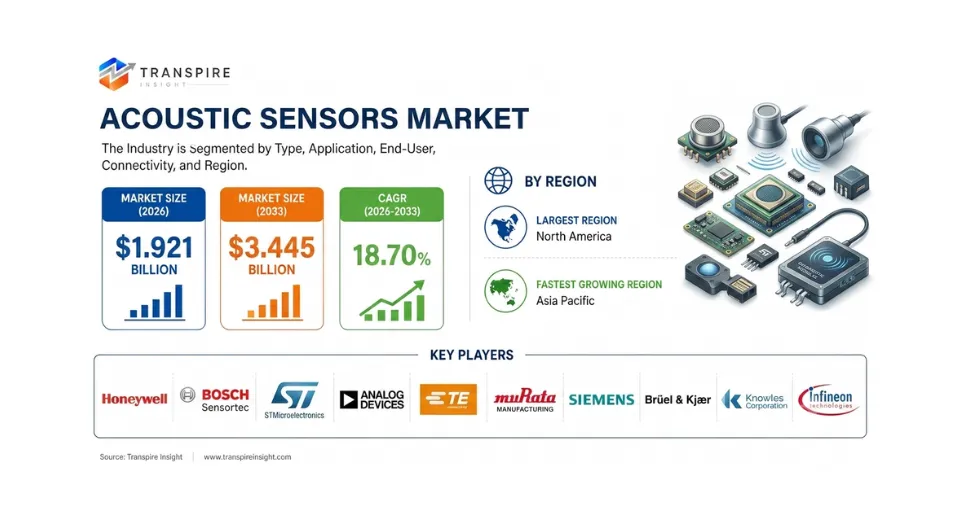
According to a new report by Transpire Insights. The acoustic sensors market recorded USD 1.921 billion in 2026 and is anticipated to reach USD 3.445 billion by 2033, growing at a CAGR of 8.70% from 2026 to 2033, reflecting steady year-on-year momentum as industries worldwide accelerate their adoption of sensing technologies. Demand surges from industrial automation, automotive safety systems, defense applications, and healthcare diagnostics continue to shape a robust growth outlook for acoustic sensor manufacturers and solution providers globally.
Key players operating in the acoustic sensors market include Honeywell, Bosch Sensortec, STMicroelectronics, Analog Devices, TE Connectivity, Murata Manufacturing, Siemens, Bruel and Kjaer, Knowles Corporation, Infineon Technologies, CTS Corporation, Qualcomm, TDK Corporation, Emerson Electric, and OmniVision.
Acoustic Sensors Market Growth & Trends
Industrial monitoring needs, very strict workplace safety laws, and our worldwide push towards predictive maintenance really drive a constant demand for acoustic sensors across many different industries. Companies are starting to switch out reactive fix-it cycles more often than not with maintenance plans driven by data - and acoustic sensors really sit right in the middle of this changeover process. Increasing infrastructure spending in developing countries even further expands our total potential market size since construction, utilities, and transportation systems need super reliable sound and vibration monitoring on a massive scale.
Automotive car manufacturers integrate acoustic sensors into advanced driver assistance systems and collision avoidance platforms, making for a very large demand channel indeed. The military sector really depends on acoustic sensors for perimeter surveillance, detecting threats underwater, and getting a better sense of our surroundings. Consumer electronics companies put MEMS microphones and surface acoustic wave sensors into wearables, smart speakers, and mobile devices, greatly increasing the number of applications and keeping the volume growth quite healthy indeed.
Emerging Economies & Technology
Really rapid industrialization across Southeast Asia, South Asia, and Latin America really opens up some huge opportunities for growth for acoustic sensor suppliers. Governments in these areas invest a lot of money into building smart cities, setting up environmental monitoring networks, and upgrading manufacturing facilities - all of which need extremely precise sensing abilities. Local production incentives and rather favorable foreign investment policies really attract sensor makers, encouraging them to share their tech and build up local capacity even more.
Eco-friendly coatings and IoT connectivity standards make it possible to remotely monitor things that were previously too expensive to set up. Online shopping channels really give smaller industrial buyers a wider selection of products, improving market access for well-established manufacturers as well as niche specialists alike. The convergence of AI-driven analytics with acoustic data streams really creates new revenue streams in predictive diagnostics and anomaly detection services, attracting both venture and corporate R&D funding into the sector.
Piezoelectric Acoustic Sensors Segment
Piezoelectric acoustic sensors have the largest product share - at 41% - because of their well-proven reliability, very wide operating temperature range, and well-set-up supply chains. These sensors turn mechanical stress right into electrical signals with great accuracy, so they're often the first choice for industrial vibration monitoring, assessing the health of structures, and non-destructive testing. Their ability to last under tough conditions and be compatible with older industrial systems really ensures that end-users keep specifying piezoelectric solutions all over oil and gas, aerospace, and heavy manufacturing applications.
Industrial Machinery & Equipment Segment
Industrial manufacturers are the biggest end-user group for acoustic sensors - and they account for most of the world's revenue. Production facilities really rely on constant acoustic monitoring to find out about bearing failures, fluid leaks, and structural wear-and-tear before it results in very expensive downtime. The adoption of Industry 4. 0 practices actually increases this demand even more, since smart factories integrate acoustic sensors right into digital twin frameworks and automated control loops. Power generation, chemical processing, and heavy equipment manufacturing all say they're setting aside more funds for sensor-based condition monitoring programs.
North America Market Dominance
North America has the largest regional share - at 36% because of a fully developed industrial base, very large defense budgets, and an already well-set-up automotive manufacturing ecosystem. The United States really drives domestic demand through its aerospace and MRO sectors, while Canada adds to it through resource extraction and energy infrastructure. Very high technology adoption rates and the presence of big sensor manufacturers like Honeywell, TE Connectivity, Analog Devices, and Emerson Electric really make the region a leader. Federal investments in smart infrastructure and grid modernization add another steady layer of demand that goes on for a long time into our forecast period.
Asia Pacific Experiences Fastest Growth
Asia Pacific is growing at the fastest rate - achieving a CAGR of 14. 1% and right now holds 31% of the world's total market share. China, Japan, South Korea, and India really push up demand through very rapid industrial development, quite aggressive smart city investment projects, and a really booming consumer electronics manufacturing sector itself. Government-backed initiatives all over electric vehicles, defence modernisation, and 5G deployment create some brand-new demand areas that sensor makers really focus on targeting. The region gets quite a lot of R&D investment in MEMS fabrication and acoustic signal processing too, which really narrows the technological difference with established Western companies.
MEMS Acoustic Sensors Show Segment Growth
MEMS acoustic sensors see the fastest expansion within our product range, expanding at a CAGR of 13. 5%. Their very small size, low power usage, and compatibility with semiconductor fabrication processes make them perfect for consumer wearables, IoT nodes, and even automotive cabin monitoring. Increased regulatory pressures on noise pollution and workplace sound exposure in Europe and North America drive more specific requirements for MEMS-based solutions in workplace safety equipment. Companies like Bosch Sensortec, STMicroelectronics, and Knowles Corporation invest heavily in the next generation of MEMS designs so they can meet this rapidly increasing demand better.
Aerospace Emerges as High-Growth Segment
The aerospace industry becomes another high-growth application area, driven by rising MRO activities, expansion of fleets among low-cost carriers, and much stricter airworthiness monitoring requirements. Acoustic sensors play really crucial roles in monitoring engine health, diagnosing landing gear issues, and even observing the condition of the aircraft's fuselage structure. Defence aviation programmes also increase demand for highly ruggedised acoustic sensing systems that can handle extremely high temperatures and vibrations. As air travel recovers completely and new aircraft programmes go into full-scale production, MRO expenditure goes up accordingly, drawing even more acoustic sensor quantities along with it.
What are the Recent Developments in the Acoustic Sensors Market?
Q4 2024 - Murata Manufacturing - Entered a strategic partnership with Bosch to co-develop next-generation acoustic sensors targeting smart home and security device applications.
Q4 2024 - Siemens - Launched a dedicated acoustic sensor suite for environmental monitoring applications, with primary targeting at smart city infrastructure and industrial pollution control networks.
Q1 2025 - Honeywell - Introduced an expanded range of MEMS-based acoustic sensors for industrial monitoring, delivering improved detection accuracy and enhanced energy efficiency for oil and gas, aerospace, and automotive applications.
Q2 2025 - STMicroelectronics - Announced an advanced MEMS microphone series optimized for automotive in-cabin voice recognition and active noise cancellation, targeting European and North American OEM programs.
Q2 2025 - Qualcomm - Expanded its research and development investments in bulk acoustic wave sensor technology to strengthen its positioning in next-generation 5G connectivity infrastructure.
Q3 2025 - Honeywell - Unveiled a new line of bulk acoustic wave sensors tailored for industrial applications, emphasizing precision durability and operational reliability in demanding process environments.
About Transpire Insight
Turning Complex Data into Clear, Actionable Market Intelligence
In today’s hyper-competitive and fast-moving economy, guessing isn’t a business strategy. To lead your industry, launch game-changing products, or scale into new geographies, you need precise, reliable market intelligence, not just high-level noise.
At Transpire Insight, we are a full-service market research, data analytics, and strategic consulting firm. We help corporate leaders, innovators, and investors navigate complex market shifts with absolute confidence.
By combining rigorous primary research, deep statistical modeling, and hands-on domain expertise, we convert raw data into high-impact strategic roadmaps that drive measurable growth.
What Drives Us
Markets don’t stand still, and neither do we. Our core mission is simple: to empower organizations with verified, technology-enabled insights that remove guesswork from strategic planning.
Whether you are evaluating a niche technological shift, assessing supply chain dynamics, or looking for high-growth target segments, our intelligence gives you a decisive competitive edge.
Why Leading Enterprises Trust Transpire Insight
1. Deep Industry Specialization
We don't offer one-size-fits-all research. Our analysts specialize in dedicated verticals—from Biotechnology and Semiconductors to Advanced Automotive, Clean Energy, and Industrial Manufacturing. We speak your industry's language and understand the specific nuances, regulatory shifts, and economic drivers shaping your market.
2. Comprehensive Research Offerings
Syndicated Market Reports: In-depth, turn-key research studies covering market size, share, competitive benchmarking, and multi-year forecasts.
Customized Market Intelligence: Tailored research engagements built around your exact business questions, specific product lines, or targeted regional dynamics.
Strategic Consulting: On-demand analytical support, entry-strategy planning, and direct consultation to help you act on data with speed and accuracy.
3. A Multi-Layered Research Methodology
Reliable forecasts demand ground-truth data. Our research process combines comprehensive desk research with extensive primary interviews across key industry stakeholders including C-suite executives, supply chain leaders, procurement heads, and subject matter experts. Every report undergoes strict validation to ensure maximum precision and relevance.
Our Core Sectors
We provide continuous tracking and deep-dive analytical coverage across high-impact industries:
Manufacturing and Construction
Let’s Shape Your Growth Strategy Together
Whether you are preparing for your next fiscal cycle, analyzing market entry barriers, or looking for deep-dive quantitative data, Transpire Insight is your trusted intelligence partner.
Ready to gain a clearer view of your market?
Email Us: [email protected]
Speak to Our Analyst: +91 7666513636
Want to dive deeper? Head over to www.transpireinsight.com or join our community on Twitter, LinkedIn, and Facebook for the latest updates

 [email protected]
 APAC:+91 7666513636
 Address


