
Sep 15, 2026
By Transpire Insight
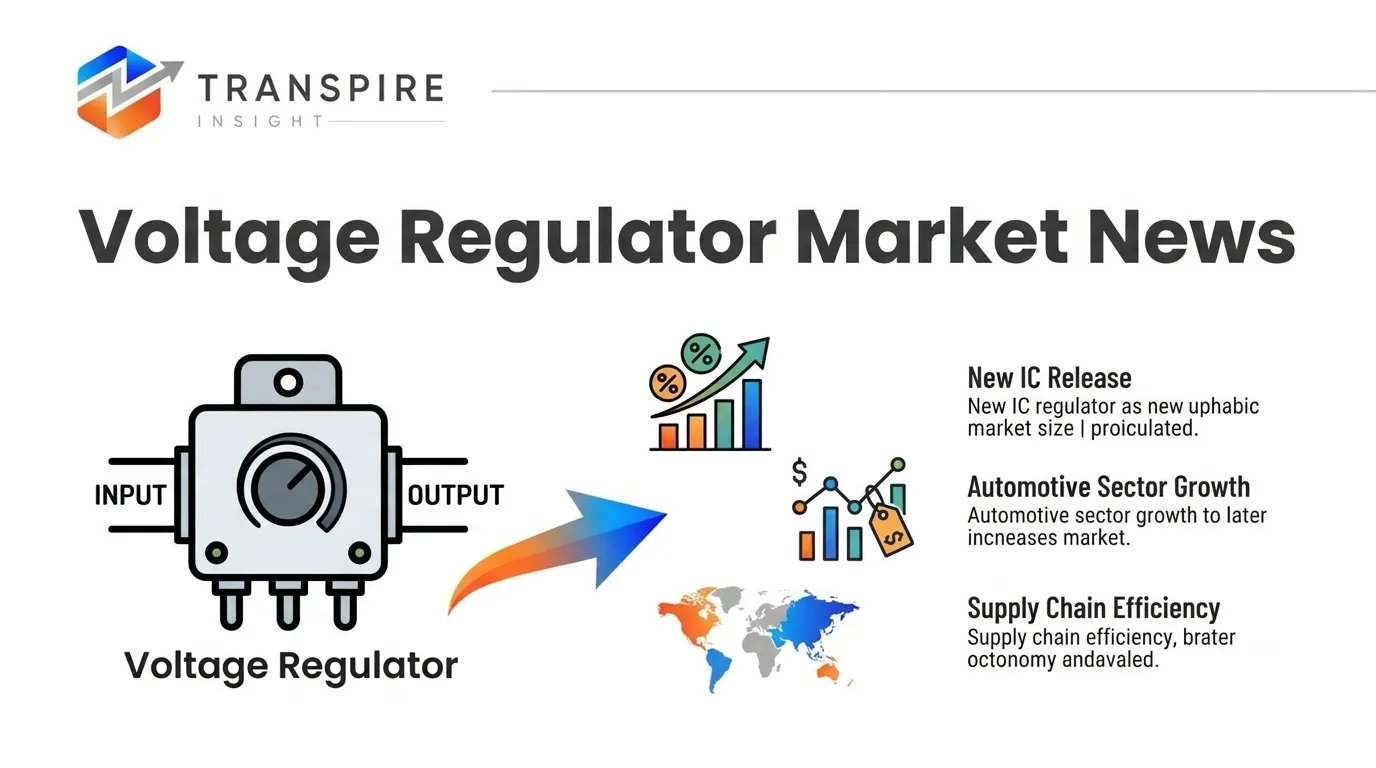
Electrification Is Increasing the Strategic Importance of Voltage Regulation
The global electricity ecosystem is becoming more digitally connected and electrically complex. As industries deploy increasingly sophisticated electronic equipment, electric vehicles, renewable-energy systems, automation platforms, communication infrastructure, and high-performance computing equipment, maintaining stable voltage has become essential to system reliability.
Voltage regulators perform a fundamental function by maintaining a controlled output voltage despite variations in input voltage and load conditions. They help protect sensitive electronics, improve power quality, reduce unwanted fluctuations, and support consistent operation across a wide range of electrical and electronic systems.
The global voltage regulator market was valued at approximately USD 14.67 billion in 2025 and is projected to reach USD 15.96 billion in 2026 and USD 29.15 billion by 2034, representing a 7.82% CAGR from 2026 to 2034. Asia Pacific accounted for approximately 36.38% of the market in 2025.
Other market definitions produce considerably smaller estimates because they focus specifically on certain voltage-regulator equipment categories rather than the broader semiconductor and electronic-regulation ecosystem. One 2026 assessment places the global market at USD 3.2 billion in 2025 and projects USD 4.5 billion by 2034.
The difference illustrates an important characteristic of the industry: "voltage regulator" can refer to semiconductor components such as LDOs and switching regulators as well as larger electrical regulation equipment used in power systems.
Modern Electronics Require More Precise Power Management
Voltage regulation is becoming increasingly demanding as electronic systems become smaller, faster, and more power intensive.
Smartphones, laptops, servers, automotive control units, industrial controllers, networking equipment, sensors, and other electronic platforms frequently contain multiple voltage rails. Different processors, memory systems, sensors, communications modules, and peripheral circuits may require different voltage levels and tightly controlled power delivery.
This is increasing demand for regulators capable of delivering:
The trend is particularly visible in digital voltage regulation. A 2026 industry assessment estimates the digital voltage regulator market at approximately USD 1.38 billion in 2025, with projected growth to USD 2.85 billion by 2032, reflecting increasing demand for telemetry, configurability, adaptive control, and precision power delivery.
As computing workloads become more dynamic, voltage regulation is increasingly being treated as part of the system architecture rather than merely a supporting component.
Switching Regulators Are Becoming Increasingly Important
Switching regulators are gaining attention because they can provide higher efficiency than conventional linear approaches in applications where energy conversion losses are critical.
Recent market analysis estimates that the switching segment is expected to account for approximately 62.95% of the global voltage regulator market in 2026.
Buck, boost, buck-boost, and inverting configurations allow designers to adapt voltage according to the requirements of batteries, processors, automotive electronics, industrial equipment, and power systems.
The increasing importance of switching regulation is closely linked to energy efficiency. As electronic devices become more power dense, even relatively small conversion losses can translate into significant heat generation and energy consumption.
This is particularly important in data centers, electric vehicles, telecommunications infrastructure, and industrial automation systems where thousands of power-conversion events may occur continuously.
Why Does the Voltage Regulator Market Matter?
Voltage regulation has become critical across industries because unstable or poorly controlled power can reduce efficiency, degrade components, interrupt operations, and shorten equipment life.
The breadth of these applications provides the market with structural resilience because voltage regulation is embedded in numerous technology ecosystems.
Automotive Electrification Is Creating New Demand
The automotive industry is undergoing one of the most significant transformations in its history as vehicles incorporate more electronics and increasingly adopt electric and hybrid powertrains.
Modern vehicles contain multiple voltage domains, including 12 V and 48 V auxiliary architectures alongside high-voltage battery systems in electrified vehicles. Voltage regulation is required to convert and stabilize electrical power for processors, sensors, control units, communication systems, lighting, infotainment, and safety technologies.
The Indian automotive voltage regulator market alone reached approximately USD 129.9 million in 2025 and is projected to reach USD 228.2 million by 2034, representing a 6.27% CAGR during 2026–2034. The market is being supported by vehicle electrification, hybrid vehicles, automotive electronics, ADAS, and electric-mobility initiatives.
The rise of ADAS is especially relevant because cameras, radar systems, processors, and sensor networks require highly stable power supplies.
Electric vehicles are also increasing the importance of efficiency. Reducing power-conversion losses can contribute to better thermal management and improved overall energy utilization.
Renewable Energy Is Increasing Grid Regulation Requirements
The transition toward renewable electricity is changing the operating conditions of power networks.
Solar and wind generation are variable by nature, and distributed energy resources can introduce more dynamic power flows into electrical networks. As renewable penetration rises, grid operators require advanced systems capable of maintaining voltage stability and responding to changing load and generation conditions.
Recent industry analysis identifies renewable-energy integration, smart-grid deployment, and advanced power-distribution systems as important growth drivers for voltage-regulation equipment.
Three-phase voltage regulation is particularly important in larger commercial, industrial, and utility environments. One 2026 market assessment estimates that three-phase systems represented approximately 58.3% of the market in 2025, with continued demand expected from renewable integration, EV charging infrastructure, and high-load applications.
This creates an important connection between the voltage regulator industry and the global transition toward decentralized and digitally managed electricity systems.
Smart Grids Are Creating a New Generation of Regulation Technologies
Traditional electrical regulation relied heavily on fixed or relatively simple control architectures. Modern grids are becoming more dynamic.
Smart-grid technologies increasingly combine sensors, communication systems, automation, analytics, and digital controls. Voltage regulation equipment can consequently become part of a broader network-management platform.
Digital monitoring can provide information about voltage levels, load conditions, equipment status, and abnormal events. Adaptive regulation can then adjust system behavior according to changing operating conditions.
This creates opportunities for manufacturers to integrate:
The evolution is particularly important for utilities managing distributed solar, battery storage, EV charging, and rapidly changing industrial loads.
Data Centers Are Raising the Performance Bar
The expansion of artificial intelligence and high-performance computing is creating another important demand channel for advanced voltage regulation.
AI processors and other high-performance chips can experience rapid changes in power demand. These changes can create transient voltage fluctuations within the power-delivery network, making fast and precise regulation increasingly important.
Recent research in 2026 has focused specifically on mitigating voltage-droop problems in advanced chiplet architectures used for machine-learning workloads, illustrating how power-delivery stability is becoming an important factor in AI-computing performance.
Another recent study examining mobile neural-processing workloads found that concentrated computational activity can create peak-current bursts that reduce low-voltage operating margins.
These developments demonstrate that voltage regulation is becoming increasingly connected to computing performance itself.
Integrated Voltage Regulation Is Moving Closer to the Processor
One of the most important technology trends is the integration of voltage regulation directly into or closer to advanced processors.
Conventional power-delivery architectures can involve multiple external components and long electrical paths. As processors become faster and power densities increase, designers are looking for ways to reduce power-delivery impedance and improve response times.
Recent analysis of integrated voltage regulators indicates that fully integrated digital regulators represented approximately 42.31% of revenue in 2024, while CPUs and GPUs accounted for approximately 47.64% of application demand. Data centers represented approximately 43.89% of end-user volumes in that market assessment.
The trend is strategically important because AI accelerators, GPUs, CPUs, and other advanced processors are becoming increasingly sensitive to power-delivery characteristics.
Integrated regulation can potentially reduce board-level complexity, improve response times, and enable tighter control of power delivery.
Low-Dropout Regulators Remain Important for Precision Applications
Despite the rapid growth of switching technologies, linear voltage regulators remain essential for applications where simplicity, low noise, fast response, and precise voltage control are prioritized.
Low-dropout regulators are particularly useful when the difference between input and output voltage is relatively small and designers require clean power with low noise.
A recent market assessment estimates that LDOs will represent approximately 35.9% of the linear voltage regulator market in 2026. Automotive applications are expected to account for approximately 40.7% of that market, supported by increasing electronic content, EV adoption, and ADAS.
This demonstrates that the market is not simply shifting from linear to switching technologies. Instead, different architectures are increasingly being selected according to application-specific power requirements.
Recent Industry Direction in 2026
The voltage regulator industry is increasingly focused on efficiency, miniaturization, digital control, automotive qualification, higher power density, and intelligent monitoring.
In September 2025, ABLIC introduced its S-19230/1 series automotive LDO linear regulators designed for 48 V, 24 V, and 12 V auxiliary battery systems, with an operating current as low as 2 µA and built-in overvoltage protection. The launch illustrates the industry's movement toward low-power, multi-voltage automotive regulation for next-generation electronic architectures.
At the system level, recent research is also addressing voltage-droop management in AI and chiplet-based computing, showing that power regulation is becoming a key design consideration as computing intensity increases.
These developments indicate that future competition will increasingly depend on precision, efficiency, integration, and intelligent control rather than basic voltage-conversion capability alone.
Investment Opportunities in Voltage Regulation
The expansion of electrification and digital infrastructure is creating opportunities throughout the voltage-regulation value chain.
Electric vehicles, hybrid vehicles, ADAS, zonal architectures, infotainment, sensors, and advanced control units require increasingly sophisticated voltage-regulation systems.
Suppliers developing automotive-qualified regulators with high efficiency, low quiescent current, thermal robustness, and multi-voltage compatibility can benefit from this transition.
Digitally controlled regulators can provide programmability, telemetry, adaptive response, and real-time monitoring.
As computing and telecommunications systems become more dynamic, digital regulation offers opportunities for manufacturers and semiconductor designers to differentiate through software-enabled power management.
AI data centers are creating demand for higher-efficiency and faster-response power architectures.
Opportunities exist in integrated voltage regulators, high-current regulators, advanced power-management ICs, and systems capable of responding to rapidly changing processor workloads.
The expansion of solar, wind, battery storage, and distributed energy resources creates demand for advanced voltage-control equipment.
Investment opportunities include digitally controlled three-phase regulators, smart-grid monitoring systems, adaptive control technologies, and equipment designed for dynamic power flows.
Energy efficiency is becoming a central purchasing criterion across electronics and industrial systems.
Technologies that reduce conversion losses, thermal output, standby consumption, and component count can capture demand from manufacturers seeking improved system-level efficiency.
Government and Regulatory Considerations
Voltage regulation is increasingly connected with government efforts to modernize electricity infrastructure, improve energy efficiency, expand renewable generation, and strengthen grid reliability.
Smart-grid investments require equipment capable of operating within increasingly dynamic distribution systems. Renewable-energy integration similarly increases the need for technologies that can manage voltage conditions as generation patterns change.
Automotive regulation is also influenced by vehicle safety, emissions, electrification, and electronic reliability requirements.
As electrification expands, governments are increasingly supporting infrastructure modernization, EV deployment, renewable-energy development, and digital manufacturing. These policies can indirectly strengthen demand for voltage-regulation technologies across multiple end-use industries.
The Market Faces Semiconductor, Thermal, and Design Challenges
Despite favorable demand fundamentals, the Voltage Regulator Market faces several challenges.
Advanced regulators increasingly require sophisticated semiconductor manufacturing, specialized packaging, and high-performance power components. Supply-chain disruptions affecting semiconductor materials or fabrication capacity can therefore influence availability and lead times.
Thermal management is another major challenge. Voltage conversion inevitably produces some energy loss, and higher current densities can increase heat generation. This makes thermal design increasingly important in compact electronics, EVs, industrial equipment, and data centers.
Design complexity is also increasing. Engineers must balance efficiency, noise, response speed, size, cost, reliability, and electromagnetic compatibility.
These factors favor manufacturers with strong semiconductor design capabilities and application-specific engineering expertise.
Policy Direction Across Major End-Use Industries
The future development of the Voltage Regulator Market is likely to be shaped by five primary priorities:
These forces indicate that voltage regulation will increasingly become an integrated component of broader energy-management architectures.
Market Expert View
The Voltage Regulator Market is entering a more technology-intensive phase as electrification and digitalization increase the complexity of power delivery.
Voltage regulators are no longer simply supporting components used to stabilize basic electrical systems. They are becoming critical to the operation of EVs, AI processors, smart-grid infrastructure, industrial automation, telecommunications equipment, and increasingly sophisticated consumer electronics.
The strongest opportunities are likely to emerge for companies that can combine high efficiency with compact designs, fast transient response, intelligent monitoring, automotive-grade reliability, and application-specific performance.
Current market estimates vary substantially because some studies include semiconductor regulators while others focus more narrowly on electrical voltage-regulation equipment. A broad 2026 assessment estimates the market at USD 14.67 billion in 2025 and projects it to USD 29.15 billion by 2034, while another assessment focused on a narrower market definition estimates USD 3.2 billion in 2025 and USD 4.5 billion by 2034.
Regardless of definition, the underlying market direction is supported by electrification, renewable integration, advanced computing, automotive electronics, and growing demand for energy-efficient power management.
Conclusion
Voltage regulation has become an essential foundation of modern electrification and digital infrastructure.
From smartphones and automotive control systems to AI data centers, renewable-energy networks, industrial automation, and smart grids, increasingly sophisticated electrical systems depend on precise and reliable power delivery.
Switching regulators, LDOs, digital regulators, integrated voltage regulators, and three-phase systems will continue to serve different parts of this expanding ecosystem.
The next stage of market development will be shaped by higher power density, faster response requirements, semiconductor integration, intelligent control, renewable-energy adoption, and vehicle electrification.
As electrical systems become more connected and power-intensive, voltage regulation is positioned to evolve from a conventional power-management function into a strategic technology supporting the reliability, efficiency, and performance of the global electrified economy.


Send us a brief description of your challenge and we'll get back to you within 24 hours.

 [email protected]
 APAC:+91 7666513636
 Address


