
Aug 18, 2026
By Transpire Insight
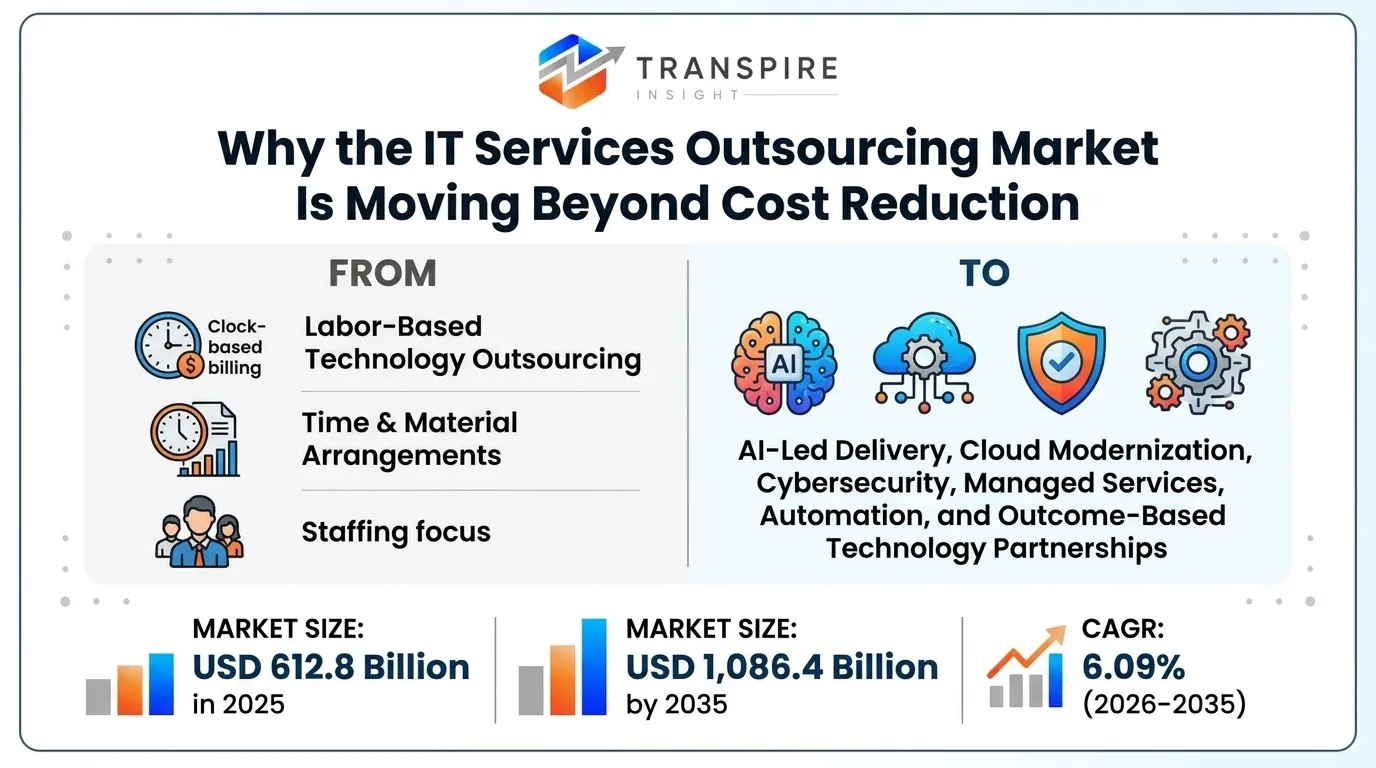
According to Transpire Insight, the IT services outsourcing market is estimated at approximately USD 612.8 billion in 2025 and is expected to reach around USD 638.6 billion in 2026. The market is projected to reach approximately USD 1,086.4 billion by 2035, expanding at an estimated CAGR of 6.09% during the forecast period 2026–2035.
The IT services outsourcing market is entering a major structural transition as enterprises increasingly move beyond the traditional objective of reducing technology costs and begin using external technology providers as strategic partners for artificial intelligence, cloud modernization, cybersecurity, application transformation, data management, automation, and digital business operations.
For decades, IT outsourcing was largely associated with transferring infrastructure support, application maintenance, help-desk operations, software development, and other technology tasks to external providers. That model remains important, but the definition of outsourcing is changing rapidly.
Organizations are increasingly seeking technology partners that can modernize legacy environments, operate cloud infrastructure, introduce AI capabilities, improve cybersecurity, automate repetitive workflows, manage data platforms, and continuously optimize technology operations.
This transition is particularly visible in managed services. Companies increasingly want an external partner to take responsibility for a business or technology outcome rather than simply provide additional technical personnel. Managed services are consequently becoming more closely connected with transformation programs, resilience, cybersecurity, and AI deployment.
In 2026, the role of artificial intelligence is becoming especially significant. Technology-service providers are increasingly integrating AI agents, automation, predictive analytics, and generative AI into service delivery itself. Reuters reported in August 2026 that traditional measures such as employee headcount and billable hours are becoming less representative of IT-services performance as AI allows providers to serve clients with fewer people and increasingly reusable technology platforms.
The result is a market moving from labor-based technology outsourcing toward AI-enabled, platform-oriented, outcome-driven, and continuously managed technology partnerships.
Market Overview
IT services outsourcing involves the use of external technology providers to deliver selected IT capabilities, operational services, development activities, infrastructure management, cybersecurity, cloud services, application support, data services, or broader technology functions.
The market serves organizations across banking, insurance, healthcare, manufacturing, retail, telecommunications, logistics, government, energy, automotive, professional services, and other industries.
One of the most established areas is application outsourcing. Enterprises can outsource software development, application maintenance, testing, modernization, integration, and support while retaining ownership of business strategy and technology architecture.
Infrastructure outsourcing represents another major category. Providers can manage data-center operations, networks, servers, workplace technology, backup systems, infrastructure monitoring, and other technology environments.
The market is increasingly being transformed by cloud outsourcing and managed cloud services. Enterprises may outsource cloud migration, infrastructure management, FinOps, security, application modernization, platform engineering, and ongoing cloud optimization.
Cybersecurity outsourcing is also becoming strategically important. Enterprises are increasingly using managed security services, threat monitoring, identity management, security operations, cloud-security support, and managed detection and response to compensate for skills shortages and address increasingly sophisticated cyber risks.
Security demand is becoming particularly significant in India. In March 2026, Gartner projected that information-security spending in India would increase during 2026, with managed security services identified as an important area of growth as organizations sought scalable expertise and stronger security capabilities.
The market is therefore increasingly positioned at the intersection of technology operations and business transformation.
Latest Market Statistics
The IT services outsourcing market is expected to maintain a positive long-term growth trajectory as enterprises increase external spending on cloud environments, cybersecurity, AI implementation, application modernization, data platforms, infrastructure, and managed technology operations.
Transpire Insight estimates that the market stood at approximately USD 612.8 billion in 2025 and could increase to around USD 638.6 billion in 2026. By 2035, market value is projected to approach USD 1,086.4 billion as enterprises increasingly use external technology partners to modernize complex IT environments.
The market is experiencing an important change in what buyers expect from outsourcing providers. Cost efficiency remains relevant, but enterprises are increasingly evaluating providers according to their ability to accelerate technology adoption, improve resilience, enhance cybersecurity, automate operations, and create measurable business outcomes.
This is changing contract structures as well. Traditional time-and-material arrangements continue to exist, while outcome-based, managed-service, subscription, platform-based, and consumption-oriented models are gaining strategic importance.
Cloud services are another major contributor to this transition. In July 2026, ISG reported record demand for technology services in the second quarter, with cloud-based services and AI-related demand driving a significant portion of the expansion.
The outsourcing model is consequently becoming more integrated with cloud consumption, managed platforms, software automation, and AI-enabled service delivery.
Major Growth Drivers
Increasing cloud adoption: Enterprises continue to migrate applications, data, workloads, and infrastructure to public, private, hybrid, and multi-cloud environments, creating demand for external cloud-management expertise.
Growing AI implementation: Organizations increasingly require specialist capabilities to deploy generative AI, AI agents, machine learning, data pipelines, governance frameworks, and AI-enabled workflows.
Cybersecurity complexity: Rapid digitalization, cloud adoption, identity threats, regulatory requirements, and AI-driven attacks are increasing demand for specialized security services.
Legacy-system modernization: Many enterprises continue to operate aging applications and infrastructure that require modernization, migration, integration, or replacement.
Technology talent shortages: Organizations may struggle to recruit and retain specialized skills in AI, cloud engineering, cybersecurity, data science, automation, and advanced software development.
Shift toward managed services: Enterprises increasingly seek external providers that can operate technology environments continuously rather than merely supply project-based personnel.
Focus on business resilience: Outsourcing can provide access to specialized infrastructure, delivery teams, disaster-recovery capabilities, cybersecurity resources, and around-the-clock operations.
Key Applications
Application development and maintenance remains a major application area. Outsourcing providers support software development, testing, maintenance, modernization, integration, and application operations.
Infrastructure management is another established segment. Services can include network management, server administration, data-center operations, workplace support, infrastructure monitoring, and system availability management.
Cloud managed services are becoming increasingly important as enterprises manage increasingly complex multi-cloud and hybrid environments.
Cybersecurity services include managed security operations, threat detection, identity management, cloud security, vulnerability monitoring, incident response, and security compliance support.
Data and analytics services represent another significant opportunity. Outsourcing providers can help enterprises build data platforms, analytics systems, AI models, reporting environments, and data-governance programs.
Business process technology services increasingly overlap with IT outsourcing as technology providers automate finance, procurement, human resources, customer service, supply-chain, and other operational workflows.
IT consulting and transformation services also form an important part of the market, particularly when organizations are undertaking large-scale modernization or technology strategy programs.
Download the exclusive IT Services Outsourcing Market sample report today to uncover expert insights, emerging trends, and the opportunities defining the future of the industry.
Government Initiatives and Digital Infrastructure Modernization
Government policies around digital transformation, cybersecurity, cloud adoption, data protection, artificial intelligence, electronics manufacturing, digital public infrastructure, and technology modernization are influencing demand for outsourced IT services.
In India, the expansion of digital infrastructure and growing emphasis on artificial intelligence are strengthening demand for specialized technology capabilities. The wider ecosystem is increasingly focused on AI deployment, cloud infrastructure, cybersecurity, data management, and digital public services.
Regulatory requirements are also increasing the complexity of enterprise technology environments. Organizations operating across jurisdictions need to manage data protection, cybersecurity, localization, resilience, industry-specific requirements, and AI governance.
The growing importance of cybersecurity is creating additional opportunities for outsourced services. In 2026, information-security spending in India was projected to rise amid increasing cyber threats and regulatory requirements, while managed security services were identified as an important growth area.
Internationally, regulations covering data protection, cyber resilience, digital services, and artificial intelligence are encouraging businesses to seek specialized external expertise.
This creates an environment in which outsourcing can increasingly function as a compliance and resilience capability, rather than only a labor or cost-management strategy.
Technology Overview
The IT services outsourcing market includes several important technology categories.
Cloud computing has become a foundational element of outsourcing. Providers can manage cloud infrastructure, workloads, applications, security, cost optimization, migration, observability, and platform engineering.
Artificial intelligence and generative AI are increasingly being embedded into service delivery. Providers can support enterprise AI strategy, model deployment, AI infrastructure, AI agents, data preparation, governance, and application integration.
Automation technologies can reduce manual effort across infrastructure monitoring, software testing, service desks, network management, application operations, and business processes.
Cybersecurity technologies are another central component, including security information and event management, endpoint protection, identity systems, cloud security, vulnerability management, threat intelligence, and managed detection and response.
Data and analytics platforms support increasingly complex business intelligence, machine learning, data engineering, and real-time analytics workloads.
Edge computing and Internet of Things are expanding outsourcing requirements in manufacturing, logistics, energy, healthcare, retail, automotive, and industrial environments.
Low-code and no-code development can also be incorporated into outsourced application programs, enabling faster development of certain business applications.
Together, these technologies are turning outsourcing into a broader digital operations and transformation platform.
Future Importance
The future of the IT services outsourcing market will be closely connected to AI-enabled service delivery, cloud modernization, cybersecurity, automation, data transformation, platform engineering, and outcome-based contracts.
The traditional model of outsourcing human capacity will continue, but it is increasingly being combined with intelligent software and reusable technology platforms.
AI agents may automate portions of service management, software development, monitoring, testing, customer support, and infrastructure operations.
This does not necessarily eliminate the need for external technology providers. Instead, it can change the capabilities enterprises expect from those providers.
The provider of the future may be expected to deliver an entire technology outcome using a combination of human expertise, AI agents, automation, proprietary platforms, cloud infrastructure, and data.
This creates a transition toward services-as-software, where reusable technology assets can support multiple customers and service providers can increasingly monetize platforms and outcomes rather than only labor hours. Reuters highlighted this transformation in August 2026 as one of the industry's major structural shifts.
Top Market Trends
The IT services outsourcing market is evolving rapidly as enterprises rethink how technology capabilities should be acquired, operated, and governed.
Technological Advancements
Technology is one of the strongest forces transforming IT services outsourcing.
Generative AI is changing application development, software testing, knowledge management, service-desk operations, documentation, and data analysis.
AI agents could automate multi-step technology workflows. Instead of responding to individual instructions, agentic systems can potentially monitor environments, identify problems, execute predefined actions, and escalate complex situations to human specialists.
AIOps is also becoming increasingly important. Intelligent monitoring systems can analyze infrastructure signals, identify anomalies, predict failures, and automate selected remediation activities.
DevSecOps automation is integrating security into software development and deployment pipelines, enabling continuous testing and monitoring.
Cloud-native technologies are enabling organizations to build applications around containers, microservices, serverless systems, managed databases, APIs, and automated infrastructure.
Digital twins and advanced simulation technologies can support complex industrial and infrastructure environments.
The growing combination of these technologies is changing the economics and operating structure of outsourcing.
Artificial Intelligence and IT Outsourcing
Artificial intelligence is becoming the central technology theme within the IT services outsourcing market.
AI can automate repetitive tasks and simultaneously create new demand for technology services.
This dual effect is important. Routine application maintenance, testing, documentation, infrastructure support, and service-desk processes can increasingly be automated, putting pressure on traditional labor-based outsourcing models.
At the same time, enterprises require new services around AI strategy, data engineering, model development, model deployment, AI security, governance, infrastructure, integration, and continuous optimization.
In June 2026, Infosys announced an expanded multi-year engagement with Foundries to provide AI-led managed services across application, infrastructure, data, and service-desk operations. The agreement illustrates how outsourcing contracts are increasingly being structured around AI-enabled transformation of ongoing IT operations rather than simple external staffing.
Another example came in February 2026, when TCS and ServiceNow announced a multi-year partnership focused on AI adoption and intelligent enterprise workflows, including areas such as human resources, finance, supply chain, procurement, and employee services.
These developments demonstrate that AI is increasingly becoming part of both the service offering and the delivery mechanism.
However, successful AI outsourcing requires strong governance. Organizations must manage model accuracy, data security, intellectual property, explainability, compliance, cybersecurity, and human oversight.
Major Applications
Application Outsourcing: External providers develop, modernize, test, maintain, and operate enterprise software.
Infrastructure Outsourcing: Providers manage networks, servers, workplace systems, cloud infrastructure, data centers, and technology operations.
Cloud Managed Services: External specialists support cloud migration, multi-cloud management, platform engineering, optimization, monitoring, and cloud security.
Cybersecurity Outsourcing: Managed security providers support monitoring, threat detection, identity protection, cloud security, vulnerability management, and incident response.
Data and AI Services: Outsourcing firms provide data engineering, analytics, artificial intelligence, machine learning, model operations, and data-governance capabilities.
IT Service Management: Providers operate service desks, incident management, change management, asset management, and other IT operations.
Digital Engineering: Services include product engineering, application modernization, embedded systems, testing, DevOps, and digital-platform development.
Investment and Growth Opportunities
The expansion of AI, cloud, cybersecurity, and digital transformation is creating opportunities for IT services providers, cloud specialists, cybersecurity companies, software platforms, data-service firms, and specialized technology consultancies.
One major opportunity is AI-enabled managed services. Enterprises increasingly need providers that can deploy AI while also operating the infrastructure, applications, data platforms, and security systems that support it.
The cloud modernization segment provides another important opportunity. Many enterprises still operate complex legacy environments that need migration, modernization, integration, and continuous optimization.
Cybersecurity outsourcing offers significant potential because organizations face rapidly changing threats and shortages of specialized security skills.
There is also strong potential in industry-specific technology outsourcing. Healthcare, banking, manufacturing, retail, telecommunications, automotive, and energy companies increasingly require providers with deep domain expertise rather than only generic technology capabilities.
Emerging markets provide additional opportunities as enterprises modernize technology infrastructure and digital businesses expand.
Market Segmentation
The IT services outsourcing market can be segmented based on service type, outsourcing model, enterprise size, industry, delivery model, and geography.
By service type, the market includes application services, infrastructure services, cloud managed services, cybersecurity services, data and analytics services, IT consulting, service management, digital engineering, and other technology services.
By outsourcing model, the market includes managed services, project-based outsourcing, staff augmentation, business-process-oriented technology services, co-managed services, and outcome-based arrangements.
By enterprise size, the market includes large enterprises, mid-sized organizations, small businesses, and public-sector organizations.
By industry, major sectors include banking and financial services, insurance, healthcare, manufacturing, retail, telecommunications, media, energy, automotive, logistics, government, and professional services.
By delivery model, the market includes onshore, nearshore, offshore, hybrid, and ly distributed delivery.
Proceed to Checkout to purchase the exclusive IT Services Outsourcing Market report and gain instant access to in-depth market intelligence, strategic analysis, and future growth opportunities.
Leading and Fastest-Growing Segments
The managed services segment is expected to remain a major part of the market as enterprises increasingly seek continuous external responsibility for technology operations.
The cloud services segment represents one of the strongest areas of expansion as organizations modernize infrastructure and migrate applications and workloads.
The AI and data services segment is expected to grow rapidly as enterprises move from experimentation toward production-scale AI deployment.
The cybersecurity outsourcing segment is also expected to remain highly attractive because of expanding cyber risks, regulatory requirements, and specialized talent shortages.
The offshore and distributed delivery segment will remain important, but its role is evolving as enterprises increasingly combine talent with automation and AI-enabled delivery.
Competitive Landscape
Competition in the IT services outsourcing market is increasingly focused on technological depth, industry specialization, AI capabilities, cloud partnerships, cybersecurity expertise, intellectual property, delivery efficiency, and measurable business outcomes.
The market includes technology-service providers, specialist consultancies, managed service providers, cloud-focused companies, cybersecurity firms, engineering companies, and niche technology specialists.
Traditional differentiation based primarily on workforce scale is becoming less sufficient. AI is allowing providers to deliver more work through automation and reusable technology assets, increasing the importance of platform capabilities and service productivity.
Reuters reported in August 2026 that the industry's traditional dependence on headcount and billable hours is becoming less reliable as AI changes service delivery economics.
Providers are therefore increasingly investing in proprietary platforms, AI agents, automated operations, industry-specific solutions, cloud capabilities, and recurring managed-service offerings.
Strategic partnerships are also becoming central to competitive positioning. Alliances with hyperscalers, software vendors, cybersecurity platforms, semiconductor companies, data providers, and AI developers can improve providers' ability to deliver complex technology programs.
Challenges and Restraints
Despite strong long-term opportunities, the IT services outsourcing market faces several challenges.
AI-driven disruption of traditional business models is one of the most significant. Automation can reduce the volume of repetitive labor-intensive work that historically supported outsourcing revenue models.
Talent transformation is another major challenge. Providers need employees with AI engineering, cloud, cybersecurity, data, automation, and industry-specific skills, while traditional roles may decline.
Cybersecurity risk can increase when external providers receive access to sensitive infrastructure, data, applications, and customer systems.
Data sovereignty and regulatory requirements can complicate delivery models, particularly for highly regulated industries and multinational organizations.
Vendor concentration is another concern. Excessive dependence on one provider can create operational and strategic risks.
Service quality and accountability can also become difficult when outsourced technology operations span multiple vendors, countries, cloud platforms, and internal teams.
Pricing pressure remains important as clients increasingly demand efficiency while providers invest heavily in AI, cybersecurity, cloud capabilities, and specialized talent.
The market is therefore moving toward more sophisticated sourcing models designed to balance external expertise with internal strategic control.
Regional Market Outlook
The IT services outsourcing market is expanding across major regions as enterprises increase digital investment and seek specialized technology capabilities.
North America remains an important market because of its large technology-services ecosystem, high enterprise technology spending, strong cloud adoption, major AI investment, and extensive demand for cybersecurity and managed services.
Europe represents a mature market supported by enterprise modernization, cybersecurity requirements, cloud adoption, regulatory complexity, data-protection requirements, and demand for industry-specific technology expertise.
Asia-Pacific represents one of the most important long-term growth regions. India, China, Japan, Australia, Singapore, South Korea, and Southeast Asian economies are expanding their technology ecosystems and demand for cloud, AI, cybersecurity, digital engineering, and managed services.
India remains particularly important to the outsourcing ecosystem because of its large technology workforce, established offshore delivery capabilities, expanding AI expertise, and growing domestic digital economy.
At the same time, India's outsourcing industry is undergoing structural change. Current 2026 reporting indicates that AI disruption and weaker discretionary technology spending are putting pressure on traditional service models, increasing the need for providers to develop higher-value offerings and new business models.
Latin America provides opportunities through nearshore delivery, digital transformation, cloud adoption, and growing demand from North American enterprises.
Middle East & Africa are also becoming increasingly relevant as governments, financial institutions, energy companies, and enterprises invest in cloud, cybersecurity, data platforms, digital public infrastructure, and AI.
Future Market Opportunities
One of the strongest future opportunities lies in AI-managed IT operations. Enterprises increasingly need providers capable of integrating AI agents into infrastructure, application, service-desk, and cybersecurity workflows.
The cloud modernization market provides another major opportunity as enterprises continue to rationalize legacy infrastructure and adopt multi-cloud or hybrid environments.
Cybersecurity managed services are also expected to see strong demand as organizations seek scalable security expertise and around-the-clock threat monitoring.
The emergence of AI infrastructure outsourcing represents a further opportunity. Enterprises require specialized capabilities in high-performance computing, data-center operations, model deployment, cloud infrastructure, and AI platforms.
Industry-specific outsourcing is also likely to become more valuable. Technology providers that understand a client's regulatory environment, workflows, data requirements, and business processes can potentially deliver more strategic value than generic providers.
There is also growing potential for outcome-based service models, where providers are compensated according to agreed technology or business results rather than simply the number of people assigned to the engagement.
Role of Automation and Advanced Service Delivery
Automation is transforming how outsourced IT services are delivered.
Infrastructure monitoring can increasingly use AI to identify anomalies and predict potential failures.
Automated software testing can execute large volumes of tests faster and more consistently.
Service desks can use AI assistants to classify tickets, recommend solutions, summarize incidents, and resolve routine requests.
Cloud operations can incorporate automated scaling, resource optimization, cost controls, security checks, and remediation.
Cybersecurity platforms can combine automated detection with human analysts to investigate and respond to threats.
Robotic process automation can automate repetitive business and IT workflows.
These technologies are reducing the amount of manual intervention required for routine tasks while increasing the importance of human expertise for complex architecture, governance, strategy, cybersecurity, and transformation.
The future service-delivery model is therefore likely to combine human specialists, AI agents, automation platforms, proprietary software, and cloud infrastructure.
Personalized and Precision IT Outsourcing
Enterprise outsourcing is becoming increasingly customized.
Large organizations no longer necessarily want identical technology services across every business unit or geography. They may require different combinations of cloud, cybersecurity, application, data, infrastructure, and AI services based on business priorities.
Providers can increasingly tailor services according to industry, workload, risk profile, regulatory environment, geography, technology maturity, and business objectives.
AI also enables more granular personalization. Service platforms can potentially learn an enterprise's technology environment and identify recurring patterns, common incidents, preferred workflows, and optimization opportunities.
This could result in a shift toward adaptive outsourcing, where the service changes continuously according to the client's technology environment and business needs.
Customize the exclusive IT Services Outsourcing Market report today to receive tailored insights, country-specific analysis, and business-focused market intelligence.
Key Strategic Developments
Companies operating in the IT services outsourcing market are expected to focus on:
These strategies demonstrate that competition is moving beyond traditional labor-based outsourcing toward AI-enabled, platform-driven, specialized, and outcome-oriented technology services.
Recent Industry Developments
The IT services outsourcing industry has seen several important developments during 2026 that illustrate the accelerating shift toward AI-enabled managed services.
On June 23, 2026, Infosys announced an expanded multi-year collaboration with Foundries covering application, infrastructure, data, and service-desk operations. The engagement is designed around AI, automation, and continuous optimization, illustrating how large outsourcing contracts are increasingly focused on transforming ongoing IT operations.
On February 23, 2026, TCS and ServiceNow announced a multi-year partnership focused on accelerating enterprise AI adoption through industry-specific solutions and intelligent workflows across functions including HR, finance, procurement, supply chain, and employee services.
On July 9, 2026, ISG reported that the technology-services market experienced its fastest quarterly growth in its index history, with cloud-based XaaS demand and enterprise AI ambitions acting as major forces. The development reinforces the increasing overlap between outsourcing, cloud consumption, and AI infrastructure.
In August 2026, Reuters highlighted another major change: AI is making traditional measures such as headcount and billable hours less representative of IT-services performance, encouraging providers to develop measures based on AI revenue, platform attachment, recurring revenue, and services delivered through reusable technology assets.
These developments indicate that IT outsourcing is increasingly becoming a technology-product and managed-platform business rather than a model based primarily on supplying external labor.
Market Expert View
From a market perspective, the IT services outsourcing market is positioned for continued transformation because it sits at the intersection of artificial intelligence, cloud computing, cybersecurity, enterprise software, digital transformation, data, automation, and technology talent.
The fundamental reason companies outsource IT remains strong: specialized technology capabilities can be expensive and difficult to develop internally.
The next generation of outsourcing is less about asking a provider to perform a fixed list of tasks and more about asking the provider to continuously improve a technology environment.
This means providers will increasingly compete on automation rates, AI capabilities, proprietary platforms, cybersecurity maturity, industry expertise, cloud partnerships, service quality, and business outcomes.
The market is also likely to experience more pressure on conventional labor-based models. AI can automate repetitive work, while clients are increasingly demanding measurable productivity improvements.
At the same time, this disruption creates new opportunities. Providers that can transition from labor arbitrage to AI-enabled value creation may be better positioned to capture higher-value engagements.
Future Outlook
The future of the IT services outsourcing market is expected to be shaped by AI-enabled service delivery, cloud modernization, cybersecurity, intelligent automation, managed services, industry specialization, and outcome-based technology partnerships.
Traditional infrastructure and application outsourcing will remain important, but future contracts are likely to include much greater automation, cloud integration, AI capabilities, analytics, and cybersecurity.
AI agents could increasingly manage routine service operations, while human specialists focus on architecture, strategy, governance, complex engineering, security, and transformation.
Cloud platforms are expected to remain a major driver as organizations continuously modernize their technology estates.
Cybersecurity will remain a strategic outsourcing opportunity as threat complexity increases and organizations seek specialized skills.
Emerging markets will continue to provide both delivery capacity and demand. India in particular is likely to remain a major outsourcing center while simultaneously experiencing pressure to move toward higher-value AI and engineering services. Current industry commentary indicates that the traditional labor-based model is under pressure, making reinvention increasingly important.
The market is consequently moving toward a model in which outsourcing providers increasingly function as technology operators, transformation partners, AI integrators, cybersecurity specialists, and managed digital platforms.
Schedule a meeting with our market experts to discuss the exclusive IT Services Outsourcing Market report and identify the best research solution for your organization.
Conclusion
The IT services outsourcing market is entering a new era in which external technology providers are increasingly expected to deliver far more than cost-efficient labor. Enterprises are seeking partners capable of modernizing applications, managing cloud environments, strengthening cybersecurity, deploying AI, automating operations, transforming data, and continuously improving technology performance.
Advances in generative AI, AI agents, cloud computing, AIOps, automated software engineering, cybersecurity platforms, data analytics, and managed services are fundamentally changing how outsourced technology work is delivered.
At the same time, AI is disrupting traditional outsourcing economics by reducing dependence on repetitive human effort and increasing the importance of reusable platforms, automation, intellectual property, and measurable outcomes.
Looking ahead, the market will increasingly depend on the ability of technology providers to combine AI capability, cybersecurity, cloud expertise, specialized talent, automation, industry knowledge, measurable outcomes, and scalable service platforms.
As enterprises continue to navigate technology complexity while demanding faster innovation and stronger resilience, next-generation IT services outsourcing is expected to evolve from a cost-management function into a strategic operating model for digital transformation.


Send us a brief description of your challenge and we'll get back to you within 24 hours.

 inquiry@transpireinsight.com
 APAC:+91 7666513636
 Address


