
Aug 18, 2026
By Transpire Insight
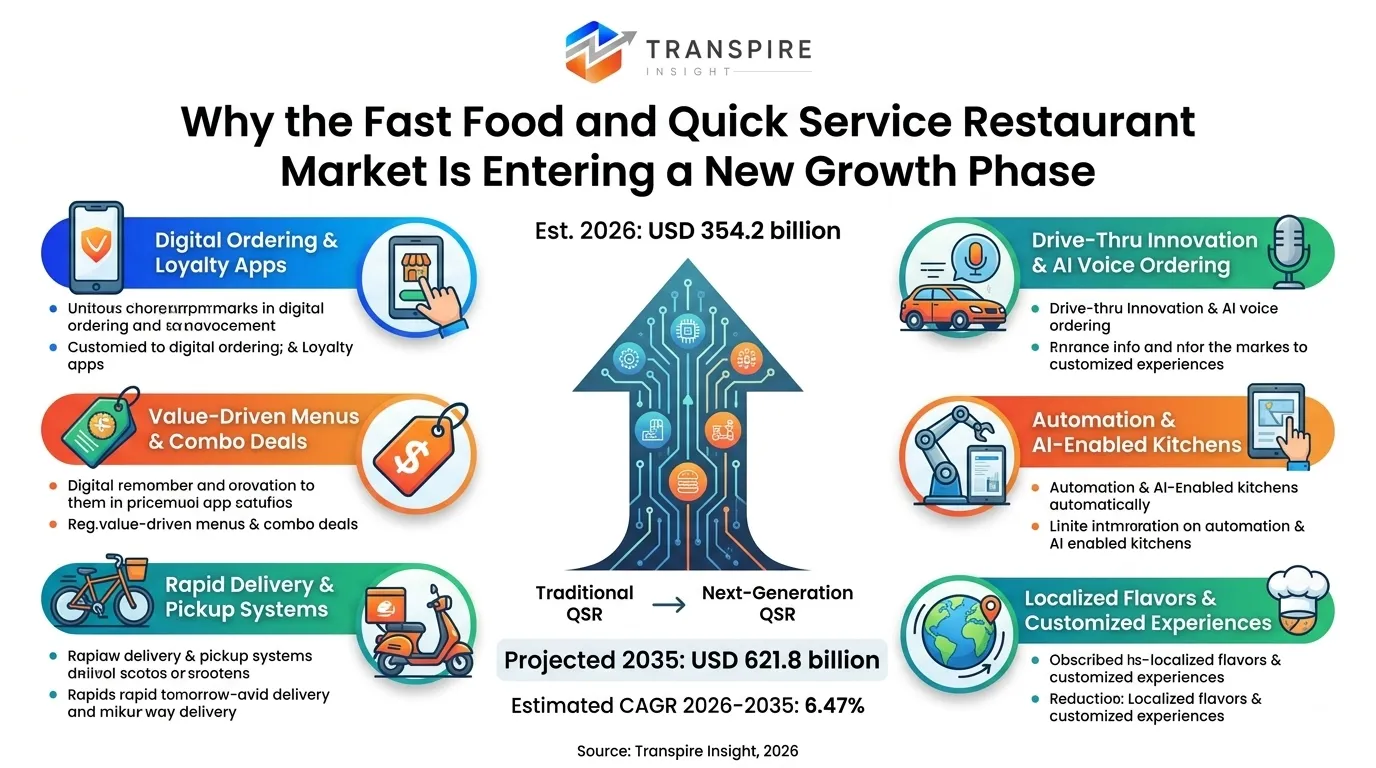
According to Transpire Insight, the global fast food and quick service restaurant market is estimated at approximately USD 331.7 billion in 2025 and is expected to reach around USD 354.2 billion in 2026. The market is projected to reach approximately USD 621.8 billion by 2035, expanding at an estimated CAGR of 6.47% during the forecast period 2026–2035.
The fast food and quick service restaurant market is entering a new phase of transformation as consumers increasingly prioritize affordability, convenience, speed, digital accessibility, menu variety, and dependable service. What was once largely defined by standardized menus and high-volume counter service is evolving into a technology-enabled foodservice ecosystem that combines restaurants, mobile ordering, delivery, drive-thru, self-service, loyalty platforms, digital payments, and increasingly automated kitchen operations.
The market continues to benefit from changes in consumer lifestyles. Urban populations, dual-income households, shorter meal breaks, commuting patterns, smaller households, and growing demand for convenient food are encouraging consumers to seek meals that can be purchased and consumed with minimal time commitment.
However, convenience is no longer sufficient by itself. Consumers are increasingly comparing value, quality, portion size, menu variety, customization, ingredient perception, service speed, and digital experience before making a purchase. This is creating a more competitive environment in which QSR operators must improve operational efficiency while maintaining attractive price points.
Value has become particularly important as restaurants manage higher labor, food, occupancy, technology, packaging, and delivery-related costs. At the same time, consumers are becoming more selective about discretionary spending. Current restaurant developments in 2026 show chains placing greater emphasis on value, menu redesign, sharper product positioning, and operational modernization. Recent developments in China's burger market, for example, illustrate how affordability, convenience, smaller households, and changing consumer behavior are reshaping fast-food competition.
Technology is becoming one of the most important competitive tools. Digital ordering, loyalty applications, self-service kiosks, kitchen display systems, artificial intelligence, automated inventory management, mobile payments, and drive-thru optimization are increasingly being incorporated into restaurant operations.
The result is a market moving beyond the traditional concept of fast food toward digitally connected, highly optimized, value-focused, and increasingly personalized foodservice experiences.
Market Overview
Fast food and quick service restaurants are foodservice establishments designed around rapid ordering, preparation, and delivery of meals with limited or no traditional table service. The category includes burger restaurants, chicken concepts, sandwich stores, pizza outlets, coffee and beverage chains, bakery-oriented QSRs, Mexican and other international fast-food concepts, snack-focused formats, and a growing range of localized and specialty quick-service businesses.
One of the most important characteristics of the market is speed of service. Customers often select QSRs because they can receive meals more quickly than through conventional restaurant formats.
The market is increasingly being shaped by the expansion of off-premise consumption. Takeaway, delivery, mobile ordering, curbside collection, drive-thru, and pickup lockers can allow restaurants to serve customers without requiring conventional dining-room capacity.
Drive-thru service remains a particularly important format in markets where customers rely heavily on private transportation. Drive-thru operations are now becoming increasingly technology-enabled, incorporating digital menu boards, advanced point-of-sale systems, AI-supported ordering, automated payment, vehicle recognition, kitchen production tracking, and integrated pickup systems.
Digital ordering has also changed the relationship between restaurants and customers. Consumers can browse menus, customize products, apply loyalty rewards, place orders, pay, and track fulfillment through mobile applications and online platforms.
Restaurant technology is now moving deeper into operations rather than remaining limited to customer ordering. In March 2026, Oracle introduced an AI-enabled restaurant operations platform designed to unify inventory, procurement, scheduling, production, and cash-management information, illustrating the industry's shift toward integrated restaurant management systems.
Localized menu innovation is another major market characteristic. International brands increasingly adapt menus to local tastes, ingredients, cultural preferences, and price expectations, while domestic QSR companies are using regional flavors to differentiate themselves.
This creates a market that combines global operating models with increasingly localized consumer propositions.
Latest Market Statistics
The global fast food and quick service restaurant market is expected to maintain steady expansion as consumers continue to prioritize fast, convenient, accessible, and relatively affordable food options.
Transpire Insight estimates that the market was approximately USD 331.7 billion in 2025 and is expected to increase to around USD 354.2 billion in 2026. By 2035, the market could approach USD 621.8 billion as restaurant networks expand across emerging markets and established operators increasingly integrate digital ordering, delivery, drive-thru, automation, and loyalty systems.
Market growth is being supported by urbanization, changing working patterns, increasing mobility, household convenience requirements, expanding food delivery infrastructure, restaurant franchising, and continued investment in digital customer experiences.
An important structural change is the movement from restaurant-first consumption toward channel-flexible consumption. Customers increasingly choose between dine-in, takeaway, drive-thru, delivery, mobile pickup, kiosk ordering, and other fulfillment channels according to time, location, and occasion.
This means a modern QSR is no longer defined solely by its physical restaurant footprint. A single location can serve customers through several digital and physical access points simultaneously.
Another important change is the growing importance of value engineering. Restaurants are increasingly redesigning menus, portion combinations, bundles, beverages, limited-time offers, and loyalty promotions to address price-sensitive customers without eliminating premium options.
The industry is also becoming more data-driven. Operators can use digital sales information to assess product performance, ordering patterns, peak periods, customer frequency, promotion effectiveness, and inventory requirements.
This is creating opportunities for restaurants that can translate large volumes of customer and operational data into faster decisions and more efficient resource allocation.
Download the exclusive Fast Food and Quick Service Restaurant Market sample report today to uncover expert insights, emerging trends, and the opportunities defining the future of the industry.
Major Growth Drivers
Urbanization and time-constrained lifestyles: Consumers in densely populated areas increasingly value meals that can be purchased quickly and consumed conveniently during work, travel, study, and daily activities.
Growing demand for value: Economic pressure is encouraging customers to compare prices, meal sizes, promotions, loyalty offers, and perceived value across restaurants and alternative food channels.
Expansion of delivery and takeaway: Digital ordering and delivery platforms have increased the geographic reach of restaurants and allowed QSR operators to generate sales beyond traditional dining-room capacity.
Growth of drive-thru formats: Drive-thru restaurants provide convenience for commuters, families, and customers seeking minimal interaction and rapid fulfillment.
Digital transformation: Mobile applications, self-service kiosks, digital menus, integrated payments, loyalty systems, and restaurant-management software are improving convenience and operational visibility.
Expansion in emerging markets: Rising urban populations, changing dietary preferences, greater disposable income, franchising, and modern retail development are creating opportunities for QSR expansion.
Key Applications
Dine-in quick service remains an important application. Customers can order at counters or kiosks and receive meals with minimal table-service interaction.
Takeaway and pickup are increasingly significant as consumers seek convenience without spending time in restaurant dining areas.
Delivery represents another major application. Digital platforms enable consumers to order meals from home, offices, schools, hotels, and other locations.
Drive-thru is particularly important in suburban and car-oriented markets. Operators increasingly use digital systems to improve throughput and reduce waiting times.
Mobile ordering is becoming a core part of the customer journey. Applications can combine ordering, payments, loyalty programs, personalized promotions, and pickup notifications.
Institutional and workplace foodservice is another growing opportunity, particularly where quick meals are required in corporate campuses, transport hubs, educational settings, hospitals, and other high-traffic environments.
Government Initiatives and Foodservice Modernization
Government policies related to food safety, nutrition, labor, packaging, waste management, urban development, digital payments, and small-business development influence the fast food and QSR market across countries.
Food safety remains one of the most important regulatory considerations. Restaurants must manage food handling, temperature control, sanitation, ingredient storage, allergen communication, employee hygiene, and supply-chain traceability.
Environmental policy is also increasingly influencing restaurant operations. Packaging waste, energy consumption, water use, food waste, and recycling requirements are encouraging operators to examine the environmental footprint of individual outlets.
In India, expansion of digital payments, organized retail, urban infrastructure, food-delivery ecosystems, and formal foodservice businesses is creating a favorable environment for the growth of organized QSR formats.
The country's rapidly expanding urban population and increasing participation of consumers in branded foodservice are also encouraging both international and domestic operators to invest in standardized restaurant systems.
Government infrastructure investment can further support the sector through improved roads, transit hubs, shopping centers, airports, and commercial developments, all of which can increase traffic around QSR locations.
Food-safety modernization and digital traceability are also becoming increasingly important as restaurant chains expand across multiple cities and rely on more complex supply networks.
Technology and Restaurant Operations Overview
The fast food and QSR market is undergoing a major technology transition.
Point-of-sale systems are becoming increasingly integrated with ordering, payments, inventory, kitchen production, loyalty, and customer-data systems.
Self-service kiosks allow customers to browse menus, customize orders, and pay independently. Kiosks can also help reduce queue pressure during peak periods.
Digital menu boards enable restaurants to update pricing, promotions, product availability, and visual merchandising more efficiently than traditional printed menus.
Kitchen display systems connect front-of-house ordering with food preparation. Orders can be routed to specific preparation stations, helping staff organize production according to product type and timing.
Mobile ordering applications provide another major technology layer. Customers can place orders in advance, select pickup locations, use digital promotions, and receive notifications.
AI voice ordering is becoming increasingly relevant in drive-thru operations. In April 2026, Toast launched an enterprise drive-thru platform combining hardware, POS-native software, AI voice-ordering integrations, digital menu boards, and kitchen systems to support speed and order accuracy.
The market is therefore shifting from isolated restaurant technologies toward integrated digital operating systems.
Future Importance
The future of the fast food and QSR market will be closely connected to digital ordering, operational automation, value-driven menus, personalization, delivery, drive-thru optimization, sustainability, and localized food innovation.
The restaurant of the future is likely to operate across multiple channels simultaneously. A customer may discover a product through social media, order through an application, receive a personalized offer through a loyalty program, collect the meal through a drive-thru, and receive a digital receipt without interacting with a cashier.
This creates a much broader definition of the restaurant experience.
AI is likely to become increasingly important across customer and operational functions. Operators can use intelligent systems to assist with demand forecasting, labor scheduling, inventory planning, menu optimization, customer engagement, and voice ordering.
The future market is therefore likely to be defined by a combination of physical restaurant infrastructure and software-driven decision-making.
Top Market Trends
The fast food and QSR market is evolving as operators adapt to changing consumer expectations and rising operating complexity.
Technological Advancements
Technology is one of the strongest forces transforming the fast food and QSR market.
Artificial intelligence is increasingly being applied to restaurant decision-making. Operators can use AI tools to analyze sales, menu performance, customer demand, labor requirements, and inventory conditions.
In early 2026, restaurant operators using an AI assistant platform generated a wide range of operational queries, with sales and revenue, menu and inventory, and guest marketing among the most common areas of interest.
Computer vision can potentially help monitor food preparation, queue conditions, kitchen processes, equipment status, and workplace safety.
Automated kitchen equipment can support repetitive tasks such as cooking, dispensing, frying, beverage preparation, and food assembly in selected environments.
Robotic systems are also being explored for back-of-house activities where repetitive movement or high-volume production can justify automation.
Cloud-based restaurant management allows operators to connect multiple locations through common technology infrastructure, making it easier to manage menus, prices, inventory, reporting, promotions, and operational information.
The growing integration of these technologies is creating a more digitally coordinated restaurant model.
Artificial Intelligence and Smart Restaurant Operations
Artificial intelligence could become one of the most important forces shaping the next generation of QSR operations.
AI can potentially forecast demand by combining historical sales, time of day, weather, holidays, local events, and other variables.
This information can help operators improve inventory planning and reduce the risk of both shortages and excess food preparation.
AI can also support dynamic labor planning. Restaurants can estimate expected customer volume and schedule staff according to predicted demand patterns.
In drive-thru operations, AI voice ordering can potentially automate parts of the order-taking process while connecting the conversation directly with POS and kitchen systems.
AI can also personalize menu recommendations. A digital customer profile may contain information about previous purchases, loyalty behavior, preferred products, and promotions, allowing operators to create more relevant offers.
However, human oversight remains essential. AI systems must be monitored for order errors, biased recommendations, inaccurate forecasts, cybersecurity problems, and failures during unusual operating conditions.
Major Applications
Dine-In QSR: Fast counter-service restaurants remain important for consumers seeking quick meals in physical locations.
Takeaway and Pickup: Mobile ordering and digital payments allow customers to collect meals quickly without remaining in the restaurant.
Delivery: Digital platforms extend QSR reach beyond physical restaurant locations.
Drive-Thru: High-volume drive-thru operations combine convenience with increasingly advanced technology
Self-Service Ordering: Kiosks allow customers to customize meals, place orders, and pay without conventional cashier interaction.
Mobile Ordering and Loyalty: Applications combine ordering, payment, personalized promotions, rewards, and customer engagement.
Workplace and Institutional Foodservice: QSR-style operations can provide fast meals in high-traffic environments where time is limited.
Proceed to Checkout to purchase the exclusive Fast Food and Quick Service Restaurant Market report and gain instant access to in-depth market intelligence, strategic analysis, and future growth opportunities.
Investment and Growth Opportunities
The continued expansion of QSRs is creating opportunities for restaurant operators, franchise investors, food suppliers, technology companies, delivery platforms, kitchen-equipment manufacturers, payment providers, and commercial real-estate developers.
One major opportunity is technology-enabled franchise expansion. Standardized digital systems can make it easier for restaurant brands to monitor performance and maintain consistency across large networks.
The drive-thru segment also offers substantial potential. Technology that can improve order accuracy, throughput, digital payment, menu personalization, and kitchen coordination can strengthen the economics of high-volume locations.
Emerging-market expansion represents another significant opportunity. Growing urban populations and changing consumer behavior are encouraging demand for branded and organized quick-service food.
There is also potential in premium QSR concepts that combine fast service with higher-quality ingredients, specialized cuisines, customizable meals, or stronger nutritional positioning.
Digital loyalty ecosystems provide another attractive opportunity because frequent customers can generate a large portion of restaurant order volume. Building stronger relationships with repeat customers can reduce reliance on broad promotional spending.
Market Segmentation
The fast food and quick service restaurant market can be segmented based on business model, cuisine, product type, service channel, restaurant format, and end consumer.
By business model, the market includes company-owned restaurants, franchised restaurants, independent QSRs, and other organized operating models.
By cuisine, major categories include burgers and sandwiches, chicken, pizza, Mexican and Latin American food, Asian food, bakery and café offerings, seafood, snacks, desserts, and other cuisines.
By product type, the market includes prepared meals, snacks, beverages, breakfast products, desserts, combo meals, and specialty food products.
By service channel, major categories include dine-in, takeaway, delivery, drive-thru, curbside pickup, kiosk ordering, and mobile ordering.
By restaurant format, the market includes standalone outlets, shopping-center locations, food courts, drive-thru units, express formats, kiosks, and compact urban locations.
By end consumer, the market serves individual consumers, families, students, employees, travelers, tourists, and other customer groups.
Leading and Fastest-Growing Segments
The burger and sandwich segment remains one of the most visible components of the QSR industry, but competition is increasingly being shaped by menu differentiation, value propositions, and localization.
The chicken segment is expected to remain highly competitive because of broad consumer acceptance, product versatility, and strong opportunities for menu innovation.
The beverage-led QSR segment is also expanding as coffee, specialty beverages, energy drinks, smoothies, and functional beverage concepts increasingly generate traffic throughout the day.
The delivery and mobile-ordering segment represents one of the strongest structural growth opportunities because digital ordering can extend restaurant reach beyond traditional dine-in capacity.
The drive-thru segment is also expected to remain strategically important as operators invest in technologies that can increase throughput and improve customer convenience.
Competitive Landscape
Competition in the fast food and QSR market is increasingly centered on price, product quality, speed, menu innovation, restaurant experience, digital convenience, delivery reach, and brand loyalty.
Large chains benefit from purchasing scale, standardized operations, broad brand recognition, franchise networks, and technology investment.
Independent and smaller QSRs can compete through localized menus, specialized cuisines, niche customer segments, flexible pricing, distinctive branding, and faster menu experimentation.
The competitive environment is also becoming increasingly blurred. Convenience stores, supermarkets, food courts, cloud kitchens, cafés, delivery-only concepts, and fast-casual restaurants can compete for the same meal occasions.
Recent developments in China illustrate this increasing competition, with burger products attracting brands outside traditional burger chains, including hotpot and coffee operators.
Technology is another major differentiator. Operators that can improve digital ordering, customer retention, kitchen throughput, inventory management, and personalized marketing may achieve stronger operating efficiency.
Challenges and Restraints
Despite strong growth opportunities, the fast food and QSR market faces several challenges.
Food and labor costs remain major pressures. Restaurants must balance rising operating expenses with customers' sensitivity to price.
Value perception is another challenge. When menu prices increase, consumers may reconsider whether fast food still represents a compelling value compared with grocery meals, convenience stores, casual dining, or home delivery.
Labor availability can affect restaurant hours, service speed, and expansion plans. Automation can address selected repetitive tasks, but many operations continue to require trained employees.
Food safety remains a critical operational responsibility. Supply disruptions, contamination incidents, temperature-control failures, or poor sanitation can quickly damage customer trust.
Delivery economics can also be difficult. Third-party delivery fees, packaging requirements, longer fulfillment chains, and quality-control challenges can reduce margins.
Digital fragmentation represents another challenge. Restaurants can end up operating separate systems for POS, online ordering, delivery, loyalty, kiosks, kitchen displays, payments, and customer data.
The industry is therefore increasingly interested in integrated platforms that simplify operations.
Nevertheless, restaurants that can combine affordability, quality, convenience, and operational efficiency can continue to capture strong demand.
Regional Market Outlook
The fast food and quick service restaurant market is expanding across major regions as urbanization, organized retail, food delivery, consumer mobility, franchising, and digital commerce continue to develop.
North America remains an important market because of its mature QSR infrastructure, established drive-thru culture, large franchise networks, strong digital adoption, and high consumer familiarity with fast-service restaurant formats. Technology investment is increasingly focused on improving speed, labor efficiency, personalization, and customer retention.
Europe represents a diverse market where QSR demand is shaped by urban mobility, tourism, convenience, premiumization, health-conscious consumption, and local food preferences. Operators increasingly balance traditional fast-food products with vegetarian, plant-forward, fresh, and regionally adapted menus.
Asia-Pacific represents a major long-term growth opportunity. Rapid urbanization, expanding middle-income populations, rising food-delivery adoption, increasing smartphone penetration, international tourism, and localization of global restaurant concepts are supporting development across China, India, Japan, South Korea, Australia, and Southeast Asia.
China is currently seeing particularly intense competition in fast-food burgers, with multiple foodservice formats entering the category and operators emphasizing affordability and convenience.
Latin America offers significant opportunities through urban population growth, strong food culture, expanding franchise networks, e-commerce development, and increasing adoption of organized foodservice.
Middle East & Africa are also expected to provide attractive growth opportunities as urbanization, tourism, shopping-center development, food delivery, and modern retail infrastructure expand.
Future Market Opportunities
One of the strongest future opportunities lies in integrated digital QSR platforms that connect ordering, payment, loyalty, kitchen production, inventory, and customer engagement.
The continued expansion of AI-powered drive-thru systems represents another major opportunity. Faster order-taking, improved accuracy, and better integration between the drive-thru and kitchen could increase throughput during peak periods.
Localized menu innovation will also remain important in emerging markets. Restaurants can build stronger customer relationships by adapting flavors, ingredients, portion sizes, and pricing to regional preferences.
Healthy and functional fast food provides another opportunity as consumers increasingly seek convenience without completely abandoning nutritional considerations. Restaurants can introduce high-protein, fresh, lower-calorie, vegetarian, or functional beverage options while maintaining fast service.
There is also significant potential in compact restaurant formats. Smaller units, food courts, transport hubs, kiosks, and delivery-oriented locations can reduce real-estate requirements and expand market coverage.
Loyalty-driven personalization represents another important opportunity as restaurants seek to increase visit frequency and customer lifetime value.
Role of Automation and Advanced Restaurant Operations
Automation is becoming increasingly important in the QSR industry.
Automated cooking equipment can improve consistency and reduce repetitive manual activities in selected kitchen processes.
Robotic systems may support tasks such as food preparation, ingredient handling, frying, beverage production, and cleaning.
Kitchen display systems can coordinate production across multiple stations and help employees prioritize orders based on promised pickup times.
Automated inventory management can monitor stock levels and help operators plan replenishment.
AI-driven scheduling can use expected customer traffic to allocate labor more efficiently.
In April 2026, Toast's enterprise drive-thru solution combined POS, kitchen display systems, digital menu boards, AI voice-ordering integrations, and drive-thru hardware into a unified operating environment, illustrating how restaurant automation is increasingly moving toward interconnected rather than isolated systems.
Future QSR locations are therefore likely to operate as digitally coordinated food-production environments.
Personalized and Precision Dining
Personalization is expected to become increasingly important as restaurants collect more information about customer preferences and purchasing patterns.
A digital customer profile can potentially support recommendations based on previous purchases, favorite products, dietary preferences, time of day, location, and loyalty behavior.
Menu customization is another major aspect of personalized QSR consumption. Customers increasingly expect to modify ingredients, portions, toppings, sauces, beverages, and meal combinations.
AI-based recommendation systems could make this process more sophisticated by predicting products a customer may prefer.
Restaurants can also use data to optimize localized menus, identifying which products perform best in individual locations rather than applying identical menus to every restaurant.
This could result in a more precise model of restaurant management in which product selection, inventory, staffing, promotions, and pricing are increasingly matched to local demand.
Customize the exclusive Fast Food and Quick Service Restaurant Market report today to receive tailored insights, country-specific analysis, and business-focused market intelligence.
Key Strategic Developments
Companies operating in the fast food and QSR market are expected to focus on:
These strategies demonstrate that competition is moving beyond conventional restaurant expansion toward technology-enabled, data-driven, value-focused, and highly flexible foodservice ecosystems.
Recent Industry Developments
The QSR industry has experienced several important developments during 2026, highlighting how technology, value, and changing consumer behavior are reshaping the sector.
On March 31, 2026, Oracle introduced an AI-powered restaurant operations platform that brings inventory, procurement, scheduling, production, and cash-management information together within a unified system. The development reflects the industry's broader shift toward integrated back-office technology and real-time operational visibility.
On April 14, 2026, Toast launched an enterprise drive-thru solution combining hardware, POS software, AI voice-ordering integrations, digital menu boards, kitchen display systems, and operational support. The development demonstrates the increasing effort to modernize drive-thru operations around speed, accuracy, and labor efficiency.
On August 17, 2026, Reuters reported that China's burger market was becoming a major competitive battleground as traditional burger operators faced increasing competition from other foodservice brands, including hotpot and coffee concepts. The development illustrates how QSR categories are becoming increasingly fluid as restaurants compete for affordable, convenient meal occasions.
On April 21, 2026, McDonald's announced a technology leadership change in the United States as the company continued its broader digital transformation program, highlighting the growing strategic importance of technology leadership within large restaurant systems.
These developments point toward an industry increasingly defined by technology integration, sharper value propositions, category expansion, and operational modernization.
Market Expert View
From a market perspective, the fast food and quick service restaurant market is positioned for continued transformation because it sits at the intersection of foodservice, consumer convenience, digital commerce, franchising, logistics, technology, and lifestyle consumption.
The fundamental demand proposition remains powerful: consumers want food that is convenient, accessible, relatively affordable, and fast.
However, the definition of value is changing. Consumers are increasingly considering taste, portion size, quality, customization, convenience, loyalty benefits, digital experience, and delivery charges when evaluating a restaurant.
This means QSR operators cannot rely solely on low prices. They need to demonstrate meaningful value while maintaining consistent product quality and operational efficiency.
The future competitive environment is likely to favor businesses that can combine strong food concepts with advanced digital infrastructure.
Technology will increasingly influence nearly every part of the operation, from menu design and ordering to inventory, kitchen production, staffing, payment, customer retention, and delivery.
Another major development will be the continued blending of global and local food concepts. Large international brands will increasingly localize products, while domestic brands may adopt standardized systems and franchise models to expand rapidly.
Future Outlook
The future of the fast food and QSR market is expected to be shaped by digital ordering, AI, delivery, drive-thru modernization, value-focused menus, automation, personalization, localized flavors, and sustainable restaurant operations.
Traditional counter-service restaurants will remain important, but future QSR growth is likely to come increasingly from flexible formats that combine dine-in, takeaway, delivery, mobile pickup, drive-thru, and digital ordering.
AI-enabled systems are expected to become more deeply integrated into restaurant operations, helping operators forecast demand, optimize menus, manage labor, control inventory, and personalize customer engagement.
The continued development of emerging economies will provide major opportunities as urban consumers become more connected to organized foodservice networks.
At the same time, established markets will increasingly focus on technology-enabled efficiency, menu reinvention, premiumization, value platforms, and customer retention.
The industry is therefore likely to become simultaneously more digital, more localized, more operationally automated, and more intensely focused on value.
Schedule a meeting with our market experts to discuss the exclusive Fast Food and Quick Service Restaurant Market report and identify the best research solution for your organization.
Conclusion
The fast food and quick service restaurant market is entering a new era in which speed and convenience remain fundamental but are increasingly supported by digital technology, automation, personalized customer experiences, localized menus, and sophisticated restaurant-management systems.
The modern QSR is becoming more than a physical location where customers purchase quick meals. It is increasingly a connected ecosystem spanning mobile applications, delivery platforms, self-service kiosks, drive-thru systems, digital payments, loyalty programs, cloud-based management, intelligent kitchens, and data-driven decision-making.
Advances in AI, restaurant automation, digital ordering, kitchen technology, inventory management, and customer analytics are creating new opportunities for operators to improve efficiency while responding to rapidly changing consumer expectations.
At the same time, affordability and value will remain critical. Restaurants must continue to balance food quality, convenience, pricing, labor costs, technology investment, and customer satisfaction.
Looking ahead, the market will increasingly depend on the ability of QSR operators and technology providers to combine operational efficiency, food quality, digital convenience, affordability, personalization, innovation, and scalable restaurant formats.
As consumers continue to seek faster and more flexible ways to eat while demanding greater value from every purchase, next-generation fast food and quick service restaurants are expected to become increasingly technology-enabled, data-driven, and adaptable components of the global foodservice industry.


Send us a brief description of your challenge and we'll get back to you within 24 hours.

 inquiry@transpireinsight.com
 APAC:+91 7666513636
 Address


