
Aug 18, 2026
By Transpire Insight
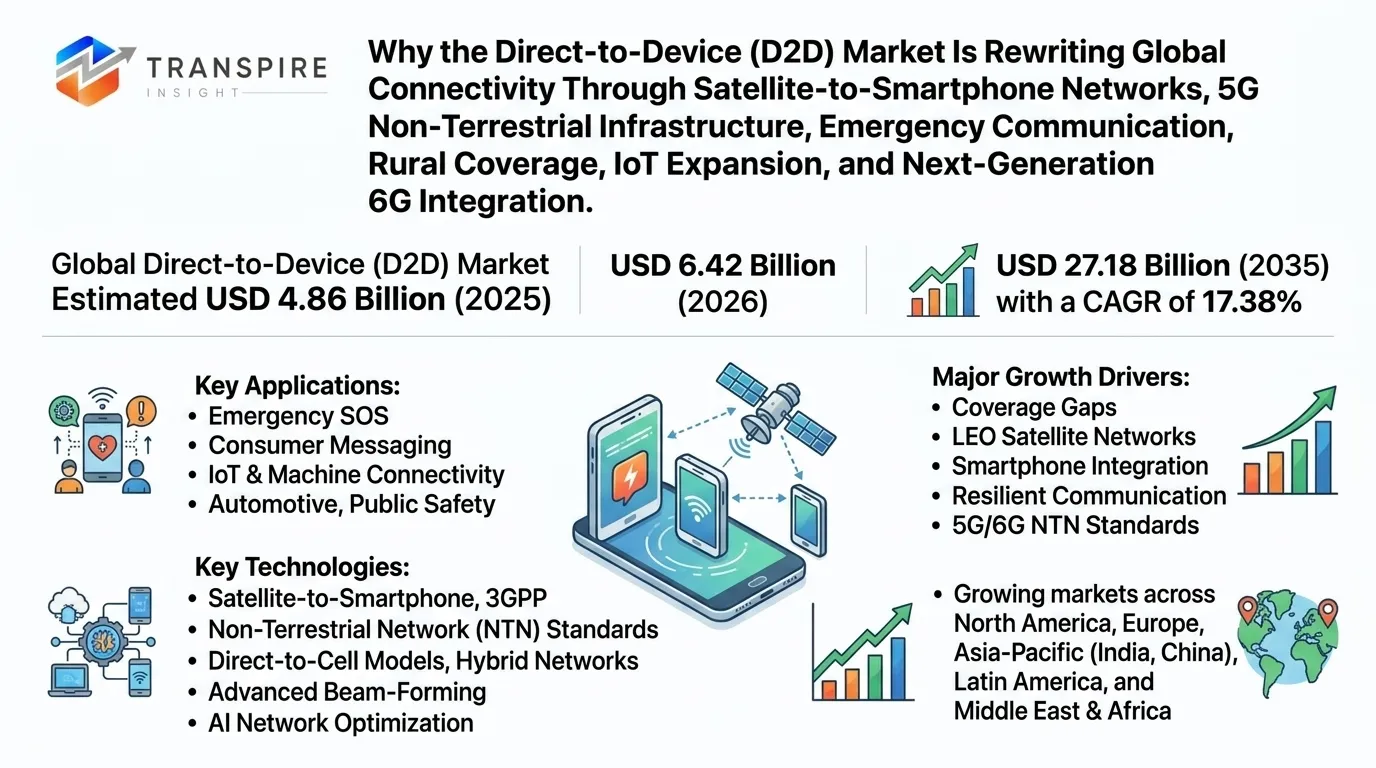
According to Transpire Insight, the global direct-to-device (D2D) market is estimated at approximately USD 4.86 billion in 2025 and is expected to reach around USD 6.42 billion in 2026. The market is projected to reach approximately USD 27.18 billion by 2035, expanding at an estimated CAGR of 17.38% during the forecast period 2026–2035.
The direct-to-device market is moving from an experimental satellite-connectivity concept toward a new layer of telecommunications infrastructure as satellite networks increasingly connect directly with ordinary smartphones and other compatible devices.
Direct-to-device technology enables a mobile handset or connected device to communicate with satellites without requiring a dedicated satellite phone or specialized external terminal. Depending on the architecture, D2D systems can support messaging, emergency communication, voice, data services, Internet of Things connectivity, and other applications through satellite-enabled non-terrestrial networks.
The technology is gaining strategic importance because terrestrial mobile networks still leave substantial geographic areas without consistent connectivity. The International Telecommunication Union highlighted in April 2026 that D2D could help extend coverage toward the remaining portions of the world's landmass that are difficult or uneconomical to serve through conventional terrestrial networks.
The market is being reshaped by advances in low-Earth-orbit satellite constellations, mobile-network integration, spectrum-sharing frameworks, phased-array and satellite communications technologies, and 3GPP non-terrestrial network standards.
What makes the current phase particularly significant is the shift from specialized satellite devices toward standard mobile handsets. This creates the possibility of connectivity appearing as an additional layer of a normal mobile subscription rather than as an entirely separate communications service.
At the same time, operators and regulators are working through difficult questions involving spectrum coordination, interference, licensing, device compatibility, network economics, and cross-border operation. These issues are becoming increasingly important as D2D moves from demonstrations toward commercial deployment.
Market Overview
Direct-to-device refers to satellite-enabled connectivity in which communications are delivered directly to end-user devices such as smartphones, connected consumer electronics, IoT equipment, automotive systems, and selected enterprise devices.
Unlike traditional satellite communication models that may require dedicated terminals, D2D systems seek to use satellites as an extension of terrestrial mobile networks. Depending on the architecture, a device may connect to a satellite using spectrum associated with terrestrial mobile services or satellite services.
One of the most important applications is emergency communication. D2D can provide messaging or SOS capabilities when users move beyond terrestrial cellular coverage. This can be particularly valuable in remote mountains, deserts, oceans, forests, rural regions, and areas affected by natural disasters or network outages.
The technology is also becoming relevant to remote and rural connectivity. Building conventional cell towers across sparsely populated or difficult terrain can require significant investment, making satellite-based supplemental coverage an alternative for selected locations.
Consumer communication represents another major application. D2D systems are increasingly being developed to support messaging and eventually broader communication services through ordinary smartphones.
IoT and machine connectivity could become one of the most significant long-term opportunities. Devices such as tracking units, industrial sensors, agricultural equipment, maritime assets, logistics systems, and environmental monitors can potentially use satellite connectivity in locations where terrestrial networks are unavailable.
Automotive connectivity is another emerging opportunity, particularly for vehicles operating across remote roads, highways, deserts, mountains, shipping corridors, and rural areas.
The fundamental market proposition is therefore changing from "satellite communication for special situations" to continuous connectivity across terrestrial and non-terrestrial environments.
Latest Market Statistics
The global direct-to-device market is expected to maintain rapid expansion as satellite operators, mobile-network operators, technology companies, and governments increasingly explore hybrid terrestrial-satellite connectivity.
Transpire Insight estimates that the market reached approximately USD 4.86 billion in 2025 and could increase to around USD 6.42 billion in 2026. By 2035, market value is projected to approach USD 27.18 billion as commercial services expand from emergency messaging toward broader communication, IoT, mobility, and data applications.
The most important market shift is the transition from demonstration-stage connectivity to integrated mobile services. D2D is increasingly being discussed as an extension of terrestrial cellular networks rather than as an isolated satellite service.
Industry standards are supporting this transition. 3GPP Release 17 established the first normative requirements for non-terrestrial networks, including support for service continuity between terrestrial and satellite access and satellite-compatible user equipment.
Another structural change is the growing focus on hybrid network architecture. Satellites can provide coverage in locations where terrestrial infrastructure is unavailable, while traditional cellular networks can continue to handle higher-capacity traffic where towers are present.
This complementary model could allow operators to extend geographic coverage without attempting to replace terrestrial networks entirely.
The market is also becoming more diversified. Initial applications have emphasized emergency messaging, while future development is increasingly moving toward voice, data, IoT, logistics, automotive, public-safety, and enterprise connectivity. ITU has highlighted this progression from emergency applications toward broader communications and IoT capabilities.
Major Growth Drivers
Persistent mobile coverage gaps: Remote regions, oceans, mountains, deserts, forests, and sparsely populated areas remain difficult to cover economically with terrestrial networks. D2D provides a potential additional connectivity layer.
Growth of low-Earth-orbit satellite networks: Increasing deployment of LEO constellations is improving the infrastructure base needed for lower-latency satellite communications and geographically broad coverage.
Expansion of smartphone-based connectivity: The ability to connect standard mobile devices directly to satellites can significantly reduce the need for specialized user hardware.
Increasing demand for resilient communication: Governments, enterprises, emergency organizations, and consumers are increasingly interested in connectivity that remains available when terrestrial infrastructures damaged or unavailable.
Development of 5G and 6G non-terrestrial networks: D2D is increasingly being connected to broader NTN architectures and future mobile-network evolution. ITU views D2D as part of the pathway toward more integrated space-terrestrial connectivity around the 6G era.
Expansion of satellite IoT: Large numbers of low-data devices operating in remote areas create a strong potential market for satellite-enabled machine connectivity.
Key Applications
Emergency communication is one of the most immediate D2D applications. Users can potentially send SOS alerts or messages from areas without terrestrial mobile coverage.
Consumer messaging is another emerging application. D2D systems can extend basic communication capabilities beyond the footprint of terrestrial networks.
Voice and data connectivity represent longer-term opportunities as satellite capacity, device capabilities, spectrum access, and network architecture improve.
IoT connectivity could become a large addressable opportunity across agriculture, logistics, maritime operations, industrial monitoring, environmental sensing, and asset tracking.
Automotive connectivity is another important application as connected vehicles increasingly require reliable communications across locations with inconsistent cellular coverage.
Public safety and disaster recovery are also significant. Satellite-connected devices can provide an additional communications layer when terrestrial infrastructure becomes unavailable during floods, earthquakes, storms, fires, or other emergencies.
Download the exclusive Direct-to-Device (D2D) Market sample report today to uncover expert insights, emerging trends, and the opportunities defining the future of the industry.
Government Initiatives and Connectivity Modernization
Governments and regulators are increasingly examining D2D as part of national connectivity, spectrum, emergency communications, and digital-inclusion strategies.
In India, the Department of Telecommunications' Telecommunication Engineering Centre held a technical workshop on April 8, 2026, focused specifically on the D2D frontier, global developments, technology, and the Indian policy environment. The Department emphasized D2D's potential contribution to "Connectivity for All," particularly for remote and underserved regions.
India's telecom regulator TRAI also examined D2D satellite services during 2026 consultations, including questions involving spectrum, authorization frameworks, interference management, and coordination with mobile and satellite network operators.
The United Kingdom has also moved further toward formalizing D2D access. Ofcom's 2026 regulations created a licence exemption for eligible mobile handsets and SIM-enabled devices connecting to approved D2D satellite services and extended the framework to specified 900 MHz frequencies.
Internationally, ITU continues to emphasize the need for spectrum coordination and regulatory frameworks capable of managing interference between terrestrial and satellite services.
These regulatory developments are significant because D2D depends heavily on coordination between mobile operators, satellite operators, device manufacturers, and national spectrum authorities.
Technology Overview
The direct-to-device market includes several important technical approaches.
Satellite-to-smartphone connectivity is the most visible model. Satellites use specialized payloads and antennas to communicate with compatible mobile devices without requiring a dedicated satellite handset.
Non-terrestrial network architecture allows satellite systems to interact with cellular network functions and user equipment through standardized frameworks. 3GPP Release 17 established the first normative NTN requirements and includes support for continuity between terrestrial and satellite access.
Direct-to-cell models use satellites to provide cellular-like services to standard phones, generally through partnerships between mobile-network operators and satellite providers.
Satellite-enabled IoT focuses on low-power devices with modest data requirements. These devices can potentially send measurements, alerts, tracking information, and status updates from locations outside terrestrial coverage.
Hybrid terrestrial-satellite networks are another important technology direction. A connected device may automatically use terrestrial cellular service where available and transition to satellite connectivity when terrestrial coverage disappears.
Antenna and beam-forming technology is critical because satellites must establish reliable links with relatively small mobile devices under changing satellite positions and environmental conditions.
Network orchestration and handover are also becoming important as systems evolve toward seamless movement between terrestrial and satellite access.
Future Importance
The future of the direct-to-device market will be closely connected to ubiquitous connectivity, 5G and 6G integration, resilient communications, IoT expansion, emergency response, and global mobility.
The fundamental value of D2D is geographic continuity. Instead of treating terrestrial coverage and satellite coverage as completely separate services, future networks could increasingly treat both as components of a unified communication environment.
ITU has described D2D as a potential pathway toward much more integrated space-terrestrial systems around the 6G era.
This could have important implications for users who travel between cities, rural regions, oceans, mountains, and other areas with changing levels of network availability.
The market is therefore moving toward the concept of network availability everywhere, rather than connectivity being defined solely by terrestrial tower coverage.
Top Market Trends
The D2D market is evolving quickly as technology providers and regulators move toward broader commercial deployment.
Technological Advancements
Technology is one of the strongest forces transforming the D2D market.
Advanced satellite payloads are being designed to communicate more effectively with conventional mobile devices, reducing the separation between satellite and terrestrial communications.
Large electronically steered antenna systems can form and direct high-performance beams toward particular geographic regions.
Beam management technology is becoming increasingly important as satellites move rapidly relative to users and must maintain connectivity over changing coverage footprints.
Low-Earth-orbit deployment can support lower latency and more dynamic coverage compared with higher-orbit systems.
3GPP standardization is also reducing the industry's dependence on proprietary approaches. Release 17 established normative requirements for NTN, while subsequent specification activity continues to evolve the broader framework.
Device-level optimization is another important area. Satellite links impose different requirements on timing, synchronization, power, antenna performance, and network selection than conventional terrestrial cellular systems.
The result is an increasingly sophisticated communications architecture combining satellites, mobile networks, spectrum, software, and specialized RF technologies.
Artificial Intelligence and Intelligent D2D Networks
Artificial intelligence could become an important part of next-generation D2D networks.
AI can potentially optimize satellite beam allocation, traffic routing, spectrum utilization, congestion management, and network handover.
Because satellite constellations involve moving nodes and changing coverage patterns, intelligent algorithms can help predict connectivity conditions and allocate network resources more efficiently.
AI can also support network anomaly detection, identifying unusual traffic patterns, interference conditions, or equipment behavior.
In disaster scenarios, intelligent systems could prioritize emergency communication and dynamically allocate available network capacity.
The long-term opportunity is the development of self-optimizing hybrid networks that dynamically coordinate satellites and terrestrial infrastructure according to user location, traffic demand, spectrum availability, and service priority.
However, reliability, cybersecurity, explainability, and the consequences of automated network decisions will remain important considerations.
Major Applications
Emergency Communications: D2D can extend messaging and SOS capabilities into areas without terrestrial service.
Consumer Connectivity: Smartphones can potentially maintain messaging, voice, and selected data services while outside terrestrial coverage.
IoT: Remote sensors and connected devices can transmit information without requiring local cellular infrastructure.
Automotive: Vehicles can maintain communication beyond traditional cellular corridors, supporting safety, tracking, and connected services.
Maritime: Ships and offshore assets can use satellite-based device connectivity where terrestrial networks are unavailable.
Public Safety: Emergency organizations can use satellite-enabled mobile connectivity to maintain communications during infrastructure outages.
Enterprise and Industrial Connectivity: Remote operations, logistics, mining, agriculture, and energy facilities can use D2D as an additional communication layer.
Investment and Growth Opportunities
The rapid development of D2D connectivity is creating opportunities for satellite operators, mobile-network operators, semiconductor companies, antenna manufacturers, telecommunications equipment providers, cloud platforms, software developers, and IoT companies.
One major opportunity is smartphone connectivity partnerships. Mobile operators can potentially expand geographic service coverage without constructing terrestrial infrastructure in every remote area.
The satellite IoT segment also offers significant long-term potential. Agricultural sensors, logistics trackers, environmental monitors, maritime devices, and industrial assets can benefit from connectivity across large geographic areas.
Automotive D2D connectivity provides another attractive opportunity as connected vehicles become more dependent on resilient communications.
There is also strong potential in government and public-safety services, particularly for disaster response, remote public services, border operations, and emergency communications.
Emerging markets represent an additional opportunity because D2D may help extend digital connectivity to areas where terrestrial infrastructure expansion is difficult or economically challenging.
Proceed to Checkout to purchase the exclusive Direct-to-Device (D2D) Market report and gain instant access to in-depth market intelligence, strategic analysis, and future growth opportunities.
Market Segmentation
The direct-to-device market can be segmented based on service type, technology, device type, application, network architecture, and end user.
By service type, major categories include messaging, emergency communication, voice, data connectivity, IoT connectivity, location services, and other satellite-enabled communication services.
By technology, the market includes direct-to-cell, satellite NTN, hybrid terrestrial-satellite systems, satellite IoT, and other D2D architectures.
By device type, major categories include smartphones, connected vehicles, IoT devices, industrial equipment, wearable devices, maritime equipment, and other compatible terminals.
By application, key areas include consumer communications, emergency response, automotive, IoT, logistics, agriculture, maritime, public safety, enterprise, and government communications.
By network architecture, the market includes LEO-based systems, other satellite-orbit architectures, terrestrial-satellite hybrid networks, and operator-integrated systems.
By end user, the market includes consumers, mobile-network operators, enterprises, governments, public-safety organizations, transport operators, and industrial users.
Leading and Fastest-Growing Segments
The smartphone D2D segment is expected to remain the central part of the market as technology providers work to connect standard mobile devices directly to satellites.
The messaging and emergency-communication segment remains important because these services require relatively limited bandwidth while providing significant value in coverage-gap scenarios.
The IoT segment represents one of the strongest long-term opportunities because large numbers of remote devices can require low-data connectivity over broad geographic areas.
The automotive segment is also expected to expand as vehicles increasingly require resilient connectivity across remote and cross-border environments.
The LEO satellite segment is likely to remain strategically important because lower orbit can support reduced latency and dynamic coverage architectures.
Competitive Landscape
Competition in the D2D market is increasingly focused on satellite constellation scale, spectrum access, mobile-network partnerships, device compatibility, network capacity, latency, coverage, interoperability, and regulatory readiness.
The competitive environment includes satellite operators, mobile-network operators, satellite-to-cellular technology providers, aerospace companies, semiconductor firms, and telecommunications infrastructure companies.
Partnerships are particularly important because no single organization necessarily controls every layer of the D2D ecosystem. Satellite operators provide space infrastructure, mobile operators provide subscriber relationships and network integration, device and chipset companies influence handset compatibility, and regulators control spectrum and authorization conditions.
The market is therefore evolving around ecosystem competition as much as individual product competition.
Companies that can achieve broad operator partnerships, reliable device compatibility, scalable satellite capacity, and favorable regulatory access may gain stronger positions.
Challenges and Restraints
Despite strong growth opportunities, the D2D market faces several major challenges.
Spectrum availability is one of the most significant. Some D2D architectures use frequencies that also serve terrestrial mobile networks, requiring careful coordination.
Interference management can become complex because satellite and terrestrial systems may operate across national borders. ITU has emphasized the need for stable regulatory frameworks and active interference management as D2D expands.
Satellite capacity is another constraint. Messaging may require relatively modest resources, while continuous broadband services would place substantially higher demands on constellation capacity.
Device limitations can also affect performance. Ordinary smartphones have limited antenna size and power compared with dedicated satellite terminals.
Regulatory fragmentation may slow global deployment if different countries adopt incompatible spectrum, licensing, or technical rules.
Network economics remain another challenge. Building and launching satellite constellations requires substantial capital investment, while operators must achieve enough subscriber and traffic volume to support long-term infrastructure costs.
Latency and service continuity can also vary by architecture, geography, satellite visibility, network loading, and service type.
Nevertheless, continued technological development and regulatory progress are creating a pathway toward broader commercial adoption.
Regional Market Outlook
The direct-to-device market is expanding across major regions as satellite infrastructure, mobile networks, regulatory frameworks, and demand for resilient connectivity develop.
North America remains an important market because of strong satellite investment, advanced mobile infrastructure, major technology companies, broad rural and remote areas, and significant government interest in resilient communications.
Europe represents an increasingly important market due to its focus on satellite technology, 5G/6G development, spectrum policy, and strategic digital infrastructure. The European space and telecommunications ecosystem is increasingly supporting the convergence of terrestrial and satellite networks
Asia-Pacific represents a major long-term growth opportunity. Large rural and remote populations, extensive island geographies, growing smartphone penetration, expanding mobile networks, and strong satellite-development programs are creating substantial potential across India, China, Japan, Australia, South Korea, and Southeast Asia.
Latin America offers opportunities because of large rural territories, mountainous geography, remote communities, and relatively uneven terrestrial coverage in some areas.
Middle East & Africa are also expected to provide important opportunities. Remote desert environments, large geographic territories, maritime activity, tourism corridors, and underserved communities can benefit from satellite-enabled connectivity.
The regional opportunity is particularly significant in locations where terrestrial network expansion is technically difficult or economically inefficient.
Future Market Opportunities
One of the strongest future opportunities lies in global smartphone connectivity. As D2D technology improves, ordinary handsets could increasingly transition between terrestrial and satellite networks without requiring users to change devices.
The development of satellite IoT networks represents another major opportunity. Remote sensors can provide operational data from agricultural fields, pipelines, ships, mining sites, forests, and infrastructure corridors.
Automotive satellite connectivity could become another important growth area as vehicles increasingly require resilient communication across remote and cross-border areas.
There is also significant potential in disaster-resilient communications. Governments and emergency organizations can use satellite-connected devices to maintain messaging and coordination when terrestrial networks are damaged.
Rural connectivity provides another large opportunity. D2D may allow users in low-density regions to access certain mobile services without waiting for extensive terrestrial tower deployment.
Role of Automation and Advanced Network Management
Automation is becoming increasingly important as satellite networks grow more complex.
D2D constellations involve large numbers of moving satellites, dynamic beams, changing user locations, variable traffic demand, and multiple terrestrial network relationships.
Automated network management can coordinate satellite selection, beam assignment, spectrum use, traffic routing, handovers, and fault detection.
Digital twins and simulation tools can potentially model network behavior before large-scale deployment.
Automated satellite operations can also improve constellation management by identifying equipment issues, adjusting network resources, and optimizing coverage.
Future D2D infrastructure is therefore likely to depend heavily on software-defined networking, AI-assisted optimization, automated spectrum management, and intelligent satellite operations.
Personalized and Precision Connectivity
D2D networks can eventually provide connectivity that adapts to different user requirements and geographic environments.
A smartphone in a densely populated urban area may rely entirely on terrestrial connectivity, while the same device could automatically switch to satellite communication when entering a remote region.
Emergency user could receive priority access during disasters, while IoT devices may be assigned low-bandwidth service optimized for battery efficiency.
Automotive customers may require persistent tracking and safety communication, while consumers may primarily need messaging.
This creates an opportunity for service-specific network orchestration, where connectivity is dynamically allocated based on device type, location, application, and priority.
Key Strategic Developments
Companies operating in the direct-to-device market are expected to focus on:
These strategies demonstrate that competition is moving beyond satellite coverage itself toward integrated space-terrestrial connectivity ecosystems.
Customize the exclusive Direct-to-Device (D2D) Market report today to receive tailored insights, country-specific analysis, and business-focused market intelligence.
Recent Industry Developments
The direct-to-device industry has moved rapidly during 2026, with several developments highlighting the transition from experimentation toward commercial infrastructure.
On April 8, 2026, India's Department of Telecommunications organized a national technical workshop focused specifically on D2D technologies and their potential role in India's future connectivity architecture. The event brought together policymakers, industry participants, and technical experts and emphasized D2D as a potential component of connectivity for remote and underserved regions.
On June 18, 2026, the UK's Ofcom finalized amended D2D exemption regulations, including a licence-exemption framework covering mobile handsets and other SIM-enabled devices using specified 900 MHz frequencies for approved D2D services. The move followed earlier decisions involving VodafoneThree and demonstrated the growing role of national spectrum policy in D2D commercialization.
On July 9, 2026, Space42 and Skylo announced successful D2D testing through the Thuraya-4 satellite, demonstrating two-way SMS and SOS messaging on standard Android devices through a 3GPP-compliant NTN platform. The companies indicated plans for commercial messaging later in 2026, subject to regulatory approval.
On July 27, 2026, Amazon's Leo division submitted a proposal to the U.S. Federal Communications Commission for a constellation of up to 5,105 satellites aimed at direct-to-device voice, messaging, data, and emergency services, with satellite deployment targeted to begin in 2028 subject to approval.
These developments show that D2D is increasingly becoming an ecosystem race involving satellite capacity, mobile operators, spectrum policy, handset compatibility, standards, and commercial service models.
Market Expert View
From a market perspective, the direct-to-device market is positioned for major transformation because it sits at the intersection of telecommunications, satellite infrastructure, 5G, 6G, IoT, mobile devices, emergency communication, and digital inclusion.
The most important competitive shift is that satellite connectivity is increasingly moving toward the ordinary smartphone.
This fundamentally changes the addressable market. Dedicated satellite devices serve specialized users, while standard-device connectivity can potentially reach consumers who already possess billions of mobile handsets.
However, the market will not simply be determined by satellite launches. Long-term success will depend on spectrum availability, operator partnerships, device compatibility, service quality, economics, regulatory coordination, and network capacity.
The companies best positioned may therefore be those that can build a complete ecosystem rather than control only one layer of the technology.
Another major development will be the convergence of satellite and terrestrial networks. Instead of competing as separate connectivity systems, future networks are increasingly likely to operate as complementary layers.
Future Outlook
The future of the direct-to-device market is expected to be shaped by satellite-to-smartphone connectivity, 5G NTN, 6G integration, emergency communication, satellite IoT, automotive connectivity, spectrum coordination, and intelligent network management.
Early D2D services are likely to remain strongly associated with messaging and emergency communication, while increasing satellite capacity and improved technology can gradually support broader data and voice services.
The expansion of 3GPP NTN standards is expected to remain important as the industry moves toward greater interoperability between satellite and terrestrial networks.
The longer-term opportunity is a communications environment in which users do not need to think about whether a signal comes from a tower or a satellite. The network can select the most suitable connectivity layer automatically.
Emerging markets may benefit significantly from this model because D2D can potentially extend communication services to areas where terrestrial infrastructure deployment is difficult or uneconomical.
ITU has described the technology as part of the pathway toward more integrated space-terrestrial communications capable of supporting connectivity across land, sea, and remote environments.
Schedule a meeting with our market experts to discuss the exclusive Direct-to-Device (D2D) Market report and identify the best research solution for your organization.
Conclusion
The direct-to-device market is transforming telecommunications by bringing satellite connectivity closer to the ordinary smartphone and connected device. What began primarily as a solution for remote or emergency communication is developing into a broader infrastructure opportunity spanning consumer messaging, IoT, automotive, public safety, enterprise communications, and future mobile networks.
Advances in LEO satellites, 3GPP non-terrestrial network standards, beam-forming, device compatibility, spectrum management, AI-based network optimization, and hybrid terrestrial-satellite architectures are creating a new generation of connectivity systems.
At the same time, spectrum coordination, regulatory alignment, satellite capacity, device limitations, network economics, and cross-border interference remain important challenges.
Looking ahead, the market will increasingly depend on the ability of satellite operators, mobile-network operators, technology companies, device manufacturers, and regulators to create reliable, interoperable, affordable, secure, and scalable connectivity across terrestrial and non-terrestrial networks.
As D2D progresses toward wider commercial deployment and becomes increasingly connected to 5G and future 6G architectures, direct-to-device communication is expected to evolve from a niche satellite capability into an important layer of the global telecommunications ecosystem.


Send us a brief description of your challenge and we'll get back to you within 24 hours.

 inquiry@transpireinsight.com
 APAC:+91 7666513636
 Address


