
_Market,_Forecast_to_2033.png)
Market Summary
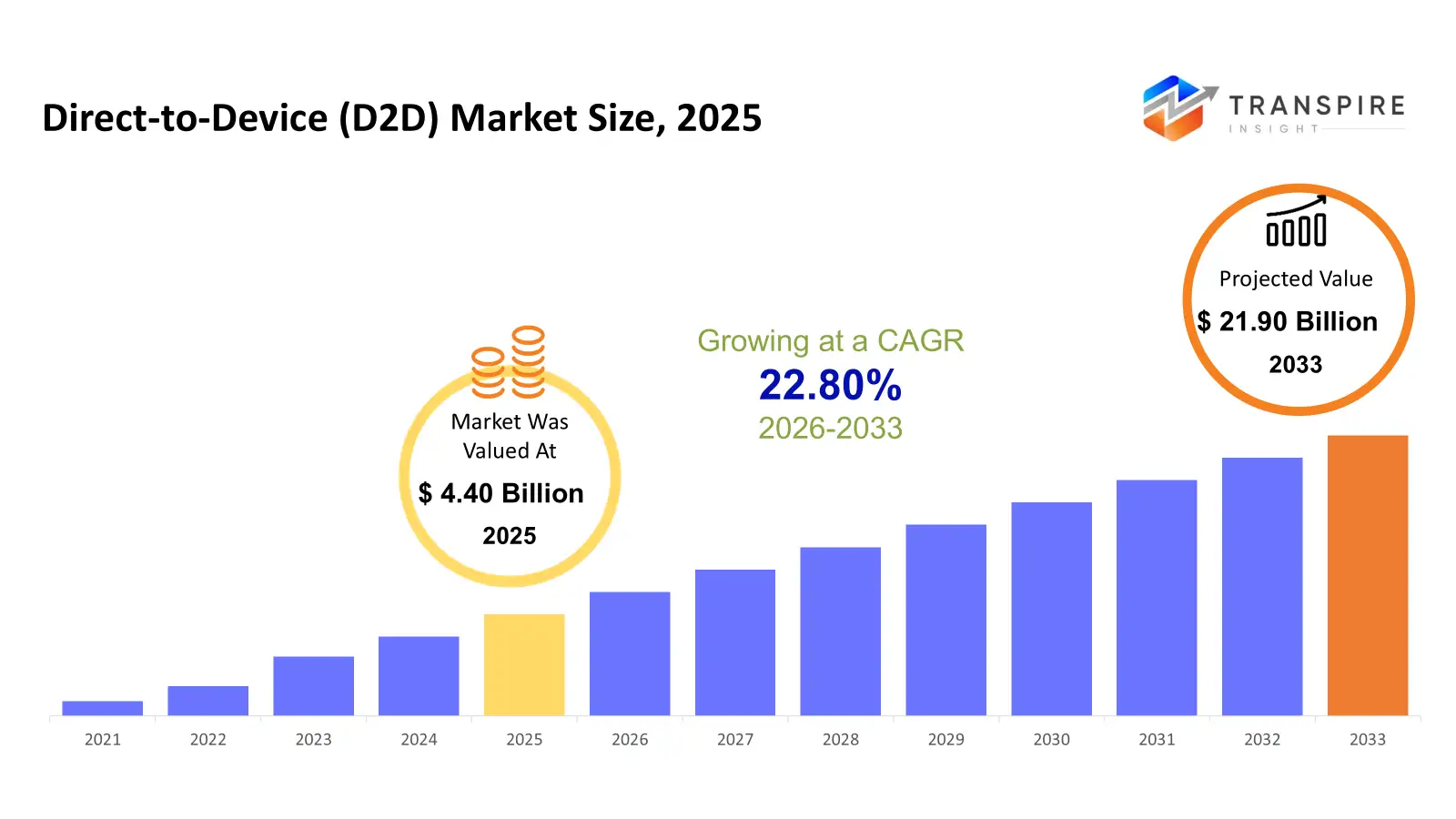
The global Direct-to-Device (D2D) market size was valued at USD 4.40 billion in 2025 and is projected to reach USD 21.90 billion by 2033, growing at a CAGR of 22.80% from 2026 to 2033. The market CAGR is driven by expanding demand for ubiquitous connectivity beyond terrestrial networks, rapid construction of LEO satellite constellations, and growing convergence between satellite operators and mobile network providers. Adoption is further accelerated by growing IoT deployments and emergency communication use cases.
Market Size & Forecast
- 2025 Market Size: USD 4.40 Billion
- 2033 Projected Market Size: USD 21.90 Billion
- CAGR (2026-2033): 22.80%
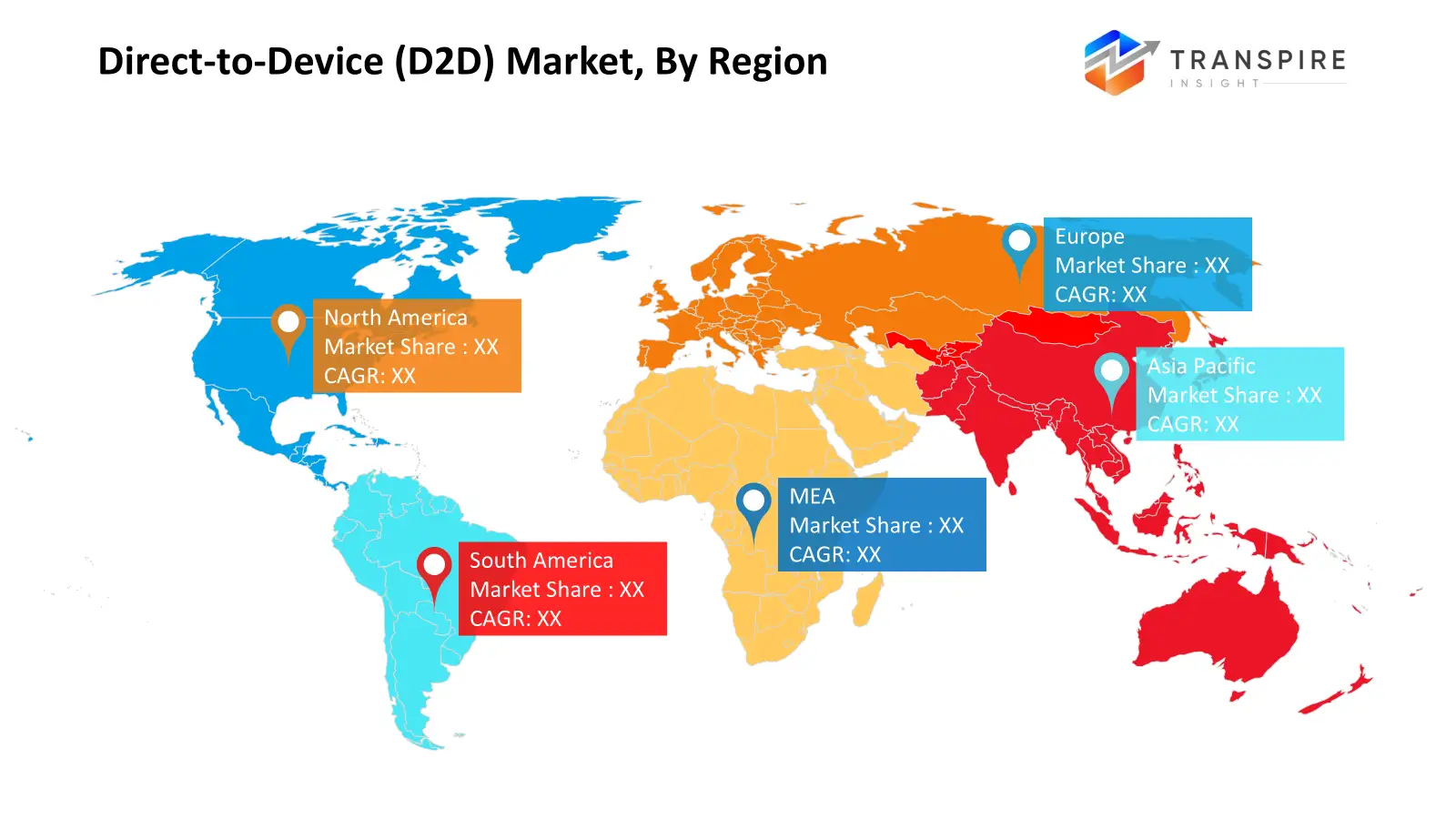
- North America: Largest Market in 2026
- Asia Pacific: Fastest Growing Market
To learn more about this report,  Download Free Sample Report
Key Market Trends Analysis
- North America indicates rapid adoption due to early development of satellite-to-device services, substantial cooperation between satellite operators and telecom carriers, and regulatory flexibility supporting pilot deployments across consumer safety, enterprise IoT, and government resilience-focused communication initiatives.
- With significant investments in LEO constellations, defense-backed satellite initiatives, and smartphone ecosystem integration, the US continues to be a major hub for innovation. The need for direct satellite communication solutions is still being driven by high enterprise digitization and disaster preparedness requirements.
- Due to government backed satellite infrastructure initiatives, fast industrial digitization and sizable underserved rural populations Asia Pacific has the highest growth momentum. To increase nationwide coverage and IoT scalability, nations like China, India, and Japan place a high priority on D2D connectivity.
- As businesses choose low-power, wide-area connectivity for asset tracking, environmental monitoring, and industrial automation, direct-to-IoT becomes the dominant service trend. It is economically feasible in a variety of verticals and regions because to its scalability and reduced bandwidth requirements.
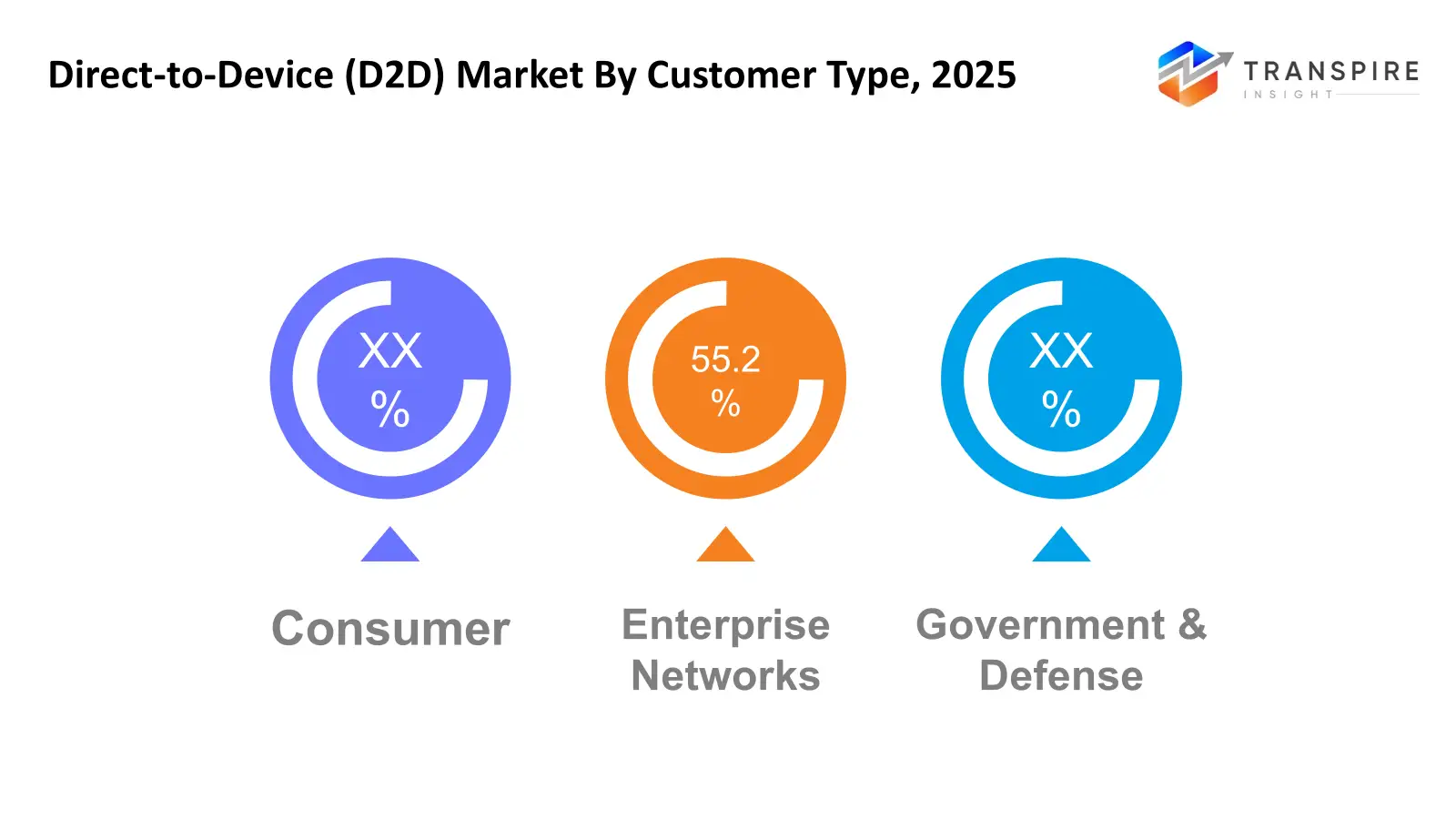
- Customer adoption trends are dominated by enterprise networks as businesses want for reliable connectivity for crucial operations. Enterprise demand is positioned as the market's main revenue stabilizer thanks to long-term contracts, consistent data usage, and integration with digital transformation programs.
- L-band is becoming more popular because of its balance of coverage, dependability, and signal penetration, especially for IoT and mobility applications. Its constant deployment across maritime, aviation, and remote industrial use cases is sustained by its demonstrated performance in a variety of situations.
- Adoption of LEO orbit is accelerating as operators place a higher priority on enhanced device interoperability and reduced latency. Since near-real-time communication is made possible by dense satellite constellations and declining launch costs, LEO is the architecture of choice for scalable D2D applications.
So, Satellite-enabled connection that enables end devices, including smartphones and Internet of Things sensors to communicate directly with satellites without exclusively depending on terrestrial infrastructure is known as the Direct-to-Device industry. This market is essential for improving network resilience and expanding connection to isolated, rural and infrastructure-poor areas. Public safety systems, enterprise IoT platforms and consumer gadgets are all progressively incorporating D2D solutions. Standardization initiatives, agreements between satellite operators and mobile network providers and developments in non-terrestrial networks all benefit the sector. Use cases include industrial monitoring, defense communications, asset tracking and emergency messages.
The D2D market is positioned as a supplementary layer to terrestrial networks rather than a replacement as digital transformation spreads throughout the world. Declining satellite deployment costs, increasing device interoperability, and increased demand for continuous connectivity across vital industries and regions all contribute to its expansion.
Direct-to-Device (D2D) Market Segmentation
By Service Type
- Direct-to-IoT (D2IoT)
Driven by the requirement for low-power, wide-area connectivity for sensors and machines in remote places, direct-to-IoT is a key revenue-generating industry. Applications for asset tracking, environmental monitoring, agriculture, utilities, and logistics are supported by this category. Rising industrial automation and the need for reliable communication outside of terrestrial networks are driving its expansion. Businesses find D2IoT to be economically appealing because to its scalable deployment and lower bandwidth requirements.
- Direct-to-Cell
Direct-to-Cell, which is mostly used for messaging and emergency communication, allows satellite connectivity straight to regular smartphones without the need for specialized hardware. Partnerships between satellite operators and mobile network providers are contributing to the segment's growth. Use cases for consumer safety, catastrophe recovery, and expanding coverage in rural areas are important growth drivers. Technological developments are anticipated to expand service possibilities, even though data speeds are currently constrained.
By Customer Type
- Customer
The need for seamless connectivity in places with spotty or nonexistent cellular coverage is what propels the consumer market. Smartphones with satellite connectivity and emergency communication services are driving adoption. Growth is stable but moderate bolstered by growing awareness of connectivity dependability and safety. Regulatory approvals and price sensitivity continue to be important determinants of widespread adoption.
- Enterprise Networks
Due to extensive IoT deployments in the energy, transportation, mining, agricultural and logistics industries, enterprise networks dominate the D2D market. D2D systems are valued by organizations for their operational efficiency, asset visibility and ongoing monitoring. Long term contracts and steady revenue streams are advantageous to the segment. Growth is further supported by high scalability and integration with digital transformation projects.
- Government & Defense
Adoption in government and defense is motivated by national security, disaster response activities, and mission-critical communication requirements. In hostile and isolated settings, D2D technologies offer reliable, secure connectivity. High dependability standards and governmental supervision define this market. Due to premium service pricing, it makes a substantial income contribution despite having a smaller volume.
To learn more about this report, Download Free Sample Report
By Frequency Band
- UHF/VHF band
Long-range, low-data-rate communications are the main use of UHF/VHF bands, especially in government and legacy applications. These frequencies are appropriate for basic message and monitoring applications because they provide excellent signal penetration and broad coverage. Growth is steady but constrained by available bandwidth. Adoption is still common in military and public safety use cases.
- L-band
Because it strikes a balance between coverage, dependability, and signal penetration, L-band is an important frequency sector. It is extensively utilized for mobile satellite services and D2IoT, especially in remote industrial, aviation, and maritime activities. The segment gains from a well-established infrastructure and track record of success. Its dominance in the D2D ecosystem is sustained by steady demand.
- S-band and Above
Higher frequency bands provide advanced D2D applications and allow for higher data flow. Next-generation satellite networks are increasingly using these frequencies, especially for improved consumer and business services. However, there are difficulties due to increased deployment costs and atmospheric condition sensitivity. Innovation in technology and the growing need for more data capacity are the main drivers of growth.
By Orbit Type
- LEO (Low Earth Orbit)
Owing to its lower latency and stronger signal, LEO is the most popular orbit type in the D2D industry. It is appropriate for consumer messaging and business IoT applications since it allows for almost instantaneous communication. Adoption is accelerated by fast constellation deployment and falling launch costs. Because of its scalability, LEO is a major facilitator of next-generation D2D services.
- GEO (Geostationary Earth Orbit)
GEO satellites are ideal for broadcast-oriented and wide-area services and provide vast geographic coverage. They are frequently employed in well-established satellite communication networks that facilitate D2D applications. Higher latency, however, restricts their application to real-time communication. For stable, long-term connectivity needs, GEO is still relevant.
- Multiple Orbits
Multi-orbit systems improve coverage, robustness, and service continuity by combining LEO and GEO capabilities. As service providers look to maximize performance across various use cases, this area is becoming more and more significant. Multi-orbit systems lessen reliance on a particular kind of network. They provide long-term strategic advantages despite being complicated and expensive.
Regional Insights
North America led by the United States due to early technology adoption, robust satellite infrastructure, and active telecom collaboration, represents the most developed D2D market. Through programs for cross-border coverage and rural connection, Canada and Mexico make a contribution. While the rest of Europe concentrates on enterprise and public sector connectivity, Germany, the UK, France, Spain, and Italy all experience consistent development thanks to government-backed space programs and regulatory harmonization.
Due to extensive population coverage requirements and industrial growth in China, India, Japan, South Korea, Australia, and New Zealand, Asia Pacific is the fastest-growing area. Regional demand is bolstered by government investments and growing IoT use, with the rest of Asia Pacific emerging as a long-term development opportunity. The demand for remote connection is driven by logistics, mining, and agriculture in South America, with Brazil and Argentina leading the way in adoption. With Saudi Arabia, the United Arab Emirates, and South Africa serving as tier-one adopters backed by infrastructure modernization and national connectivity initiatives, the Middle East and Africa area depends on D2D solutions for huge distant terrains.
To learn more about this report, Download Free Sample Report
Recent Development News
- October 2025, Viasat demonstrated the viability of direct-to-device (D2D) connectivity via L-band satellite and ecosystem partner infrastructure by successfully completing a first-of-its-kind D2D demonstration in Mexico that included native SMS and push-to-talk over satellite on commercially available Android devices using 3GPP NTN standards.
- In September 2024, Iridium Communications announced that the 3GPP has approved its work item to expand NB-IoT for Non-Terrestrial Networks (NTN) into Release 19, opening the door for worldwide D2D and NB-IoT satellite connectivity and allowing its Iridium NTN Direct℠ service to be supported on industry standard chipsets.
|
Report Metrics |
Details |
|
Market size value in 2025 |
USD 4.40 Billion |
|
Market size value in 2026 |
USD 5.20 Billion |
|
Revenue forecast in 2033 |
USD 21.90 Billion |
|
Growth rate |
CAGR of 22.80% from 2026 to 2033 |
|
Base year |
2025 |
|
Historical data |
2021 – 2024 |
|
Forecast period |
2026 – 2033 |
|
Report coverage |
Revenue forecast, competitive landscape, growth factors, and trends |
|
Regional scope |
North America; Europe; Asia Pacific; Latin America; Middle East & Africa |
|
Country scope |
United States; Canada; Mexico; United Kingdom; Germany; France; Italy; Spain; Denmark; Sweden; Norway; China; Japan; India; Australia; South Korea; Thailand; Brazil; Argentina; South Africa; Saudi Arabia; United Arab Emirates |
|
Key company profiled |
SpaceX, Iridium Communications, Globalstar,, ORBCOMM, Viasat, AST SpaceMobile, Lynk Global, OneWeb, Inmarsat, EchoStar, Skylo Technologies, OQ Technology, Thales Alenia Space, Qualcomm, Sateliot |
|
Customization scope |
Free report customization (country, regional & segment scope). Avail customized purchase options to meet your exact research needs. |
|
Report Segmentation |
By Service Type (Direct-to-IoT (D2IoT), Direct-to-Cell), By Customer Type (Consumer, Enterprise Networks, Government & Defense), By Frequency Band (UHF/VHF-band, L-band, S-band and Above) and By Orbit Type (LEO (Low Earth Orbit), GEO (Geostationary Earth Orbit), Multi-Orbit) |
Key Direct-to-Device (D2D) Company Insights
SpaceX's strategic investments in spectrum and technological integration, along with its Starlink satellite constellation, have made it a major catalyst in the Direct-to-Device industry. Its strategy makes use of a sizable LEO network that can provide internet and messaging services in order to target worldwide direct-to-cell and IoT connection. SpaceX's competitive advantage is strengthened by its size, rate of innovation, and cooperation with mobile operators, which allow for the deployment of distinctive services in remote and unconnected areas. Future satellite-terrestrial hybrid communication ecosystems will be shaped by SpaceX's ability to grow beyond traditional broadband into comprehensive D2D offerings through ongoing improvements and spectrum purchases.
Key Direct-to-Device (D2D) Companies:
- SpaceX
- Iridium Communications
- Globalstar
- ORBCOMM
- Viasat
- AST SpaceMobile
- Lynk Global
- OneWeb
- Inmarsat
- EchoStar
- Skylo Technologies
- OQ Technology
- Thales Alenia Space
- Qualcomm
- Sateliot
Global Direct-to-Device (D2D) Market Report Segmentation
By Service Type
- Direct-to-IoT (D2IoT)
- Direct-to-Cell
By Customer Type
- Consumer
- Enterprise Networks
- Government & Defense
By Frequency Band
- UHF/VHF-band
- L-band
- S-band and Above
By Orbit Type
- LEO (Low Earth Orbit)
- GEO (Geostationary Earth Orbit)
- Multi-Orbit
Regional Outlook
- North America
- United States
- Canada
- Mexico
- Europe
- Germany
- United Kingdom
- France
- Spain
- Italy
- Rest of Europe
- Asia Pacific
- Japan
- China
- Australia & New Zealand
- South Korea
- India
- Rest of Asia Pacific
- South America
- Brazil
- Argentina
- Rest of South America
- Middle East & Africa
- Saudi Arabia
- United Arab Emirates
- South Africa
- Rest of the Middle East & Africa
Frequently Asked Questions
Find quick answers to common questions.
The approximate Direct-to-Device (D2D) Market size for the market will be USD 21.90 billion in 2033.
Key segments for the Direct-to-Device (D2D) Market are By Service Type (Direct-to-IoT (D2IoT), Direct-to-Cell), By Customer Type (Consumer, Enterprise Networks, Government & Defense), By Frequency Band (UHF/VHF-band, L-band, S-band and Above) and By Orbit Type (LEO (Low Earth Orbit), GEO (Geostationary Earth Orbit), Multi-Orbit).
Major Direct-to-Device (D2D) Market players are SpaceX, Iridium Communications, Globalstar, AST SpaceMobile, Viasat.
The North America region is leading the Direct-to-Device (D2D) Market.
The CAGR of the Direct-to-Device (D2D) Market is 22.80%.
- SpaceX
- Iridium Communications
- Globalstar
- ORBCOMM
- Viasat
- AST SpaceMobile
- Lynk Global
- OneWeb
- Inmarsat
- EchoStar
- Skylo Technologies
- OQ Technology
- Thales Alenia Space
- Qualcomm
- Sateliot
Recently Published Reports
-
Apr 2026
3D Optical Profiler Market
3D Optical Profiler Market Size, Share & Analysis Report By Type (Desktop 3D Optical Profiler, and Portable 3D Optical Profiler), By Technology (Confocal Technology, and White Light Interference), By End-Use Industry (Manufacturing, Research Institutions, Automotive, Aerospace and Defense, Medical Devices, and Other), and Geography (North America, Europe, Asia-Pacific, Middle East and Africa, South and Central America), 2021 - 2031
-
Apr 2026
Depth Sensor Market
Depth Sensor Market Size, Share & Analysis Report By Type (Infrared Depth Sensors, Time-of-Flight (ToF) Sensors, Stereo Vision Sensors, Structured Light Sensors, Ultrasonic Depth Sensors), By Application (Automotive, Robotics, Gaming, Consumer Electronics, Industrial Automation, Healthcare, Security & Surveillance, Others), By End Users (Automotive Manufacturers, Consumer Electronics Companies, Healthcare Providers, Industrial Companies, Security Agencies, Gaming Companies, Robotics Companies, Others), and Geography (North America, Europe, Asia-Pacific, Middle East and Africa, South and Central America), 2021 – 2031
-
Apr 2026
Digital Manufacturing Market
Digital Manufacturing Market Size, Share & Analysis Report By Component (Hardware, Software, and Services), By Technology (Robotics, 3D Printing, Internet of Things (IoT), and Others), By Application (Automotive and Transportation, Aerospace and Defense, Consumer Electronics, Industrial Machinery, and Others), By Process Type (Computer-Based Designing, Computer-Based Simulation, Computer 3D Visualization, Analytics, and Others), and Geography (North America, Europe, Asia-Pacific, Middle East and Africa, South and Central America), 2021 – 2031
-
Apr 2026
Digital Visa Services Market
Digital Visa Services Market Size, Share & Analysis Report By Type (Individual Travelers, Group Travelers), By Application (Tourism, Business Travel, Others), and Geography (North America, Europe, Asia-Pacific, Middle East and Africa, South and Central America), 2021 – 2031