
Aug 12, 2026
By Transpire Insight
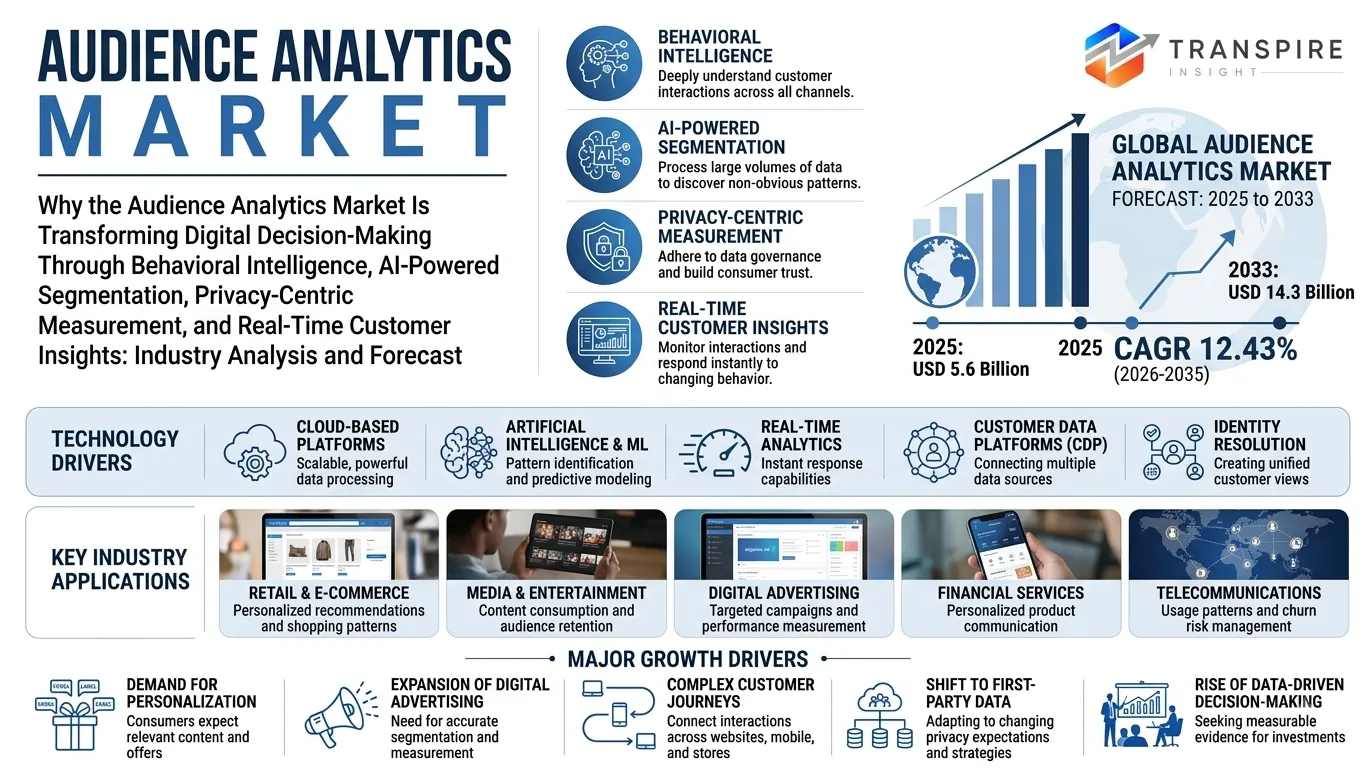
According to industry analysis, the Global Audience Analytics Market is projected to expand from USD 5.6 billion in 2025 to USD 14.3 billion by 2033, registering a CAGR of 12.43% during the forecast period 2026-2035.
The audience analytics market is gaining strategic importance as businesses increasingly seek to understand how customers interact with digital platforms, physical channels, advertising campaigns, products, and services. Organizations across retail, media, entertainment, financial services, telecommunications, healthcare, travel, consumer goods, and technology are using audience intelligence to better understand customer behavior and improve engagement.
Audience analytics combines behavioral data, demographic information, transaction patterns, digital interactions, campaign responses, content consumption, and other customer signals to create a more detailed understanding of target audiences. The growing volume of connected consumer activity is creating new opportunities for businesses to convert fragmented information into actionable insights.
Compared with conventional market research and basic customer reporting, audience analytics provides a more dynamic approach to understanding consumers. Organizations can evaluate who their customers are, what they interact with, when they engage, which channels they prefer, and how their behavior changes over time. This capability is increasingly important as customer journeys become more complex and span websites, mobile applications, social platforms, connected devices, physical stores, and other touchpoints.
The market is also benefiting from advances in artificial intelligence, machine learning, cloud computing, data management, predictive modeling, and real-time analytics. These technologies are allowing businesses to process larger volumes of audience information and identify patterns that may not be visible through traditional reporting methods.
Latest Market Statistics and Growth Outlook
The global audience analytics market is developing alongside the broader expansion of customer intelligence, digital marketing, data analytics, advertising technology, and business intelligence. While market valuations can differ depending on whether audience measurement, customer analytics, advertising analytics, or broader consumer intelligence solutions are included, the underlying demand environment is supported by increasing digital engagement and the need for measurable marketing outcomes.
Businesses are generating growing quantities of customer information through websites, mobile applications, e-commerce platforms, loyalty programs, connected devices, social media, advertising campaigns, customer service interactions, and transaction systems. The challenge is increasingly shifting from data collection to meaningful interpretation.
Organizations are therefore investing in analytics platforms capable of combining multiple audience signals and translating them into practical business insights. This is particularly important for companies managing large customer bases across multiple geographic regions and communication channels.
The continued expansion of digital advertising and personalized customer experiences is also supporting demand. Marketing teams increasingly require detailed audience intelligence to identify high-value segments, optimize campaign performance, reduce inefficient advertising expenditure, and improve customer retention.
The transition toward first-party data strategies is another important market factor. As organizations seek greater control over customer information and adapt to changing privacy expectations, audience analytics platforms are increasingly being used to organize and interpret directly collected customer data.
Growth Drivers
One of the strongest drivers for the audience analytics market is the increasing demand for personalized customer experiences. Consumers are exposed to a large number of digital messages every day, making generic marketing less effective for many businesses.
Audience analytics allows organizations to identify differences between customer groups and develop more relevant communications. Businesses can use audience intelligence to understand purchasing behavior, content preferences, engagement patterns, channel preferences, and customer lifecycle stages.
Another important growth driver is the expansion of digital advertising. Advertisers increasingly require accurate audience segmentation and performance measurement to determine whether campaigns are reaching the intended consumers.
Audience analytics can support campaign planning by identifying potential audience groups based on behavioral and contextual characteristics. It can also help marketers evaluate campaign outcomes and identify segments that demonstrate stronger engagement or conversion potential.
The increasing complexity of customer journeys is another major factor. Customers may discover a product through social media, research it through a website, compare prices through an online marketplace, visit a physical store, and ultimately complete the transaction through a mobile application.
Understanding this multi-channel journey requires analytics capabilities that can connect information from different touchpoints.
Download the exclusive Audience Analytics Market sample report today to uncover expert insights, emerging trends, and the opportunities defining the future of the industry.
Applications Across Marketing and Business Intelligence
The applications of audience analytics extend across numerous industries. Retail companies can use audience intelligence to understand shopping behavior, identify customer segments, personalize promotions, and improve product recommendations.
In media and entertainment, audience analytics can help organizations understand viewing behavior, content preferences, engagement patterns, and audience retention. Streaming platforms, broadcasters, publishers, and digital content providers can use these insights to improve content strategies.
The advertising industry represents another major application area. Agencies, advertisers, publishers, and media owners can use audience analytics to understand campaign reach, engagement, conversion behavior, and audience composition.
Financial services companies can apply audience analytics to understand customer preferences, identify cross-selling opportunities, improve digital engagement, and develop more targeted communications.
Telecommunications companies can also use audience intelligence to evaluate customer usage patterns, identify churn risks, and improve service personalization.
Additionally, healthcare organizations, travel businesses, hospitality providers, education companies, automotive businesses, and technology providers can use audience analytics to better understand their customers and improve engagement strategies.
Government Initiatives and Data Governance
Government policies related to data privacy, consumer protection, cybersecurity, digital services, and responsible artificial intelligence are influencing the development of the audience analytics market.
As businesses collect and analyze increasingly detailed customer information, compliance with applicable privacy and data-protection requirements has become an important consideration.
Organizations are therefore placing greater emphasis on consent management, data governance, access controls, data security, retention policies, and transparent data practices.
Regulatory developments are also encouraging companies to reconsider how audience information is collected and used. This is creating opportunities for analytics platforms that provide stronger governance capabilities while allowing organizations to continue generating useful customer insights.
Data quality is equally important. Poorly structured, duplicated, outdated, or incorrectly classified customer information can reduce the accuracy of audience analysis. As a result, businesses are increasingly investing in data-cleaning, identity-resolution, integration, and governance capabilities.
Technology Overview
Technology is fundamentally reshaping the audience analytics market. Cloud-based analytics platforms allow organizations to process and analyze large quantities of customer information without relying exclusively on traditional on-premise infrastructure.
Artificial intelligence and machine learning are increasingly being integrated into analytics workflows. These technologies can identify patterns, classify audiences, detect behavioral changes, estimate customer intent, and support predictive decision-making.
Real-time analytics is another important technology development. Instead of relying only on historical reports, organizations can monitor customer interactions as they occur and respond more quickly.
For example, an online retailer can analyze browsing behavior and provide relevant recommendations during a customer session. A media company can identify changes in content engagement, while an advertiser can monitor campaign performance and adjust targeting strategies.
Customer data platforms, data warehouses, data lakes, application programming interfaces, identity-resolution technologies, and visualization tools are also becoming important components of modern audience analytics ecosystems.
Future Importance of the Audience Analytics Market
The future of the audience analytics market will increasingly depend on the convergence of artificial intelligence, customer data, privacy management, personalization, predictive modeling, and real-time decision-making.
As businesses compete for consumer attention, the ability to understand audiences accurately will become increasingly important. Organizations that can transform fragmented behavioral information into actionable intelligence may gain advantages in customer acquisition, engagement, retention, and marketing efficiency.
The next stage of market development is likely to involve greater use of predictive audience modeling, automated segmentation, real-time personalization, privacy-conscious data activation, and AI-assisted decision-making.
Ultimately, audience analytics is becoming an important component of modern customer intelligence. Its applications extend beyond marketing into product development, customer experience, sales, media planning, service optimization, and strategic decision-making.
Rising Demand for Data-Driven Customer Understanding
The audience analytics market is benefiting from the broader shift toward data-driven business decision-making. Organizations increasingly want measurable evidence behind marketing investments, customer experience initiatives, and product strategies.
Traditional assumptions about customer behavior are gradually being supplemented by behavioral evidence collected from multiple interaction points.
Audience analytics can help organizations identify which customer groups are most engaged, which channels generate stronger responses, and where customers experience friction throughout their journey.
This shift is encouraging businesses to move from broad demographic targeting toward more detailed behavioral and contextual audience analysis.
The growing importance of customer lifetime value is also creating opportunities. Companies can use audience intelligence to distinguish between one-time purchasers, repeat customers, high-value users, inactive customers, and customers at risk of leaving.
Personalization Is Creating New Market Opportunities
Personalization is becoming one of the most important applications of audience analytics. Consumers increasingly expect businesses to provide relevant content, offers, recommendations, and communications.
Audience analytics can support personalization by identifying differences in consumer behavior and preferences.
Retailers can use customer insights to recommend products, media companies can personalize content discovery, financial institutions can tailor product communications, and travel businesses can create more relevant offers.
However, personalization also requires responsible data management. Businesses must balance relevance with privacy expectations and avoid creating experiences that consumers perceive as intrusive.
This balance is creating demand for analytics solutions capable of supporting personalization while incorporating appropriate privacy and governance controls.
Expansion of Predictive and Real-Time Analytics
The audience analytics market is increasingly moving beyond historical reporting toward predictive and real-time intelligence.
Historical analytics explains what happened, while predictive analytics can help organizations estimate what may happen next. Businesses can use predictive models to identify potential churn, estimate purchase intent, evaluate campaign response, or identify audiences with stronger conversion potential.
Real-time analytics adds another dimension by allowing organizations to respond to customer behavior as it occurs.
For example, an e-commerce company can recognize a customer's interaction with multiple products and adjust recommendations during the same session. Media companies can respond to changes in audience engagement, while advertisers can optimize campaigns based on emerging performance signals.
These capabilities can increase the practical value of audience analytics for businesses operating in fast-moving digital environments.
Advertising and Marketing Industry Drives Demand
Advertising and marketing represent important application areas for audience analytics. Brands and agencies increasingly require detailed audience information to plan campaigns and measure performance.
Audience analytics can support audience discovery, segmentation, campaign planning, media allocation, engagement measurement, and conversion analysis.
Advertisers are also seeking stronger measurement capabilities as marketing budgets face greater pressure to demonstrate measurable returns.
The increasing fragmentation of media consumption is further supporting demand. Consumers now interact with brands through search engines, social media, streaming platforms, websites, mobile applications, connected television, retail media, and physical channels.
Understanding audiences across these environments requires analytics capabilities capable of integrating multiple sources of information.
North America Remains a Key Market
North America is expected to remain an important region for audience analytics because of its advanced digital advertising ecosystem, strong technology industry, extensive enterprise software adoption, and high level of investment in data-driven marketing.
The region includes a large concentration of technology companies, advertising agencies, media organizations, retailers, financial institutions, and consumer brands that increasingly rely on audience intelligence.
The United States represents a major opportunity because businesses across industries have adopted cloud platforms, digital advertising, customer data technologies, and advanced analytics.
Canada also offers opportunities through expanding digital commerce, data-driven marketing, and technology adoption.
Meanwhile, privacy considerations and evolving data governance requirements are encouraging organizations across the region to invest in more structured approaches to audience data management.
Sustainable and Responsible Data Practices Create Opportunities
Responsible data usage is becoming increasingly important in the audience analytics market.
Organizations are under growing pressure to collect, store, analyze, and activate customer information responsibly. This is encouraging companies to implement stronger data governance, privacy controls, security systems, and transparency mechanisms.
Sustainable data practices can also involve reducing unnecessary data collection, improving data quality, eliminating redundant information, and using computing resources efficiently.
As analytics workloads increase, organizations may increasingly evaluate the efficiency of cloud infrastructure, data processing, storage, and AI systems.
Responsible analytics will therefore become an important component of long-term market development.
Digital transformation is opening new opportunities for audience analytics providers.
Businesses are connecting customer relationship management systems, e-commerce platforms, websites, mobile applications, advertising systems, social channels, customer service platforms, and transaction databases.
Integrating these sources can provide organizations with a more complete view of customer behavior.
Artificial intelligence can further enhance this process by identifying patterns across large datasets. Automated audience segmentation can reduce manual analysis requirements, while predictive models can help businesses identify emerging customer trends.
For smaller organizations, however, implementation challenges may include software costs, data quality issues, technical skills, integration complexity, and privacy requirements.
E-Commerce Expands Market Reach
The expansion of e-commerce is creating significant opportunities for audience analytics.
Online businesses generate detailed information about customer searches, product views, clicks, cart activity, purchases, returns, reviews, and repeat visits.
This information can be analyzed to identify purchasing patterns and improve the customer journey.
E-commerce companies can use audience intelligence to create personalized recommendations, identify high-value customers, improve promotional strategies, and understand why visitors abandon transactions.
Social commerce is adding another layer of customer interaction. Consumers increasingly discover products through social platforms, influencers, video content, and online communities.
Audience analytics can help businesses understand how these interactions contribute to customer engagement and purchasing decisions.
Major Challenges Facing the Market
Despite its growth potential, the audience analytics market faces several challenges.
One major challenge is data fragmentation. Customer information is often distributed across multiple systems, platforms, departments, and external channels. Connecting these sources can be technically complex.
Data privacy represents another significant challenge. Organizations must ensure that customer information is collected and processed in accordance with applicable requirements.
Data quality can also influence analytical accuracy. Incorrect identities, incomplete customer profiles, duplicated records, and inconsistent data structures can produce misleading results.
Cybersecurity is another important consideration. Audience analytics systems can contain valuable customer information, making them potential targets for unauthorized access or misuse.
Organizations must therefore balance analytical capability with security, privacy, governance, and operational efficiency.
Proceed to Checkout to purchase the exclusive Audience Analytics Market report and gain instant access to in-depth market intelligence, strategic analysis, and future growth opportunities.
Future Opportunities for Technology Providers and Businesses
The market offers significant opportunities for companies developing advanced audience analytics technologies.
Technology providers can focus on AI-powered segmentation, predictive analytics, real-time decision-making, privacy-enhancing technologies, identity resolution, customer journey analytics, and automated reporting.
Businesses can also develop specialized audience intelligence solutions for individual industries.
Retail-focused platforms can emphasize shopping behavior, while media analytics solutions can focus on content consumption and audience engagement. Advertising technologies can prioritize campaign measurement, and financial services platforms can focus on customer value and behavioral analysis.
Integration capabilities will remain particularly important because organizations increasingly require analytics systems that can work across their existing technology environments.
Competitive Landscape and Industry Development
Competition in the audience analytics market includes analytics software providers, customer data platforms, marketing technology companies, advertising technology providers, business intelligence companies, data management firms, and specialized audience measurement businesses.
The competitive environment is evolving as traditional analytics companies expand into AI-powered customer intelligence and marketing technology companies increase their analytics capabilities.
Larger technology providers can benefit from broad software ecosystems, cloud infrastructure, extensive enterprise relationships, and advanced research capabilities.
Smaller and specialized providers can compete through industry-specific solutions, faster implementation, specialized analytics models, flexible pricing, and customized customer experiences.
The future competitive environment is likely to reward companies that combine analytical accuracy with usability, interoperability, privacy, scalability, and real-time capabilities.
Outlook
The audience analytics market is transitioning from conventional customer reporting toward increasingly intelligent and predictive audience understanding.
Demand is being supported by digital transformation, personalized marketing, e-commerce expansion, AI adoption, digital advertising, customer experience management, and the growing importance of measurable business outcomes.
The strongest opportunities are likely to emerge where businesses combine audience analytics with customer data platforms, artificial intelligence, predictive modeling, real-time personalization, and responsible data governance.
As customer journeys continue to become more fragmented, the ability to connect audience signals across multiple channels will become increasingly valuable.
Innovation Is Reshaping the Audience Analytics Market
Innovation is becoming an important factor in the development of the audience analytics market as businesses seek faster and more accurate methods of understanding customers.
Modern analytics platforms are increasingly incorporating machine learning, natural language processing, automated segmentation, predictive modeling, behavioral scoring, and real-time decision engines.
Automation can reduce the amount of manual work required to identify audience groups and generate customer insights.
AI-assisted analytics can also help business teams identify relationships between different customer signals and discover behavioral patterns that may otherwise remain hidden within large datasets.
Generative AI is creating another potential development area by allowing analysts and business users to interact with customer data using natural-language queries and automated summaries.
However, organizations will need to maintain appropriate human oversight, data governance, and validation processes when deploying AI-generated insights.
Privacy Technology Creates Product Differentiation
Privacy is becoming increasingly important as audience analytics becomes more sophisticated.
Organizations are exploring privacy-conscious approaches to customer intelligence that allow useful analysis while reducing unnecessary exposure of sensitive or personally identifiable information.
Techniques such as data minimization, consent management, access controls, anonymization, pseudonymization, secure data environments, and privacy-enhancing technologies can support responsible analytics.
Analytics providers that integrate privacy and governance into their platforms may gain advantages as businesses face increasingly complex data-management requirements.
The ability to demonstrate transparent data practices can also strengthen customer trust.
Regional Opportunities
North America is expected to remain an important region because of strong enterprise technology adoption, digital advertising activity, advanced analytics infrastructure, and the presence of major technology businesses.
Europe offers opportunities through digital transformation, advanced customer experience strategies, and growing demand for privacy-conscious analytics. Organizations in the region are placing greater emphasis on responsible data management and regulatory compliance.
Asia-Pacific represents a significant growth opportunity due to expanding digital commerce, increasing smartphone adoption, rapidly developing advertising ecosystems, and the growth of technology-driven businesses.
Countries such as China, Japan, India, South Korea, Singapore, and Australia offer opportunities across e-commerce, financial services, telecommunications, retail, media, and digital advertising.
Latin America and the Middle East and Africa also represent developing opportunities as businesses increase their adoption of digital platforms and data-driven marketing.
Market development in these regions will depend on technology infrastructure, digital maturity, skilled workforce availability, data governance, and investment in analytics capabilities.
India Offers Attractive Growth Potential
India represents an important opportunity for the audience analytics market because of its rapidly expanding digital economy, large internet user base, growing e-commerce sector, digital payments ecosystem, and increasing adoption of technology-driven marketing.
Indian retailers, financial institutions, telecommunications companies, consumer brands, media businesses, and online platforms are increasingly using customer data to improve engagement and personalization.
The expansion of digital commerce is generating new behavioral information that can be analyzed to understand customer preferences and purchasing patterns.
Indian businesses are also increasingly adopting cloud technologies, artificial intelligence, customer relationship management systems, and marketing automation platforms.
As enterprises become more focused on measurable customer acquisition and retention, demand for audience intelligence is likely to expand across both large companies and digitally enabled smaller businesses.
Sustainability and Responsible Data Analytics
Sustainability is expected to become a stronger consideration in the audience analytics industry.
The increasing use of artificial intelligence and large-scale data processing requires computing infrastructure, storage capacity, and energy resources.
Organizations may therefore increasingly evaluate the efficiency of analytics architectures, cloud environments, data storage policies, and AI workloads.
Responsible data management can also contribute to sustainability by reducing unnecessary duplication, excessive storage, and inefficient processing.
The industry's long-term development will depend on balancing analytical performance, business value, privacy, cybersecurity, infrastructure efficiency, and responsible technology use.
Customize the exclusive Audience Analytics Market report today to receive tailored insights, country-specific analysis, and business-focused market intelligence.
Consumer Trust Will Be Critical
One of the most important factors influencing the future of audience analytics will be consumer trust.
Consumers are increasingly aware that businesses collect information about their online and offline interactions. Companies that fail to communicate clearly about data collection and usage may face reputational challenges.
Organizations can strengthen trust through transparent privacy policies, clear consent mechanisms, appropriate data security, and responsible personalization.
Businesses should also avoid excessive personalization that may make customers uncomfortable.
The future of audience analytics will therefore involve not only understanding customers better but also understanding the boundaries of acceptable data usage.
Product Diversification Will Strengthen Market Growth
The future market is unlikely to depend exclusively on traditional audience measurement tools. Product diversification could become one of the strongest strategies for expanding the market.
Potential categories include:
These solutions can serve different industries and customer requirements.
Basic analytics platforms can support reporting and segmentation, while advanced systems can provide predictive modeling, automated recommendations, real-time intelligence, and AI-assisted decision-making.
Competitive Strategies for Market Participants
Companies operating in the audience analytics market can strengthen their competitive position through several strategies.
Analytical accuracy will remain fundamental because businesses depend on reliable customer information to make marketing and strategic decisions.
Ease of integration can also create competitive advantages. Organizations prefer platforms capable of connecting with existing CRM systems, advertising platforms, e-commerce technologies, customer data platforms, and business intelligence environments.
Data privacy and security will increasingly influence purchasing decisions. Providers that demonstrate strong governance and security capabilities may gain greater trust among enterprise customers.
Industry specialization can provide another opportunity. Solutions designed specifically for retail, media, financial services, telecommunications, healthcare, or travel can address unique customer intelligence requirements.
Partnerships between analytics providers, cloud companies, advertising platforms, technology integrators, and enterprise software businesses may also accelerate market expansion.
Challenges That Could Influence Future Growth
Despite its potential, the market will continue to face technical, regulatory, and commercial challenges.
Data fragmentation can make it difficult to establish unified customer profiles, while inconsistent data quality can affect analytical accuracy.
Privacy regulations may also increase the complexity of audience data collection and activation.
Cybersecurity risks remain significant because analytics systems may process valuable customer information.
The shortage of specialized data scientists, AI professionals, analytics engineers, and privacy experts can also affect implementation.
Smaller businesses may face additional barriers related to technology costs, integration requirements, and access to skilled personnel.
Addressing these challenges will require continued investment in data architecture, privacy technologies, cybersecurity, workforce development, interoperability, and user-friendly analytics platforms.
Future Outlook
The future of the audience analytics market is closely connected to several major technology and business trends, including artificial intelligence, predictive analytics, personalization, digital advertising, e-commerce, customer experience management, privacy-conscious data practices, and real-time decision-making.
As businesses compete for customer attention across an expanding number of channels, audience intelligence will become increasingly important.
Technological advancements can help organizations move from descriptive reporting toward predictive and prescriptive analytics.
The strongest growth opportunities are likely to emerge from integrated platforms that combine customer data, behavioral analytics, AI, real-time intelligence, privacy management, and automated decision support.
Schedule a meeting with our market experts to discuss the exclusive Audience Analytics Market report and identify the best research solution for your organization.
Conclusion
The audience analytics market is evolving through the convergence of artificial intelligence, customer intelligence, digital advertising, personalization, e-commerce, predictive analytics, and responsible data management.
What was once primarily focused on understanding audience demographics is becoming a broader discipline capable of analyzing customer journeys, behavioral patterns, engagement signals, purchasing activity, content preferences, and future customer intent.
Future growth will depend on the ability of businesses and technology providers to improve analytical accuracy, strengthen privacy and security, integrate fragmented data sources, adopt advanced AI capabilities, and convert customer information into practical business decisions.
At the same time, responsible data practices and consumer trust will become increasingly important. Organizations will need to demonstrate that audience intelligence can create meaningful customer experiences without compromising privacy or transparency.
With continued innovation in artificial intelligence, cloud analytics, real-time processing, customer data management, predictive modeling, and privacy technologies, the audience analytics market has the potential to establish an increasingly important position within the global digital economy and data-driven business ecosystem.


Send us a brief description of your challenge and we'll get back to you within 24 hours.

 inquiry@transpireinsight.com
 APAC:+91 7666513636
 Address


