
Sep 15, 2026
By Transpire Insight
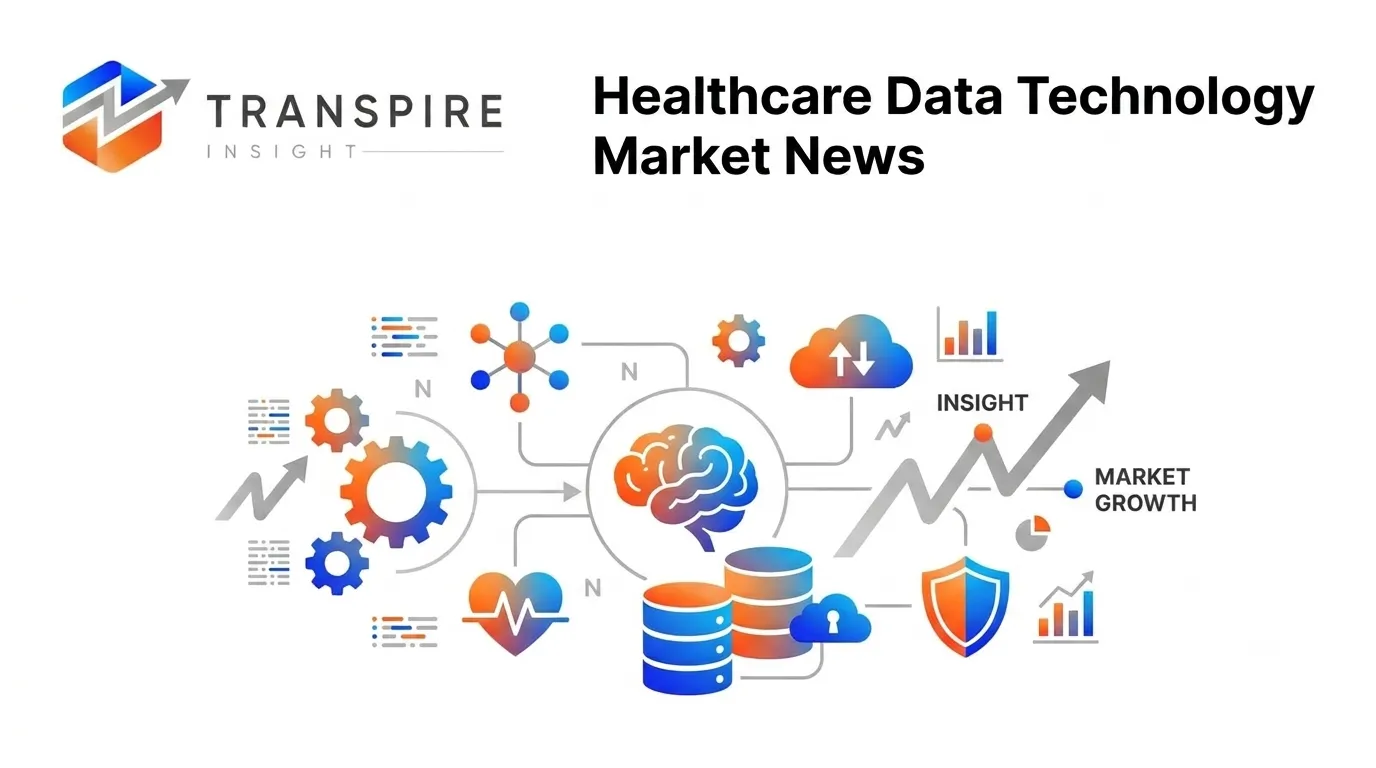
Rapid digitization of healthcare is increasing the volume and complexity of clinical data, driving demand for data integration, harmonization, interoperability, analytics, artificial intelligence, and secure health-data platforms.
The expansion of electronic health records, connected medical devices, real-world evidence, and AI applications is making healthcare data infrastructure increasingly important to the future of clinical care and medical research.
Rapid Healthcare Digitization Is Increasing Demand for Data Technology
The healthcare industry is generating more data than ever before through electronic health records, medical imaging, laboratory systems, connected devices, remote monitoring platforms, insurance claims, pharmaceutical research, and patient-generated information. However, the growing volume of data does not automatically translate into better healthcare outcomes. Data must be standardized, integrated, secured, analyzed, and delivered to the right users at the right time.
This is creating a growing requirement for healthcare data technology capable of connecting fragmented information across hospitals, laboratories, payers, pharmaceutical companies, research organizations, and digital health platforms. Data harmonization and structuring, health-data integration, analytics, interoperability, and data monetization are consequently becoming increasingly important components of modern healthcare infrastructure.
The global Healthcare Data Technology Market was valued at approximately USD 3.1 billion in 2024 and is projected to grow from around USD 4.0 billion in 2026 to USD 9.5 billion by 2033, representing a CAGR of approximately 13.4% from 2025 to 2033. North America accounted for approximately 46.5% of market revenue in 2024, while Asia Pacific is identified as the fastest-growing regional market.
The expansion is being supported by increasing EHR adoption, demand for interoperable healthcare systems, AI-driven analytics, real-world evidence generation, and growing interest in extracting actionable insights from fragmented healthcare datasets.
Fragmented Healthcare Data Creates a Growing Technology Challenge
Healthcare organizations often operate multiple information systems that were developed at different times and may use different data structures, terminology, and communication protocols. This fragmentation can make it difficult to obtain a complete view of a patient's clinical history or combine information across providers.
The problem becomes more significant as healthcare becomes increasingly distributed. Patients may receive treatment from hospitals, specialists, laboratories, pharmacies, telehealth providers, and other organizations, each producing different categories of information.
Healthcare data technology is therefore increasingly focused on creating a connected data layer capable of collecting information from multiple sources and transforming it into usable formats.
Interoperability is an important component of this transition. Modern health-data platforms increasingly use standards such as FHIR and data-fabric architectures to support information exchange across healthcare environments. Gartner has identified the convergence of interoperability, clinical data integration, health-information exchange, and digital-health capabilities as an important development in the health-data management platform landscape.
Artificial Intelligence Is Increasing the Value of Healthcare Data
The rapid development of artificial intelligence is creating a second major growth engine for healthcare data technology.
AI systems require large quantities of structured, high-quality, representative data for training, validation, monitoring, and deployment. Consequently, healthcare organizations are increasingly recognizing that AI performance depends not only on algorithms but also on the quality and architecture of the underlying data.
This is creating demand for technologies capable of data normalization, de-identification, terminology mapping, data governance, quality management, and secure data access.
Recent developments in India illustrate this direction. In 2026, the country introduced the Strategy for Artificial Intelligence in Healthcare and the BODH evaluation platform, with the objective of enabling evaluation of healthcare AI models using real-world healthcare data while addressing privacy and safety considerations.
The development highlights a broader industry shift: healthcare organizations are increasingly investing in the infrastructure required to make medical data usable for AI rather than treating AI as an isolated software layer.
Why Does Healthcare Data Technology Matter?
The importance of healthcare data technology extends across clinical care, research, administration, and public health.
Data Harmonization Is Becoming a Strategic Healthcare Requirement
Healthcare data is often generated in different formats and with different terminology. A laboratory system, hospital EHR, wearable device, insurance database, and clinical research platform may describe similar information in different ways.
Data harmonization addresses this challenge by transforming heterogeneous datasets into more consistent and usable structures. This makes it easier for healthcare organizations and researchers to combine information from multiple sources.
The importance of harmonization is increasing as healthcare organizations seek to develop AI models, conduct population-level research, and create real-world evidence. Industry analysis identifies health data integration and monetization as the leading technology segment in the healthcare data technology market, accounting for more than 66.55% of market share in 2024.
This indicates that the market opportunity is moving beyond simple data storage toward technologies capable of making healthcare information interoperable, analyzable, and commercially or clinically useful.
Health Data Sharing Is Creating New Research Opportunities
The growing ability to securely connect healthcare datasets is also changing medical research. Historically, valuable patient information has often remained inside individual institutions because of technical, legal, privacy, and organizational barriers.
New data platforms are attempting to connect these previously fragmented datasets while maintaining appropriate privacy protections.
In August 2026, a U.S.-based initiative involving multiple academic medical centers was reported to be connecting biobank resources to generate larger de-identified molecular datasets for AI-enabled medical research. The initiative illustrates the increasing value of combining datasets from multiple institutions to address research questions that cannot be adequately studied using a single organization's data.
This creates opportunities for healthcare data technology providers across data integration, privacy-preserving analytics, secure research environments, data marketplaces, and real-world evidence platforms.
Healthcare Data Governance Is Becoming as Important as Data Access
As healthcare organizations collect and exchange increasing quantities of sensitive information, data governance is becoming a fundamental part of technology investment.
Healthcare providers need to control who can access data, where information is stored, how it is transferred, and how it can be used for secondary purposes such as research or AI development.
The issue is becoming particularly important as healthcare systems adopt cloud platforms, APIs, connected devices, and AI tools. Cybersecurity and data governance are increasingly viewed as patient-safety and operational requirements rather than purely IT concerns.
Recent healthcare-sector discussions in India have emphasized that digitization and connected systems can increase exposure to cyber threats, making identity management, access controls, backups, endpoint security, and incident recovery important components of healthcare technology strategy.
Government Initiatives Supporting Healthcare Data Technology
Governments and healthcare authorities are increasingly establishing frameworks for electronic health information exchange, interoperability, privacy, AI governance, and standardized healthcare data.
The United States remains one of the largest healthcare data technology markets because of its extensive EHR infrastructure, large healthcare-provider networks, digital health ecosystem, and mature healthcare IT environment.
The widespread adoption of electronic medical records is creating a substantial foundation for data integration and analytics. CDC data cited in recent market analysis indicates that 88.2% of U.S. office-based physicians used an EMR/EHR system in 2024, while 77.8% used a certified system.
The U.S. healthcare market is also placing greater emphasis on interoperability and patient access to electronic health information.
Europe is developing one of the world's most ambitious frameworks for healthcare data harmonization through the European Health Data Space (EHDS).
The initiative is designed to facilitate interoperable access to health data across European countries for healthcare delivery, research, and related purposes. Recent industry analysis describes the EHDS as one of the world's largest healthcare-data harmonization initiatives, with implementation milestones extending through 2028.
The framework is expected to strengthen demand for standardized data infrastructure, interoperability solutions, secure data exchange, and healthcare analytics.
Australia is also investing in healthcare-data standardization. In October 2025, the country announced a project valued at approximately USD 3.88 million to harmonize hospital electronic medical records, supporting standardized data exchange and research collaboration between public hospitals and universities.
The initiative demonstrates the growing importance of national-level data standards for improving information exchange across healthcare institutions.
India is developing an increasingly important healthcare data ecosystem through digital health infrastructure, interoperable health records, AI initiatives, and expanding medical-data capabilities.
The country's 2026 AI-healthcare initiatives highlight a growing emphasis on building the underlying data infrastructure required to safely evaluate and deploy AI systems.
India's large population, expanding digital-health ecosystem, and increasing healthcare digitization create substantial long-term opportunities for healthcare data technology providers.
Across Asia Pacific, expanding healthcare infrastructure and digitalization are creating demand for cloud-based data platforms, interoperability systems, health analytics, and secure data exchange.
The region is expected to remain the fastest-growing geographic market for healthcare data technology as hospitals, governments, pharmaceutical companies, and digital-health providers increasingly modernize their data infrastructure.
Policy Direction Across Major Healthcare Markets
Major healthcare markets are increasingly moving toward five common priorities: data interoperability, standardized information exchange, privacy and security, AI readiness, and patient-centered data access.
The direction of policy is gradually changing the role of healthcare data. Data is no longer being viewed simply as an administrative record; it is increasingly becoming a strategic infrastructure asset that supports clinical decision-making, research, population health, healthcare operations, and artificial intelligence.
However, greater data availability also creates challenges surrounding privacy, consent, cybersecurity, data ownership, algorithmic bias, and cross-border information exchange.
Consequently, future healthcare data technology platforms will need to balance data accessibility with security and governance.
Investment Opportunities in the Healthcare Data Technology Industry
The expanding healthcare data ecosystem is creating investment opportunities across integration, analytics, AI infrastructure, security, and data commercialization.
Data integration represents one of the most important opportunities because healthcare organizations increasingly need to connect EHRs, laboratories, imaging systems, claims platforms, medical devices, and digital-health applications.
Integration platforms that can connect heterogeneous systems while maintaining data quality are likely to remain strategically important.
Organizations developing tools for terminology mapping, normalization, data quality, metadata management, and semantic interoperability can benefit from the increasing need to make healthcare datasets AI-ready.
This segment is particularly important for pharmaceutical companies, research organizations, and healthcare providers seeking to combine information from multiple sources.
AI development is creating demand for specialized data platforms that can securely prepare, label, de-identify, validate, and manage clinical datasets.
The ability to provide reliable data pipelines may become a major competitive advantage as healthcare organizations move from AI experimentation toward large-scale deployment.
As healthcare data moves across more platforms, cybersecurity and privacy technologies represent an increasingly important investment area.
Opportunities include identity management, consent management, encryption, secure data exchange, privacy-preserving analytics, anomaly detection, and governance platforms.
Pharmaceutical companies, biotechnology firms, research institutions, and healthcare organizations are increasingly interested in using real-world healthcare data to generate evidence.
Healthcare data technology can facilitate secure aggregation, analysis, and controlled access to datasets, creating opportunities for real-world evidence platforms and data-analytics services.
Market Expert View
Healthcare data technology is becoming a foundational layer of the modern healthcare system. The industry's challenge is no longer simply generating more data; it is making increasingly fragmented information interoperable, trustworthy, secure, and useful.
The strongest market opportunity is emerging at the intersection of healthcare data integration and artificial intelligence. As organizations deploy more AI applications, the importance of standardized and high-quality underlying data will increase substantially.
North America is expected to maintain its leading position because of its mature digital-health infrastructure and high EHR adoption, while Asia Pacific is positioned for faster expansion as healthcare systems across the region accelerate digital transformation.
At the same time, regulatory developments are pushing healthcare organizations toward stronger interoperability and governance frameworks. The growth of FHIR-based architectures, national data initiatives, and cross-institutional health-data platforms suggests that healthcare data technology will increasingly become a core component of healthcare infrastructure rather than an optional digital tool.
For technology providers, competitive advantage will increasingly depend on interoperability, data quality, security, scalability, AI readiness, regulatory compliance, and the ability to integrate fragmented healthcare information without compromising patient trust.
Conclusion
Healthcare data technology is becoming an increasingly important foundation for the next generation of connected and intelligent healthcare. The expansion of EHRs, medical devices, remote monitoring, digital health platforms, and AI applications is generating enormous quantities of information that healthcare organizations need to integrate and transform into actionable intelligence.
Data harmonization, interoperability, analytics, AI-ready infrastructure, privacy technologies, and secure health-data exchange are therefore emerging as critical areas of investment.
As governments strengthen healthcare-data frameworks and providers move toward increasingly connected care models, the healthcare data technology market is positioned for sustained expansion. The next phase of growth will depend not simply on how much healthcare data is generated, but on how effectively the industry can connect, standardize, protect, analyze, and responsibly use that data to improve healthcare delivery and accelerate medical innovation.


Send us a brief description of your challenge and we'll get back to you within 24 hours.

 inquiry@transpireinsight.com
 APAC:+91 7666513636
 Address


