
Aug 18, 2026
By Transpire Insight
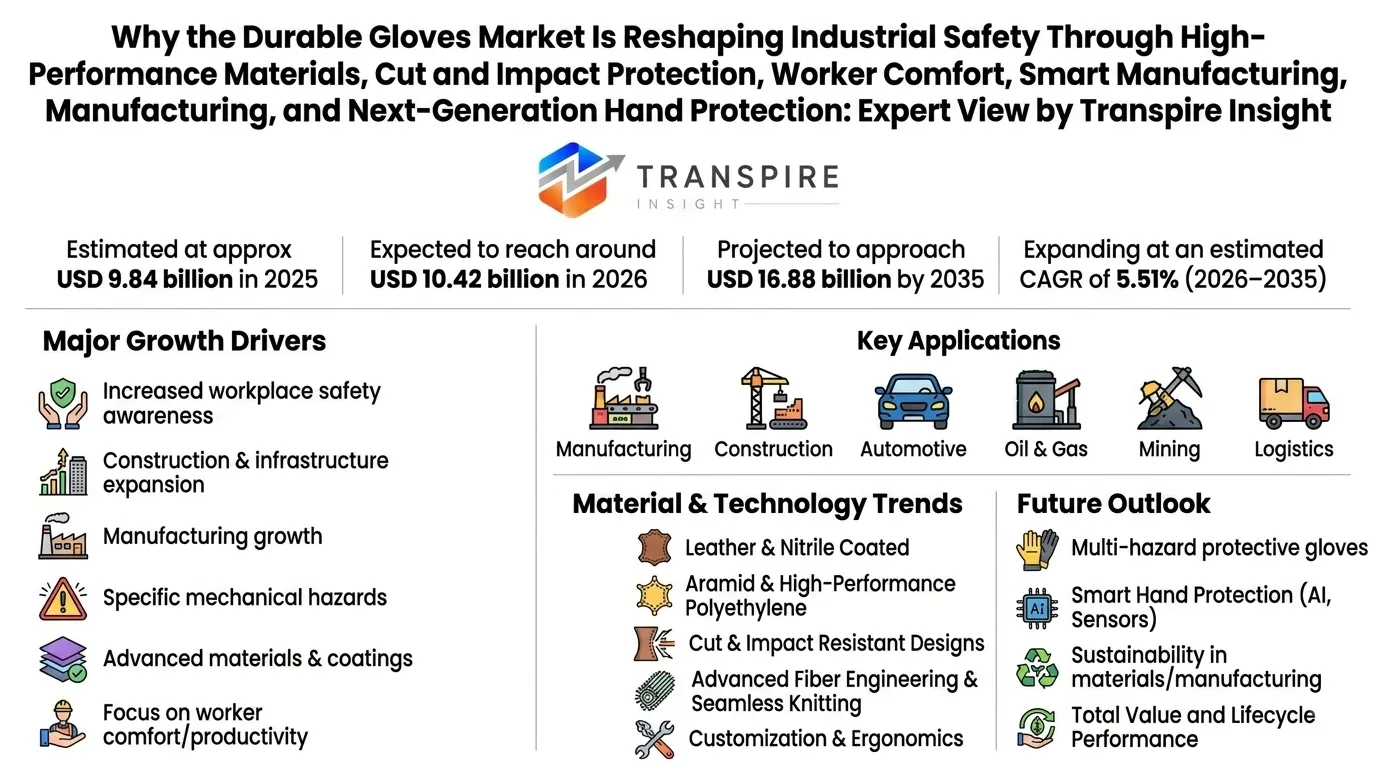
According to Transpire Insight, the global durable gloves market is estimated at approximately USD 9.84 billion in 2025 and is expected to reach around USD 10.42 billion in 2026. The market is projected to approach USD 16.88 billion by 2035, expanding at an estimated CAGR of 5.51% during the forecast period 2026–2035.
The durable gloves market is becoming an increasingly important part of industrial safety as employers place greater emphasis on hand protection that can withstand demanding working environments while maintaining dexterity and comfort. Durable gloves are designed for repeated or heavy-duty use and are commonly manufactured with materials such as leather, nitrile, latex, neoprene, aramid fibers, high-performance polyethylene, synthetic blends, and engineered composite materials.
The market is gaining momentum across manufacturing, construction, automotive, oil and gas, mining, utilities, warehousing, logistics, agriculture, and other industrial activities where workers face mechanical, thermal, chemical, abrasion, cut, puncture, or impact hazards.
The changing nature of industrial work is also influencing product development. Workers increasingly require protective gloves that do not simply provide a barrier but can balance protection, flexibility, grip, breathability, tactile sensitivity, and extended wear. This is encouraging manufacturers to develop lighter protective materials, advanced coatings, ergonomic constructions, and application-specific glove designs.
The growing use of automation is another important development. While robotics can reduce direct human exposure to hazardous operations, many installation, maintenance, inspection, material-handling, and repair tasks still depend on human workers. These activities require gloves that provide protection without substantially limiting movement or precision.
Market Overview
Durable gloves represent a broad category of reusable or longer-life hand-protection products designed for demanding occupational and industrial environments. Unlike short-use disposable gloves, durable gloves are generally intended to withstand repeated handling, friction, mechanical stress, environmental exposure, and other workplace conditions.
The performance requirements vary considerably according to the application. Construction workers may require abrasion and impact resistance, while metal-processing personnel may prioritize cut protection. Oil and gas workers can require chemical resistance and grip, whereas utility workers may require specialized electrical protection.
One of the most important application areas is manufacturing. Production environments often involve sharp components, moving machinery, metal parts, tools, chemicals, heat, and repetitive handling. Durable gloves can protect workers while supporting routine assembly and maintenance activities.
The market is also benefiting from increasing requirements within construction and infrastructure development. Workers handling concrete, steel, timber, tools, pipes, equipment, and construction materials can face repeated mechanical hazards, generating demand for gloves capable of maintaining performance under rough working conditions.
Automotive manufacturing and maintenance is another important market. Workers may encounter metal components, lubricants, oils, machinery, sharp edges, and heat. Glove manufacturers are therefore developing products with application-specific grip, dexterity, and abrasion characteristics.
In mining, oil and gas, and heavy industry, glove performance can be particularly important because work environments may combine several hazards simultaneously. This is increasing demand for engineered products designed around specific risk profiles rather than generic hand protection.
Protective-glove design is also influenced by international standards. ISO 21420:2020 establishes general requirements for protective glove design, construction, innocuousness, comfort, efficiency, marking, and manufacturer information, while specific protective properties require additional applicable standards. The standard was reviewed and confirmed in 2025.
Download the exclusive Durable Gloves Market sample report today to uncover expert insights, emerging trends, and the opportunities defining the future of the industry.
Latest Market Statistics
The global durable gloves market is expected to maintain steady expansion as industrial employers increase investment in worker protection, workplace safety programs, and application-specific personal protective equipment.
The expansion reflects increasing industrial employment, stricter attention to occupational safety, growth in construction and infrastructure, and the continued use of manual activities alongside automated production systems.
Demand is increasingly shifting from basic work gloves toward high-performance protective gloves that combine multiple characteristics. A single product may increasingly need to provide abrasion resistance, cut protection, grip, impact absorption, flexibility, and improved wear comfort.
This transition is encouraging manufacturers to invest in engineered fibers, advanced coatings, seamless knitting, composite structures, ergonomic patterns, and lighter protective constructions.
The market is also increasingly influenced by the total cost of workplace protection. Employers are evaluating not only the purchase price of gloves but also replacement frequency, worker productivity, comfort, protection performance, and potential safety-related costs.
Major Growth Drivers
Increasing workplace safety awareness: Employers are placing greater emphasis on reducing occupational injuries and improving personal protective equipment programs. Hand protection remains important in sectors where workers interact directly with tools, machinery, materials, and hazardous substances.
Expansion of construction and infrastructure: Construction, utilities, transportation infrastructure, and industrial development require substantial manual handling and maintenance activity, supporting demand for durable hand protection.
Growth of manufacturing: Expansion of automotive, machinery, electronics, metal processing, and general manufacturing increases the number of industrial processes where workers require specialized protection.
Increasing mechanical hazards: Cutting, abrasion, impact, puncture, crushing, and repetitive handling remain common occupational risks. This is encouraging demand for gloves designed around specific mechanical hazards.
Improvement in glove materials: Advances in engineered fibers, coatings, synthetic materials, and composite structures allow manufacturers to improve protection while reducing unnecessary bulk.
Greater focus on worker productivity: Employers increasingly recognize that uncomfortable protective equipment can affect worker acceptance and productivity. Gloves that balance protection with dexterity and comfort are gaining importance.
Key Applications
Manufacturing represents a major application area for durable gloves. Workers in assembly, metal fabrication, machinery production, component handling, and maintenance regularly require protection from mechanical and environmental hazards.
Construction is another important application. Gloves are used during material handling, concrete work, carpentry, installation, equipment operation, and general construction activities.
Automotive applications include vehicle assembly, component handling, repair, maintenance, bodywork, and parts manufacturing. Gloves need to provide protection while preserving sufficient tactile control for precision work.
Oil and gas activities can expose workers to mechanical hazards, chemicals, oil, harsh environments, and demanding outdoor conditions. This creates opportunities for specialized protective gloves offering multiple forms of resistance.
Mining requires durable hand protection for equipment maintenance, material handling, drilling-related activities, processing, and other demanding operations.
Utilities and energy represent additional applications where workers may perform installation, repair, inspection, and maintenance activities under difficult environmental and operational conditions.
Government Initiatives and Workplace Safety Modernization
Government workplace-safety programs and occupational health regulations are supporting greater attention to personal protective equipment across industrial sectors.
In India, industrialization, infrastructure investment, manufacturing expansion, construction activity, and increasing awareness of workplace safety are contributing to the development of more structured PPE procurement and safety-management practices.
Globally, workplace safety programs increasingly focus on hazard identification and selecting PPE appropriate for the specific risk. This approach is creating opportunities for manufacturers that can provide specialized gloves rather than one-product-fits-all solutions.
Standardization is also influencing product development. Protective gloves must be matched to the relevant hazard and performance requirement, while manufacturers must provide appropriate information regarding product use and limitations. ISO 21420 establishes general requirements for protective gloves but is intended to be used together with specific protective-performance standards rather than independently.
Material and Technology Overview
The durable gloves market includes several important material categories.
Leather gloves remain widely relevant for applications requiring durability, abrasion resistance, and robust handling performance. Different leather constructions can be adapted to general industrial, construction, material-handling, and heavy-duty applications.
Nitrile-coated gloves are increasingly used where users require a combination of durability, grip, and resistance characteristics. Coated constructions can be engineered for different dry, oily, or wet working conditions.
Aramid fiber gloves are designed for applications where high levels of cut and heat protection may be required. Their application can extend across metalworking, glass handling, manufacturing, and other demanding environments.
High-performance polyethylene and engineered fiber gloves are increasingly important in cut-resistant applications. Advanced fiber constructions can deliver protective performance while supporting relatively lightweight designs.
Neoprene and other synthetic materials can provide specialized resistance properties for chemical, oil, temperature, and industrial applications.
The market is also moving toward seamless knitted constructions and advanced coatings. These approaches can improve fit and dexterity while allowing manufacturers to engineer protection into thinner and more flexible glove structures.
Proceed to Checkout to purchase the exclusive Durable Gloves Market report and gain instant access to in-depth market intelligence, strategic analysis, and future growth opportunities.
Future Importance
The future of the durable gloves market will be closely connected to worker safety, material innovation, ergonomic design, industrial automation, sustainability, and application-specific protection.
As workplaces become more automated, the tasks that remain with human operators can become more specialized. Workers may increasingly handle maintenance, installation, inspection, troubleshooting, and high-precision activities, creating demand for gloves that provide protection without significantly reducing tactile capability.
Manufacturers are also likely to focus increasingly on lightweight protection. The objective is to achieve high mechanical performance while reducing glove thickness, stiffness, heat retention, and hand fatigue.
The market is therefore moving toward protective products designed around the complete working experience rather than protection alone.
Top Market Trends
The durable gloves market is evolving as employers and workers seek improved protection, comfort, and product performance. Several trends are shaping the industry's future.
Technological Advancements
Technology is becoming one of the strongest forces transforming the durable gloves market.
Advanced fiber engineering allows manufacturers to combine multiple fibers to achieve targeted levels of cut, abrasion, tear, and thermal performance.
Seamless knitting technology is another important development. Three-dimensional glove construction can improve fit while reducing unnecessary seams that may contribute to discomfort or weak points.
Advanced coating technologies are also changing glove performance. Thin coatings can be engineered to provide grip while maintaining flexibility and tactile sensitivity.
Impact-protection systems can incorporate flexible protective materials into the back of gloves to reduce the effect of impacts without creating excessive stiffness.
Ergonomic design is increasingly important as well. Manufacturers are analyzing hand movement, finger articulation, palm geometry, and repetitive tasks to develop gloves that are more compatible with extended use.
Artificial Intelligence and Smart Hand Protection
Artificial intelligence could influence the durable gloves market indirectly through the development of smarter workplace-safety systems.
Computer-vision systems are increasingly capable of identifying PPE usage and safety-compliance conditions in industrial environments. Research into PPE detection for manufacturing environments has demonstrated the potential for machine-learning systems to identify protective equipment usage through visual data.
Future workplace safety platforms could potentially combine glove detection, machine monitoring, worker-location information, and hazard identification to create more comprehensive safety systems.
Smart gloves could also become an emerging specialized category. Sensors embedded into gloves may eventually support applications involving hand movement, ergonomic assessment, environmental monitoring, or human-machine interaction.
However, durability, washability, battery life, worker acceptance, privacy, cybersecurity, and cost will remain important considerations before smart technologies become widespread in industrial gloves.
Major Applications
Manufacturing: Durable gloves protect workers during component handling, assembly, fabrication, maintenance, machining, and material movement.
Construction: Gloves are used for handling tools, steel, wood, concrete, machinery, pipes, and other construction materials.
Automotive: Protective gloves are used in vehicle assembly, repair, parts handling, machining, bodywork, and maintenance.
Oil and Gas: Workers require gloves capable of addressing combinations of mechanical, environmental, and chemical hazards.
Mining: Durable gloves support workers performing equipment maintenance, material handling, processing, and field operations.
Energy and Utilities: Glove demand is supported by installation, maintenance, repair, inspection, and infrastructure activities.
Logistics and Warehousing: Material handling, packaging, loading, unloading, and equipment operation create demand for gloves offering grip and abrasion protection.
Investment and Growth Opportunities
The expansion of industrial safety requirements is creating opportunities for protective-glove manufacturers, material suppliers, technology developers, distributors, and specialized PPE providers.
One major opportunity is the development of multi-hazard protective gloves. Industrial customers increasingly prefer products that can provide more than one protective characteristic without becoming excessively thick or uncomfortable.
The cut-resistant segment represents another attractive area. Increased handling of sharp components, metal sheets, glass, machinery parts, and industrial materials is creating demand for advanced fiber technologies.
There is also significant opportunity in impact-resistant gloves for construction, mining, logistics, oil and gas, and heavy industrial operations.
Emerging economies represent another growth opportunity as industrialization, infrastructure development, manufacturing expansion, and formal workplace-safety programs increase.
Customize the exclusive Durable Gloves Market report today to receive tailored insights, country-specific analysis, and business-focused market intelligence.
Market Segmentation
The durable gloves market can be segmented based on material, protection type, application, and end user.
By material, major categories include leather, nitrile, latex, neoprene, aramid, high-performance polyethylene, synthetic fibers, and blended or composite materials.
By protection type, the market includes abrasion-resistant gloves, cut-resistant gloves, puncture-resistant gloves, impact-resistant gloves, heat-resistant gloves, chemical-resistant gloves, and multi-hazard gloves.
By application, major areas include manufacturing, construction, automotive, oil and gas, mining, energy and utilities, logistics, agriculture, and other industrial applications.
By end user, the market includes industrial companies, construction organizations, automotive manufacturers, energy companies, mining operators, logistics providers, maintenance contractors, and other professional users.
Leading and Fastest-Growing Segments
The manufacturing segment is expected to remain an important contributor to durable glove demand because of its extensive use of machinery, tools, components, raw materials, and repetitive manual activities.
The construction segment is also expected to maintain strong demand as infrastructure development and building activities continue across emerging and developed economies.
The cut-resistant glove segment represents an attractive growth area because of increasing requirements in metalworking, manufacturing, glass handling, automotive production, and other sharp-material environments.
The impact-resistant segment is gaining importance in heavy-duty industries where workers can face hand and knuckle injuries from tools, machinery, equipment, and material handling.
The advanced synthetic and engineered-fiber segment is expected to gain market share as manufacturers seek lighter products with stronger and more specialized protective characteristics.
Competitive Landscape
Competition in the durable gloves market is increasingly focused on protection performance, material innovation, comfort, durability, grip, ergonomics, and application-specific functionality.
Manufacturers are investing in engineered fibers, advanced coatings, improved knitting processes, ergonomic designs, and multi-hazard protection systems.
Another important competitive factor is product lifecycle performance. Industrial purchasers increasingly evaluate how long gloves remain functional under actual working conditions rather than focusing exclusively on initial purchase price.
Manufacturers are therefore emphasizing abrasion life, coating durability, washability, dexterity retention, fit, and consistent protective performance.
Strategic partnerships with industrial distributors, safety organizations, manufacturing customers, and material suppliers are also expected to remain important for expanding market access.
Challenges and Restraints
Despite favorable growth prospects, the durable gloves market faces several challenges.
Cost sensitivity remains a major consideration. Advanced fibers, specialized coatings, impact materials, and multi-hazard constructions can increase manufacturing costs compared with basic work gloves.
Comfort and protection trade-offs are another challenge. Increasing protective performance can sometimes result in thicker or less flexible products. Manufacturers therefore need to balance safety with dexterity and long-duration wearability.
Material durability can also vary according to workplace conditions. Exposure to chemicals, oils, heat, moisture, ultraviolet radiation, or repeated washing can affect product performance.
User compliance remains important. Even highly engineered gloves cannot provide their intended protection if workers do not wear them correctly or consistently. Employers therefore need appropriate training, hazard assessment, and PPE-selection programs.
Nevertheless, advances in materials, ergonomic design, coatings, and manufacturing processes are creating opportunities to overcome many of these limitations.
Regional Market Outlook
The durable gloves market is developing across major regions as industrial activity, workplace safety programs, infrastructure investment, and manufacturing capacity expand.
North America remains an important market because of its established industrial base, construction activity, energy operations, sophisticated PPE procurement systems, and strong focus on workplace safety. Demand is supported by manufacturing, automotive, oil and gas, logistics, utilities, and professional maintenance.
Europe represents a mature market supported by industrial manufacturing, automotive production, construction, energy transition, and strong occupational safety requirements. Buyers increasingly value certified protection, ergonomic design, durability, and lifecycle performance.
Asia-Pacific represents a major long-term growth opportunity. Rapid industrialization, manufacturing expansion, construction, automotive production, mining, infrastructure development, and rising workplace-safety awareness are supporting demand. India, China, Japan, South Korea, and Southeast Asian manufacturing economies are important contributors to regional development.
Latin America is expected to provide additional opportunities through mining, construction, agriculture, manufacturing, energy, and infrastructure projects.
Middle East & Africa are also expected to experience increasing demand as oil and gas operations, construction, mining, utilities, logistics, and industrial infrastructure continue to develop.
Future Market Opportunities
One of the strongest future opportunities lies in multi-hazard gloves that combine protection characteristics within a single lightweight construction.
The integration of advanced sensing technologies represents another potential opportunity. Smart glove systems could eventually support workplace monitoring, ergonomic assessment, hand-motion tracking, and specialized industrial applications.
Sustainable glove manufacturing is also likely to become more important. Industrial customers are increasingly considering product longevity, material efficiency, packaging reduction, recycled content, and end-of-life management.
There is also potential for customized glove programs designed around specific industrial tasks. Instead of purchasing one general-purpose glove for an entire workforce, companies can increasingly select products according to particular risks, tasks, and work environments.
Role of Automation and Advanced Manufacturing
Automation is changing industrial workplaces but is not eliminating the requirement for human hand protection.
Robotic systems increasingly perform repetitive and hazardous production operations, while workers remain involved in programming, maintenance, inspection, equipment changeovers, repair, quality control, and material handling.
This is creating a new requirement for gloves that combine mechanical protection with precision and tactile sensitivity.
Advanced manufacturing processes are also enabling more sophisticated glove construction. Digital knitting, precision coating, automated inspection, and material optimization can support consistent product quality while allowing manufacturers to develop application-specific designs.
Future factories may increasingly use robotics and automation in glove manufacturing itself, improving production consistency while allowing greater design customization.
Personalized and Precision Protection
The movement toward personalized workplace safety is expected to influence the durable gloves market.
Workers perform different tasks even within the same facility, meaning that the optimal glove for a welding operator may differ substantially from the best product for an assembly worker or maintenance technician.
Manufacturers are increasingly developing gloves around specific work motions, hazard combinations, hand sizes, climate conditions, and material-handling requirements.
This shift could lead to greater use of task-specific glove portfolios, enabling industrial employers to select products based on individual risk assessments instead of using a single standard glove throughout an organization.
Key Strategic Developments
Companies operating in the durable gloves market are expected to focus on:
These strategies demonstrate that competition is moving beyond basic hand protection toward specialized, ergonomic, durable, and increasingly technology-enabled safety solutions.
Transpire Insight Expert View
From a market perspective, the durable gloves market is positioned for continued transformation because it aligns with several major industrial priorities: worker safety, industrial productivity, material innovation, ergonomic protection, automation, and sustainable PPE use.
The continued expansion of manufacturing, construction, infrastructure, energy, mining, automotive production, and logistics will remain important demand drivers.
The future competitive environment is likely to favor manufacturers that can provide a strong balance between protection and usability. Workers need products that protect their hands without creating unnecessary restrictions during repetitive or precision-intensive activities.
Another important development will be the increasing focus on the total value of protective gloves. Industrial customers are likely to evaluate service life, replacement frequency, comfort, worker acceptance, safety performance, and productivity alongside purchase cost.
This could encourage a shift toward higher-quality gloves capable of delivering longer and more consistent service under demanding conditions.
Future Outlook
The future of the durable gloves market is expected to be shaped by advanced materials, ergonomic engineering, multi-hazard protection, connected safety technologies, sustainability, and application-specific design.
Cut-resistant, impact-resistant, abrasion-resistant, and chemical-resistant products are expected to remain important as industrial tasks become more specialized.
The increasing adoption of electric vehicles, advanced manufacturing, renewable-energy systems, infrastructure, and automated machinery will create new hand-protection requirements.
At the same time, smart workplace technologies could introduce a new category of connected glove solutions capable of contributing to safety monitoring, ergonomics, training, and specialized human-machine interaction.
Emerging economies are expected to provide additional opportunities as industrial employment, manufacturing infrastructure, construction, mining, energy projects, and workplace-safety practices continue to develop.
Schedule a meeting with our market experts to discuss the exclusive Durable Gloves Market report and identify the best research solution for your organization.
Conclusion
The durable gloves market is reshaping industrial hand protection by combining stronger materials, advanced coatings, ergonomic construction, specialized hazard protection, and increasingly sophisticated manufacturing technologies. From factories and construction sites to automotive plants, energy facilities, mines, warehouses, and maintenance operations, durable gloves remain a fundamental component of workplace safety.
Advances in engineered fibers, seamless knitting, impact protection, cut-resistant technologies, grip systems, lightweight materials, and application-specific designs are expanding the capabilities of modern protective gloves. At the same time, increasing attention to worker comfort and productivity is encouraging manufacturers to develop products that combine protection with dexterity and long-duration wearability.
Looking ahead, the market will increasingly depend on the ability of manufacturers to combine protection performance, comfort, durability, material efficiency, ergonomic design, and application-specific intelligence. As industrial workplaces continue to evolve through automation and advanced manufacturing, next-generation durable gloves are expected to become an increasingly specialized and strategically important component of modern occupational safety.


Send us a brief description of your challenge and we'll get back to you within 24 hours.

 inquiry@transpireinsight.com
 APAC:+91 7666513636
 Address


