
Sep 15, 2026
By Transpire Insight
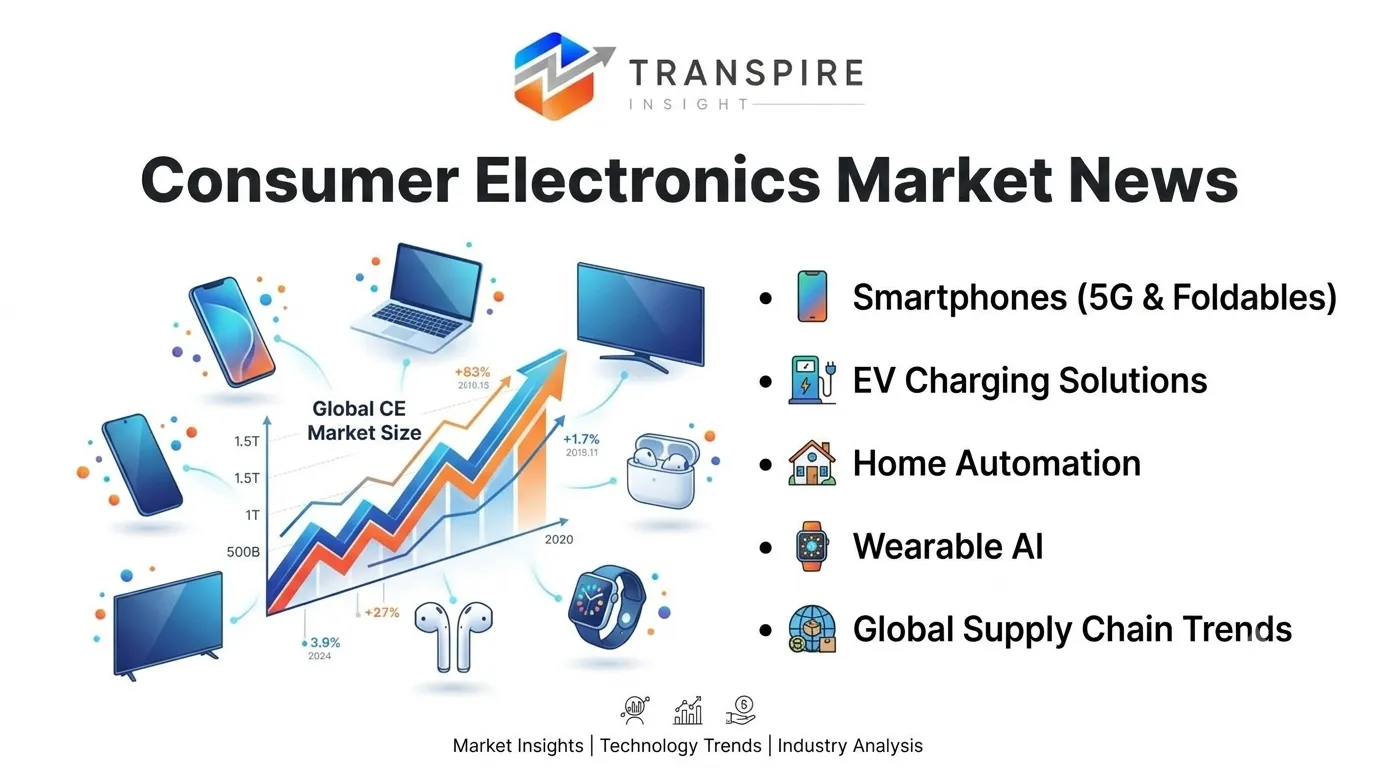
Rapid advances in artificial intelligence, connected devices, smart-home technology, wearables, and premium displays are reshaping consumer electronics, creating new opportunities for intelligent, energy-efficient, and increasingly personalized devices.
The consumer electronics industry is moving beyond conventional hardware upgrades as AI, connectivity, interoperability, and changing consumer expectations redefine the next generation of personal and household technology.
AI and Connected Living Are Reshaping the Consumer Electronics Market
The consumer electronics industry is entering a period in which product differentiation increasingly depends on intelligence, connectivity, software integration, and the overall user experience rather than hardware specifications alone. Smartphones, televisions, computers, audio devices, wearables, smart-home products, and emerging connected categories are becoming increasingly interconnected.
The global consumer electronics market was valued at approximately USD 1.32 trillion in 2025 and is projected to increase from around USD 1.39 trillion in 2026 to USD 2.07 trillion by 2033, representing a CAGR of approximately 5.9% during 2026–2033. Asia Pacific accounted for approximately 49.3% of global revenue in 2025, making it the industry's largest regional market.
However, headline market growth does not tell the complete story. Consumer technology spending is becoming increasingly differentiated by product category and geography. NielsenIQ estimates that global Consumer Tech and Durable Goods sales reached approximately USD 1.3 trillion in 2025, up around 3% from 2024, while 2026 sales are expected to be broadly flat at approximately -0.4% year over year as consumers become more selective and prioritize value.
This environment is encouraging manufacturers to focus on products that deliver visible improvements in convenience, performance, energy efficiency, durability, and intelligent functionality.
Artificial Intelligence Creates a New Competitive Layer for Consumer Devices
Artificial intelligence is becoming one of the most important technologies influencing consumer electronics. Manufacturers are integrating AI capabilities into smartphones, computers, televisions, wearables, earbuds, smart-home equipment, and emerging device categories.
The emphasis, however, is gradually shifting from simply adding AI features to determining whether those features provide meaningful consumer value. AI-powered image processing, voice interaction, personalized recommendations, translation, health monitoring, content generation, and device automation are becoming increasingly common.
The 2026 consumer-electronics outlook from TechInsights identifies AI, sensors, connectivity, and efficiency as major forces influencing innovation across smart TVs, smart-home devices, wearables, and IoT products. At the same time, the report notes that edge AI adoption remains constrained by cost, indicating that manufacturers must balance computational capability with device economics.
This creates a new competitive environment in which semiconductor efficiency, on-device processing, software ecosystems, and AI models are becoming as important as traditional hardware specifications.
Smart Devices Are Creating a More Connected Consumer Ecosystem
The traditional boundaries between consumer electronics categories are becoming less distinct. Smartphones increasingly control smart-home devices, televisions integrate streaming and gaming platforms, wearables connect with health and fitness applications, and wireless audio devices interact with broader digital ecosystems.
Interoperability is consequently becoming a critical requirement. The continued development of the Matter smart-home standard is particularly important because it aims to improve compatibility between devices from different manufacturers.
TechInsights identifies Matter's continued maturation as a key consumer-electronics development for 2026, with an increasing number of certified smart-home devices entering the market.
The broader implication is that consumers are increasingly purchasing ecosystems rather than isolated products. Manufacturers that can offer seamless interaction between multiple devices may therefore gain stronger customer retention and recurring software-service opportunities.
Why Does Consumer Electronics Matter?
The importance of consumer electronics extends far beyond entertainment because connected devices increasingly influence communication, work, education, health, home management, and personal productivity.
Wearables Are Moving Toward More Intelligent and Less Intrusive Designs
Wearable electronics represent one of the most dynamic areas of consumer technology. Smartwatches, smart rings, fitness trackers, smart glasses, and connected health devices are expanding the definition of personal electronics.
The market is now moving toward more specialized and less intrusive form factors. Smart rings and screenless fitness devices, for example, can collect health information without requiring users to constantly interact with a display.
At the same time, smart glasses are emerging as a potentially important new category. TechInsights identifies smart glasses as a major driver of the wearables opportunity, although adoption remains dependent on practical use cases, price, battery life, comfort, and consumer acceptance.
Recent industry developments illustrate this shift. Samsung's 2026 product strategy includes intelligent eyewear alongside its newest smartphones and smartwatches, reflecting increasing competition around AI-enabled wearable computing.
The opportunity is therefore moving from simply making wearables more powerful toward making them more natural and useful in everyday life.
Premium Displays and Home Entertainment Are Entering a New Upgrade Cycle
Televisions remain a major consumer-electronics category, but replacement demand and premiumization are creating new opportunities. Improvements in display technologies, processing, gaming capabilities, connectivity, and AI-powered picture optimization are encouraging consumers to upgrade existing devices.
NielsenIQ expects television demand to receive support in 2026 as pandemic-era purchases reach replacement age, while major sporting events—including the FIFA World Cup—are creating additional upgrade opportunities in relevant markets. The company also highlights RGB Mini LED innovation as a contributor to premiumization.
This illustrates an important market dynamic: mature categories may still generate substantial growth when technological improvements coincide with natural replacement cycles.
Supply-Chain Pressure Is Becoming a Strategic Challenge
Consumer electronics manufacturers are operating in an increasingly complex cost environment. Semiconductor availability, memory pricing, energy costs, logistics, tariffs, component lead times, and geopolitical uncertainty can all affect product pricing and profitability.
TechInsights identifies supply-chain complexity, tariffs, energy intensity in semiconductor manufacturing, and cost volatility as important risks for consumer-electronics companies in 2026. Its mid-year analysis also indicates that supply-chain volatility has become a more significant concern than tariffs in some areas of the industry.
This is encouraging manufacturers to diversify sourcing, improve inventory planning, localize selected production activities, and redesign products around component availability.
For consumers, the result can be higher prices or slower product cycles in certain categories, increasing the importance of value-oriented positioning.
Government Initiatives Supporting the Consumer Electronics Ecosystem
Governments are increasingly supporting consumer-electronics development through semiconductor policies, digital infrastructure investment, manufacturing incentives, energy-efficiency requirements, e-waste regulations, and connected-device standards.
The United States remains a major innovation center for consumer electronics, particularly in AI computing, semiconductor technology, software ecosystems, and connected devices.
Increasing attention to domestic semiconductor manufacturing and resilient technology supply chains is influencing the consumer-electronics ecosystem. At the same time, manufacturers are balancing domestic investment with global production networks and changing trade conditions.
Europe continues to place strong emphasis on energy efficiency, product durability, repairability, recycling, and responsible electronics consumption.
These priorities are influencing product design, component selection, packaging, energy consumption, and end-of-life management. Manufacturers increasingly need to consider the complete product lifecycle rather than focusing solely on device performance.
China remains one of the world's most important consumer-electronics manufacturing and consumption centers.
Large-scale production of smartphones, televisions, appliances, components, wearables, and other connected products provides the country with a substantial position in the global supply chain. Domestic technology development and consumer incentives have also influenced market demand.
NielsenIQ expects China's consumer-tech growth to moderate in 2026 following a strong 2025 supported by trade-in policies, demonstrating how government-backed consumer incentives can significantly influence electronics purchasing cycles.
India is becoming increasingly important in the global electronics ecosystem because of its expanding manufacturing capabilities, growing consumer base, digital infrastructure, and rising demand for connected products.
Consumer demand is also becoming more premium in selected categories. NielsenIQ specifically identifies India as a regional growth driver, with consumers expected to trade up in several consumer-technology categories.
The combination of domestic manufacturing expansion and increasing consumer purchasing power provides opportunities across smartphones, televisions, wearables, audio equipment, computing devices, and smart-home products.
Japan and South Korea continue to play important roles in advanced displays, semiconductors, smartphones, televisions, appliances, imaging technologies, and connected devices.
Their strength in component engineering and consumer-product innovation provides an important foundation for premium electronics and emerging AI-enabled device categories.
Policy Direction Across Major Consumer Markets
Major consumer-electronics markets are increasingly focused on five priorities: technology innovation, supply-chain resilience, energy efficiency, interoperability, and sustainable product lifecycles.
At the same time, governments are increasingly addressing issues surrounding electronic waste, consumer privacy, cybersecurity, repairability, and product sustainability.
This means manufacturers will need to balance rapid innovation with longer product lifecycles and responsible design. The companies best positioned for long-term growth are likely to be those that can combine advanced technology with reliability, affordability, energy efficiency, and strong ecosystem compatibility.
Investment Opportunities in the Consumer Electronics Industry
The transformation of consumer electronics is creating investment opportunities across both established product categories and emerging technology platforms.
AI-powered smartphones, PCs, televisions, wearables, headphones, and smart-home products represent one of the most important technology opportunities.
The strongest products are likely to be those where AI provides tangible benefits such as personalization, automation, improved image quality, translation, health insights, or productivity assistance rather than simply serving as a marketing feature.
Smart-home adoption continues to expand as consumers connect lighting, appliances, security, entertainment, climate-control, and other systems.
Matter and related interoperability technologies can reduce fragmentation and make multi-brand ecosystems easier to operate, creating opportunities for device manufacturers, platform providers, chip companies, and software developers.
Smart glasses, smart rings, advanced fitness trackers, and AI-enabled wearables represent important emerging investment areas.
The development of smaller AI processors, improved battery efficiency, better sensors, and low-power connectivity is making new wearable form factors increasingly practical. Qualcomm and MediaTek are among the chip suppliers developing platforms aimed at bringing more AI processing into next-generation wearables.
Mini LED, OLED, advanced gaming displays, immersive audio, and AI-powered picture processing are creating opportunities in premium home entertainment.
Replacement cycles and major global sporting events can also provide temporary demand catalysts for television upgrades.
Energy efficiency is becoming increasingly important as consumers become more conscious of operating costs and governments introduce stronger sustainability requirements.
Opportunities are emerging in efficient displays, low-power processors, intelligent power-management systems, energy-efficient appliances, and devices capable of adapting their energy consumption according to usage patterns.
The growing volume of electronic waste is creating opportunities in refurbishment, component recovery, recycling, repair, and product-life extension.
Circular business models can potentially create additional value from products that would otherwise be discarded while helping manufacturers address sustainability requirements.
Market Expert View
The consumer electronics industry is entering a period in which intelligence, connectivity, efficiency, and value are becoming more important than simply increasing hardware specifications.
The overall market remains enormous, but growth is becoming more selective. NielsenIQ's 2026 outlook suggests that consumers are becoming more careful about spending, with value for money increasingly influencing purchasing decisions.
This means manufacturers face a dual challenge: they must continue introducing meaningful technological innovation while keeping products accessible enough to justify replacement or first-time purchase.
AI will remain one of the industry's strongest technological themes, but its commercial impact will depend on practical applications. Smart-home interoperability, advanced wearables, premium displays, AI-enabled PCs, and intelligent mobile devices are likely to remain important areas of development.
At the regional level, Asia Pacific will continue to dominate because of its manufacturing scale and consumer base, while Europe, the Middle East and Africa, and India offer important pockets of growth as consumer demand shifts toward connected and premium products.
For manufacturers, competitive advantage will increasingly depend on AI integration, ecosystem compatibility, supply-chain resilience, energy efficiency, design quality, affordability, and long-term customer engagement.
Conclusion
Consumer electronics are becoming an increasingly intelligent and interconnected component of everyday life. Smartphones, televisions, computers, wearables, audio devices, smart-home products, and emerging AI hardware are converging into broader technology ecosystems rather than operating as isolated products.
The next phase of market development will be shaped by the balance between technological innovation and consumer value. AI, advanced displays, smart-home interoperability, intelligent wearables, efficient processors, and connected services are creating new opportunities, while supply-chain volatility, component costs, sustainability requirements, and market saturation are creating new challenges.
As consumers increasingly seek technology that delivers greater convenience, meaningful intelligence, better performance, and measurable value, the consumer electronics market is positioned for continued long-term transformation. The companies that successfully convert emerging technologies into practical everyday experiences will be best positioned to shape the next generation of global consumer electronics.


Send us a brief description of your challenge and we'll get back to you within 24 hours.

 inquiry@transpireinsight.com
 APAC:+91 7666513636
 Address


