
Sep 15, 2026
By Transpire Insight
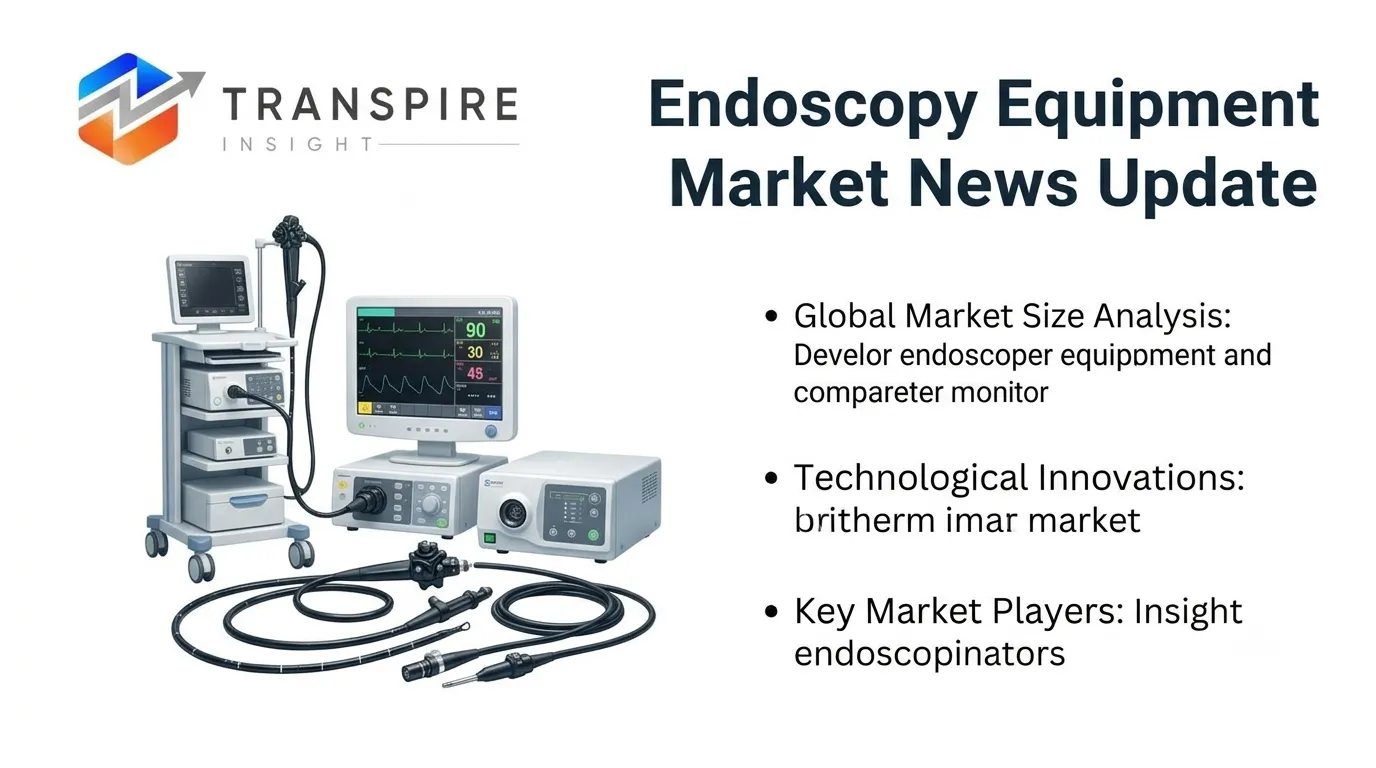
Rising demand for minimally invasive diagnosis, earlier cancer detection, AI-assisted visualization, and infection-control technologies is increasing investment in advanced endoscopy equipment across hospitals, ambulatory centers, and specialty clinics.
The shift toward earlier diagnosis and less invasive treatment is transforming endoscopy from conventional visualization equipment into an increasingly intelligent and digitally connected clinical platform.
Rising Disease Burden Is Increasing Demand for Endoscopy Equipment
The global healthcare industry is experiencing a sustained increase in demand for minimally invasive diagnostic and therapeutic procedures. Gastrointestinal disorders, cancers, respiratory diseases, urological conditions, and age-associated chronic illnesses are creating a larger patient population requiring internal visualization and tissue assessment.
Endoscopy equipment has become central to this shift because it allows physicians to visualize anatomical structures, collect tissue samples, remove lesions, and perform selected therapeutic interventions without the need for conventional open surgery. The technology is used across gastroenterology, pulmonology, urology, gynecology, ENT, and surgical specialties.
The global endoscopy equipment market is estimated at approximately USD 35.90 billion in 2025 and is expected to reach USD 38.40 billion in 2026, with the market projected to reach around USD 60.16 billion by 2032, representing a CAGR of approximately 7.65%.
The market is simultaneously moving beyond conventional endoscopes toward high-definition and 4K visualization, image-enhanced endoscopy, capsule systems, endoscopic ultrasound, single-use equipment, automated reprocessing, and AI-assisted diagnostic technologies.
Early Disease Detection Creates a Growing Opportunity for Endoscopy
One of the strongest structural drivers for the endoscopy equipment industry is the increasing emphasis on early disease detection. Endoscopic procedures allow clinicians to identify abnormalities at an earlier stage, obtain biopsies, and in selected cases treat lesions during the same procedure.
Colorectal cancer screening is an important example. The U.S. Preventive Services Task Force recommends colorectal cancer screening for adults from ages 45 through 75, supporting continued demand for colonoscopy and related visualization systems in mature healthcare markets.
As healthcare systems focus increasingly on preventive medicine, screening programs and earlier intervention, endoscopy equipment manufacturers are being pushed to improve image quality, procedural efficiency, ergonomics, and diagnostic accuracy.
The result is a market in which purchasing decisions are increasingly influenced not simply by the availability of an endoscope, but by the broader capabilities of the complete endoscopy platform.
Artificial Intelligence Is Reshaping Endoscopic Visualization
Artificial intelligence is becoming one of the most important technological developments in the endoscopy equipment market. AI-assisted systems can support clinicians by identifying suspicious lesions, highlighting areas of interest, assisting with image analysis, and improving procedural documentation.
The FDA's authorization of GI Genius in 2021 established an important regulatory milestone for AI-assisted colonoscopy, providing a pathway for computer-aided detection technology to support clinicians during real-time procedures.
The opportunity is now expanding beyond lesion detection. AI can potentially support procedure documentation, image triage, quality benchmarking, withdrawal-time analysis, training feedback, and workflow management.
The AI-in-endoscopy segment itself is projected to grow rapidly, with one 2026 industry assessment estimating the market at USD 2.35 billion in 2026 and projecting it to reach USD 14.86 billion by 2034, reflecting a CAGR of 25.92%.
This creates an increasingly important distinction between conventional endoscopy hardware and intelligent endoscopy platforms that combine optics, image processing, software, analytics, and clinical decision support.
Why Does Endoscopy Equipment Matter?
The importance of endoscopy equipment extends across diagnosis, treatment, screening, and healthcare-system efficiency.
Single-Use Endoscopy Creates a New Infection-Control Opportunity
The increasing focus on infection prevention is encouraging healthcare providers to evaluate disposable and single-use endoscopic equipment.
Reusable endoscopes require complex cleaning, disinfection, inspection, storage, and maintenance procedures. Single-use technologies can reduce certain reprocessing requirements and may lower the risk associated with inadequate or incomplete decontamination.
The single-use endoscopy market is estimated at approximately USD 3.85 billion in 2026 and is projected to reach USD 13.15 billion by 2036, representing a CAGR of approximately 13.1%.
However, adoption also depends on acquisition cost, waste management, environmental considerations, image quality, device performance, and clinical economics. Manufacturers therefore face the challenge of demonstrating that disposable technologies can deliver sufficient clinical and operational value.
Hospitals and Ambulatory Centers Are Upgrading Endoscopy Infrastructure
Endoscopy purchasing is increasingly shifting toward complete procedural ecosystems rather than individual devices. Hospitals and ambulatory surgery centers are evaluating visualization towers, image processors, light sources, scopes, therapeutic accessories, documentation systems, reprocessing equipment, and software as interconnected components.
The growth of outpatient procedures is particularly important because ambulatory facilities seek technologies that can increase procedure throughput while maintaining clinical quality and infection-control standards.
This trend is encouraging manufacturers to develop equipment with improved ergonomics, faster setup, connected workflow systems, and integrated data capabilities.
At the same time, healthcare providers in emerging markets are expanding endoscopy capacity beyond major metropolitan hospitals, creating opportunities for mid-range equipment designed around affordability, reliability, and serviceability.
Asia Pacific Creates a Major Growth Engine for Endoscopy Equipment
Asia Pacific is becoming increasingly important to the global endoscopy equipment industry because of its large population, expanding healthcare infrastructure, increasing awareness of cancer screening, and rising adoption of minimally invasive procedures.
India illustrates this expansion particularly clearly. India's endoscopy equipment market was valued at approximately USD 461.7 million in 2025 and is projected to reach USD 716.2 million by 2030, representing a CAGR of approximately 9.2%.
India's broader endoscopy-device market is also being influenced by upgrades from standard-definition systems toward 4K and AI-enabled visualization, expanding hospital networks, and efforts to strengthen domestic medical-device manufacturing.
The expansion of healthcare infrastructure into Tier-2 and Tier-3 cities can further broaden the addressable market as more patients gain access to advanced diagnostic and therapeutic procedures.
Government Initiatives Supporting Advanced Endoscopy Infrastructure
Governments and healthcare systems are increasingly investing in early diagnosis, cancer screening, medical-device manufacturing, digital healthcare, and minimally invasive treatment capacity. These priorities are supporting the development and adoption of advanced endoscopy equipment.
The United States remains one of the world's most developed markets for endoscopy equipment. Established colorectal cancer screening recommendations, large hospital networks, ambulatory surgery centers, and rapid adoption of AI-assisted technologies are supporting demand.
The U.S. market is also becoming an important testing ground for AI-assisted endoscopic diagnosis because regulatory authorization is creating pathways for software to be incorporated into clinical workflows.
European healthcare systems are increasingly emphasizing early diagnosis, efficient outpatient treatment, and minimally invasive procedures.
These priorities are encouraging investment in high-quality visualization systems, advanced imaging, therapeutic endoscopy, and infection-control technologies. The region also provides a strong environment for manufacturers developing equipment that combines clinical performance with increasingly demanding healthcare standards.
Japan remains a strategically important market because of its sophisticated healthcare infrastructure and established expertise in gastrointestinal endoscopy.
The country's strong focus on early cancer detection and advanced visualization has encouraged continuous development of endoscopic imaging technologies and procedural techniques.
China's expanding healthcare infrastructure and growing demand for advanced diagnostic procedures are creating opportunities for endoscopy manufacturers.
The combination of a large patient population, hospital modernization, increasing cancer-screening awareness, and domestic medical-device development is strengthening the country's long-term market potential.
India is becoming an increasingly important endoscopy market as healthcare infrastructure expands and hospitals upgrade their diagnostic capabilities.
Government-backed manufacturing initiatives are also encouraging localization of medical-device production. Recent market analysis indicates that the country's Production-Linked Incentive program is supporting domestic development of endoscopes and visualization systems while reducing reliance on imported equipment.
Policy Direction Across Major Healthcare Markets
Healthcare systems across major economies are increasingly aligned around five priorities: earlier diagnosis, minimally invasive treatment, infection prevention, digital integration, and improved healthcare efficiency.
These priorities are directly influencing the endoscopy equipment industry. Equipment is no longer being evaluated solely according to optical quality; hospitals increasingly consider AI compatibility, workflow integration, reprocessing requirements, cybersecurity, ergonomics, service support, and total cost of ownership.
This broader purchasing framework is likely to benefit manufacturers capable of providing integrated endoscopy ecosystems rather than standalone hardware.
Investment Opportunities in the Endoscopy Equipment Industry
The transformation of endoscopy from conventional visualization toward intelligent, connected, and minimally invasive platforms is creating opportunities across the entire technology value chain.
AI-assisted detection and analysis represent one of the fastest-developing opportunities within the industry.
Software capable of detecting lesions, supporting image interpretation, documenting procedures, and measuring quality indicators can increase the value of existing endoscopy hardware without requiring hospitals to completely replace their equipment infrastructure.
Healthcare providers are increasingly upgrading from conventional visualization toward high-definition, 4K, 3D, narrow-band, and other image-enhanced technologies.
These systems can improve visualization and support more detailed assessment of tissue and anatomical structures. The continuing upgrade cycle creates recurring opportunities for equipment manufacturers and component suppliers.
Disposable endoscopes represent a major growth opportunity because of infection-control requirements and the potential to simplify certain procedural workflows.
While reusable equipment will remain important, the rapid projected growth of single-use endoscopy demonstrates increasing commercial interest in disposable alternatives.
Capsule endoscopy provides a less invasive approach to imaging portions of the gastrointestinal tract that can be difficult to access using conventional scopes.
Continued improvements in wireless imaging, battery performance, AI-assisted interpretation, and automated image analysis can expand the role of capsule systems in gastrointestinal diagnostics.
Endoscopic ultrasound and therapeutic endoscopy are expanding the role of endoscopic procedures beyond simple visualization.
Technologies that combine imaging with biopsy, drainage, resection, ablation, or other therapeutic capabilities can increase the clinical value of endoscopy and reduce the need for more invasive procedures.
Market Expert View
The endoscopy equipment market is moving through a significant technological transition. Conventional scopes remain the foundation of the industry, but the next phase of growth is increasingly being shaped by AI, high-resolution imaging, single-use technologies, therapeutic endoscopy, workflow automation, and connected clinical systems.
The strongest opportunities are emerging where equipment can simultaneously improve diagnostic confidence, procedural efficiency, infection control, and patient outcomes. AI is particularly important because it can add intelligence to established endoscopic workflows rather than requiring healthcare providers to completely redesign their clinical infrastructure.
At the regional level, mature markets such as North America and Europe will continue to support advanced technology adoption, while Asia Pacific is expected to provide substantial expansion opportunities through healthcare infrastructure development and increasing procedure volumes. India's comparatively strong projected growth illustrates the broader opportunity emerging in developing healthcare markets.
For manufacturers, competitive differentiation will increasingly depend on image quality, AI integration, device reliability, infection-control performance, ergonomics, interoperability, service capabilities, and the ability to deliver economically viable systems across different healthcare environments.
Conclusion
Endoscopy equipment is becoming an increasingly important component of modern minimally invasive healthcare. Rising demand for early cancer detection, growing chronic disease burdens, expansion of outpatient procedures, and increasing healthcare investment are creating a sustained requirement for advanced diagnostic and therapeutic systems.
At the same time, technological innovation is changing what an endoscopy platform can deliver. AI-assisted detection, 4K visualization, image enhancement, capsule systems, single-use devices, therapeutic endoscopy, and connected workflow technologies are expanding the industry's capabilities beyond conventional internal imaging.
As healthcare systems focus increasingly on earlier diagnosis, lower procedural risk, infection prevention, and efficient delivery of care, endoscopy equipment is positioned to become an even more sophisticated part of the global medical-device ecosystem. Continued innovation and investment in intelligent visualization, minimally invasive treatment, and accessible endoscopic infrastructure will shape the next phase of market development.


Send us a brief description of your challenge and we'll get back to you within 24 hours.

 inquiry@transpireinsight.com
 APAC:+91 7666513636
 Address


