
Sep 16, 2026
By Transpire Insight
From offshore energy and naval systems to autonomous underwater vehicles and oceanographic research, underwater connectors are becoming increasingly critical as subsea operations move toward deeper, smarter and more connected environments.
Global Underwater Connectors Market Overview
New York: The global underwater connectors market is entering a technology-driven growth phase as offshore energy infrastructure, subsea communications, marine defense, remotely operated vehicles (ROVs), autonomous underwater vehicles (AUVs), oceanographic research and underwater robotics expand worldwide. Underwater connectors provide reliable electrical, optical and hybrid connections in environments characterized by high pressure, corrosion, vibration, shock and difficult maintenance conditions.
The global underwater connectors market was valued at approximately USD 1.96 billion in 2025 and is projected to reach around USD 2.14 billion in 2026, with the market expected to reach approximately USD 4.25 billion by 2034, registering a CAGR of about 8.96% during 2026–2034. North America remained the leading regional market in 2025, supported by defense modernization, offshore energy and marine technology, while Asia Pacific is emerging as the fastest-growing regional market.
The industry is increasingly moving beyond conventional underwater electrical connections toward wet-mateable, fiber-optic, hybrid, high-density and application-specific connector systems. This evolution is being driven by the need to transmit greater amounts of power and data while maintaining reliability during long-duration subsea deployment.
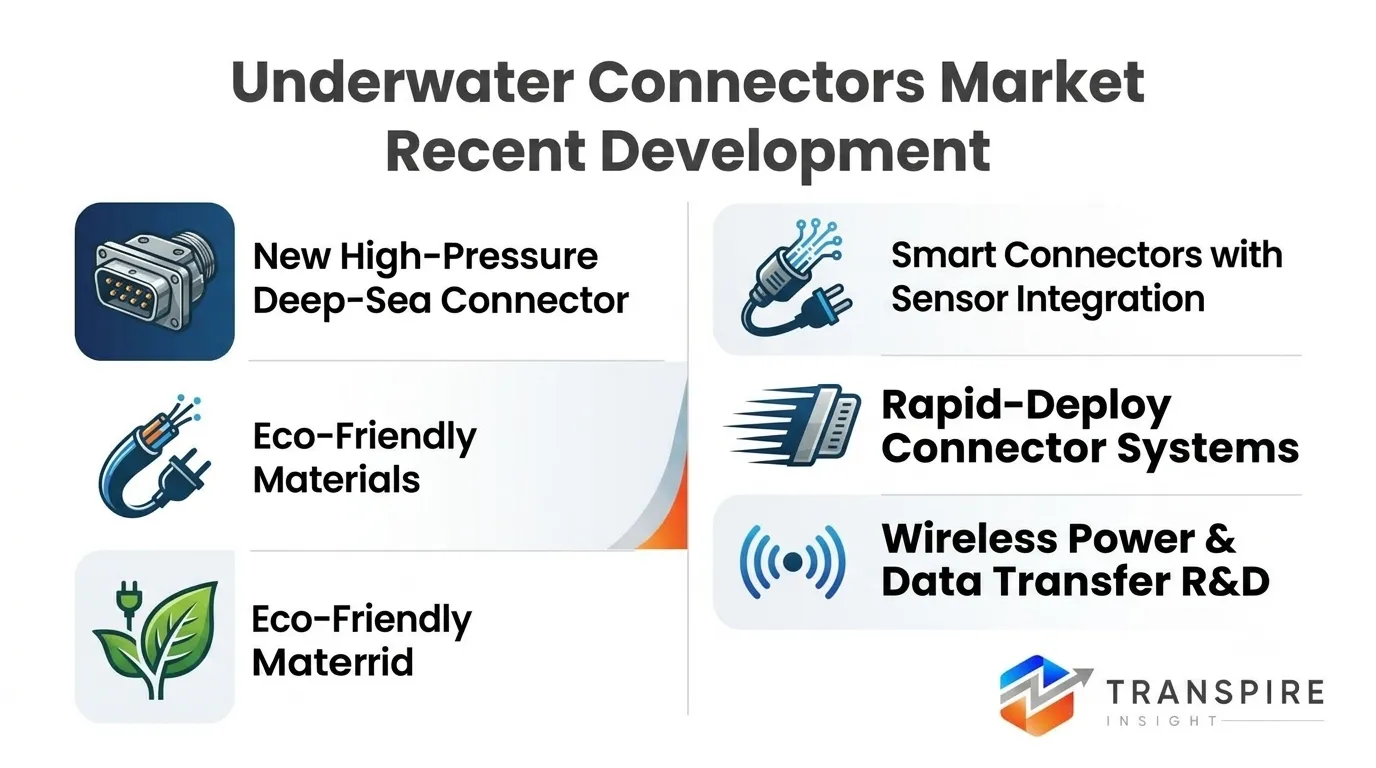
Latest Developments in the Underwater Connectors Market
Growth Drivers of the Underwater Connectors Market
Oil and gas remains one of the largest application areas for underwater connectors. Subsea production systems, control equipment, pipelines, remotely operated inspection platforms and intervention systems require reliable electrical and communication connections.
As offshore operations move into deeper and technically more challenging environments, connector performance becomes increasingly important. Failures can require expensive intervention operations, making reliability and environmental resistance key purchasing criteria.
ROVs and AUVs are becoming increasingly important for inspection, exploration, mapping, surveillance and scientific research. These systems depend on multiple sensors, cameras, navigation systems, power components and communications equipment.
The increasing sophistication of autonomous underwater platforms is therefore creating demand for smaller, lighter and higher-performance connectors capable of supporting greater functionality within constrained equipment architectures.
Underwater connectivity is strategically important for naval platforms, unmanned underwater vehicles, sonar systems, surveillance equipment and subsea defense infrastructure.
Defense organizations require connectors capable of operating reliably under pressure, saltwater exposure, vibration and shock. Increasing investment in underwater surveillance and autonomous systems is consequently supporting demand for specialized marine connectors.
Offshore wind farms require subsea electrical infrastructure, monitoring systems, sensors and communication networks. As offshore renewable projects expand farther from coastlines and into deeper waters, reliable subsea connectivity becomes increasingly important.
The expansion of offshore renewable infrastructure therefore provides an additional long-term market beyond traditional oil and gas applications.
Subsea telecommunications depend heavily on reliable underwater infrastructure. At the same time, marine research and industrial systems are generating increasingly large volumes of underwater data through sensors, cameras and monitoring platforms.
This is increasing demand for optical and hybrid connectors capable of supporting high-speed data transmission while maintaining environmental reliability.
Underwater robotics is moving from specialized research applications toward broader commercial deployment. Inspection, maintenance, environmental monitoring, seabed mapping and infrastructure management can increasingly be performed using remotely operated and autonomous systems.
This trend creates demand for connectors designed around modularity, repeated mating cycles, compact form factors and long-term underwater operation.
Future Importance
The future of the underwater connectors market will be closely linked to the development of the broader subsea economy. Oil and gas will remain an important source of demand, but emerging applications in offshore renewable energy, autonomous marine systems, defense, telecommunications and oceanographic research are gradually diversifying the market.
Future connector designs are likely to focus increasingly on higher power density, faster data transmission, smaller form factors, greater mating-cycle durability and improved resistance to pressure and corrosion.
The transition toward autonomous subsea infrastructure is particularly significant. As underwater systems become capable of operating for longer periods without human intervention, connectors must provide reliable interfaces that minimize maintenance requirements and support remote servicing.
Why Advanced Underwater Connectivity Matters
Equipment deployed underwater can be extremely difficult and expensive to retrieve. High-quality connectors reduce the risk of electrical or communication failures and support longer operational lifetimes.
AUVs and other autonomous platforms require connections for sensors, propulsion, navigation, imaging and communication systems. Advanced connectors allow more equipment to be integrated into increasingly compact underwater platforms.
Subsea connectors are essential for connecting control systems, monitoring equipment and power infrastructure associated with offshore energy installations.
Wet-mateable connectors allow certain underwater systems to be connected or disconnected without recovering the entire subsea assembly, potentially reducing intervention time and operating costs.
Optical-fiber and hybrid connector systems support the growing data requirements of underwater imaging, scientific research, telecommunications, monitoring and autonomous platforms.
Investment Opportunities
The underwater connectors market provides investment opportunities across subsea energy, marine defense, underwater robotics, telecommunications, oceanographic research and offshore renewable energy.
One of the most attractive opportunities lies in wet-mateable and hybrid connectors because subsea operators increasingly require equipment that can be serviced without extensive recovery operations. Fiber-optic connectivity is another promising area as underwater systems generate larger volumes of sensor and imaging data.
Investors can also explore opportunities in connector materials, sealing technologies, pressure-resistant housings, subsea cable assemblies, underwater sensors and specialized manufacturing equipment. The development of autonomous marine systems provides an additional opportunity for compact connector architectures designed specifically for AUVs and robotic platforms.
The growing deployment of offshore wind and other marine-energy infrastructure can further broaden the addressable market as subsea electrical and communication systems become an increasingly important part of renewable-energy installations.
Top 10 Companies in the Underwater Connectors Market
Major industry participants include diversified connectivity manufacturers as well as specialized subsea technology companies. Competitive differentiation increasingly depends on environmental qualification, pressure resistance, customization, signal integrity and long-term reliability.
1) Amphenol Corporation
Amphenol is one of the leading global connectivity companies serving demanding industrial, defense, aerospace, transportation and marine applications. Its broad portfolio and engineering capabilities position the company strongly in harsh-environment and subsea connectivity.
Amphenol was identified as the market leader in 2025, with more than 23% market share, according to Global Market Insights.
2) TE Connectivity
TE Connectivity provides connectivity solutions across industrial, transportation, energy and harsh-environment applications. Its broad engineering and manufacturing capabilities allow it to address specialized connectivity requirements where resistance to environmental stress and reliable signal transmission are critical.
3) Eaton Corporation
Eaton participates in electrical and power-management technologies serving industrial and energy applications. Its capabilities in electrical systems provide opportunities in subsea environments where reliable power connectivity and protection are essential.
4) Teledyne Technologies
Teledyne is strongly associated with marine technology, sensing and subsea systems. Its position across underwater imaging, instrumentation and marine equipment gives it a complementary role in the underwater connectivity ecosystem.
5) Molex
Molex develops electronic and connectivity solutions across multiple industries. Its expertise in interconnect technologies supports applications requiring compact and reliable electrical interfaces, including demanding industrial and marine environments.
Challenges & Restraints
The underwater connectors market faces several technical and economic challenges. The first is the extreme operating environment. Connectors must withstand hydrostatic pressure, corrosion, vibration, mechanical shock and temperature variations while maintaining electrical or optical performance.
Manufacturing costs can also be relatively high because subsea connectors require specialized materials, precision manufacturing, sealing technologies and extensive environmental qualification. Failure can have substantial financial consequences when equipment is deployed at significant depths.
Another challenge is maintenance. Although wet-mateable technologies can reduce intervention requirements, subsea servicing remains technically complex and expensive. Connector systems must also be compatible with specific equipment architectures and deployment conditions, which can limit standardization.
Market Expert View
The underwater connectors market is transitioning from a specialized component industry into an increasingly strategic part of the global subsea technology ecosystem. The combination of offshore energy, defense modernization, autonomous underwater vehicles, marine research and subsea communications is creating demand for connectivity that can function reliably where conventional electronic interfaces cannot.
The most significant opportunity lies in moving toward smart, modular and high-performance connectivity systems rather than treating connectors as simple mechanical components. Wet-mateable architectures, hybrid power-and-data connections and fiber-optic interfaces are particularly well positioned as underwater systems become more autonomous and data-intensive.
The competitive landscape is also likely to favor companies capable of combining connector manufacturing with cable assemblies, sensors, subsea electronics and system-level engineering. This broader integration can help customers reduce complexity and improve reliability across complete underwater systems.
North America is expected to retain its leadership position because of its established defense, offshore energy and marine technology ecosystem, while Asia Pacific is positioned for faster expansion as offshore infrastructure, telecommunications, robotics and marine engineering capabilities develop.
Conclusion
The global underwater connectors market is entering an important growth phase as subsea operations become deeper, more autonomous and more connected. Offshore oil and gas, naval systems, ROVs, AUVs, offshore renewable energy, telecommunications and oceanographic research are creating sustained demand for reliable underwater connectivity.
While pressure, corrosion, technical complexity, high manufacturing costs and difficult maintenance remain important challenges, advances in wet-mateable, optical, hybrid and high-density connector technologies are creating new opportunities.
As the subsea economy expands, underwater connectors will become increasingly important not merely as connection components but as critical infrastructure enabling power, data, sensing and control across the next generation of marine and underwater systems.


Send us a brief description of your challenge and we'll get back to you within 24 hours.

 inquiry@transpireinsight.com
 APAC:+91 7666513636
 Address


