
Sep 23, 2026
By Transpire Insight
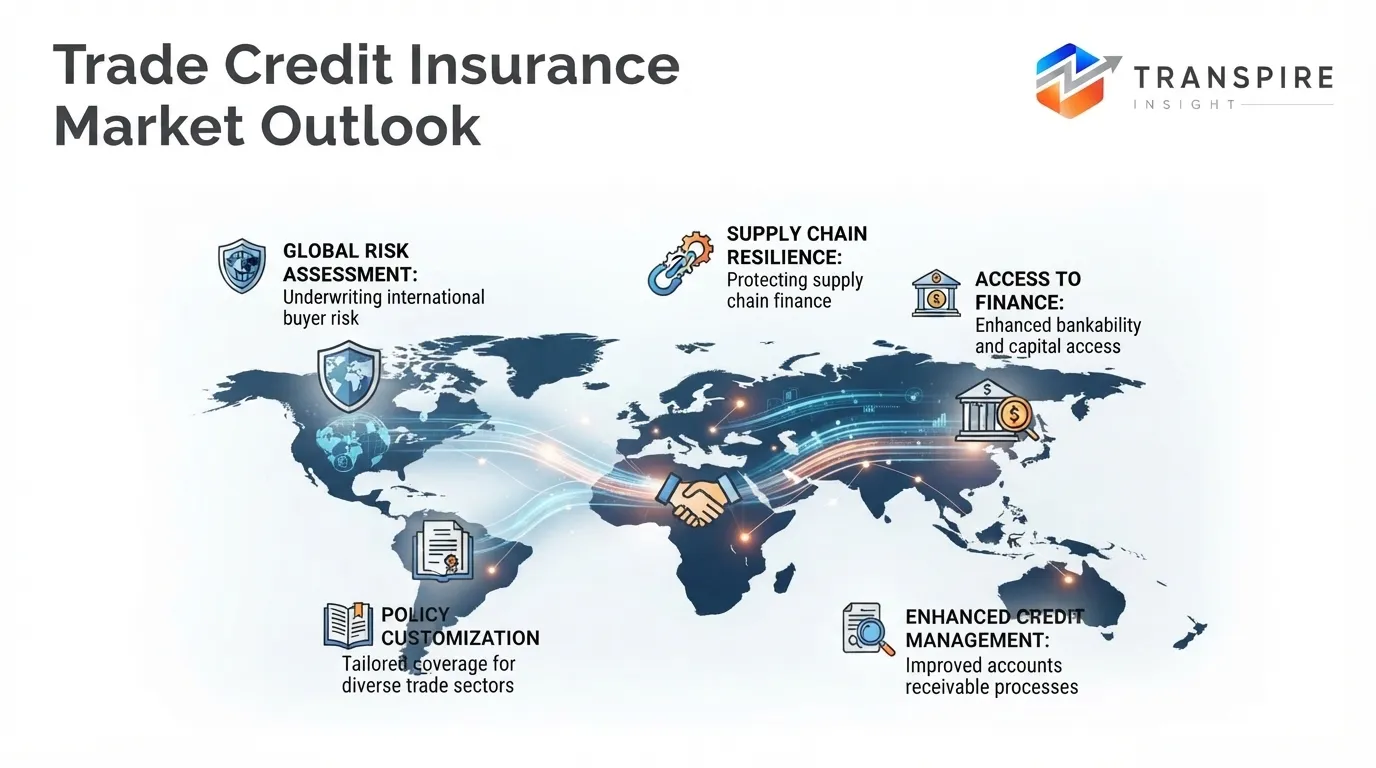
Trade credit insurance is becoming increasingly important as companies face longer payment cycles, customer insolvencies, geopolitical uncertainty and greater exposure to cross-border receivables.
The global trade credit insurance market is entering a period of structural expansion as businesses seek stronger protection against customer default, insolvency and delayed payments.
Companies routinely sell products and services before receiving payment. While credit terms can help generate sales and strengthen customer relationships, they also expose suppliers to significant receivables risk.
Trade credit insurance protects businesses against qualifying losses caused by customer non-payment and can support working-capital management, financing and international expansion.
Current market research produces a wide range of estimates depending on the policy types and market participants included. Recent estimates place the market at approximately USD 13.2 billion in 2025, with the potential to reach around USD 30 billion by 2035, representing a high-single-digit growth rate.
A changing global trade environment is creating demand
The commercial opportunity begins with the complexity of modern trade.
Manufacturers, exporters and distributors increasingly operate across multiple markets, currencies and customer groups. This creates exposure to different economic conditions and payment behaviors.
When a buyer becomes insolvent or fails to pay, the supplier may face a direct financial loss as well as pressure on working capital.
Trade credit insurance transfers part of this risk to an insurer, allowing companies to continue offering credit terms while protecting their balance sheets.
This is particularly valuable for businesses that depend heavily on a small number of major customers.
Market Size
The global trade credit insurance market is estimated at approximately USD 13.2 billion in 2025 and could approach USD 30 billion by 2035, with growth supported by expanding trade, increased credit-risk awareness and digital underwriting. Recent published estimates include values ranging from roughly USD 12.9 billion to USD 14.4 billion for 2025, demonstrating the effect of differing market definitions.
Insolvency risk remains a major driver
One of the strongest drivers is concern over corporate insolvency.
When economic conditions weaken, businesses may face higher financing costs, weaker demand and increased pressure on cash flow.
For suppliers, customer insolvency can create a chain reaction. An unpaid invoice can affect the supplier's ability to pay employees, lenders and its own suppliers.
Trade credit insurance helps mitigate this risk.
Insurers also provide credit intelligence, monitoring customer financial health and adjusting risk assessments as conditions change.
This information component is becoming increasingly valuable because companies want not only protection against losses but also better visibility into their customer portfolios.
Digital underwriting is changing the industry
Technology is transforming trade credit insurance.
Insurers increasingly use data analytics, artificial intelligence and automated risk assessment to evaluate buyers.
Traditional underwriting can require substantial documentation and manual review. Digital systems can analyze financial data, payment histories, trade information and other indicators more rapidly.
Real-time or near-real-time monitoring can also allow insurers to identify changes in buyer risk.
This can improve underwriting efficiency and potentially support more customized policies.
Recent market research highlights AI-driven credit monitoring and digital underwriting as important industry trends.
SMEs represent a major growth opportunity
Large corporations have historically been more likely to use trade credit insurance because they have substantial receivables exposure and dedicated risk-management teams.
However, small and medium-sized enterprises represent a major opportunity.
SMEs often have less capacity to absorb a major customer default. At the same time, many SMEs increasingly participate in international supply chains.
Digital distribution platforms and simplified products could make trade credit insurance easier for smaller businesses to understand and purchase.
The expansion of embedded finance could further increase adoption by integrating insurance into trade-finance and receivables-management platforms.
Cross-border trade creates additional demand
International transactions expose suppliers to additional risks.
Political instability, currency volatility, regulatory changes and differences in legal systems can complicate debt collection.
Trade credit insurance can provide coverage structures designed for these environments, making it an important tool for exporters.
As companies diversify supply chains and enter new markets, demand for international credit-risk protection is expected to increase.
Asia Pacific is particularly attractive because of expanding trade activity and growing insurance adoption. One current estimate places the region among the fastest-growing markets through 2035.
Banks are becoming part of the ecosystem
Trade credit insurance can also support financing.
Insured receivables may provide lenders with greater confidence because the risk of customer non-payment is partially transferred.
This creates opportunities for partnerships between insurers, banks, fintech companies and trade-finance platforms.
However, regulatory capital requirements and banking rules can influence how effectively insured receivables are treated for financing purposes.
The relationship between insurance and financing is therefore likely to remain an important strategic issue.
Customized policies are becoming more important
Businesses do not all face the same credit risk.
A manufacturer selling to hundreds of customers may require whole-turnover coverage, while another company may need protection for a small number of strategically important buyers.
Single-buyer policies, whole-turnover policies and excess-of-loss structures allow insurers to address different risk profiles.
Customization can become an important competitive differentiator as customers become more sophisticated.
Key challenges
The market faces several challenges.
First, many SMEs remain unfamiliar with trade credit insurance and may view it as an unnecessary cost during stable economic periods.
Second, underwriting complex international risks requires significant data and expertise.
Third, insurers must balance competitive pricing with rapidly changing credit conditions.
Fourth, claims and policy structures can become complicated when disputes arise over contract performance, delivery or the precise cause of non-payment.
Finally, economic downturns can increase claims at the same time that insurers face pressure to maintain capacity.
Competitive landscape
Competition is concentrated among specialist trade-credit insurers and large global insurance groups.
Major providers compete through international coverage networks, buyer-information databases, underwriting expertise, digital platforms and specialized products.
Top 10 Companies in Trade Credit Insurance Market
Headquarters: Paris, France
Allianz Trade is one of the world's major trade credit insurance specialists. Its global network, buyer-risk information and receivables-management capabilities provide strong positioning as businesses seek protection against commercial non-payment.
Headquarters: Amsterdam, Netherlands
Atradius provides trade credit insurance, surety and related credit-management services. Its international network enables businesses to manage receivables risk across domestic and cross-border markets.
Headquarters: Bois-Colombes, France
Coface combines credit insurance with business-information and risk-management services. Its international presence allows it to support exporters and companies operating across multiple markets.
Headquarters: New York, New York, USA
AIG provides a broad portfolio of commercial insurance solutions, including products relevant to credit and political risks. Its global insurance infrastructure gives it access to multinational customers.
Headquarters: Zurich, Switzerland
Zurich offers commercial insurance solutions to businesses across global markets. Its broad corporate-insurance portfolio allows it to participate in risk-management programs where trade credit protection forms part of a wider insurance strategy.
Outlook: Could trade credit insurance become a core corporate-finance tool?
Trade credit insurance is increasingly moving beyond a niche risk-management product.
As companies manage more complex supply chains, longer payment cycles and greater international exposure, protecting receivables can become an important part of financial planning.
Digital underwriting, AI-based risk monitoring, embedded insurance and partnerships with financial institutions could make coverage easier to access.
The strongest long-term opportunity will likely come from combining insurance protection with credit intelligence and financing solutions, allowing companies to manage not just the consequences of customer default but the underlying risk itself.


Send us a brief description of your challenge and we'll get back to you within 24 hours.

 inquiry@transpireinsight.com
 APAC:+91 7666513636
 Address


