
Nov 12, 2026
By Transpire Insight
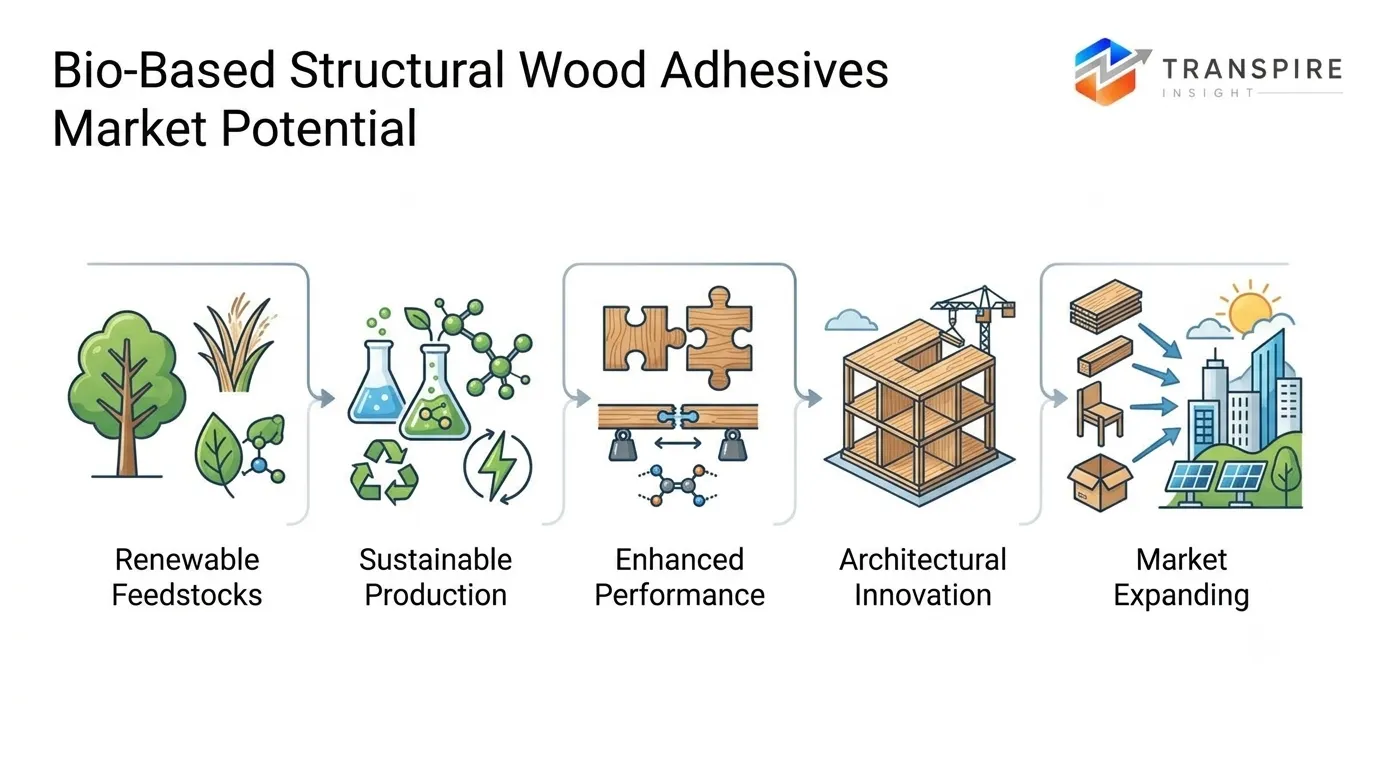
Description
According to a research report published by Transpire Insight, the global Bio-Based Structural Wood Adhesives Market size was valued at USD 2.61 billion in 2026 and is projected to grow at a CAGR of 9.97% during the 2027–2035 forecast period. Based on this growth rate, the market is expected to reach approximately USD 6.14 billion by 2035, increasing from USD 2.87 billion in 2027. Rising adoption of sustainable construction materials, growing demand for engineered wood products, and increasing restrictions on formaldehyde emissions are supporting market expansion. Manufacturers are investing in renewable raw materials, lignin-based resins, soy protein adhesives, tannin-based formulations, and bio-based polyurethane technologies to develop structural bonding solutions with lower dependence on fossil-derived chemicals.
Introduction
Wood adhesives determine whether engineered timber performs reliably over decades or develops bonding problems under moisture, temperature changes, and mechanical stress. That makes adhesive selection particularly important in structural applications.
Bio-based structural wood adhesives are bonding materials manufactured partly or substantially from renewable biological resources. Common feedstocks include lignin, soy protein, starch, tannins, plant oils, and other naturally derived polymers. These materials are being developed for applications where conventional synthetic adhesives have traditionally dominated.
Cross-laminated timber (CLT), glued laminated timber (glulam), laminated veneer lumber (LVL), plywood, oriented strand board (OSB), and prefabricated timber components require adhesives that maintain bonding strength under demanding operating conditions. Structural applications place additional requirements on water resistance, creep performance, temperature stability, curing behavior, and long-term durability.
Manufacturers face a technical challenge: replacing fossil-derived ingredients without compromising the mechanical properties required for load-bearing applications.
Companies including Henkel, H.B. Fuller, Arkema, Sika, Ashland, Stora Enso, and UPM Biochemicals are participating in different parts of this competitive ecosystem. Some develop finished adhesive formulations, while others supply renewable chemical intermediates and bio-based raw materials.
Recent Development News
September 2026: UK-based sustainable adhesive company BindEthics announced that its Ecohesive formaldehyde-free adhesive had progressed from laboratory development to industrial-scale production. The company reported production-grade batches of 40 liters and a validated pathway toward 2,000-liter manufacturing volumes. Commercial discussions represented potential industrial demand exceeding 6,000 tonnes, highlighting the growing interest in scalable alternatives for engineered wood applications.
July 2026: Research published on advances in bio-based wood adhesives examined developments in protein-, carbohydrate-, lignin-, and tannin-based adhesive systems. The research highlighted the role of polymer structure, crosslinking chemistry, and interfacial bonding in determining the mechanical performance and sustainability of renewable adhesive formulations.
October 2026: A research review examining adhesives derived from distillers' dried grains and soybean highlighted the potential of agricultural processing by-products as renewable feedstocks for wood-composite bonding. The research adds to ongoing efforts to develop alternatives to conventional petroleum-derived wood adhesive formulations.
Stay Ahead of Emerging Opportunities with Expert Market Insights by Transpire Insight
Transpire Insight provides market intelligence covering industry developments, competitive positioning, market sizing, regional demand, and future growth opportunities.
Our research evaluates the commercial potential of bio-based adhesive technologies, including lignin-based, protein-based, starch-based, tannin-based, and bio-polyurethane formulations. We also examine manufacturer capabilities, raw-material availability, product development, application opportunities, and changing procurement requirements.
For adhesive manufacturers, chemical suppliers, engineered wood producers, investors, and construction material companies, understanding the competitive structure is increasingly important as renewable feedstocks enter industrial production.
Bio-Based Structural Wood Adhesives Market Size & Statistics
Regional Growth and Demand Analysis by Transpire Insight
Europe
Europe represents an established market for sustainable wood materials, engineered timber construction, and renewable chemical technologies. Germany, Sweden, Finland, Austria, France, and Italy have developed industries spanning timber processing, forestry, wood panels, and specialty chemicals.
The region's established forestry and pulp industries provide an advantage in developing lignin-based adhesive ingredients. Companies such as Stora Enso, UPM Biochemicals, Borregaard, Henkel, and Dynea participate in different parts of the renewable materials and wood adhesive value chain.
Demand is also supported by the use of engineered timber in residential buildings, commercial construction, and prefabricated structures. Manufacturers are focusing on reducing formaldehyde emissions and improving the environmental characteristics of structural bonding systems.
North America
North America has a developed wood products industry, with substantial manufacturing activity in plywood, OSB, engineered lumber, and structural timber components.
The United States and Canada offer opportunities for adhesive manufacturers supplying industrial wood processors and construction material producers. Companies such as H.B. Fuller, Ashland, Franklin International, Huntsman, and Dow have established adhesive or specialty chemical capabilities relevant to wood bonding.
The commercial challenge is straightforward: bio-based formulations must satisfy industrial production requirements. Manufacturers need consistent raw-material quality, reliable curing times, moisture resistance, and competitive production economics before large-scale adoption becomes practical.
Asia-Pacific
Asia-Pacific is an important growth market because of its expanding construction sector, large wood-processing industries, and established chemical manufacturing capabilities.
China, Japan, India, South Korea, and Southeast Asian countries contribute to demand for wood panels, furniture, plywood, and construction materials.
Companies including Aica Kogyo, Pidilite Industries, Dynea, KLEIBERIT, and Chimar serve different parts of the regional and international adhesive supply chain. Increasing interest in renewable feedstocks and lower-emission manufacturing is creating opportunities for bio-based formulations.
India also presents opportunities through furniture manufacturing, plywood production, infrastructure development, and the expansion of organized construction material supply chains.
Top 15 Trends in the Bio-Based Structural Wood Adhesives Market
Growing Adoption of Lignin-Based Structural Adhesives
Lignin is attracting attention as a renewable alternative to petroleum-derived phenolic ingredients. It is obtained as a by-product of pulp and paper manufacturing and offers an established industrial feedstock pathway.
Companies involved in lignin processing are exploring applications in wood adhesives, resins, and other specialty chemical formulations. The main technical challenge is maintaining consistent reactivity and bonding performance across different lignin sources.
Stora Enso, UPM Biochemicals, and Borregaard have relevant lignin and renewable chemical capabilities.
Increasing Demand for Formaldehyde-Free Wood Bonding Solutions
Formaldehyde emissions remain a significant consideration in wood panel and construction material manufacturing. Manufacturers are evaluating alternative adhesive chemistries that reduce dependence on conventional formaldehyde-based systems.
Protein-based, lignin-based, and other renewable formulations are receiving research and commercial attention. However, structural-grade applications require more than low emissions. Bond durability, moisture resistance, and compliance with application-specific testing requirements remain essential.
Rising Use of Soy Protein-Based Adhesive Formulations
Soy protein provides a renewable feedstock for wood adhesive development. Its availability through established agricultural supply chains makes it an attractive option for manufacturers researching plant-based bonding systems.
Formulation improvements focus on water resistance, crosslinking, storage stability, and bonding strength. These improvements are particularly relevant to plywood and engineered wood applications where conventional synthetic adhesives have an established performance advantage.
Development of Tannin-Based Renewable Adhesive Technologies
Tannins are naturally occurring polyphenolic compounds found in various plant materials and forestry resources. Their chemical properties make them useful in research involving renewable phenolic adhesive alternatives.
Manufacturers and research institutions are studying tannin-based formulations for wood panels and structural bonding applications. Feedstock consistency and the cost of processing remain important considerations for commercial expansion.
Growing Adoption of Bio-Based Polyurethane Adhesives
Bio-based polyurethane adhesives combine renewable chemical ingredients with polyurethane bonding technology. Their potential applications include engineered timber, prefabricated wood structures, and load-bearing timber components.
Henkel's development of bio-based polyurethane adhesive products for load-bearing timber construction illustrates the commercial direction of this technology. Formulators are working to maintain mechanical performance while increasing renewable content in adhesive systems.
Expansion of Cross-Laminated Timber Construction
Cross-laminated timber is gaining attention as a construction material for buildings that use prefabricated structural wood components. CLT manufacturing requires dependable adhesive systems that maintain bonding integrity across multiple layers of timber.
Adhesive manufacturers are therefore focusing on moisture resistance, curing performance, production efficiency, and long-term structural reliability. Renewable formulations that satisfy these requirements have an opportunity to enter a growing engineered timber supply chain.
List of Top 30 Companies Leading the Bio-Based Structural Wood Adhesives Market
The following companies represent established adhesive manufacturers, specialty chemical suppliers, renewable feedstock producers, and wood adhesive technology developers participating in the broader bio-based structural wood adhesives value chain as of 2026.
The leading manufacturers and suppliers above cover different positions in the market, from finished adhesive formulations to lignin, starch, protein, and specialty chemical technologies.
1. Henkel AG & Co. KGaA
Henkel is one of the established global adhesive manufacturers, with a broad portfolio covering industrial bonding, construction, packaging, and engineered wood applications. Its Adhesive Technologies business develops polyurethane and other specialty adhesive systems.
The company has developed bio-based polyurethane adhesive solutions for load-bearing timber construction, positioning it among the directly relevant participants in the renewable structural wood bonding segment.
Headquarters: Düsseldorf, Germany.
Why It Ranks: Established industrial adhesive capabilities, international customer relationships, and documented bio-based polyurethane technology for timber construction.
Product Line: Polyurethane adhesives, structural wood adhesives, industrial bonding systems, and renewable-content adhesive formulations.
2. H.B. Fuller Company
H.B. Fuller supplies industrial adhesives for woodworking, construction, packaging, and engineered materials. Its portfolio includes adhesive technologies designed for industrial manufacturing environments.
The company is relevant to the market through its wood adhesive expertise, formulation capabilities, and sustainability-focused product development.
Headquarters: St. Paul, Minnesota, USA.
Why It Ranks: International adhesive distribution, established woodworking applications, and specialty formulation capabilities.
Product Line: Woodworking adhesives, polyurethane adhesives, structural bonding products, hot-melt adhesives, and industrial adhesive systems.
3. Arkema S.A. (Bostik)
Arkema participates in the adhesives industry through its Bostik business, which develops specialty bonding solutions for construction, industrial manufacturing, and consumer applications.
Its polymer chemistry and adhesive formulation capabilities provide a foundation for developing renewable-content and lower-impact adhesive technologies.
Headquarters: Colombes, France.
Why It Ranks: Global specialty chemical capabilities, established adhesive operations, and investment in sustainable material technologies.
Product Line: Construction adhesives, polyurethane adhesives, industrial bonding systems, specialty polymers, and bio-based adhesive technologies.
4. Sika AG
Sika develops specialty chemicals and bonding technologies for construction and industrial applications. Its product portfolio includes structural adhesives, sealants, and polyurethane systems.
The company is relevant to engineered timber construction through its structural bonding and construction material expertise.
Headquarters: Baar, Switzerland.
Why It Ranks: Strong construction chemical capabilities, international operations, and structural bonding expertise.
Product Line: Structural adhesives, polyurethane bonding systems, construction adhesives, sealants, and specialty chemical solutions.
5. Ashland Inc.
Ashland is a specialty chemicals manufacturer with experience in adhesives, functional ingredients, and polymer technologies. Its capabilities in renewable materials and adhesive formulation make it relevant to the development of bio-based wood bonding systems.
Headquarters: Wilmington, Delaware, USA.
Why It Ranks: Specialty chemical expertise, adhesive formulation capabilities, and participation in sustainable material development.
Product Line: Specialty adhesives, functional polymers, cellulose-based ingredients, and industrial chemical solutions.
6. Stora Enso Oyj
Stora Enso is a renewable materials company with substantial experience in forestry products, pulp, packaging, and biomaterials. Its lignin-related activities are particularly relevant to the bio-based adhesive supply chain.
Lignin offers an alternative renewable feedstock for selected adhesive and resin formulations, especially where conventional phenolic ingredients are being reconsidered.
Headquarters: Helsinki, Finland.
Why It Ranks: Renewable forestry feedstocks, lignin processing capabilities, and established industrial biomaterials operations.
Product Line: Kraft lignin, renewable biomaterials, wood products, pulp, and specialty bio-based materials.
7. UPM Biochemicals
UPM Biochemicals develops renewable chemicals using sustainable forestry-based raw materials. Its operations support the transition toward alternatives to fossil-derived chemical ingredients.
The company's wood-based biochemical capabilities make it relevant to adhesive manufacturers investigating renewable feedstock integration.
Headquarters: Helsinki, Finland.
Why It Ranks: Industrial-scale renewable chemical development and access to forestry-derived raw materials.
Product Line: Renewable glycols, lignin-based materials, and wood-based biochemical intermediates.
8. Borregaard ASA
Borregaard is a Norwegian biochemicals company specializing in products derived from wood-based raw materials. Its lignin and cellulose technologies serve several industrial markets.
Its lignin-based products are relevant to adhesive manufacturers evaluating renewable alternatives for conventional resin ingredients.
Headquarters: Sarpsborg, Norway.
Why It Ranks: Established lignin processing expertise and specialized wood-based chemical production.
Product Line: Lignin-based products, specialty cellulose, bioethanol, and wood-based biochemical ingredients.
9. BASF SE
BASF is a major chemical manufacturer with operations across polymers, resins, performance materials, and specialty chemicals. Its chemical development capabilities are relevant to adhesive formulation and renewable raw material integration.
The company participates in the wider engineered wood adhesive value chain through its chemical and polymer technologies.
Headquarters: Ludwigshafen, Germany.
Why It Ranks: Extensive chemical manufacturing capabilities, research infrastructure, and global industrial customer base.
Product Line: Specialty chemicals, polymer materials, resin ingredients, and adhesive-related chemical technologies.
10. Dow Inc.
Dow develops materials and chemical technologies serving construction, packaging, industrial manufacturing, and other applications. Its polymer and specialty material capabilities support adhesive formulation and performance development.
The company's relevance comes from its broad chemical technology base and participation in industrial bonding markets.
Headquarters: Midland, Michigan, USA.
Why It Ranks: Global chemical manufacturing presence, polymer expertise, and industrial materials development capabilities.
Product Line: Polyurethane materials, specialty polymers, construction chemicals, and adhesive-related ingredients.
Why Bio-Based Structural Wood Adhesives Are Attracting Investment
The investment case extends beyond environmental positioning.
For investors, the strongest opportunities are likely to emerge where renewable feedstock production connects directly with commercially validated structural adhesive formulations.
Conclusion
The Bio-Based Structural Wood Adhesives Market is developing around a clear industrial requirement: renewable ingredients must deliver dependable structural performance.
Henkel, H.B. Fuller, Arkema, Sika, and other adhesive manufacturers bring established formulation and distribution capabilities. Stora Enso, UPM Biochemicals, and Borregaard contribute renewable feedstock expertise, while companies such as Ingredion and Cargill provide access to plant-derived materials.
The next competitive milestone will be commercial validation. Manufacturers should prioritize moisture resistance, bond durability, curing efficiency, renewable-content verification, and application-specific structural testing before expanding production capacity.
For businesses entering this market, evaluating the relationship between raw-material suppliers, adhesive formulators, and engineered wood manufacturers is a practical starting point for identifying commercially viable opportunities.


Send us a brief description of your challenge and we'll get back to you within 24 hours.

 inquiry@transpireinsight.com
 APAC:+91 7666513636
 Address


