
Nov 12, 2026
By Transpire Insight
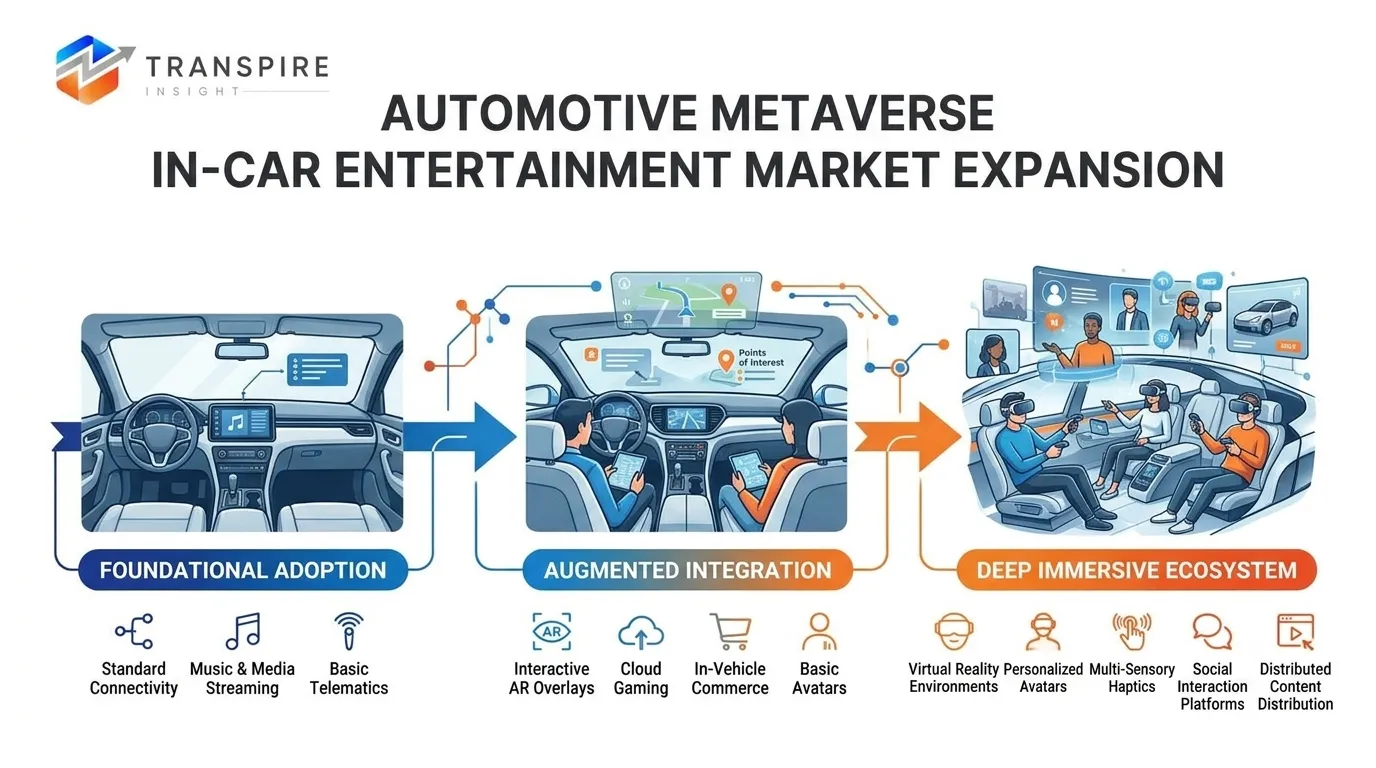
Description
According to a research report published by Transpire Insight, the global Automotive Metaverse In-Car Entertainment Market size was valued at USD 1,042.5 million in 2026 and is projected to grow at a CAGR of 27.45% during the 2027–2035 forecast period. Based on this growth rate, the market is expected to reach approximately USD 9,249.8 million by 2035. The market is estimated to reach USD 1,328.7 million in 2027. Increasing adoption of connected vehicles, augmented reality (AR), virtual reality (VR), 3D visualization, immersive passenger experiences, and AI-powered automotive interfaces is supporting industry expansion. Automakers and technology providers are developing interactive digital cockpits, virtual vehicle environments, personalized entertainment platforms, and connected in-car experiences to differentiate next-generation vehicles.
Introduction
Automotive metaverse in-car entertainment combines connected vehicle technologies with immersive digital experiences, including augmented reality, virtual environments, 3D interfaces, interactive content, virtual assistants, and personalized multimedia. Rather than limiting passengers to conventional audio and video systems, these technologies introduce more interactive ways to experience journeys.
The shift is particularly relevant to electric vehicles, software-defined vehicles, and premium connected cars. Large display systems, high-speed connectivity, advanced infotainment processors, and cloud-based services provide the technical foundation for these experiences.
There is also a difference between driver-facing technology and passenger entertainment. Augmented reality head-up displays support navigation and contextual information for drivers, while immersive screens, gaming, virtual environments, and interactive applications primarily target passengers. Keeping these functions separate is essential for safe product development.
Automotive manufacturers are working with technology companies, semiconductor suppliers, software developers, and entertainment providers to build these systems. Companies such as NVIDIA, Qualcomm, Unity, Epic Games, Mercedes-Benz, BMW, Hyundai, and Sony are relevant participants across the underlying automotive technology and entertainment ecosystem.
Market Scope and Competitive Positioning
The Automotive Metaverse In-Car Entertainment Market covers technologies and services that bring immersive digital environments into vehicle cabins. Its commercial scope extends beyond conventional infotainment hardware.
The competitive ecosystem includes:
A key commercial distinction is that not every connected-car or infotainment supplier is a direct metaverse platform provider. Some companies supply the computing hardware, graphics engines, operating systems, and connectivity that make immersive experiences possible.
Recent Development News
January 2026: Sony Honda Mobility presented the AFEELA Prototype 2026 at CES 2026, advancing its vision of mobility as a creative entertainment space. The company highlighted developments in connected entertainment, technology partnerships, and the AFEELA Co-Creation Program, which is designed to support the development of in-car entertainment content.
January 2026: Xperi announced increased adoption of its DTS AutoStage Video Service Powered by TiVo among automotive manufacturers. Mercedes-Benz selected the video entertainment platform for upcoming vehicles, expanding its connected-car entertainment offerings alongside DTS audio technologies.
April 2026: Valeo and holoride expanded their partnership to scale extended reality gaming in vehicles. Their collaboration combines vehicle sensor information, spatial intelligence, and motion-synchronized content to develop immersive gaming experiences for passengers. The companies also presented new content and demonstrations at Auto China 2026.
July 2026: Goer Dynamics and IMAX announced a partnership to develop an IMAX-branded in-vehicle entertainment system. The planned system combines multidimensional acoustic architecture with calibrated high-definition displays. The companies targeted commercial production by the end of 2026 and plan to market the system to premium automotive manufacturers in China.
July 2026: Cinemo and SmashLabs announced a collaboration to introduce immersive in-car gaming. The platform synchronizes gameplay with vehicle lighting, audio, haptics, and climate functions, creating interactive entertainment experiences for passengers and during vehicle charging stops.
August 2026: Cinemo, Dolby Laboratories, and SmashLabs announced an expanded collaboration for immersive in-car gaming. The solution integrates Cinemo's In-Car Game APIs, Dolby Atmos audio, and interactive gameplay, allowing game events to influence sound, lighting, haptics, and climate responses inside the vehicle.
September 2026: FORVIA HELLA announced a strategic development partnership with Distance Technologies focused on three-dimensional augmented reality head-up display technology. The virtual 3D AR canvas supports flexible automotive information displays and creates opportunities for passenger entertainment and video communication applications.
October 2026: LG Electronics announced an integrated package of six vehicle technologies for the Genesis GV90. The solutions cover displays, infotainment, entertainment, and connectivity. LG also highlighted its variable pop-up display system and expanded content options through its automotive content platform.
Stay Ahead of Emerging Opportunities with Expert Market Insights by Transpire Insight
Transpire Insight provides comprehensive, data-driven market intelligence to support informed business decisions. Our research combines market sizing, competitive benchmarking, regional analysis, technology assessment, and growth forecasting to help businesses understand emerging industry opportunities.
We provide detailed assessments of market segmentation, leading manufacturers, product innovation, automotive technology partnerships, and evolving entertainment platforms. Our research helps automotive manufacturers, investors, technology suppliers, and industry professionals evaluate market developments and identify opportunities for business expansion.
Automotive Metaverse In-Car Entertainment Market Size & Statistics
Regional Growth and Demand Analysis by Transpire Insight
Asia-Pacific
Asia-Pacific held the leading position in the Automotive Metaverse In-Car Entertainment Market in 2025. The region benefits from a substantial automotive manufacturing base, strong electric vehicle adoption, consumer electronics production, and investment in connected vehicle technologies.
China is a particularly important market because automotive manufacturers are competing through digital cockpits, passenger displays, gaming applications, and connected entertainment ecosystems. Companies such as BYD, Geely, NIO, XPeng, Huawei, and Tencent are relevant to the region's connected mobility ecosystem.
Japan and South Korea also contribute through automotive electronics, display technologies, entertainment platforms, and semiconductor development. Sony Honda Mobility's AFEELA project illustrates the growing relationship between automotive engineering and digital entertainment.
Europe
Europe represented the second-largest regional market in 2025. Germany, France, the United Kingdom, and Italy have established automotive manufacturing and engineering industries, supporting the development of advanced digital cockpit and passenger entertainment technologies.
BMW, Mercedes-Benz, Volkswagen, Audi, Porsche, Valeo, Bosch, Continental, and FORVIA are important participants in the regional ecosystem. Their activities span connected infotainment, augmented reality displays, vehicle computing, automotive software, and immersive passenger applications.
European demand is also influenced by premium vehicle production, software-defined vehicle development, and investment in advanced driver assistance systems. These technologies create opportunities to integrate contextual digital information and entertainment into vehicle interiors.
North America
North America is projected to be the fastest-growing regional market during the forecast period. The United States has a strong technology ecosystem covering graphics processing, cloud computing, gaming engines, artificial intelligence, and connected vehicle software.
NVIDIA, Qualcomm, Google, Microsoft, Unity, Epic Games, and Meta are important technology participants. Their capabilities support the development of graphics-intensive automotive interfaces, real-time 3D environments, cloud-connected applications, and immersive digital experiences.
Automotive manufacturers are also investing in software-defined vehicle platforms and advanced infotainment systems. As autonomous driving technology develops, passenger entertainment is expected to receive greater attention, particularly in vehicles designed around connected digital services.
Top 15 Trends in the Automotive Metaverse In-Car Entertainment Market
Immersive Gaming Transforming Passenger Entertainment
Automotive gaming is moving beyond conventional touchscreen applications. Companies are developing interactive experiences that respond to vehicle movement, cabin lighting, audio, and passenger activity.
The Valeo and holoride partnership demonstrates this direction through motion-synchronized extended reality gaming. Cinemo and SmashLabs are taking a different approach by connecting gameplay with vehicle systems, including lighting, haptics, and climate functions.
These developments create opportunities for entertainment during charging stops, autonomous driving scenarios, and passenger journeys.
Augmented Reality Creating New Digital Cockpit Experiences
Augmented reality is becoming an important part of automotive interface development. AR head-up displays can project navigation instructions, contextual information, and visual elements into the driver's field of view.
For passenger applications, three-dimensional displays provide additional opportunities for interactive entertainment and communication.
Automotive suppliers such as FORVIA HELLA, WayRay, Continental, and Bosch are relevant participants in this technology segment. Product development must maintain a clear distinction between driver information and entertainment content to avoid unnecessary distraction.
3D Graphics Engines Supporting Virtual Automotive Environments
Real-time graphics engines are providing the foundation for more sophisticated digital cockpits. Automotive developers use 3D rendering to create vehicle interfaces, digital twins, interactive environments, and visual simulations.
Unity and Epic Games are relevant because their development platforms support real-time rendering and interactive content creation. NVIDIA and Qualcomm contribute through computing platforms that handle graphics-intensive automotive applications.
This technology also supports virtual vehicle configuration, personalized interfaces, and interactive brand experiences.
Cloud Gaming and Connected Entertainment Expanding
Cloud connectivity is changing how passengers access entertainment inside vehicles. Instead of relying exclusively on locally installed applications, connected vehicles can access remote content libraries and streaming services.
Cloud-based gaming requires dependable network connections, low latency, and sufficient onboard processing capabilities. Automotive manufacturers are therefore considering connectivity, display performance, and subscription integration together when designing entertainment platforms.
The commercial opportunity extends to content licensing, platform subscriptions, and partnerships between automakers and entertainment providers.
AI-Powered Personalization Improving In-Car Experiences
Artificial intelligence is creating opportunities to personalize entertainment according to passenger preferences, usage patterns, and vehicle settings.
AI-powered assistants can support content discovery, natural-language interaction, and personalized infotainment recommendations. In more advanced systems, passenger profiles can synchronize preferences across connected devices and vehicle applications.
The commercial advantage comes from making the entertainment environment more relevant without requiring passengers to configure every function manually.
Spatial Audio and Multi-Sensory Entertainment Gaining Attention
Audio is becoming a larger part of immersive automotive entertainment. Traditional vehicle speakers are increasingly complemented by advanced sound processing, spatial audio, and cabin-specific acoustic systems.
The Goer Dynamics and IMAX collaboration illustrates the opportunity to combine specialized audio architecture with high-definition visual entertainment.
Cinemo, Dolby, Harman, and Sony are relevant participants in the broader automotive audio and entertainment ecosystem. Combining sound with displays, lighting, and interactive applications creates additional opportunities for premium vehicle differentiation.
List of Top 30 Companies Leading the Automotive Metaverse In-Car Entertainment Market
The following companies are active participants in the automotive metaverse, immersive infotainment, extended reality, automotive graphics, connected entertainment, and digital cockpit ecosystem as of 2026.
1. NVIDIA Corporation
NVIDIA is a major technology supplier in automotive computing, artificial intelligence, and graphics processing. Its automotive platforms support digital cockpits, advanced visualization, simulation, and graphics-intensive vehicle applications.
Headquarters: Santa Clara, California, USA.
Why It Ranks: Strong automotive computing capabilities, graphics technology, AI infrastructure, and relationships with automotive manufacturers.
Product Line: NVIDIA DRIVE platforms, automotive computing systems, GPU technologies, simulation software, and real-time graphics solutions.
2. Qualcomm Technologies, Inc.
Qualcomm develops semiconductor and connectivity technologies for connected vehicles. Its Snapdragon Digital Chassis and Cockpit Platforms support digital infotainment, high-performance vehicle computing, multimedia, and connected passenger experiences.
Headquarters: San Diego, California, USA.
Why It Ranks: Established automotive semiconductor portfolio, digital cockpit technologies, and collaborations with global automakers.
Product Line: Snapdragon Cockpit Platforms, Snapdragon Digital Chassis, automotive connectivity, and vehicle computing solutions.
3. Unity Technologies
Unity develops a real-time 3D development platform used across gaming, simulation, visualization, and interactive digital experiences. Its technology is relevant to automotive human-machine interfaces, interactive vehicle environments, and virtual experiences.
Headquarters: San Francisco, California, USA.
Why It Ranks: Established real-time 3D development ecosystem and applications across automotive visualization and immersive content.
Product Line: Unity Engine, 3D development tools, simulation applications, and interactive visualization technologies.
4. Epic Games, Inc.
Epic Games is the developer of Unreal Engine, a real-time 3D graphics platform used in gaming, visualization, simulation, and automotive interface development. Its collaboration with Qualcomm provides a route for Unreal Engine-based experiences on automotive cockpit platforms.
Headquarters: Cary, North Carolina, USA.
Why It Ranks: Advanced graphics capabilities, automotive development partnerships, and established interactive entertainment technology.
Product Line: Unreal Engine, real-time 3D rendering, interactive applications, and digital visualization tools.
5. Sony Group Corporation
Sony operates across entertainment, electronics, gaming, imaging, and digital technologies. Its Sony Honda Mobility venture demonstrates the company's interest in combining automotive technology with content, connectivity, and entertainment experiences.
Headquarters: Tokyo, Japan.
Why It Ranks: Strong entertainment ecosystem, gaming capabilities, and direct participation in automotive entertainment development.
Product Line: PlayStation technologies, imaging systems, entertainment platforms, audio solutions, and AFEELA-related digital mobility technologies.
6. Samsung Electronics Co., Ltd.
Samsung is a major manufacturer of consumer electronics, semiconductors, and display technologies. Its automotive electronics activities and display capabilities support the development of advanced infotainment and connected cabin experiences.
Headquarters: Suwon, South Korea.
Why It Ranks: Display manufacturing capabilities, semiconductor technologies, and automotive electronics ecosystem.
Product Line: Automotive displays, semiconductor components, connected electronics, memory solutions, and digital entertainment technologies.
7. LG Electronics Inc.
LG Electronics supplies vehicle components, displays, infotainment systems, and connected automotive solutions. Its automotive business is particularly relevant to digital cockpits and integrated passenger entertainment.
Headquarters: Seoul, South Korea.
Why It Ranks: Automotive infotainment expertise, display technologies, and collaborations with vehicle manufacturers.
Product Line: Automotive displays, in-vehicle infotainment, connected vehicle platforms, and digital cockpit solutions.
8. Panasonic Holdings Corporation
Panasonic provides automotive electronics, infotainment equipment, display technologies, and connected vehicle solutions. Its experience in consumer entertainment and automotive systems supports its position in the digital cabin ecosystem.
Headquarters: Osaka, Japan.
Why It Ranks: Long-standing automotive electronics business and capabilities in multimedia and cabin technologies.
Product Line: Automotive infotainment, cockpit electronics, connected vehicle systems, and audio-visual technologies.
9. Robert Bosch GmbH
Bosch is an established automotive technology supplier offering vehicle electronics, software, sensors, and digital cockpit solutions. Its technologies support the development of connected and intelligent vehicle interiors.
Headquarters: Gerlingen, Germany.
Why It Ranks: Global automotive supplier presence, electronics engineering, software development, and sensor expertise.
Product Line: Automotive computing, cockpit systems, vehicle sensors, software solutions, and connected mobility technologies.
10. Continental AG
Continental develops automotive electronics, display systems, connectivity technologies, and human-machine interfaces. Its digital cockpit and augmented reality-related capabilities are relevant to immersive vehicle environments.
Headquarters: Hanover, Germany.
Why It Ranks: Established automotive electronics portfolio and experience in cockpit integration and display technologies.
Product Line: Digital cockpit systems, head-up displays, automotive displays, connectivity, and vehicle electronics.
Opportunities for Investment in Automotive Metaverse In-Car Entertainment
The market presents investment opportunities across hardware, software, content, and connected vehicle infrastructure. However, companies should distinguish between technologies already entering automotive production and concepts that remain at the development or demonstration stage.
Conclusion
The Automotive Metaverse In-Car Entertainment Market is moving beyond conventional infotainment toward interactive, graphics-intensive, and personalized passenger experiences. Its growth depends on more than larger displays or faster processors. Vehicle computing, connectivity, content partnerships, passenger safety, and software integration will determine which technologies reach commercial scale.
NVIDIA, Qualcomm, Unity, Epic Games, Sony, and other technology providers contribute important components of the ecosystem. Meanwhile, Valeo, holoride, Cinemo, GoerTek, and IMAX demonstrate how specialized partnerships are translating immersive entertainment concepts into automotive applications.
For manufacturers and investors, the strongest starting point is to assess the commercial readiness of three categories: automotive XR gaming, next-generation digital cockpits, and connected entertainment platforms. Comparing supplier capabilities, OEM partnerships, technology ownership, and production timelines across these categories will help identify businesses with a credible route from development projects to recurring automotive revenue.


Send us a brief description of your challenge and we'll get back to you within 24 hours.

 inquiry@transpireinsight.com
 APAC:+91 7666513636
 Address


