
Sep 11, 2026
By Transpire Insight
Description
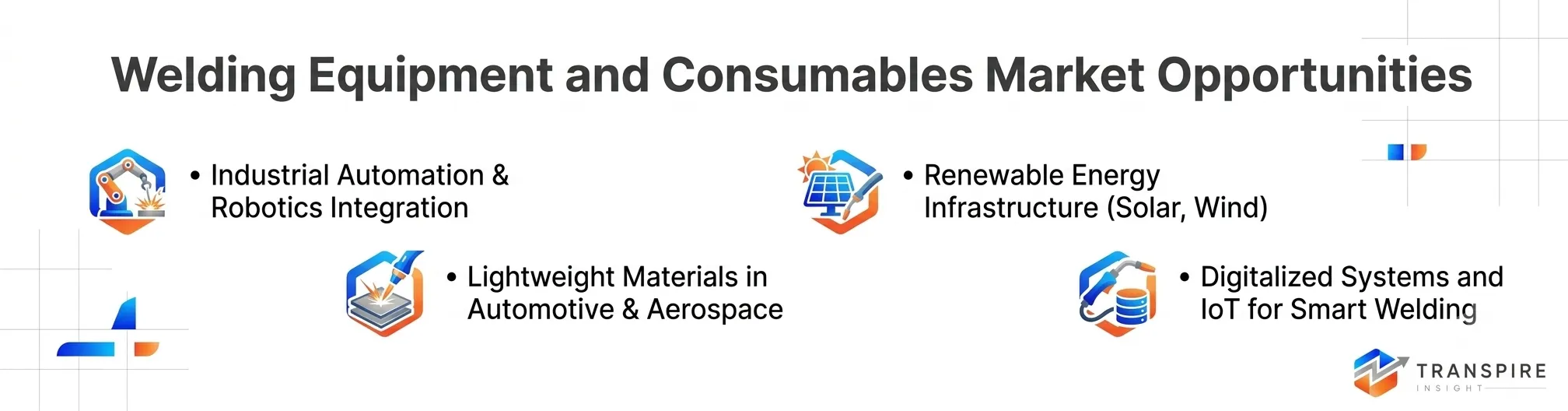
According to a research report published by Transpire Insight, the welding equipment and consumables market size is projected to grow from USD 15.48 billion in 2026 to USD 25.37 billion by 2035, at a CAGR of 5.15% during the forecast period 2027-2035. Market growth is propelled by expanding infrastructure projects, surging automotive and EV production, rapid adoption of industrial automation, and increasing reliance on advanced lightweight alloy joinery that requires high-performance consumables.
Introduction
The welding equipment and consumables market serves as a cornerstone of structural assembly, metal joining, and industrial manufacturing across diverse sectors. Valued at tens of billions of dollars, the industry plays a critical role in heavy engineering, ship construction, automotive assembly, and commercial infrastructure development. Driven by digital integration, high-tech filler materials, and precision power sources, the market remains vital for modern industrial growth.
Recent Development News
Stay Ahead of Emerging Opportunities with Expert Market Insights by Transpire Insight
Transpire Insight provides comprehensive, data-driven market intelligence to support smarter business decisions. Our research is rooted in comprehensive analysis, authoritative predictions, and industry expertise, enabling organizations to make informed decisions in rapidly evolving markets. In-depth analysis of market segmentation, competitive positioning, regional trends, and emerging investment opportunities in high-growth areas. We blend accuracy with actionable intelligence, empowering companies to uncover new avenues for growth, bolster strategic decision-making, and stay ahead in a dynamic market.
Welding Equipment and Consumables Market Size & Statistics
Regional Growth and Demand Analysis by Transpire Insight
Asia-Pacific's leadership rests on the concentrated shipbuilding, automotive, and heavy engineering base of China, Japan, South Korea, and India. Chinese yards continue to hold the largest shipbuilding order books, sustaining bulk demand for arc welding consumables and automated welding lines, while Japanese firms such as Panasonic and DAIHEN keep expanding robotic welding portfolios for automotive OEMs. India's infrastructure push, including metro rail expansion and highway corridor projects, is pulling in fresh demand for structural steel welding, and government-backed manufacturing incentives are drawing consumable producers to localize flux, wire, and electrode production closer to end users rather than relying on imports. South Korea's shipbuilders, including Hyundai Heavy Industries, are simultaneously investing in laser and hybrid welding to cut fabrication time on LNG carriers, reinforcing the region's pull on both equipment and consumable spending.
Europe's faster pace is being driven by regulation and reinvestment rather than sheer volume. EU sustainability rules are pushing manufacturers to replace older, inefficient machines with digitally controlled, networked welding systems, forcing a continuous capital expenditure cycle across the automotive, construction, and heavy engineering sectors. Germany's auto sector is leading this shift toward AI-integrated and robotic welding lines, while France is registering the highest country-level CAGR in the region on the back of defense and nuclear-linked fabrication work. The consumables side is moving in parallel, with flux-cored wires gaining share in shipbuilding and heavy industry applications for their high-deposition performance, and eco-friendly, recyclable formulations spreading fastest in this region as manufacturers respond to circular-economy mandates.
Top 15 Trends in the Welding Equipment and Consumables Market
Rising adoption of robotic and automated welding systems
Manufacturers across automotive and heavy engineering sectors are deploying robotic welding cells to boost throughput, reduce labor dependency, and maintain consistent weld quality at scale.
Growth of laser beam welding technology
Laser beam welding is steadily replacing conventional arc processes across automotive and electronics manufacturing, offering superior precision, faster cycle times, and minimal heat-affected weld zones.
Shift toward eco-friendly, low-emission welding consumables
European Union sustainability regulations are pushing manufacturers toward low-emission, recyclable welding consumables, prompting flux and wire producers to reformulate products for stricter environmental compliance standards.
Expansion of AI-integrated digital welding power sources
Welding equipment makers are embedding AI-driven digital controls and IoT connectivity into power sources, enabling real-time weld quality monitoring, predictive maintenance, and remote fleet management.
Increasing demand from EV battery pack assembly
Electric vehicle battery pack manufacturing is driving demand for precision laser and resistance welding equipment capable of joining thin, dissimilar metals without compromising battery safety.
Increasing adoption of cobots in metal fabrication
Small and mid-sized fabricators are adopting collaborative robots, or cobots, to automate repetitive welds affordably, addressing skilled-welder shortages while preserving flexibility for custom, low-volume production.
leader in designing, developing, and manufacturing arc welding solutions.
Founded: 1895 | HQ: Cleveland, Ohio, USA.
Why It Ranks: Holds the top market share with unparalleled distribution network reach.
Regional Dominance: Strong market presence across North America, Europe, and Asia-Pacific regions.
Product Line: Advanced arc welders, robotic systems, stick electrodes, and flux-cored wires.
Key innovator producing premium Miller-branded industrial welding power sources globally.
Founded: 1912 | HQ: Glenview, Illinois, USA.
Why It Ranks: Recognized widely for high reliability, premium build quality, and field-tested performance.
Regional Dominance: Dominates commercial fabrication and heavy construction markets across North America.
Product Line: TIG, MIG, engine-driven welders, plasma cutters, and filler metals.
Worldwide leader in comprehensive cutting, digital control, and heavy welding systems.
Founded: 1904 | HQ: North Bethesda, Maryland, USA.
Why It Ranks: Top-tier brand offering complete end-to-end welding and cutting ecosystems.
Regional Dominance: Holds commanding presence in Europe, North America, and South America.
Product Line: Filler metals, automated welding systems, digital software, and protective gear.
Austrian pioneer specializing in high-precision, digital inverter welding power supplies.
Founded: 1945 | HQ: Pettenbach, Austria.
Why It Ranks: Tech innovation leader in robotic MIG/MAG and high-end automated joining.
Regional Dominance: Extremely strong market footprint across Western and Central European manufacturing sectors.
Product Line: TPS/i intelligence welders, digital power sources, and automation components.
Japanese automation giant providing integrated robotic arc welding solution suites.
Founded: 1918 | HQ: Kadoma, Osaka, Japan.
Why It Ranks: Premier choice for high-speed automated automotive assembly lines worldwide.
Regional Dominance: Commands huge market presence in Japan and across East Asia.
Product Line: Robotic arms, laser welding heads, and inverter power supplies.
industrial gas power offering specialized welding, cutting, and shielding technologies.
Founded: 1902 | HQ: Paris, France.
Why It Ranks: Unmatched integration of shielding gas mixtures and advanced hardware delivery.
Regional Dominance: Major leadership across European industrial centers and expanded Asian operations.
Product Line: Shielding gas blends, oxy-fuel gear, plasma machines, and consumables.
Premier chemical and atmospheric gas company producing high-purity welding consumables.
Founded: 1879 | HQ: Woking, United Kingdom.
Why It Ranks: Massive supply capabilities for industrial, gas-shielded arc welding operations globally.
Regional Dominance: reach spanning North America, Europe, and Asia-Pacific markets.
Product Line: Special gases, arc welders, safety wear, and specialty flux consumables.
Major steel producer renowned for high-grade welding wires and specialized flux-cored wires.
Founded: 1905 | HQ: Kobe, Hyogo, Japan.
Why It Ranks: Preferred consumable supplier for shipbuilding and structural steel applications.
Regional Dominance: Dominates marine fabrication and infrastructure sectors across East Asia.
Product Line: Solid wires, flux-cored wires, stick electrodes, and flux materials.
Leading manufacturer of industrial robots, power sources, and automated welding systems.
Founded: 1919 | HQ: Osaka, Japan.
Why It Ranks: High reputation for seamless synergy between robotic manipulators and power sources.
Regional Dominance: Strong dominance in East Asian and North American heavy industry markets.
Product Line: Weldee robots, TIG power sources, and automated torch assemblies.
Specialized manufacturer offering elite joint welding and brazing filler materials.
Founded: 1926 | HQ: Linz, Austria.
Why It Ranks: Unrivaled technical expertise in stainless steel and high-alloy joining applications.
Regional Dominance: Industry staple across Europe and expanding rapidly in the Americas/Asia.
Product Line: Cored wires, bare rods, covered electrodes, and submerged arc flux.
Conclusion
The welding equipment and consumables market remains an indispensable engine of modern manufacturing. Driven by infrastructure investments and rapid industrial automation, key players are advancing high-performance filler metals, digitized inverter sources, and collaborative robotic joinery. As heavy industries transition toward sustainable, IoT-connected, and energy-efficient practices, these 25 industry leaders will continue shaping fabrication standards, ensuring structural reliability, operational precision, and heightened productivity across all major sectors worldwide.


Send us a brief description of your challenge and we'll get back to you within 24 hours.

 inquiry@transpireinsight.com
 APAC:+91 7666513636
 Address


