
Global Welding Equipment and Consumables Market Size & Forecast:
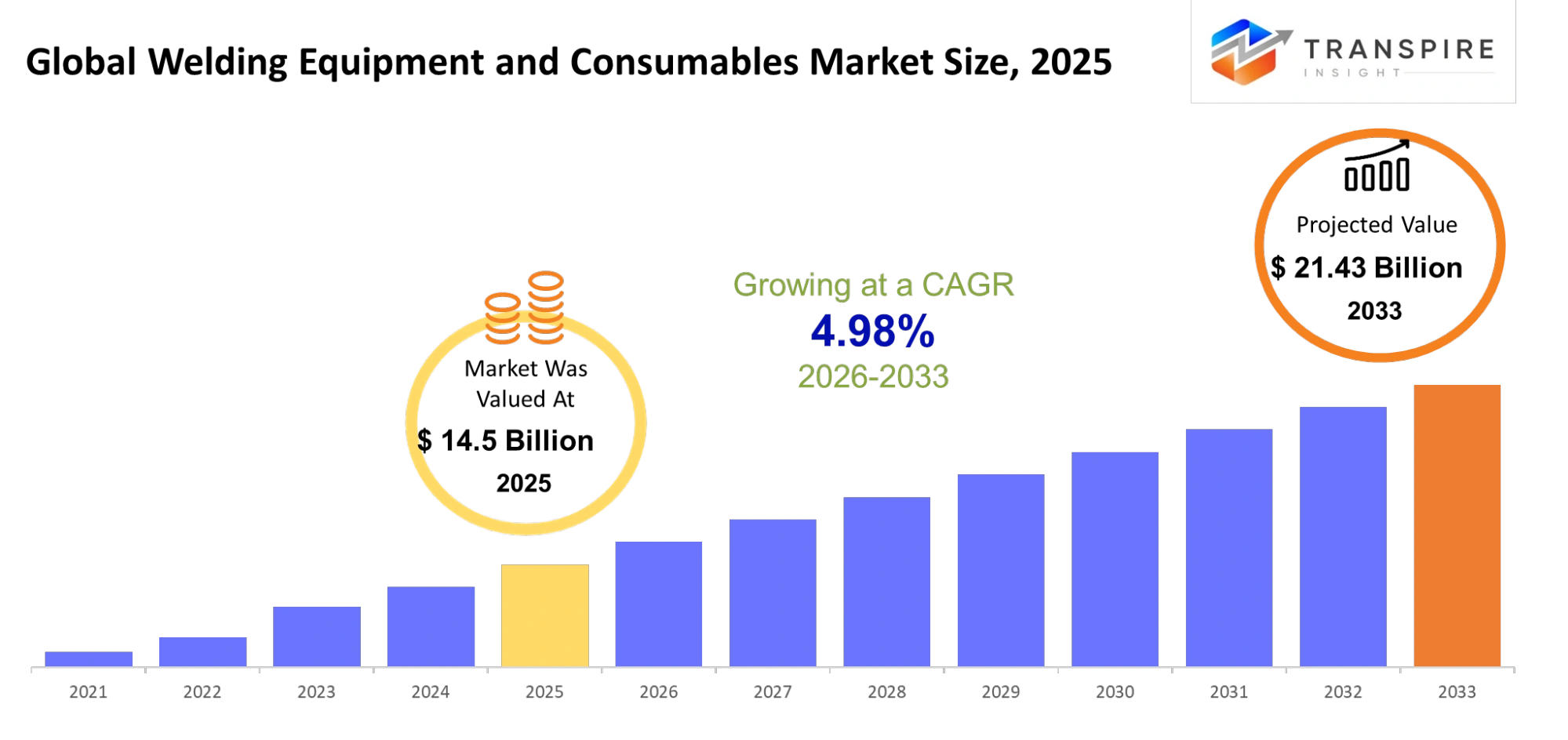
Global Welding Equipment and Consumables Market Size 2025: USD 14.5 Billion
Global Welding Equipment and Consumables Market Size 2033: USD 21.43 Billion
Global Welding Equipment and Consumables Market CAGR: 4.98%
Global Welding Equipment and Consumables Market Segments: By Product Type (Arc Welding Equipment, Resistance Welding Equipment, Oxy-fuel Welding Equipment), By Consumables (Electrodes, Flux-cored Wires, Solid Wires, Fluxes), By End-User Industry (Automotive, Construction, Shipbuilding, Oil & Gas).
To learn more about this report,  Download Free Sample Report
Global Welding Equipment and Consumables Market Summary:
The Global Welding Equipment and Consumables Market was valued at USD 14.5 billion in 2025 and is projected to reach USD 21.43 billion by 2033, at a CAGR of 4.98% from 2026 to 2033. Welding is a permanent joining process used by almost all manufacturing and construction industries that handle metal. The industry really covers both the equipment side - the power sources, torches, wire feeders, and positioning systems that actually do the weld - and the consumables side - the electrodes, wires, fluxes, and shielding gases that are used up or deposited during welding itself and need to be constantly replenished. That consumables part is really crucial structurally: once a welding system is installed, the operator buys consumables for the life of the machine - which gives consumable suppliers a very stable income stream, less affected by capital expenditure cycles than the sales of equipment.
The concentration also really shows arc welding's dominance as the most popular joining method across the widest variety of industrial applications. Within arc welding, MIG/MAG (GMAW), TIG (GTAW), and stick (SMAW) are the three process types that cover the vast majority of actual welding work in the industrial world. MIG/MAG is sort of the backbone of automotive and general fabrication since it is quick, very easy to automate, and produces highly consistent welds using either solid wire or flux-cored wire consumables. TIG is slower, yet produces the cleanest, most controllable welds, making it the preferred process for stainless steel, aluminum, and very thin-gauge materials in aerospace, food processing, and quite precise fabrication. Stick welding remains quite relevant in construction and maintenance work where portability and tolerance of contaminated base metal surfaces are more important than speed or appearance itself.
Consumables really make up a large portion of our total market revenue and have really different demand patterns compared to equipment. A fabrication shop might upgrade its MIG welders every ten to fifteen years - but buys wire and electrodes every week. The ratio of consumable spend to equipment spend in a typical industrial welding operation is heavily weighted towards consumables for many years. This makes the consumables segment really attractive to suppliers who can become preferred vendors with big users since the cost of switching includes requalifying weld procedures, retesting samples, and retraining operators on different product behavior.
The actual end-user mix is quite diverse indeed. Automotive is the single biggest industry, driving a huge demand for resistance welding equipment in body shop operations - and for solid wire MIG consumables in both manual and robotic welding. Construction buys a whole lot of electrode and flux-cored wire consumables for structural steel and site welding work all the time. Shipbuilding is another highly technical sector that uses a really wide variety of processes and requires weld procedure qualification under the strictest classification society rules.
Key Market Trends & Insights:
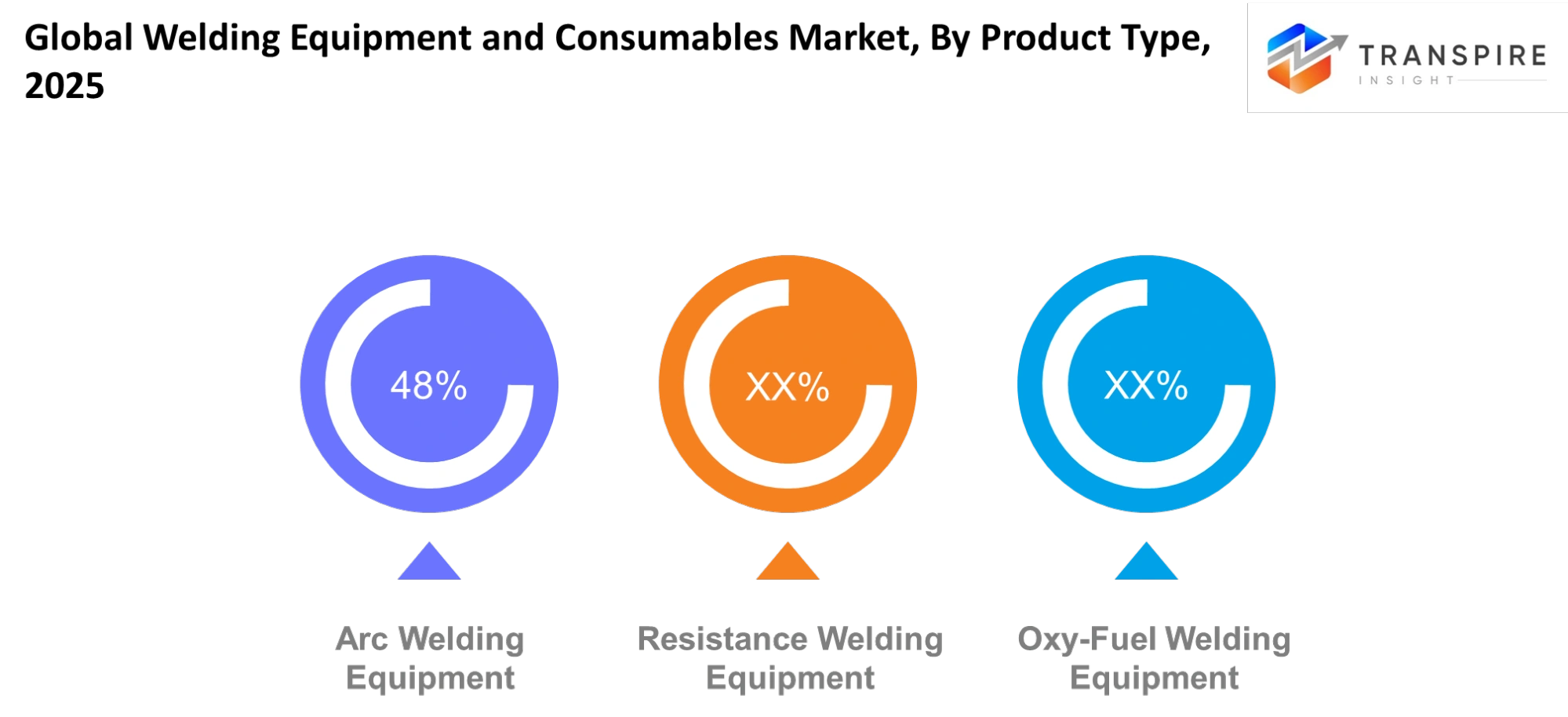
- Arc welding equipment accounts for approximately 48% of Global Welding Equipment and Consumables Market revenue, with MIG/MAG, TIG, and stick process variants collectively covering the widest range of industrial welding applications.
- Consumables generate recurring revenue that persists through equipment replacement cycles, making them structurally more stable than capital equipment sales across the economic cycle.
- Robotic and automated welding is growing its share of automotive and heavy fabrication operations, pulling demand toward systems-level welding solutions that combine power source, wire feeder, torch, and motion control rather than standalone equipment.
- Flux-cored wire has gained ground versus solid wire in shipbuilding and heavy structural fabrication because its deposition rate at higher amperages and tolerance of less-than-ideal surface conditions reduce cycle time in environments where weld prep is difficult.
- The skilled welder shortage is an active problem in North America, Europe, and parts of Asia, and it is pushing fabricators toward process automation, semi-automatic systems with simplified operator interfaces, and cobot welding platforms that allow less-experienced operators to produce consistent welds under automated guidance.
Global Welding Equipment and Consumables Market Segmentation
By Product Type
Arc Welding Equipment: Arc welding equipment comprises the biggest product segment in the Global Welding Equipment and Consumables Market - about 48% of our total revenue. Arc welding involves an electrical arc struck between a consumable wire or an electrode and your base metal to create all the heat required to fuse your joint. This category really covers MIG/MAG power sources, wire feeders, TIG welders, stick welders, submerged arc welding systems for heavy steel plate work, and plasma arc systems both for cutting and for special types of joining. Modern arc welding power sources rely on inverters, making them much lighter, even more energy-efficient, and able to achieve a lot more precise arc control over the transformer-rectifier machines from before. Inverter technology also made it possible to develop pulse and double-pulse MIG processes that decrease the heat input, minimize the amount of spatter produced, and let you weld thinner materials much more effectively with a better appearance. Automation of arc welding through robotic cells and cobot platforms is one of the very most active areas of product development at the major equipment manufacturers.
Resistance Welding Equipment: Resistance welding really relies on electrical resistance at the point where two metal sheets overlap to create heat and form a weld nugget under applied force - all without the need for any filler material. Spot welding, essentially the most common resistance welding process, is actually the leading joining method in automotive body shop activities: a modern vehicle body will have many thousands of spot welds created by robotic spot welding guns working at cycle times measured in parts of a second. Seam welding uses rotating wheel electrodes to make a continuous or overlapping weld bead - and is really used for fuel tanks, heat exchangers, and sheet metal components requiring a tight seal. Resistance welding equipment doesn't consume wire or electrodes like arc welding does, but the electrode caps contacting your workpiece wear out and need regular replacement, creating a relatively small but still real consumable demand in high-volume automotive production.
Oxy-Fuel Welding Equipment: Oxy-fuel welding and cutting uses the combustion of a fuel gas (most commonly acetylene) with pure oxygen to generate a flame so hot that it melts steel and other metals itself. When used as a welding process, oxy-fuel has largely given way to arc welding in industrial applications - arc methods are faster, more controllable and much better suited to automation. However, oxy-fuel really stands out as a cutting process - especially for very thick plate and structural sections where flame cutting is right up there with plasma and laser on cost - and even beats them when it comes to site cutting where its portability is key. It also stays in play for maintenance and repair tasks on older equipment, for torch brazing of copper and brass parts, and in markets where electrode and wire consumables or electrical power are harder to get. The product type is making up a decreasing share of the Global Welding Equipment and Consumables Market in very developed industrial countries, although demand persists in a few developing market applications.
To learn more about this report, Download Free Sample Report
By Consumables
Electrodes: Electrodes for stick welding - also called covered or coated electrodes - are among the oldest and most widely used welding consumables. A flux coating on the electrode rod gives us a shielding gas through combustion, deoxidizers, and slag formers that really protect the weld pool from atmospheric contamination - and they even influence the mechanical properties of the deposited weld metal. Different electrode classifications are designed for specific base metal compositions, position requirements, and mechanical property targets. Electrodes are used wherever portability and tolerance of changing conditions count for a lot more than deposition rate: construction site welding, maintenance and repair, field fabrication, and developing market manufacturing all use stick electrodes in huge quantities. Electrode demand is particularly high in Asia and the Middle East - where construction and infrastructure development at a very large scale generates a significant amount of consumable usage.
Flux-cored Wires: Flux-cored wires are tubular wires with a powdered flux core that offers shielding and metallurgical benefits - just like coated electrodes, but in a continuous wire format that's compatible with semi-automatic and automatic wire feeders. They give you a higher deposition rate than solid wire at about the same amperage, perform better in vertical and overhead positions, and have a much greater tolerance of mill scale and surface contamination than solid wire MIG processes. These characteristics really make flux-cored wire the most popular consumable for heavy structural fabrication, shipbuilding, and offshore construction - especially when weld preparation is difficult, welding in many different positions is necessary, and the deposition rate has a big impact on our productivity. Self-shielded flux-cored wires - which don't need an external gas shielding - are used for outdoor structural welding wherever the wind could ruin your gas shield. Gas-shielded variants, however, require a shielding gas supply - but they produce better weld quality, so they're chosen in controlled fabrication environments.
Solid Wires: Solid wires represent the predominant consumable in MIG/MAG welding of carbon steel, stainless steel, and aluminum. They are employed with a shielding gas, often a blend of argon and carbon dioxide for carbon steel - or pure argon for stainless and aluminum - to protect the weld pool from oxidation. Solid wire is the standard consumable in automotive body shop robotic welding, general fabrication shops, and any application where consistent arc behavior, very little spatter, and a very good appearance are the main welding performance criteria. Wire is supplied on spools or drums for high-output applications - and the amount consumed in a rather large fabrication or automotive operation is quite large enough that wire pricing and availability are real purchasing considerations. Copper-coated wire is the standard for carbon steel applications; copper-free variants have been produced for applications where copper contamination of the weld is a concern.
Fluxes: Fluxes are used in submerged arc welding, a high-deposition process for really thick plates and heavy structural work where the arc burns under a layer of granular flux providing complete shielding and influencing the weld chemistry and mechanical properties of the deposited metal itself. Submerged arc welding is employed for the longitudinal and circumferential seams in large-diameter pipes, pressure vessels, structural beams, and shipbuilding applications where the joint geometry is accessible from above - and the production volume justifies setting up a dedicated welding system. Flux consumption per unit of wire deposited is quite significant, making it a considerable consumable cost in operations that use the process a lot. Flux composition is chosen in combination with the wire to achieve very specific mechanical property targets, especially notch toughness at low temperatures for pipelines and offshore structures operating in very cold environments itself.
By End-User Industry
Automotive: Automotive is the biggest consumer market in the global welding equipment and consumables market. Vehicle body assembly pretty much counts on resistance spot welding for sheet metal joining all the time, while powertrain components, frames, exhaust systems, and structural subassemblies make use of arc welding methods with solid wire and flux-cored wire consumables quite a bit. The move toward electric vehicles hasn't decreased the significance of welding in automotive manufacturing, though it's changed the recipe somewhat: EV battery enclosures and structural reinforcements for battery pack integration require welding processes and joint designs adapted to the different materials and very tight tolerances of battery-electric platforms quite well. Robotic welding really dominates in body shop and high-volume component welding, and the automotive sector drives demand for robotic welding systems and those high-volume solid wire consumables they consume mainly.
Construction: Construction really makes use of welding quite a lot for structural steel fabrication - both in the workshop setting preparing beams and columns before they get to the site and out in the field where connections are set up during construction. Stick electrodes and flux-cored wires are the primary consumables for structural steel welding mostly, with process choice often decided by joint position, how easily we can get to it, and the qualification requirements of the relevant structural welding code, like AWS D1. 1 in the US or EN 1090 in Europe. Infrastructure projects, such as bridges, stadiums, industrial buildings, and energy facilities, really create concentrated weld amounts. The construction segment is cyclical and tied quite closely to investment in the built environment instead of day-to-day manufacturing, so welding equipment and consumable demand from construction tracks infrastructure spending cycles quite well with a little delay.
Shipbuilding: Shipbuilding is one of the most technically demanding welding end-users - it consumes vast amounts of consumables primarily consisting of flux-cored wire and electrodes for assembling ship hull sections, bulkheads, decks, and structural components. All weld procedures in shipbuilding need to be qualified under the rules of a classification society - like Lloyd's Register, DNV, or Bureau Veritas - that govern both the process parameters and the mechanical property requirements of the deposited weld metal. This qualification requirement really means that shipyards are very cautious with their consumable procurement practices: changing a supplier requires requalification of the weld procedure, which takes time and resources. Large shipbuilding countries - including China, South Korea, and Japan - dominate production volume and thus consumable consumption. Korean and Japanese yards in particular remain highly productive through investments in mechanized and automated welding for the routine structural weld joints making up the bulk of man-hours in ship assembly.
Oil & Gas: Oil and gas welding covers the construction and maintenance of pipelines, fabrication of pressure vessels, refinery piping, offshore platform construction, and welding of wellhead and subsea equipment. A common thread running through all these applications is that the welds are either pressure-containing or structurally critical - so weld procedure qualification, non-destructive testing, and traceability of consumable lot numbers are essential rather than optional. Premium wire and electrode consumables with very strict chemistry tolerances and guaranteed low-temperature toughness are specified for pipelines and offshore applications operating in extremely cold climates. Consumable selection in oil and gas is mainly determined by the applicable code - typically API 1104 for pipelines or ASME Section IX for pressure vessels - much more than by cost, which really helps price out suppliers that consistently meet the necessary classifications.
Regional Insights
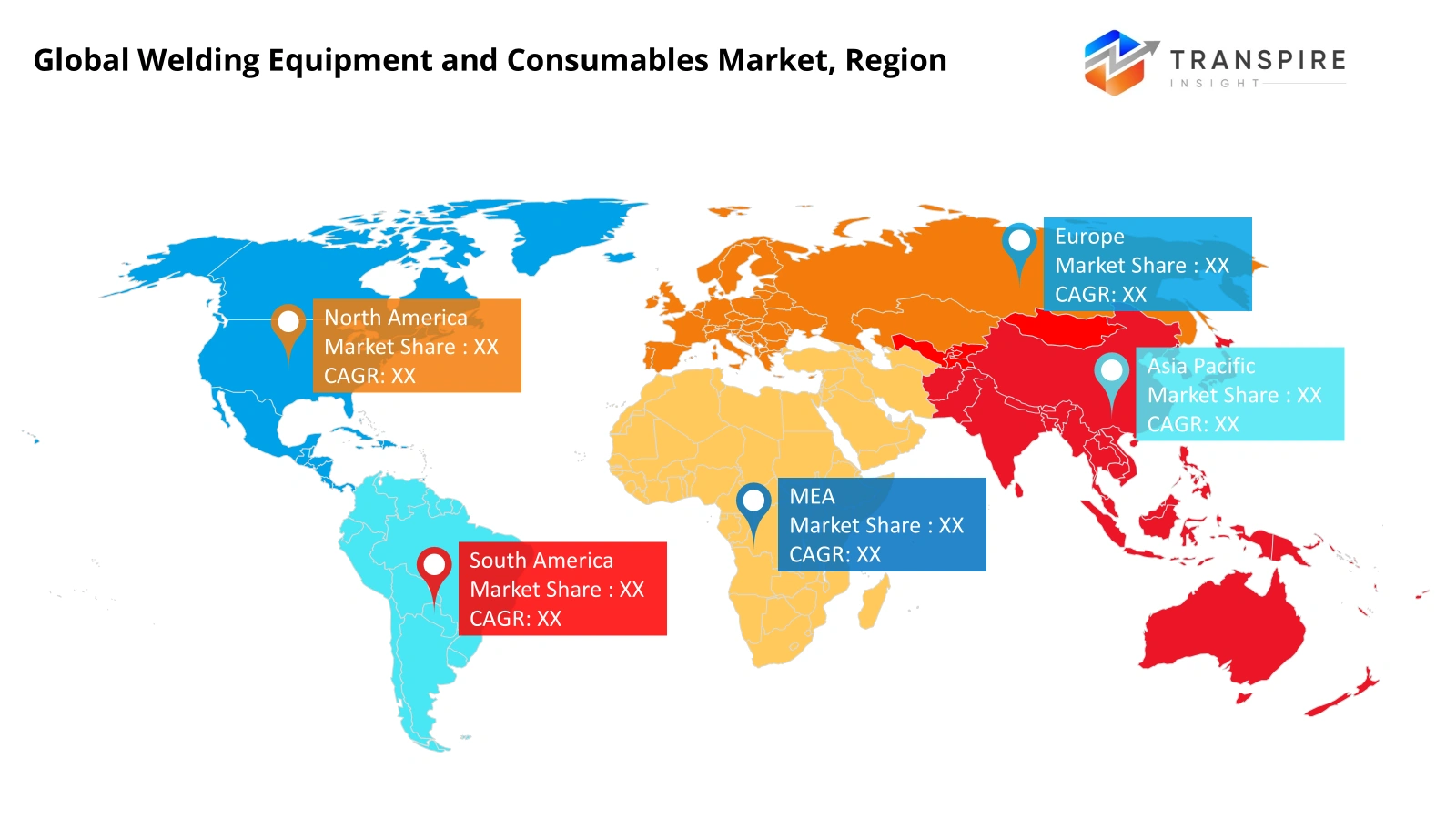
Asia-Pacific is our largest regional market worldwide in the global welding equipment and consumables market - thanks to an enormous amount of manufacturing, shipbuilding, construction, and infrastructure investment happening every day across China, Japan, South Korea, and India. China remains our biggest single national market for both welding equipment and consumables, with homegrown companies like Jasic Technology and many other smaller electrode and wire producers serving the local market - along with imports from the major international brands. South Korea and Japan consume a great deal of welding consumables through their shipbuilding industries, while also hosting some major consumable manufacturers, such as Hyundai Welding and Kobe Steel, that export products all over the world.
India possesses a very large and continuously growing welding market, driven by infrastructure spending, automotive production expansion, and a manufacturing sector that keeps investing to increase domestic production across many different sectors from defense to rail. Ador Welding is actually the best-known homegrown name in Indian consumables, although the market is quite competitive indeed with imported and domestically produced alternatives available in all sorts of process categories.
North America is our second-largest regional market, with the United States housing the headquarters of Lincoln Electric and Miller Electric - two of the most recognized welding brands around the globe. US demand is quite dispersed throughout the automotive, energy, construction, and general fabrication sectors, with the oil and gas sector particularly driving demand for high-end pipeline welding consumables. The movement of manufacturing back into the US across multiple sectors has really helped increase the demand for welding equipment in recent years.
Europe has a lot of solid domestic welding equipment manufacturers, with ESAB, Fronius, Kemppi, and Lincoln Electric's European operations all competing in a market where automotive, heavy fabrication, shipbuilding in Germany and Scandinavia, and energy infrastructure investment all support demand all the time. European laws on the environment and efficiency have greatly sped up the adoption of inverter power sources and pulse processes - which use less energy and produce fewer fumes when compared to traditional welding methods per weld.
To learn more about this report, Download Free Sample Report
Recent Development News
September 2023 – Lincoln Electric expanded its Cooper™ Cobot Welding System portfolio with enhanced user interface and faster deployment features.
March 2024 – Introduced updates focused on SME fabricators, improving ease-of-use and integration with existing welding power sources.
Report Metrics
|
Report Metrics |
Details |
|
Market size value in 2025 |
USD 14.5 Billion |
|
Market size value in 2026 |
USD 15.254 Billion |
|
Revenue forecast in 2033 |
USD 21.43 Billion |
|
Growth rate |
CAGR of 4.98% from 2026 to 2033 |
|
Base year |
2025 |
|
Historical data |
2021 - 2024 |
|
Forecast period |
2026 - 2033 |
|
Report coverage |
Revenue forecast, competitive landscape, growth factors, and trends |
|
Regional scope |
Global |
|
Key company profiled |
Lincoln Electric Holdings Inc., Illinois Tool Works Inc., ESAB Corporation, Fronius International GmbH, Panasonic Corporation, Kemppi Oy, Miller Electric Mfg. LLC, Air Liquide S.A., Kobe Steel Ltd., Voestalpine Böhler Welding GmbH, Ador Welding Ltd., Colfax Corporation, Hyundai Welding Co. Ltd., Daihen Corporation, Jasic Technology Co. Ltd. |
|
Customization scope |
Free report customization (country, regional & segment scope). Avail customized purchase options to meet your exact research needs. |
|
Report Segmentation |
By Product Type (Arc Welding Equipment, Resistance Welding Equipment, Oxy-fuel Welding Equipment), By Consumables (Electrodes, Flux-cored Wires, Solid Wires, Fluxes), By End-User Industry (Automotive, Construction, Shipbuilding, Oil & Gas). |
Key Global Welding Equipment and Consumables Company Insights
The global welding equipment and consumables market sees a few key players competing worldwide across both equipment and consumables, while having many more manufacturers that excel in one area or in one region. Lincoln Electric and Illinois Tool Works - via its Hobart and Miller brands - represent the two largest North American players, each offering the entire range from entry-level stick welders to robotic welding systems - plus all the consumables associated with them. ESAB, after separating from Colfax and engaging in various acquisitions, also competes globally across equipment and consumables - really demonstrating its strength in Europe and in consumables for heavy fabrication and shipbuilding.
Fronius is well known for the quality and high precision of its inverter power sources - especially in pulse MIG and TIG applications - and thus holds a significant position in the automotive and precise fabrication industries - without really targeting the high-volume, commodified end of the consumables market. Kemppi occupies a similar spot in Europe, thanks to its software-integrated welding management systems setting it apart from other manufacturers - along with the quality of its hardware. On the consumables side, Kobe Steel and Hyundai Welding are the two leading global suppliers of electrodes and wires with quite a presence in the Asian shipbuilding market. Voestalpine Böhler Welding competes in the premium end of the wire and electrode market for highly demanding applications in oil and gas, power generation, and offshore construction where weld quality demands really justify higher-priced consumables.
Company List
- Lincoln Electric Holdings Inc.
- Illinois Tool Works Inc.
- ESAB Corporation
- Fronius International GmbH
- Panasonic Corporation
- Kemppi Oy
- Miller Electric Mfg. LLC
- Air Liquide S.A.
- Kobe Steel Ltd.
- Voestalpine Böhler Welding GmbH
- Ador Welding Ltd.
- Colfax Corporation
- Hyundai Welding Co. Ltd.
- Daihen Corporation
- Jasic Technology Co. Ltd.
Global Welding Equipment and Consumables Market Report Segmentation
By Product Type
- Arc Welding Equipment
- Resistance Welding Equipment
- Oxy-fuel Welding Equipment
By Consumables
- Electrodes
- Flux-cored Wires
- Solid Wires
- Fluxes
By End-User Industry
- Automotive
- Construction
- Shipbuilding
- Oil & Gas
Frequently Asked Questions
Find quick answers to common questions.
The Global Welding Equipment and Consumables Market is expected to reach approximately USD 21.43 billion by 2033.
Key segments include Product Type (Arc Welding Equipment, Resistance Welding Equipment, Oxy-fuel Welding Equipment), Consumables (Electrodes, Flux-cored Wires, Solid Wires, Fluxes), and End-User Industry (Automotive, Construction, Shipbuilding, Oil & Gas).
Major players include Lincoln Electric Holdings Inc., Illinois Tool Works Inc., ESAB Corporation, Fronius International GmbH, Panasonic Corporation, Kemppi Oy, Miller Electric Mfg. LLC, Air Liquide S.A., Kobe Steel Ltd., Voestalpine Böhler Welding GmbH, Ador Welding Ltd., Colfax Corporation, Hyundai Welding Co. Ltd., Daihen Corporation, and Jasic Technology Co. Ltd.
The Global Welding Equipment and Consumables Market size is approximately USD 14.5 billion in 2025.
The Global Welding Equipment and Consumables Market is expected to grow at a CAGR of 4.98% from 2026 to 2033.
- Lincoln Electric Holdings Inc.
- Illinois Tool Works Inc.
- ESAB Corporation
- Fronius International GmbH
- Panasonic Corporation
- Kemppi Oy
- Miller Electric Mfg. LLC
- Air Liquide S.A.
- Kobe Steel Ltd.
- Voestalpine Böhler Welding GmbH
- Ador Welding Ltd.
- Colfax Corporation
- Hyundai Welding Co. Ltd.
- Daihen Corporation
- Jasic Technology Co. Ltd.
Recently Published Reports
-
Apr 2026
Healthcare Polymer Packaging Market
Healthcare Polymer Packaging Market Size, Share & Analysis Report By Packaging Type (Syringes, IV Bottles and Pouches, Clamshells, Blisters, Bottles & Jars, Containers, Tubes, IV Parental Packaging, Others), By Type (Regulated, Non-regulated), By Polymer Type (LDPE (Low-Density Polyethylene), HDPE (High-Density Polyethylene), Homo-polymer (Homo), Random Copolymer (Random), Block Copolymer (Block), PET, Polystyrene, Polyvinyl Chloride, Polyamide/EVOH, Others), and Geography (North America, Europe, Asia-Pacific, Middle East and Africa, South and Central America), 2021 - 2031
-
Apr 2026
Hydrophilic Tape (Waterstop) Market
Hydrophilic Tape (Waterstop) Market Size, Share & Analysis Report By Type (Bentonite-Based Hydrophilic Tape, Rubber-Based Hydrophilic Tape), By Application (Residential Buildings, Commercial Buildings, Infrastructure Projects), and Geography (North America, Europe, Asia-Pacific, Middle East and Africa, South and Central America), 2021 - 2031
-
Apr 2026
Metalens Market
Metalens Market Size, Share & Analysis Report By Type (Visible Light Metalens, and Infrared Metalens), By Application (Consumer Electronics, Automotive Electronics, Industrial, Medical, and Others), and Geography (North America, Europe, Asia-Pacific, Middle East and Africa, South and Central America), 2021 - 2031
-
Apr 2026
PBT Resin Market
PBT Resin Market Size, Share & Analysis Report By Type (Reinforced PBT Resin, Unreinforced PBT Resin), By Processing Method (Injection Molding, Extrusion, Blow Molding, Others), By End-User (Automotive, Electrical & Electronics, Consumer Appliances, Industrial Machinery, Medical Devices, Packaging, Others), and Geography (North America, Europe, Asia-Pacific, Middle East and Africa, South and Central America), 2021 - 2031