
Sep 07, 2026
By Transpire Insight
Description
According to a research report published by Transpire Insight, the variable air volume box market size is projected to grow from USD 7.10 billion in 2026 to USD 11.5 billion by 2035, at a CAGR of 8.90% during the forecast period 2027-2035. Strict green building energy codes, fast commercial construction growth, smart HVAC automation, legacy system upgrading, and cost-effective airflow optimization via AI are among the factors promoting market expansion.
Introduction
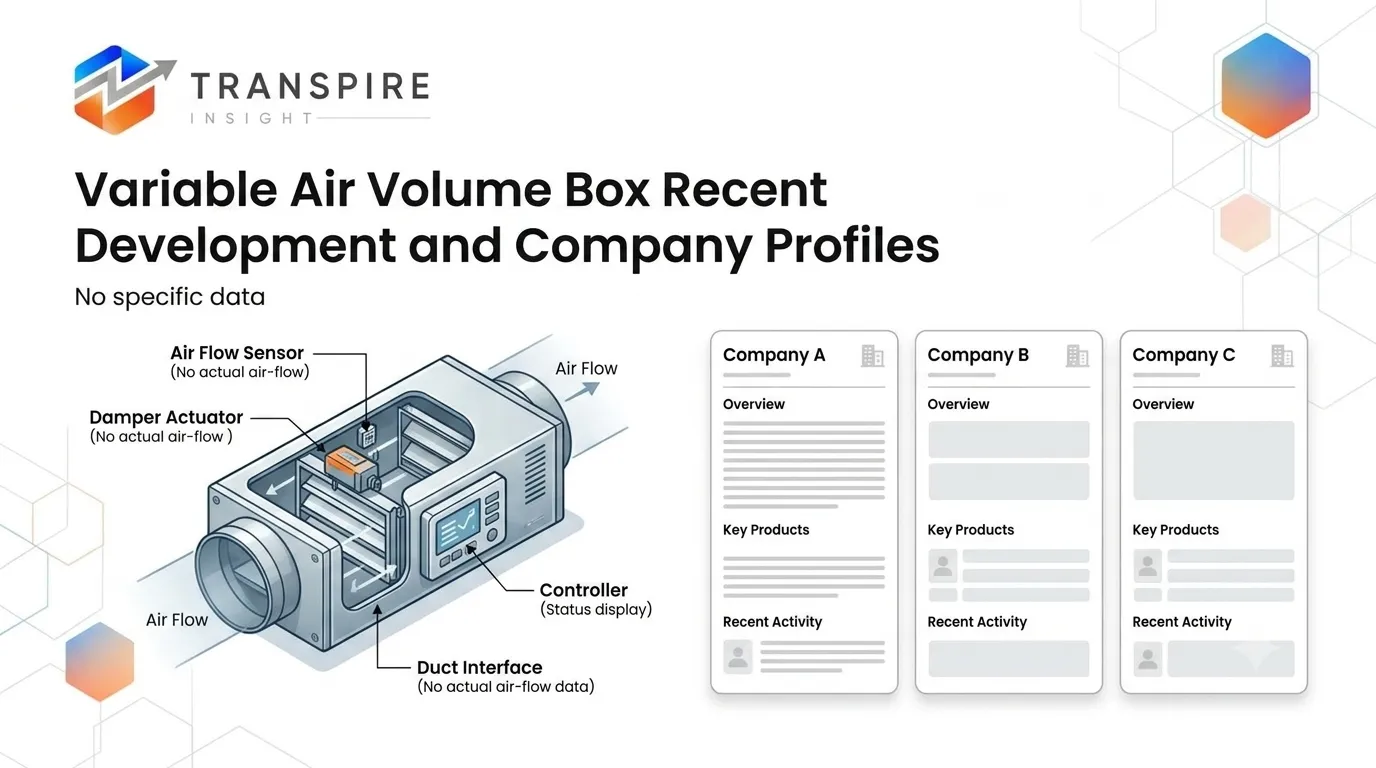
The variable air volume (VAV) box is a major terminal device in present-day HVAC systems that adjusts the airflow inside the thermal zones in real time according to the requirement for heating or cooling. VAV systems control air quantity by changing the amount of air, instead of the constant air flow, to achieve optimum indoor environment quality and significant energy savings. The market is growing quickly, as smart building integration, digital controls, and strict decarbonization demands globally drive the market.
Recent Development News
Stay Ahead of Emerging Opportunities with Expert Market Insights by Transpire Insight
Transpire Insight provides comprehensive, data-driven market intelligence to support smarter business decisions. Our research is rooted in comprehensive analysis, authoritative predictions, and industry expertise, enabling organizations to make informed decisions in rapidly evolving markets. In-depth analysis of market segmentation, competitive positioning, regional trends, and emerging investment opportunities in high-growth areas. We blend accuracy with actionable intelligence, empowering companies to uncover new avenues for growth, bolster strategic decision-making, and stay ahead in a dynamic market.
Variable Air Volume Box Market Size & Statistics
Regional Growth and Demand Analysis by Transpire Insight
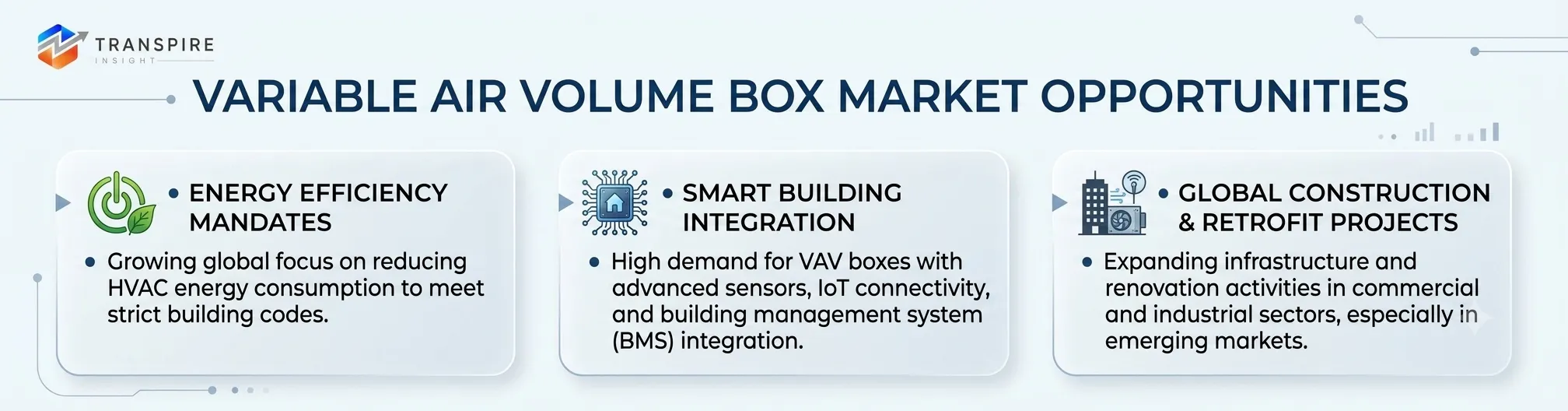
North America's strength is in the high density of aging commercial buildings that are being upgraded, not replaced, by the building owner. Single duct and fan-powered VAV boxes have been in steady demand in office towers, hospitals, and university campuses as the U.S. General Services Administration (GSA) continues its push to modernize federal building HVAC systems, and the upcoming compliance deadline for ASHRAE 90.1 has pushed older constant-volume systems out of service. Canada's push for tighter provincial energy codes is driving other retrofit cycles, and healthcare construction driven by an aging population is keeping replacement demand alive. To stand out in a mature and affordable market, manufacturers are investing more in ECM-motor upgrades and diagnostics via apps.
The growth pattern in Asia Pacific is significantly different due to the focus on new-builds rather than replacement. For the first time, VAV installations are being adopted at scale in China, India and Southeast Asia, driven by the build-out of its Tier 1 and Tier 2 commercial towers, its IT parks and data centers, and Southeast Asia's green building certification momentum (similar to BCA Green Mark in Singapore). The region is not only catching up on installed bases but is also implementing new installations with the addition of IoT airflow sensors, which is putting Japan and South Korea ahead of the pack. These factors indicate that North America is expected to continue to possess the highest share of revenues over the next few years, and Asia-Pacific is catching up with the fastest growth in percentage terms.
Top 15 Trends in the Variable Air Volume Box Market
ECM Motor Adoption
Electronically commutated motors are replacing older pneumatic actuators in VAV boxes, cutting energy draw while giving facility managers finer, more responsive control over zone-level airflow.
Built-in Airflow Sensors
Manufacturers increasingly embed airflow sensors directly into VAV boxes, enabling pressure-independent operation and reducing commissioning time compared with older systems requiring separate sensor installation.
Mobile App-Based Control
Facility teams now adjust setpoints, monitor damper position, and receive fault alerts through smartphone apps, cutting truck rolls and speeding troubleshooting across distributed commercial building portfolios.
IoT-Enabled Predictive Maintenance
Connected VAV boxes stream operating data to cloud platforms, letting building operators flag failing actuators or drifting sensors before comfort complaints arise, reducing unplanned downtime.
Retrofit Demand in Mature Markets
North American and European building owners are replacing constant-volume systems with VAV boxes to meet tightening energy codes, sustaining steady demand without new construction.
Green Building Certification Push
Certifications like LEED and BCA Green Mark increasingly mandate demand-controlled ventilation, pushing architects and mechanical contractors to specify VAV boxes over simpler constant-air-volume alternatives.
List of Top 25 Companies Leading the Variable Air Volume Box Market
1. Carrier Corporation
Offers industry-leading single- and dual-duct VAV terminal units with quiet operation.
Founded: 1915 | HQ: Palm Beach Gardens, Florida, USA.
Why It Ranks: Dominates through expansive distribution networks and pioneering smart HVAC architectures.
Regional Dominance: Strongest market footprint in North America and Western European commercial sectors.
Product Line: Single-duct, dual-duct, and fan-powered VAV terminal units with integrated controls.
2. Trane Technologies plc
Engineers ultra-efficient Varitrane terminal units integrated with advanced digital building controls.
Founded: 1913 | HQ: Swords, Ireland.
Why It Ranks: Recognized globally for high-efficiency terminal units and smart BMS ecosystem integration.
Regional Dominance: Holds major market dominance across North America and key European territories.
Product Line: VariTrane single-duct, fan-powered, and bypass VAV boxes with digital controls.
3. Johnson Controls International plc
Provides comprehensive YORK and Titus VAV box lineups featuring precision airflow controls.
Founded: 1885 | HQ: Cork, Ireland.
Why It Ranks: Market leader in automated building management systems and smart air terminal technology.
Regional Dominance: Leads across North America, Europe, and expanding commercial hubs in Asia.
Product Line: Titus and Metasys integrated single-duct, parallel, and series VAV terminals.
4. Daikin Industries, Ltd.
Manufactures advanced eco-friendly VAV units tailored for high-performance sustainable commercial buildings.
Founded: 1924 | HQ: Osaka, Japan.
Why It Ranks: World's largest HVAC manufacturer leveraging massive R&D resources and scale.
Regional Dominance: Commands primary dominance across Asia-Pacific and rapid growth in European markets.
Product Line: Precise airflow VAV terminal boxes, fan coil units, and smart controls.
5. Honeywell International Inc.
Specializes in intelligent actuators, airflow sensors, and networked controllers for VAV assemblies.
Founded: 1906 | HQ: Charlotte, North Carolina, USA.
Why It Ranks: Premier provider of smart HVAC automation, sensor technology, and dynamic controllers.
Regional Dominance: Maintains massive market presence across North America, Europe, and the Middle East.
Product Line: Smart VAV controllers, pressure-independent actuators, and airflow measuring stations.
6. Siemens AG
Delivers pressure-independent Desigo VAV controllers and high-precision compact terminal actuators globally.
Founded: 1847 | HQ: Munich, Germany.
Why It Ranks: leader in industrial automation, smart infrastructure, and digital building management.
Regional Dominance: Exercises supreme dominance across Europe with major infrastructure influence worldwide.
Product Line: Desigo smart VAV actuators, compact controllers, and dynamic room pressure sensors.
7. Systemair AB
Produces premium noise-attenuated VAV units built for commercial and institutional airflow management.
Founded: 1974 | HQ: Skinnskatteberg, Sweden.
Why It Ranks: Exceptional acoustic engineering and sustainable ventilation solutions drive widespread European adoption.
Regional Dominance: Heavy commercial dominance across Northern, Central, and Eastern European ventilation markets.
Product Line: Circular and rectangular VAV controllers, sound-attenuated units, and pressure regulators.
8. TROX GmbH
World-renowned for developing ultra-precise acoustic and energy-saving VAV terminal devices.
Founded: 1951 | HQ: Neukirchen-Vluyn, Germany.
Why It Ranks: Unmatched reputation for superior acoustics, custom aerodynamics, and premium airflow components.
Regional Dominance: Dominates European commercial real estate and key Middle Eastern development projects.
Product Line: VAV terminal units, smart louvers, sound attenuators, and volume flow limiters.
9. Titus HVAC (Air Distribution Technologies)
Pioneers commercial air distribution products with industry-benchmark fan-powered and single-duct boxes.
Founded: 1946 | HQ: Plano, Texas, USA
Why It Ranks: Benchmark standard brand for commercial air distribution engineering across North America.
Regional Dominance: Exercises heavy market leadership in American commercial, educational, and healthcare builds.
Product Line: Single-duct, dual-duct, quiet fan-powered VAV terminals, and displacement diffusers.
10. Price Industries Limited
Leading manufacturer of high-performance architectural air distribution equipment and specialized terminal units.
Founded: 1949 | HQ: Winnipeg, Manitoba, Canada.
Why It Ranks: Outstanding custom engineering capabilities and rapid delivery times for complex projects.
Regional Dominance: Dominates Canadian commercial markets while holding extensive North American market share.
Product Line: Single-duct VAVs, quiet fan-powered terminals, and retrofitted digital control units.
Conclusion
The Variable Air Volume (VAV) boxes market is moving towards an age of intelligence, with the ability of this technology to automate energy optimisation, deliver exact control, and manage the building seamlessly. With aggressive net zero goals and stringent indoor air quality regulations, top manufacturers are focused on low-leakage design, low-noise acoustics, and native IoT functionality. The need for energy-efficient, sustainable commercial spaces around the world is continuing to drive the growth of retrofitting old infrastructure, and smart VAV systems are still proving vital to the effort.


Send us a brief description of your challenge and we'll get back to you within 24 hours.

 inquiry@transpireinsight.com
 APAC:+91 7666513636
 Address


