

Market Summary
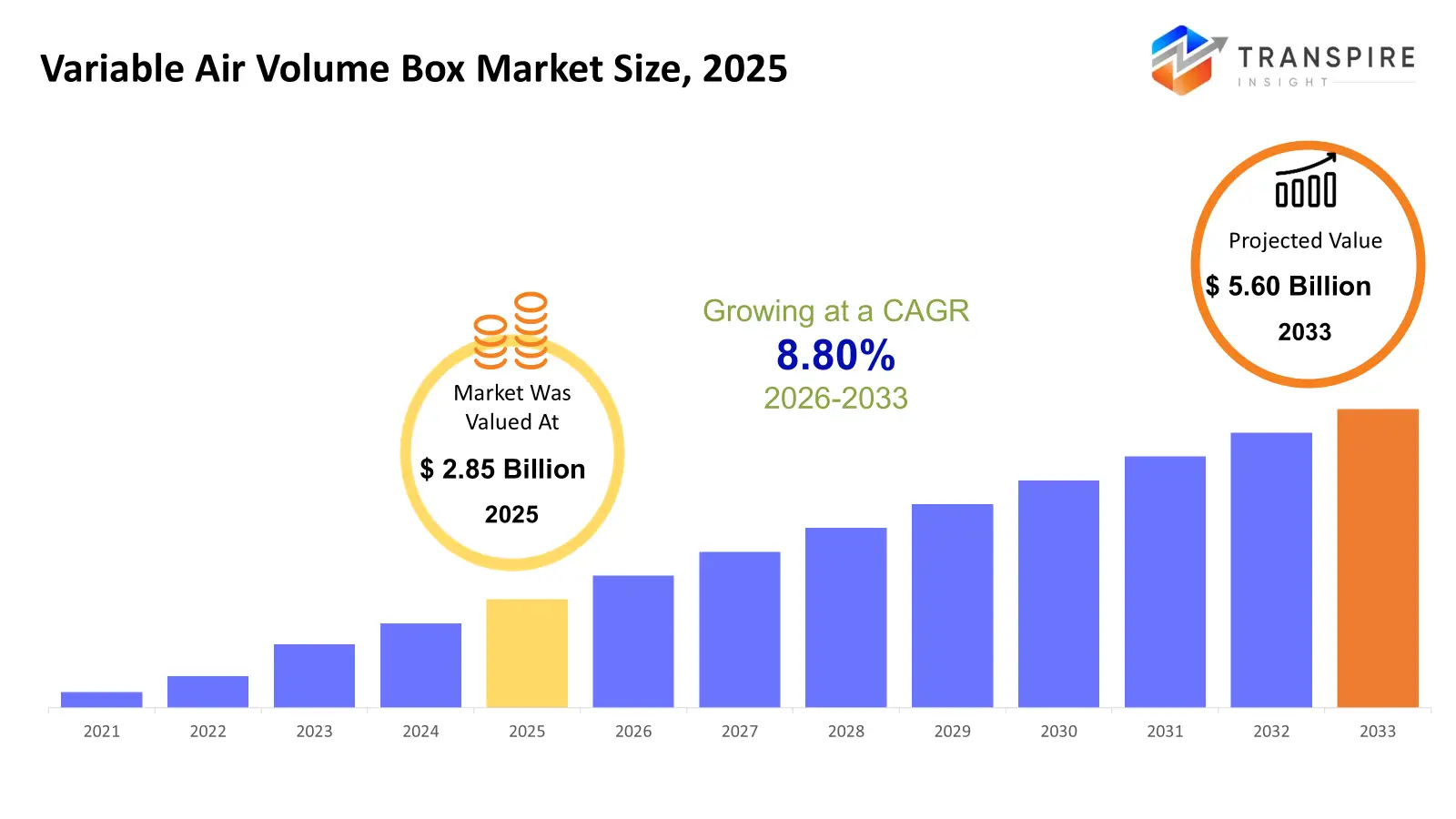
The global Variable Air Volume Box market size was valued at USD 2.85 billion in 2025 and is projected to reach USD 5.60 billion by 2033, growing at a CAGR of 8.80% from 2026 to 2033. The growing need for energy-efficient HVAC solutions due to the increasing focus on energy regulations and sustainability goals is driving the stable adoption of variable air volume systems. Moreover, the rising development of smart buildings and upgrades of existing infrastructure are driving the adoption of automated airflow control systems, which are expected to promote replacement demand in mature markets due to their high efficiency.
Market Size & Forecast
- 2025 Market Size: USD 2.85 Billion
- 2033 Projected Market Size: USD 5.60 Billion
- CAGR (2026-2033): 8.80%
- North America: Largest Market in 2026
- Asia Pacific: Fastest Growing Market
To learn more about this report,  Download Free Sample Report
Key Market Trends Analysis
- The trade dynamics in North America are fueled by robust replacement demand, sophisticated HVAC regulations, and energy efficiency standards, with continuous investments in retrofitting and smart building upgrades driving steady demand for variable air volume box systems in commercial infrastructure.
- The United States trade movement is fueled by very high adoption rates of automated building management systems, robust commercial construction spending, and rising modernization of office and healthcare facilities, driving continuous demand for sophisticated airflow control systems and intelligent HVAC components.
- Asia Pacific trade movement is driven by very high urbanization rates, rising commercial real estate development, and rising investments in energy-efficient infrastructure, with rising imports and domestic manufacturing driving demand for variable air volume systems in emerging markets.
- Single duct variable air volume box system holds the largest share in the type category as architects and building owners focus on cost-effective and easy-to-implement airflow control solutions that meet standardized HVAC system requirements, driving widespread adoption in commercial and office settings worldwide.
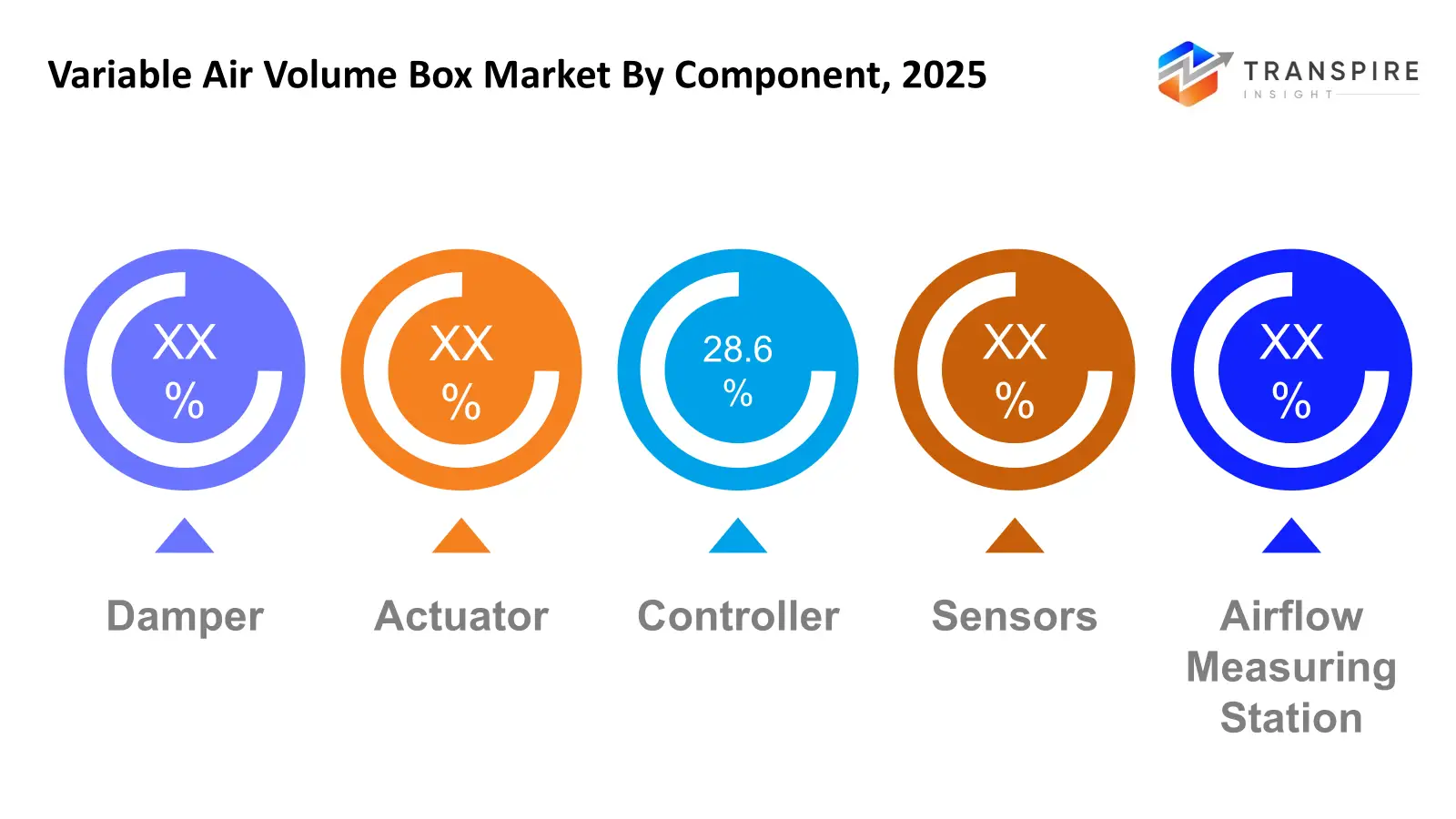
- Controllers lead the component type market because of the increasing adoption of automation and digital monitoring solutions, which make it possible to optimize airflow in real time and save energy, and support centralized building management approaches that are becoming more popular in infrastructure projects.
- Commercial buildings are the leading application type market because of the increasing demand for energy efficiency and sustainability certifications that promote the use of advanced airflow management solutions that can handle varying occupancy rates and improve the performance of large buildings.
- Offices are the largest end-use market because of the growing focus on occupant comfort, zoning, and efficiency, which promotes the use of variable air volume systems that provide precise temperature control while consuming less energy in modern office spaces.
So, The Variable Air Volume Box Market is defined as the area of HVAC technology developed to control the airflow in different zones of a building, thus providing efficient temperature control. These systems control air volume according to real-time requirements, thus increasing the efficiency of operation and comfort in commercial, institutional and industrial buildings. Market development is directly associated with the growing need for energy conservation and the increasing adoption of intelligent building management systems. Variable air volume boxes help in energy conservation by efficiently controlling airflow distribution, thus becoming a crucial part of the HVAC system infrastructure. The growing need for sustainability and compliance with regulations is further increasing adoption in developed and developing countries. Technological developments such as smart sensors, automated controllers, and monitoring systems are further improving the efficiency and reliability of these systems. The market is also experiencing the benefits of increased retrofitting in existing buildings for energy efficiency improvements along with the increasing development of commercial buildings that require advanced airflow control systems.
Variable Air Volume Box Market Segmentation
By Type
- Single Duct Variable Air Volume Box
Single duct systems are the most widely used due to their simplicity, economy, and adaptability to conventional HVAC system designs. These systems control airflow to regulate zone temperatures, which makes them ideal for commercial spaces that require energy optimization and simplified operation.
- Fan Powered Variable Air Volume Box
Fan powered VAV boxes are gaining popularity in large commercial and institutional facilities where improved air distribution and comfort are needed. The system's capability to deliver supplementary airflow helps in energy efficiency, especially during low-load operation, and enhances indoor air distribution performance.
- Induction Variable Air Volume Box
Induction VAV boxes are employed in situations where better air mixing and lower primary airflow requirements are necessary. These systems are finding increasing applications in energy-efficient building designs, especially where air quality and smaller duct sizes are of utmost operational importance.
By Component
- Damper
Dampers are a critical component of VAV systems, controlling airflow directly related to energy consumption and temperature control accuracy. Demand is fueled by the requirement for precise airflow control and system responsiveness in contemporary building automation systems.
- Actuator
Actuators facilitate automatic control of dampers and are increasingly being incorporated with intelligent control systems. The growing trend of building management systems is fueling the adoption of advanced actuators that provide better reliability, faster response times, and lower maintenance needs.
- Controller
Controllers are the control intelligence of VAV boxes, controlling airflow based on thermal and occupancy inputs. The trend towards intelligent HVAC systems and energy optimization techniques is propelling the adoption of programmable and network-capable controllers.
- Sensors
Sensors track data like temperature, pressure, and airflow, ensuring optimal system functioning. The growing need for indoor air quality and energy management is fueling the demand for accurate sensors that can transmit data in real time.
- Airflow Measuring Station
An airflow measuring station improves system functioning by allowing accurate measurement of airflow. The use of airflow measuring stations is on the rise in business and healthcare organizations, where system compliance and performance are key operational considerations.
To learn more about this report, Download Free Sample Report
By Application
- Commercial Buildings
Commercial buildings have the largest application segment because of the high HVAC requirement and the growing need for energy-efficient climate control solutions.
- Industrial Facilities
Industrial facilities need advanced airflow control solutions to handle heat loads and ensure operational safety. VAV boxes are being increasingly used in applications where controlled ventilation and energy efficiency are required without affecting process stability.
- Residential Buildings
Residential applications are gradually gaining traction with the growing need for smart homes and energy-efficient residential developments. The growing awareness of energy savings, comfort control, and indoor air quality solutions is driving demand in this application segment.
- Institutional Buildings
Institutional buildings like hospitals and educational institutions need precise airflow control solutions to ensure comfort and regulatory requirements. The need for consistent environmental conditions and operational efficiency is driving the adoption of VAV boxes in this application segment.
By End User
- Offices
Office spaces contribute largely to the market due to the requirement for flexible zoning and energy-efficient temperature control. The trend towards hybrid working and the adoption of smart buildings are promoting the adoption of advanced VAV systems for enhanced comfort and efficiency.
- Healthcare Facilities
Healthcare facilities require precise airflow control to ensure cleanliness and patient comfort. Growing investments in the healthcare sector and the need for stringent ventilation systems are driving the adoption of advanced VAV box technology.
Educational Institutions
- Educational institutions adopt VAV systems to control varying occupancy levels and minimize energy consumption in large campuses. Energy efficiency mandates and the upgrading of existing infrastructure are promoting market growth in this sector.
- Retail Spaces
Retail spaces need flexible climate control solutions to address varying levels of foot traffic and equipment usage. VAV systems help manage airflow effectively and support energy conservation and customer comfort.
- Hospitality
The hospitality industry focuses on customer comfort and efficiency. This has led to the adoption of VAV systems that can provide individual temperature control. The development of hotels and up-scale facilities for accommodation has continued to support the demand for VAV systems.
Regional Insights
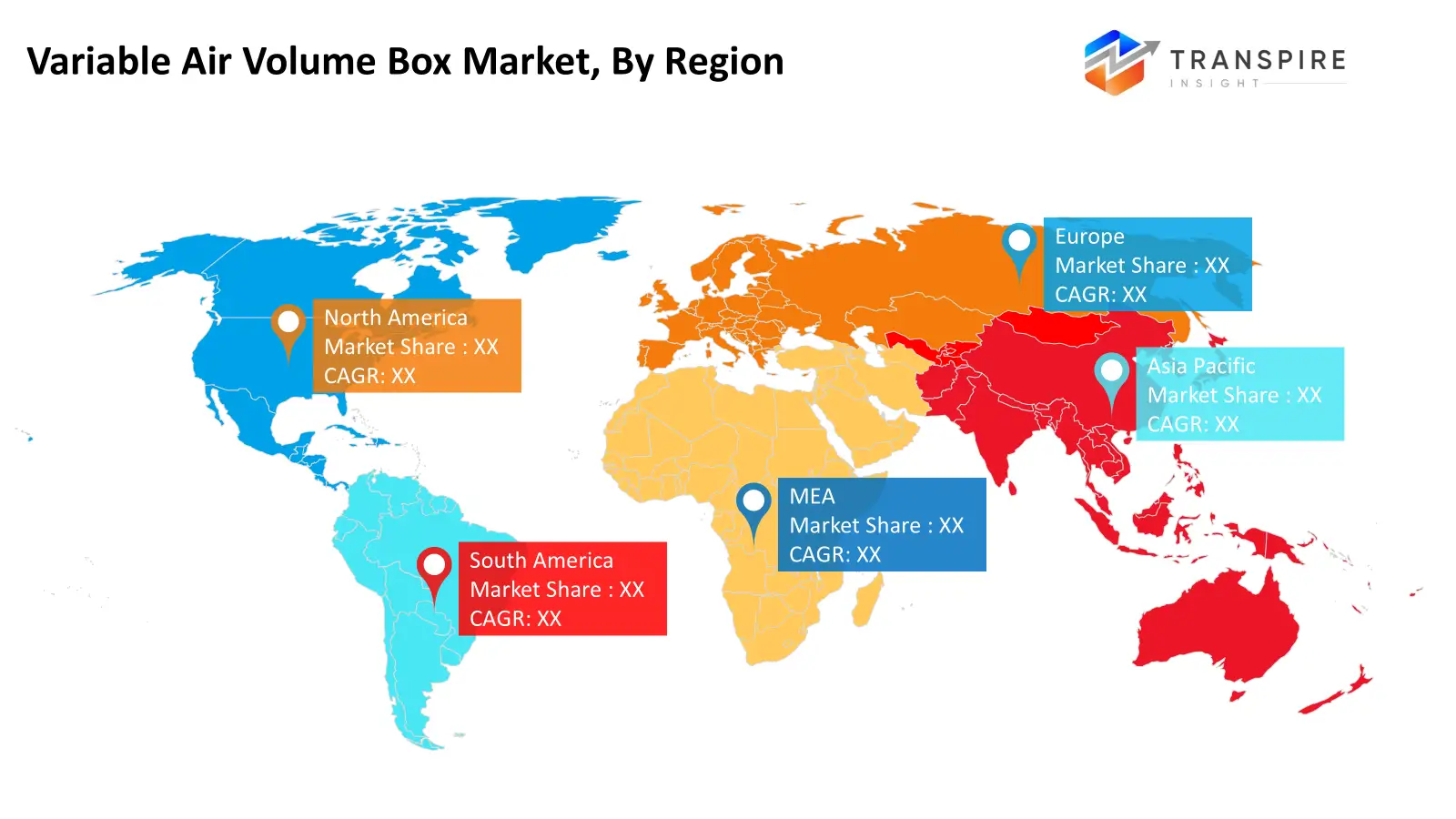
Geographically, North America including the United States, Canada, and Mexico is a mature market with robust regulatory structures and early adoption of cutting-edge HVAC technology. The high demand for retrofits and the widespread adoption of building automation systems continue to ensure market stability in tier 1 countries in this region. Europe including Germany, the United Kingdom, France, Spain, Italy, and the rest of Europe is growing steadily due to the adoption of stringent energy efficiency regulations and sustainability projects. The upgrade of existing infrastructure and the adoption of green buildings in tier 1 and tier 2 countries are ensuring stable demand for energy-efficient airflow solutions. Asia Pacific including Japan, China, Australia & New Zealand, South Korea, India, and the remaining Asia Pacific is the fastest-growing regional market because of the rapid urbanization, growing commercial building construction, and increasing investments in smart infrastructure. South America including Brazil and Argentina is witnessing a gradual adoption trend because of the urban development and growing awareness about energy optimization. The Middle East & Africa including Saudi Arabia, United Arab Emirates, South Africa, and the remaining Middle East & Africa is driven by the infrastructure development and the cooling demand because of the climatic conditions.
To learn more about this report, Download Free Sample Report
Recent Development News
- November 2025, Johnson Controls (NYSE: JCI), the world leader in smart, healthy, and sustainable buildings, is pleased to announce its attendance at the HVACR World 2025, scheduled to take place from 24th to 27th November 2025 at the Dubai World Trade Centre (DWTC) at Stand No - Z5 A61, Za'abeel Hall 5. It is the first event in the MEASA region that focuses solely on heating, ventilation, air conditioning, and refrigeration (HVACR).
(Source: https://me.johnsoncontrols.com/media-center/news/press-release/2025/11/13/hvac-r-world)
- In May 2025, Carrier Global Corporation (NYSE: CARR), the world’s leading provider of intelligent climate and energy solutions, announced today that it plans to invest an additional $1 billion over five years in U.S. manufacturing, innovation, and hiring, in addition to its existing commitments to its American businesses. The new investment is expected to create 4,000 highly skilled jobs.
|
Report Metrics |
Details |
|
Market size value in 2025 |
USD 2.85 Billion |
|
Market size value in 2026 |
USD 3.10 Billion |
|
Revenue forecast in 2033 |
USD 5.60 Billion |
|
Growth rate |
CAGR of 8.80% from 2026 to 2033 |
|
Base year |
2025 |
|
Historical data |
2021 – 2024 |
|
Forecast period |
2026 – 2033 |
|
Report coverage |
Revenue forecast, competitive landscape, growth factors, and trends |
|
Regional scope |
North America; Europe; Asia Pacific; Latin America; Middle East & Africa |
|
Country scope |
United States; Canada; Mexico; United Kingdom; Germany; France; Italy; Spain; Denmark; Sweden; Norway; China; Japan; India; Australia; South Korea; Thailand; Brazil; Argentina; South Africa; Saudi Arabia; United Arab Emirates |
|
Key company profiled |
Johnson Controls International plc, Carrier Global Corporation, Trane Technologies plc, Daikin Industries, Ltd., Honeywell International Inc., Siemens AG, TROX GmbH, Systemair AB, Price Industries Limited, Nailor Industries, Inc., Titus HVAC, Krueger-HVAC, Lennox International Inc., Swegon Group AB, and FläktGroup Holding GmbH |
|
Customization scope |
Free report customization (country, regional & segment scope). Avail customized purchase options to meet your exact research needs. |
|
Report Segmentation |
By Type (Single Duct Variable Air Volume Box, Fan Powered Variable Air Volume Box, Induction Variable Air Volume Box), By Component (Damper, Actuator, Controller, Sensors, Airflow Measuring Station), By Application (Commercial Buildings, Industrial Facilities, Residential Buildings, Institutional Buildings) and By End User (Offices, Healthcare Facilities, Educational Institutions, Retail Spaces, Hospitality) |
Key Variable Air Volume Box Company Insights
Johnson Controls International plc has a robust presence in the Variable Air Volume box market because of its comprehensive HVAC offering, which combines air distribution products, controls, and building automation solutions. The company derives benefits from its robust penetration in commercial infrastructure and smart building projects, especially in North America and Europe. Its VAV solutions are backed by digital control solutions and energy optimization tools, which help manage airflow effectively and meet the latest energy regulations. The company’s relentless focus on intelligent building solutions and service-oriented HVAC offerings helps build robust recurring revenue streams. Its broad distribution network and engineering prowess enable the execution of large-scale projects, which helps the company maintain a competitive edge in the institutional and commercial markets.
Key Variable Air Volume Box Companies:
- Johnson Controls International plc
- Carrier Global Corporation
- Trane Technologies plc
- Daikin Industries, Ltd.
- Honeywell International Inc.
- Siemens AG
- TROX GmbH
- Systemair AB
- Price Industries Limited
- Nailor Industries, Inc.
- Titus HVAC
- Krueger-HVAC
- Lennox International Inc.
- Swegon Group AB
- FläktGroup Holding GmbH
Global Variable Air Volume Box Market Report Segmentation
By Type
- Single Duct Variable Air Volume Box
- Fan Powered Variable Air Volume Box
- Induction Variable Air Volume Box
By Component
- Damper
- Actuator
- Controller
- Sensors
- Airflow Measuring Station
By Application
- Commercial Buildings
- Industrial Facilities
- Residential Buildings
- Institutional Buildings
By End User
- Offices
- Healthcare Facilities
- Educational Institutions
- Retail Spaces
- Hospitality
Regional Outlook
- North America
- United States
- Canada
- Mexico
- Europe
- Germany
- United Kingdom
- France
- Spain
- Italy
- Rest of Europe
- Asia Pacific
- Japan
- China
- Australia & New Zealand
- South Korea
- India
- Rest of Asia Pacific
- South America
- Brazil
- Argentina
- Rest of South America
- Middle East & Africa
- Saudi Arabia
- United Arab Emirates
- South Africa
- Rest of the Middle East & Africa
Frequently Asked Questions
Find quick answers to common questions.
The approximate Variable Air Volume Box Market size for the market will be USD 5.60 billion in 2033.
Key segments for the Variable Air Volume Box Market By Type (Single Duct Variable Air Volume Box, Fan Powered Variable Air Volume Box, Induction Variable Air Volume Box), By Component (Damper, Actuator, Controller, Sensors, Airflow Measuring Station), By Application (Commercial Buildings, Industrial Facilities, Residential Buildings, Institutional Buildings) and By End User (Offices, Healthcare Facilities, Educational Institutions, Retail Spaces, Hospitality).
Major Variable Air Volume Box Market players are Johnson Controls International plc, Carrier Global Corporation, Trane Technologies plc, Daikin Industries, Ltd., Honeywell International Inc.
The North America region is leading the Variable Air Volume Box Market.
The CAGR of the Variable Air Volume Box Market is 8.80%.
- Johnson Controls International plc
- Carrier Global Corporation
- Trane Technologies plc
- Daikin Industries, Ltd.
- Honeywell International Inc.
- Siemens AG
- TROX GmbH
- Systemair AB
- Price Industries Limited
- Nailor Industries, Inc.
- Titus HVAC
- Krueger-HVAC
- Lennox International Inc.
- Swegon Group AB
- FläktGroup Holding GmbH
Recently Published Reports
-
Apr 2026
Healthcare Polymer Packaging Market
Healthcare Polymer Packaging Market Size, Share & Analysis Report By Packaging Type (Syringes, IV Bottles and Pouches, Clamshells, Blisters, Bottles & Jars, Containers, Tubes, IV Parental Packaging, Others), By Type (Regulated, Non-regulated), By Polymer Type (LDPE (Low-Density Polyethylene), HDPE (High-Density Polyethylene), Homo-polymer (Homo), Random Copolymer (Random), Block Copolymer (Block), PET, Polystyrene, Polyvinyl Chloride, Polyamide/EVOH, Others), and Geography (North America, Europe, Asia-Pacific, Middle East and Africa, South and Central America), 2021 - 2031
-
Apr 2026
Hydrophilic Tape (Waterstop) Market
Hydrophilic Tape (Waterstop) Market Size, Share & Analysis Report By Type (Bentonite-Based Hydrophilic Tape, Rubber-Based Hydrophilic Tape), By Application (Residential Buildings, Commercial Buildings, Infrastructure Projects), and Geography (North America, Europe, Asia-Pacific, Middle East and Africa, South and Central America), 2021 - 2031
-
Apr 2026
Metalens Market
Metalens Market Size, Share & Analysis Report By Type (Visible Light Metalens, and Infrared Metalens), By Application (Consumer Electronics, Automotive Electronics, Industrial, Medical, and Others), and Geography (North America, Europe, Asia-Pacific, Middle East and Africa, South and Central America), 2021 - 2031
-
Apr 2026
PBT Resin Market
PBT Resin Market Size, Share & Analysis Report By Type (Reinforced PBT Resin, Unreinforced PBT Resin), By Processing Method (Injection Molding, Extrusion, Blow Molding, Others), By End-User (Automotive, Electrical & Electronics, Consumer Appliances, Industrial Machinery, Medical Devices, Packaging, Others), and Geography (North America, Europe, Asia-Pacific, Middle East and Africa, South and Central America), 2021 - 2031