Top 25 Companies in the Synthetic Biology Market: Company Profile by Transpire Insight
By Transpire Insight
Description
According to a research report published by Transpire Insight, the synthetic biology market size is projected to grow from USD 22.35 billion in 2026 to USD 70.83 billion by 2035, at a CAGR of 17.90% during the forecast period 2027-2035. The synthetic biology market is poised for strong growth with rapid developments in AI-based gene editing, the growing demand for bio-based sustainable products, decreasing DNA sequencing costs, and growing investments in biomanufacturing.
Introduction
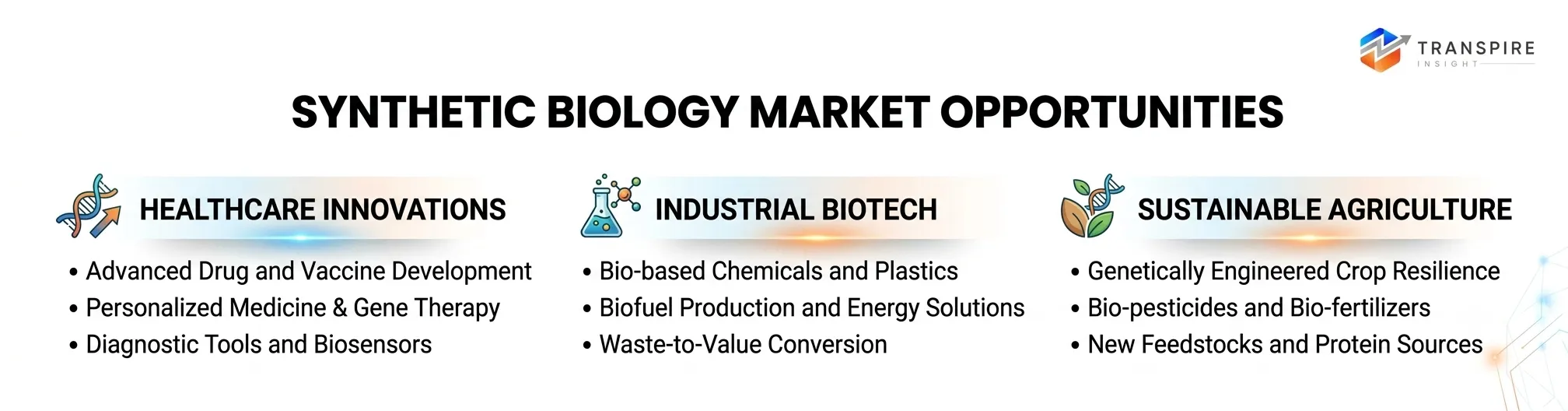
The synthetic biology market is a revolutionary advancement in biotechnology, combining engineering with biology to reshape organisms for beneficial applications. It encompasses a wide range of disciplines, including healthcare, agriculture, energy, and sustainable materials, benefiting from cutting-edge DNA synthesis, CRISPR gene editing, and computational biology. Synthetic biology is on the verge of broadening its impact from the lab to commercial and industrial applications across the globe, as there is a quickly growing appetite for green biomanufacturing and personalized medicine around the world.
Recent Development News
- June 2026: biotechs convened at the SEED 2026 conference in Denver to launch next-generation AI foundation models dedicated to automated biological design and cell-free biomanufacturing.
- July 2026: The researchers were able to build synthetic "cell-like" structures, dubbed "SpudCells," that have been outfitted with lab-made DNA and are able to feed, grow, and replicate on their own.
Stay Ahead of Emerging Opportunities with Expert Market Insights by Transpire Insight
Transpire Insight provides comprehensive, data-driven market intelligence to support smarter business decisions. Our research is rooted in comprehensive analysis, authoritative predictions, and industry expertise, enabling organizations to make informed decisions in rapidly evolving markets. In-depth analysis of market segmentation, competitive positioning, regional trends, and emerging investment opportunities in high-growth areas. We blend accuracy with actionable intelligence, empowering companies to uncover new avenues for growth, bolster strategic decision-making, and stay ahead in a dynamic market.
Download the exclusive Synthetic Biology Market sample report today to explore expert insights, key trends, and emerging opportunities shaping the future of the industry.
Synthetic Biology Market Size & Statistics
- The Market Size for Synthetic Biology Was Estimated to be Worth USD 22.35 Billion in 2026.
- The Market Size is Going to Expand at a CAGR of 17.90% between 2026 and 2035.
- The Synthetic Biology Market Size is anticipated to reach USD 70.83 Billion by 2035.
- North America is projected to drive the highest demand during the forecast period, accounting for 43.12% of the synthetic biology market.
- Asia-Pacific is projected to grow the fastest during the forecast period at a CAGR of 21.7% in the synthetic biology market.
Regional Growth and Demand Analysis by Transpire Insight
North America's dominance rests on deep biotechnology infrastructure and sustained capital inflows into genome engineering and biomanufacturing. Meanwhile, firms like Ginkgo Bioworks, Thermo Fisher Scientific and Amyris are enhancing their strain engineering and enzyme production capabilities, and federal biomanufacturing programs are helping to establish new domestic capacity build-outs. Academic-industry collaborations, especially in the area of gene therapy platforms and CRISPR diagnostics continue to drive the region's advantage in translational research, while robust venture funding supports new biofoundry companies moving into the commercial pipeline.
The momentum in Asia-Pacific is due to coordinated national strategies for self-sufficient biomanufacturing ecosystems. China's growing contract development and manufacturing market is pushing its synthetic DNA and enzyme capacity to scale, with WuXi Biologics leading the way, while research institutes in Japan and South Korea are being expanded to genome engineering capacity, and automation is radically changing biofoundries. Combined, rising government funding, more biotech talent, and greater cooperation with Western pharmaceutical firms are driving the region's progress from research to commercial production.
Top 15 Trends in the Synthetic Biology Market
- AI-driven biological design accelerating strain and pathway engineering.
- Rising adoption of cell-free synthetic biology platforms.
- Expansion of biomanufacturing facilities for sustainable bio-based products.
- Growing use of CRISPR and genome engineering tools.
- Increased investment in synthetic biology startups and platforms.
- Rising demand for enzyme engineering across industrial applications.
- Expansion of DNA synthesis and sequencing capacity.
- Growing focus on biosecurity and biosafety regulations.
- Integration of automation and robotics in biofoundries.
- Rising demand for precision medicine and gene therapies.
- Growth of agricultural biotechnology and biopesticides.
- Expansion of synthetic biology in food and alternative proteins.
- Increasing government funding for domestic biomanufacturing capacity.
- Rising collaborations between biotech firms and pharmaceutical companies.
- Growing adoption of synthetic biology in biofuels and bioplastics.
Proceed to checkout to purchase the exclusive Synthetic Biology Market report and get instant access to detailed market insights, strategic analysis, and future growth opportunities.
AI-Driven Biological Design
Artificial intelligence now accelerates strain optimization and protein design, letting biofoundries model, test, and refine genetic constructs faster than traditional trial-and-error engineering methods allow today.
Biomanufacturing Facility Expansion
Companies are scaling biomanufacturing facilities worldwide to produce sustainable, bio-based chemicals, materials, and fuels, replacing petroleum-derived inputs while meeting rising demand for greener industrial production.
CRISPR and Genome Engineering Growth
CRISPR-based gene editing and genome engineering tools continue expanding across healthcare, agriculture, and industrial biotechnology, enabling precise organism modification for therapeutic, diagnostic, and production applications.
Automation in Biofoundries
Biofoundries increasingly integrate robotics, automation, and high-throughput screening to design, build, and test genetic constructs rapidly, shortening research cycles and improving reproducibility across development pipelines.
Precision Medicine and Gene Therapy Demand
Rising chronic and genetic disease prevalence drives demand for precision medicine, gene therapies, and synthetic biology diagnostics, enabling faster drug discovery and personalized treatment development.
Government- Backed Domestic Biomanufacturing Funding
Governments worldwide are increasing funding for domestic biomanufacturing capacity to reduce reliance on foreign supply chains, strengthen national biosecurity, and support strategic industrial biotechnology production.
List of Top 25 Companies Leading the Synthetic Biology Market
- Ginkgo Bioworks
- Thermo Fisher Scientific
- Twist Bioscience
- Danaher Corporation
- Amyris
- GenScript Biotech
- Agilent Technologies
- Novozymes (Novonesis)
- Codexis
- Merck KGaA
- Eurofins Scientific
- Precigen
- Beam Therapeutics
- Synthego
- Cathay Biotech
- Tessera Therapeutics
- New England Biolabs (NEB)
- Ribometrix
- Bota Biosciences
- Spiber
- Bluepha
- Inscripta
- Metabolic Explorer (METEX)
- Arzeda
- Colossal Biosciences
Customize the exclusive Synthetic Biology Market report to receive insights tailored to your needs, including country-specific analysis and business-focused market intelligence.
- Ginkgo Bioworks
Leading cell-programming platform engineering custom microbes for diverse commercial applications.Founded: 2008 | HQ: Boston, Massachusetts, USA.Why It Ranks: Ginkgo dominates bio-foundry automation by combining massive genetic libraries with high-throughput robotics to scale horizontal biomanufacturing.Regional Dominance: Leading presence across North American markets.Product Line: Foundry platform services and codebase development.
- Thermo Fisher Scientific
life sciences giant supplying essential reagents, instruments, and synthetic genes.Founded: 1956 | HQ: Waltham, Massachusetts, USA.Why It Ranks: Provides end-to-end biological infrastructure, including critical enzyme reagents, automated synthesis instruments, and scalable bioprocessing systems.Regional Dominance: Strong footprint dominated by North America.Product Line: GeneArt custom gene synthesis reagents ecosystem.
- Twist Bioscience
Pioneer in high-throughput silicon-based DNA synthesis for research and medicine.Founded: 2013 | HQ: South San Francisco, California, USA.Why It Ranks: Twist's proprietary silicon platform enables low-cost, high-density oligo writing, accelerating biological assembly across therapeutics and data storage.Regional Dominance: Robust primary operations headquartered across North America.Product Line: High-throughput custom DNA oligo pool libraries.
- Danaher Corporation
Conglomerate powering genetic engineering and diagnostic tools through key subsidiaries.Founded: 1969 | HQ: Washington, D.C., USA.Why It Ranks: Danaher holds immense market weight by owning vital synthetic technology providers like Integrated DNA Technologies (IDT) and Cytiva.Regional Dominance: Major market share across North American territories.Product Line: Custom synthesis reagents and bioprocessing systems.
- Amyris
Pioneer using synthetic biology to produce sustainable ingredients for cosmetics.Founded: 2003 | HQ: Emeryville, California, USA.Why It Ranks: Amyris excels in industrial yeast fermentation pathways to replace rare natural materials with sustainable bio-identical molecules.Regional Dominance: Dominant active operations expanding across North America.Product Line: Fermentation-derived sustainable squalane and specialty ingredients.
- GenScript Biotech
contract provider specializing in synthetic gene assembly and peptide services.Founded: 2002 | HQ: Nanjing, China.Why It Ranks: Operates one of the world's largest automated gene synthesis networks, serving academic and pharmaceutical researchers globally.Regional Dominance: Strong market position across the Asia-Pacific region.Product Line: Precision molecular cloning and gene building.
- Agilent Technologies
Key analytical instrumentation and nucleic acid synthesis supplier for research labs.Founded: 1999 | HQ: Santa Clara, California, USA.Why It Ranks: Provides vital analytical measurement tools, targeted mutagenesis kits, and high-fidelity oligo synthesis platforms.Regional Dominance: Extensive distribution footprint dominating North America.Product Line: SurePrint high-density custom oligonucleotide microarrays.
- Novozymes (Novonesis)
World leader in industrial biological enzymes engineered via modern synthetic biology.Founded: 2000 | HQ: Bagsværd, Denmark.Why It Ranks: Harnesses synthetic biology techniques to yield high-efficiency biological enzymes that decarbonize consumer biomanufacturing workflows.Regional Dominance: Primary commercial manufacturing centered in Europe.Product Line: High-performance industrial enzymes and microbes.
- Codexis
Protein engineering firm developing optimized enzymes for pharmaceutical biocatalysis.Founded: 2002 | HQ: Redwood City, California, USA.Why It Ranks: Utilizes its CodeEvolver platform to engineer custom enzymatic catalysts that revolutionize commercial chemical synthesis routes.Regional Dominance: Strong commercial base established across North America.Product Line: Proprietary CodeEvolver protein-directed evolution platform.
- Merck KGaA
Multinational science and technology leader providing synthetic tools and materials.Founded: 1668 | HQ: Darmstadt, Germany.Why It Ranks: Supplies extensive genome editing lines, custom oligonucleotides, and cell lines through its robust Life Science business.Regional Dominance: Deep commercial network operating out of Europe.Product Line: Custom oligonucleotides and synthetic CRISPR reagents.
Schedule a meeting with our market experts to discuss the exclusive Synthetic Biology Market report and find the right research solution for your business.
Conclusion
The synthetic biology market is still in the process of changing from theory to practice, from design to manufacturing. With advances in gene writing and artificial intelligence, and automated biomanufacturing, major industry players are transforming medicine, materials, and sustainable agriculture. Synthetic biology will continue to be a core driver to address challenges of climate change, resource scarcity, and complex human health challenges as regulatory pathways continue to develop and production scales up.



 inquiry@transpireinsight.com
 APAC:+91 7666513636
 Address


