
Sep 11, 2026
By Transpire Insight
Description
According to a research report published by Transpire Insight, the solar water desalination plant market size is projected to grow from USD 3.60 billion in 2026 to USD 6.23 billion by 2035, at a CAGR of 10.23% during the forecast period 2027-2035. Adoption is fueled by severe, worldwide freshwater scarcity, rapidly evolving climate change, increased municipal demand, and enforced zero-carbon regulations. The cost of solar photovoltaic and the energy-efficient membrane technology make off-grid solar desalination economically viable globally.
Introduction
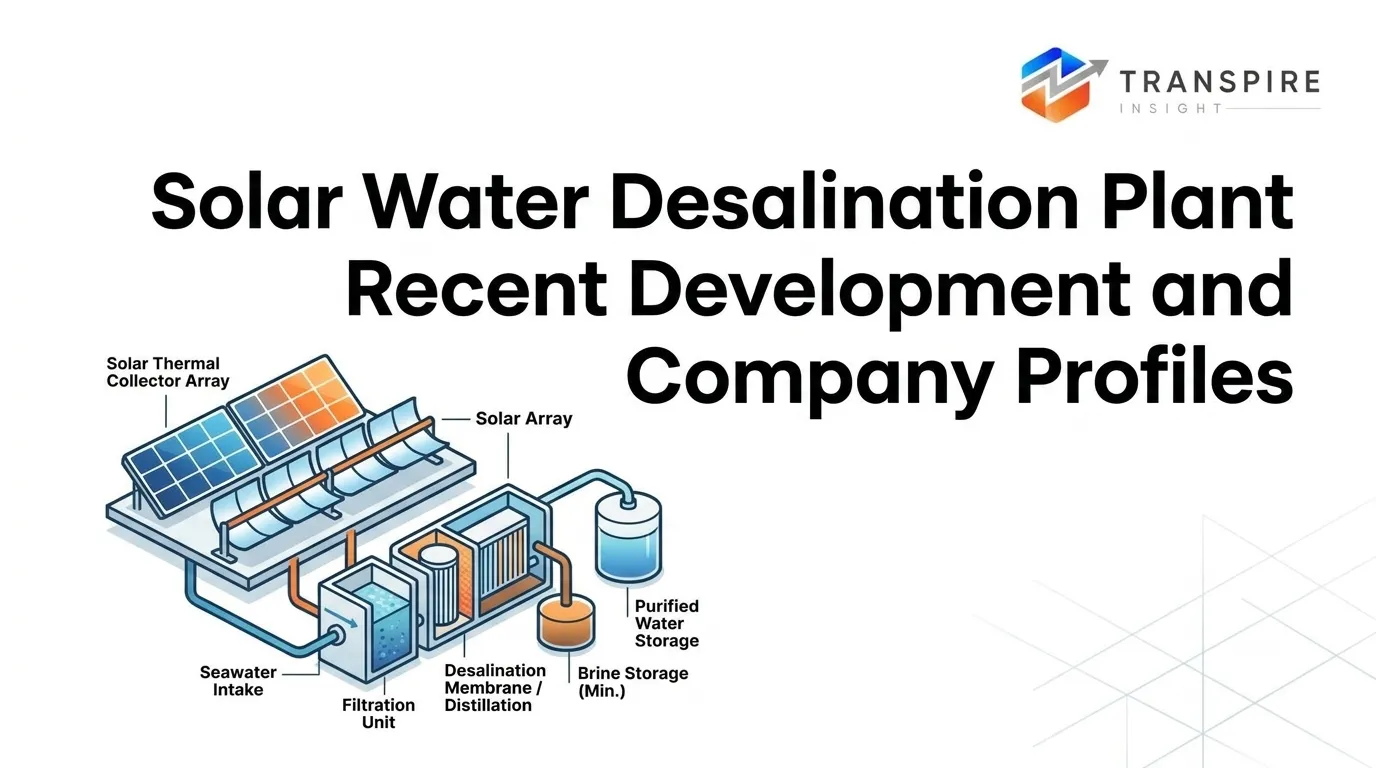
Solar water desalination (SWD) is a technology that uses PV and solar thermal energy to desalinate seawater or brackish water and produce clean, potable water, which does not require the use of fossil fuels. Solar RO/D plants offer essential, climate-resilient water infrastructure, offsetting carbon emissions and reducing the operational costs of the grid. Solar desalination is a critical tool for sustainable water resource management in arid coastal areas, especially as cities increasingly grow and develop.
Recent Development News
Stay Ahead of Emerging Opportunities with Expert Market Insights by Transpire Insight
Transpire Insight provides comprehensive, data-driven market intelligence to support smarter business decisions. Our research is rooted in comprehensive analysis, authoritative predictions, and industry expertise, enabling organizations to make informed decisions in rapidly evolving markets. In-depth analysis of market segmentation, competitive positioning, regional trends, and emerging investment opportunities in high-growth areas. We blend accuracy with actionable intelligence, empowering companies to uncover new avenues for growth, bolster strategic decision-making, and stay ahead in a dynamic market.
Solar Water Desalination Plant Market Size & Statistics
Regional Growth and Demand Analysis by Transpire Insight
Asia Pacific's dominance rests on acute water stress across India and China, where governments are directly financing solar-linked desalination as public infrastructure rather than isolated pilots. The Zhoushan Green Desalination Project in China's Zhejiang province is a very practical example of this trend: the project combines floating solar panels with a desalination capacity of 100,000 cubic metres per day, reducing the reliance on electricity from the grid by 70%. Similarly, India is moving ahead with large-scale coastal power stations like the Perur power station near Chennai, to compensate for the saline groundwater intrusion, and the national schemes are rolling out financial assistance for solar desalination for municipal, agricultural and manufacturing purposes. The state-backed investment and the renewable integration are helping to ensure the dominance of the region and foreshadow continued equipment demand for solar-thermal and solar-PV desalination systems in East and South Asia.
Europe's growth is anchored in Spain, already the continent's largest desalination operator, where state-owned Acuamed has committed €600 million to tender new desalination plants coupled directly with photovoltaic solar parks under a broader drought-response investment strategy. In tandem, there are projects like Agua+S in Andalusia, which is experimenting with floating PV arrays over reservoirs to power desalination processes, and others in Europe that are looking to retro-commission existing coastal plants with renewable energy, instead of constructing new plants that can tie into existing electricity grids. Increasing stress on water resources in the Mediterranean region, the EU's push for sustainability financing, and public concerns about drought are driving a surge in solar retrofit and hybrid renewables desalination initiatives throughout the Mediterranean, as the region is poised to outpace even Asia Pacific in percentage growth despite having a smaller revenue base.
Top 15 Trends in the Solar Water Desalination Plant Market
Floating photovoltaic arrays powering coastal desalination plants
Floating photovoltaic arrays are being installed over reservoirs and coastal sites to power desalination directly, cutting land use, reducing grid dependence, and lowering operating costs.
Government-backed solar desalination tenders and subsidies expanding
State agencies across Spain, India, and the Gulf are launching dedicated tenders and subsidy programs that pair desalination contracts directly with mandatory solar generation capacity.
Solar photovoltaic reverse osmosis gaining cost-efficiency advantage
Solar-powered reverse osmosis is outpacing older thermal desalination methods because falling panel prices and modular design let operators cut per-unit freshwater production costs down significantly.
AI-driven energy and water flow optimization adoption
Operators are deploying AI systems that balance solar power output against desalination demand, automatically adjusting plant operations to maximize freshwater yield while minimizing energy waste.
Industrial water demand driving large-scale solar plant orders
Manufacturing and mining operations facing water scarcity are increasingly commissioning large-scale solar desalination plants directly, securing dedicated freshwater supply chains independent of stressed municipal grids.
Middle East investing heavily in solar desalination capacity
Gulf nations are pairing utility-scale solar parks directly with desalination facilities, exemplified by Oman's 17-megawatt solar installation supplying a plant serving six hundred thousand people.
Top 25 Companies Leading the Solar Water Desalination Market
1. ACCIONA S.A.
pioneer in utility-scale solar-powered reverse osmosis desalination infrastructure.
Founded: 1997 | HQ: Alcobendas, Spain.
Why It Ranks: Commands over 7.6% market share in sustainable desalination projects worldwide.
Regional Dominance: Strong market leadership across Europe, Latin America, and the Middle East.
Product Line: Utility-scale solar RO plants, integrated renewable energy water solutions.
2. IDE Technologies
Deploys massive thermal and membrane solar desalination systems globally.
Founded: 1965 | HQ: Kadima, Israel.
Why It Ranks: World leader in mega-scale energy-efficient thermal and RO desalination.
Regional Dominance: Middle East, North America, and Asia-Pacific markets.
Product Line: IDE PROGREEN solar-powered modular reverse osmosis desalination systems.
3. Aquatech International LLC
Offers solar-assisted zero liquid discharge and industrial water treatment systems.
Founded: 1981 | HQ: Canonsburg, Pennsylvania, USA.
Why It Ranks: Top-tier provider of customized solar-integrated industrial desalination technologies.
Regional Dominance: North America, India, and the Middle Eastern region.
Product Line: Solar-driven Zero Liquid Discharge (ZLD) and brackish water RO.
4. Elemental Water Makers B.V.
Specializes in off-grid solar-powered reverse osmosis plants using gravity storage.
Founded: 2012 | HQ: Siddeburen, Netherlands.
Why It Ranks: Leading innovator in chemical-free, energy-recovery solar desalination.
Regional Dominance: Island nations, coastal Africa, and the Caribbean region.
Product Line: Plug-and-play containerized solar RO, battery-free seawater desalination units.
5. Desolenator
Combines thermal and electrical solar energy for circular water desalination.
Founded: 2013 | HQ: Maastricht, Netherlands.
Why It Ranks: Key player in zero-chemical solar thermal desalination for industries.
Regional Dominance: Middle East, South Asia, and North Africa.
Product Line: Circular solar thermal desalination, climate-resilient water production systems.
6. Veolia Environment S.A.
Integrates solar power networks into municipal water and wastewater treatment plants.
Founded: 1853 | HQ: Paris, France.
Why It Ranks: water management giant advancing solar integration for eco-desalination.
Regional Dominance: Europe, North America, and Sub-Saharan Africa.
Product Line: Barrel solar-compatible RO modules, municipal seawater desalination facilities.
7. Suez Group
Focuses on sustainable smart water networks driven by solar microgrids.
Founded: 1858 | HQ: Paris, France.
Why It Ranks: Top environmental services leader expanding solar-driven coastal water facilities.
Regional Dominance: Europe, Middle East, and Asia-Pacific region.
Product Line: SeaWater RO (SWRO) systems, hybrid solar water purification plants.
8. Abengoa Water
Developer of large-scale solar thermal concentrating plants and desalination assets.
Founded: 1941 | HQ: Seville, Spain.
Why It Ranks: Renowned for integrating concentrated solar power with reverse osmosis systems.
Regional Dominance: Middle East, North Africa, and South America.
Product Line: CSP-integrated desalination units, large-scale industrial water purification facilities.
9. Solar Water PLC
Uses concentrated solar power domes for carbon-neutral water production.
Founded: 2019 | HQ: London, United Kingdom.
Why It Ranks: Disruptor utilizing parabolic solar domes for zero-carbon hydro-technology projects.
Regional Dominance: Middle East and North Africa (MENA) region.
Product Line: Solar dome greenhouse desalination plants, carbon-neutral water infrastructure.
10. Bionic Water (formerly Boreal Light GmbH)
Manufactures high-capacity, off-grid solar water desalination and purification systems.
Founded: 2013 | HQ: Berlin, Germany.
Why It Ranks: Market leader in affordable, off-grid solar water kiosks across Africa.
Regional Dominance: Sub-Saharan Africa, East Africa, and South Asia.
Product Line: Winture solar desalination plants, mobile renewable water treatment units.
Conclusion
The market for solar water desalination plants is a crucial solution to water security challenges worldwide. By combining the latest reverse osmosis and thermal distillation technologies with low-cost solar PV and thermal systems, major market leaders deliver sustainable, zero-emission drinking water. Solar desalination will continue to be a major emerging market in sustainable infrastructure development, driven by accelerated membrane innovation, battery-free energy storage and scaling up of off-grid deployment.


Send us a brief description of your challenge and we'll get back to you within 24 hours.

 inquiry@transpireinsight.com
 APAC:+91 7666513636
 Address


