

Global Solar Water Desalination Plant Market Size & Forecast:
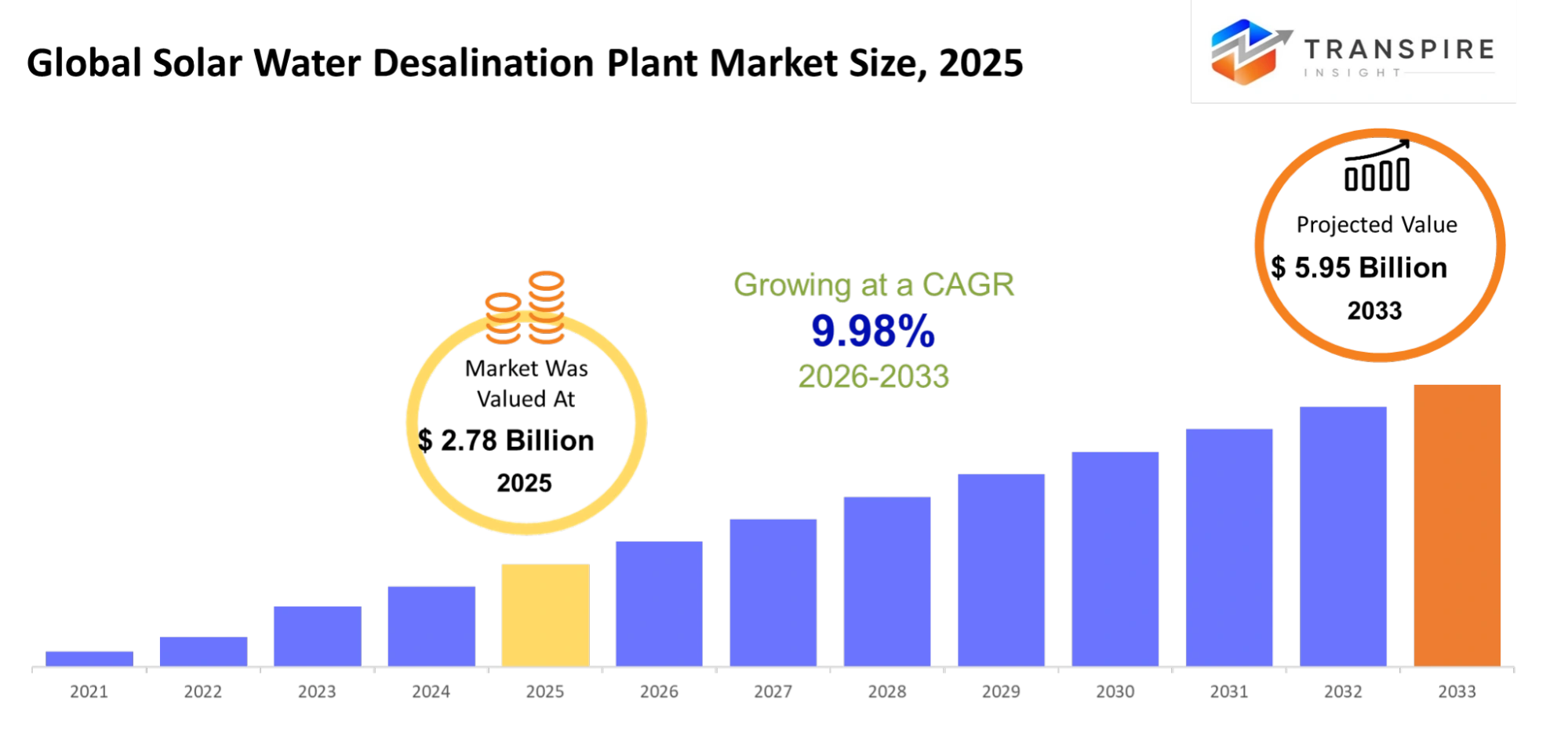
Global Solar Water Desalination Plant Market Size 2025: USD 2.78 Billion
Global Solar Water Desalination Plant Market Size 2033: USD 5.95 Billion
Global Solar Water Desalination Plant Market CAGR: 9.98%
Global Solar Water Desalination Plant Market Segments: By Technology (Solar Thermal Desalination, Solar Photovoltaic Desalination), By Application (Drinking Water, Industrial Water Supply, Agricultural Irrigation), By End-User (Municipal, Industrial, Residential).
To learn more about this report,  Download Free Sample Report
Global Solar Water Desalination Plant Market Summary:
The Global Solar Water Desalination Plant Market was valued at USD 2.78 billion in 2025. It is expected to reach USD 5.95 billion by 2033. That is a CAGR of 9.98% from 2026 to 2033. Solar desalination takes salt out of seawater or brackish water by using sunlight itself. The process yields quite safe drinking water indeed. The water can then be employed for drinking purposes, agriculture, and industries as well. The whole process requires two key technological systems really. Solar thermal systems capture solar energy by extracting heat from sunlight itself. Photovoltaic systems generate electrical power from sunlight to power reverse osmosis membrane systems.
Many of the target markets lack very reliable power grids altogether. Solar thermal plants operate independently of the power grid system. They use the heat itself to evaporate and condense water. The system is really capable of functioning in remote areas - like coastal regions and arid terrains. These are also the places where the most severe water shortages occur really.
Water scarcity remains the core driving factor all along. More than 2 billion people all over the world really don't have enough water to meet their needs. People in these areas get to enjoy a lot of sunshine continuously throughout each day. The Middle East, North Africa, and South Asia actually fit this profile quite well. These regions have quite a lot of sun and either seawater or brackish groundwater. Solar desalination connects these resources together to produce very clean water indeed.
Over the last decade solar power prices really have decreased significantly. This reduction in solar power prices has greatly improved the market position of solar desalination technology. Traditional desalination processes generally rely on fossil fuels for their power source. Decreasing solar prices really narrows down the operating cost difference between solar and other methods. The cheapest new solar capacity in very sunny areas is solar desalination systems itself. The market really has become much more attractive to investors and developers all thanks to this change.
Key Market Trends & Insights:
- The market really is seeing a major move towards sustainable and highly efficient desalination technologies - with solar-powered systems emerging as quite a viable alternative to traditional very energy-intensive desalination methods. This shift is being driven by worldwide efforts to lower our carbon emissions and start using cleaner energy solutions.
- Solar thermal desalination technology is actually dominating the market right now since it really efficiently uses solar heat for processes such as multi-effect distillation and membrane distillation. Its ability to work quite well in both very large-scale installations makes it really suitable for municipal and industrial applications in those areas where water is scarce.
- There's a lot more adoption of solar photovoltaic (PV)-based desalination systems - especially in decentralized and small-scale applications. These systems make use of solar panels to generate electricity that powers reverse osmosis units - so they're perfect for isolated places and communities without a power grid.
- Governments all over the region are putting into place water security initiatives and renewable energy policies - which have really significantly increased investments in solar desalination projects. Public-private partnerships are also doing a lot to develop that very large-scale desalination infrastructure.
- Increasing demand for clean drinking water and sustainable agricultural irrigation is greatly accelerating the deployment of solar desalination plants - especially in regions facing a problem with their groundwater supply and its salinity levels.
Global Solar Water Desalination Plant Market Segmentation
By Technology
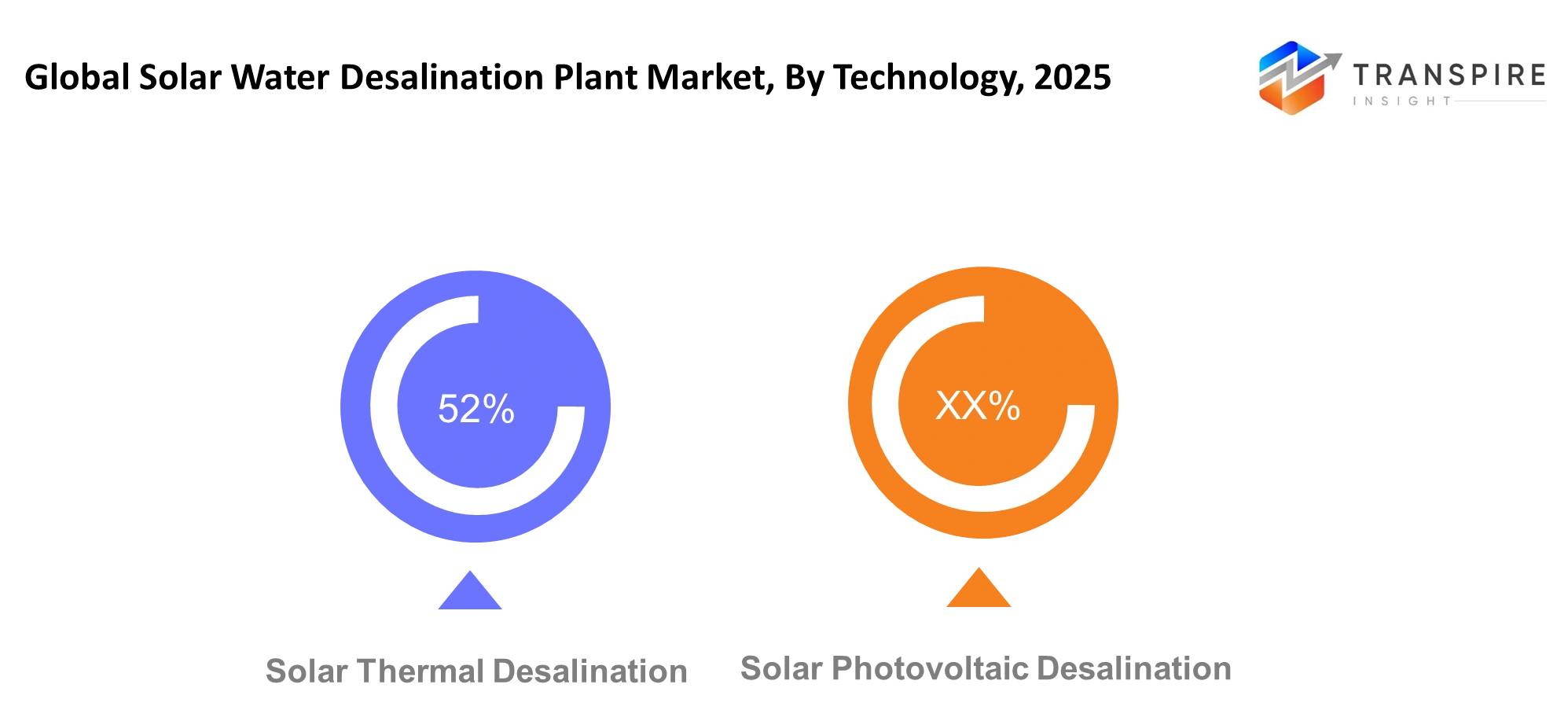
- Solar Thermal Desalination: Solar thermal desalination really leads the way in terms of technology - it makes up about 52% of the Global Solar Water Desalination Plant Market's revenue. These systems collect heat from sunlight. That heat makes water evaporate and then condense. Commonly used set-ups are multi-stage flash, multi-effect distillation, and even solar stills. Not one of them needs a power grid - that's their key practical advantage. Remote coastal villages, island communities, and very dry inland areas can really use them since they don't need utility infrastructure. Solar thermal plants may take up a bit more space than PV-RO systems for the same amount of production. However, their rather straightforward operations and very little need for electricity truly make them the best option where you don't have access to a power grid - or have a very limited one.
- Solar Photovoltaic Desalination: Solar PV desalination makes use of solar panels to generate electricity itself. That electricity powers a reverse osmosis membrane system. RO is by far the most widely used desalination method world-wide. It does require quite a lot of energy - that's why solar-powered RO was once very expensive. But PV costs have dropped by more than 80% over the last ten years. That really changed things, making solar PV-RO a viable option at a much larger scale. Now the combination even competes with diesel-powered desalination systems in very sunny locations. PV-RO systems are easy to scale by adding modules. A single unit could service a very small community or a very large municipal plant. You can even store extra power in batteries or connect them to the grid to let them operate at night or during periods of low sunlight. This area of the market is expanding a lot faster than solar thermal within the Global Solar Water Desalination Plant Market itself.
To learn more about this report, Download Free Sample Report
By Application
- Drinking Water: Drinking water is the biggest application globally in the Solar Water Desalination Plant Market. Most investment projects at the community and municipal level focus on providing safe drinking water - this application really shows a clear social necessity. It also attracts quite a lot of development finance. Projects are set up in coastal towns, islands, remote villages, and even municipal utilities. Output really needs to meet the standards for drinking water. That calls for a bit stricter treatment and monitoring than we see in agricultural or industrial uses. The drinking water segment starts the largest projects by investment - and you'll find them all over the globe with the most geographic spread of installations.
- Industrial Water Supply: Industrial consumers require massive and very reliable water volumes every time. Mining, oil, and gas - along with manufacturing in very dry regions - just can't depend on the municipal supply. Solar desalination gives us an option for on-site production. It decreases our reliance on transported water or even long pipelines. The quality requirements vary a lot by process. Some applications really need water quality as good as drinking water. Others can get by with slightly less treated output. Industrial projects are usually privately funded and sized for the specific site demands. They tend to be bigger in size than community drinking water projects. The segment is smaller than drinking water in the Global Solar Water Desalination Plant Market, but it's really growing fast as industrial water costs rise in arid regions.
- Agricultural Irrigation: Agriculture actually accounts for about 70% of all global fresh water withdrawals. Irrigation in very dry areas might consider using solar desalination when there are no better sources around. Brackish groundwater desalination powered by solar PV fits really well into this application. Salt-tolerant crops and drip irrigation systems greatly decrease the amount of water we need per hectare. Water quality thresholds for irrigation are a lot lower than what we see for drinking water. That really simplifies - and also reduces the cost - of the treatment process. Agricultural projects tend to be scattered and relatively small in scale. They are also much more sensitive to price than municipal or industrial installations. Government subsidy programs in a few very dry countries have indeed helped take off in this segment.
By End-User
- Municipal: Municipal end-users make up the largest group in the Global Solar Water Desalination Plant Market. City and town utilities really invest in solar desalination to meet local population requirements. This is very true in coastal cities that don't have enough fresh water. Municipal projects are usually the biggest by capacity - and also the most complicated to finance and get permits for. They very often use public-private partnerships or development bank loans. The output of the system has to meet national drinking water standards. Municipal buyers are looking for long-term reliability, low operating costs, and even less use of fossil fuels. Solar desalination really does meet all three requirements in areas with lots of sunlight.
- Industrial: Industrial end-users purchase solar desalination capacity in order to get a steady supply of water right on site. Mining, petrochemicals, food production, and power generation all require reliable water sources. When we're talking about water-scarce regions, municipal supplies won't be able to deliver that alone. Solar desalination plants at industrial facilities provide a completely controlled supply of water. The operator is really in charge of the quality, quantity, and costs without having to rely on an outside utility company. Industrial buyers have very specific targets for water costs. They invest in solar desalination when the cost per cubic meter beats out their current supply costs over the plant's lifetime. Financing for these plants is often done on a project-by-project basis or even corporate level financing - not usually through the public sector.
- Residential: Residential end-users cover everything from single-family homes to small groups of houses - and even rural villages. These are really the smallest installations within the Global Solar Water Desalination Plant Market. However, they're also the most common when it comes to sheer number of units. Small solar stills and compact photovoltaic - reverse osmosis units can serve one family unit or even a group of households. They are quite common in off-grid island and coastal communities. The technology at this scale is relatively simple and more affordable compared to municipal systems. Production levels are pretty small, but the impact is significant - especially when there aren't other options like long-distance water transport or buying it very expensively by tanker truck. NGOs and development organizations have actually funded a lot of these residential-scale installations in many parts of sub-Saharan Africa, South Asia, and Pacific islands.
Country Insights
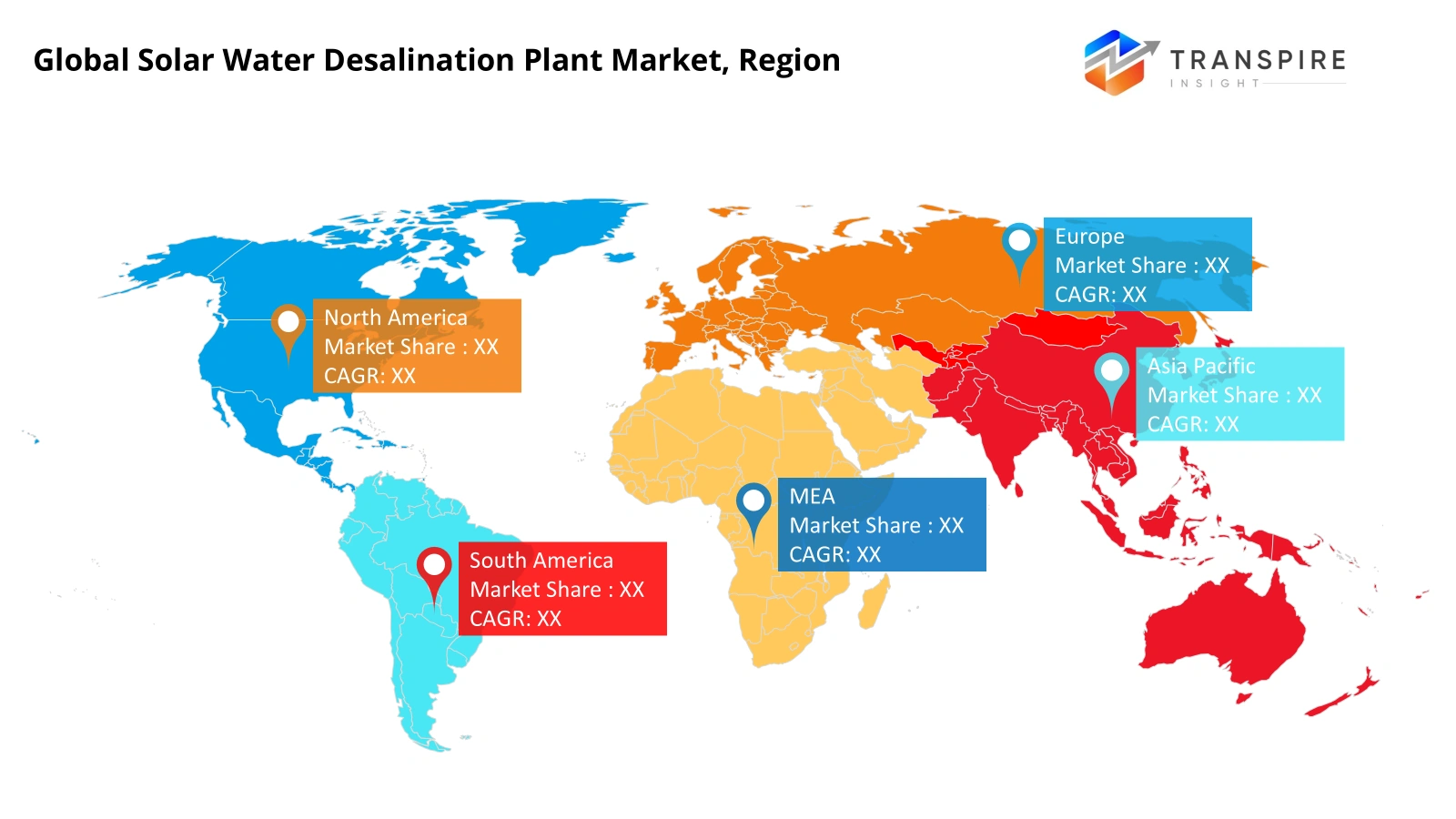
The Middle East is really the most active region in the global solar water desalination plant market. Saudi Arabia, the UAE, Qatar, and Kuwait - all of them have very severe water shortages. They also have amongst the highest levels of solar irradiance anywhere on the planet. Saudi Arabia has announced quite a few large-scale solar desalination projects lately. The country aims to reduce its reliance on highly energy-intensive conventional plants somewhat. The UAE has invested in solar-powered reverse osmosis at both the Ghantoot facility and other locations.
North Africa also follows a similar pattern. Algeria, Tunisia, Morocco, and Egypt - these countries have lots of people living along their coastlines and very dry inland areas. Solar resources are quite strong across this entire region. Project pipelines have attracted international developers and development finance from all over. Morocco has a rather broad renewable energy plan that includes water infrastructure. Egypt has desalination goals tied to Nile water stress and the growth of coastal populations.
India is the biggest South Asian market for solar desalination. Coastal states like Tamil Nadu, Gujarat, and Andhra Pradesh - they are all facing problems with groundwater loss and the intrusion of saltwater. Central and state government programs have actually funded solar desalination pilot projects and community systems. India's solar manufacturing base and decreasing costs of solar panels really support the economics of solar-powered RO at even smaller scales.
Australia has an extremely dry center and an incredibly long coastline. Perth's Water Corporation runs one of the world's largest desalination plants. Solar power integration into desalination is increasing every year. Remote mining communities in Western Australia use solar-diesel hybrid desalination for on-site water production. The US has solar desalination activity going on in California, Texas, and island territories such as Puerto Rico and the US Virgin Islands.
To learn more about this report, Download Free Sample Report
Recent Development News
In March 2023, Pilot announcements in Gulf countries (Saudi/UAE region) exploring floating solar-powered desalination platforms.
In July 2024, Feasibility and pilot-scale deployments expanded with focus on reducing land use and co-locating solar + intake systems.
Report Metrics
|
Report Metrics |
Details |
|
Market size value in 2025 |
USD 2.78 Billion |
|
Market size value in 2026 |
USD 3.058 Billion |
|
Revenue forecast in 2033 |
USD 5.95 Billion |
|
Growth rate |
CAGR of 9.98% from 2026 to 2033 |
|
Base year |
2025 |
|
Historical data |
2021 - 2024 |
|
Forecast period |
2026 - 2033 |
|
Report coverage |
Revenue forecast, competitive landscape, growth factors, and trends |
|
Country scope |
Global |
|
Key company profiled |
Veolia Environnement S.A., Acciona S.A., Abengoa S.A., IDE Technologies Ltd., Doosan Enerbility Co. Ltd., Suez S.A., Aquatech International LLC, Hyflux Ltd., Dow Water & Process Solutions, Toray Industries Inc., Hitachi Ltd., Mitsubishi Heavy Industries Ltd., Xylem Inc., Siemens AG, GE Water & Process Technologies. |
|
Customization scope |
Free report customization (country, regional & segment scope). Avail customized purchase options to meet your exact research needs. |
|
Report Segmentation |
By Technology (Solar Thermal Desalination, Solar Photovoltaic Desalination), By Application (Drinking Water, Industrial Water Supply, Agricultural Irrigation), By End-User (Municipal, Industrial, Residential). |
Key Global Solar Water Desalination Plant Company Insights
The global solar water desalination plant market really has two key types of competitors. The first group comprises quite large water infrastructure companies. Veolia, Suez, and Acciona all have their own pre-existing desalination businesses. They integrate solar power into their current designs - and even expand their project pipelines. Their real advantage is all their experience with delivering projects and very long-standing customer relationships indeed.
The second group consists of specialist technology companies. IDE Technologies and Aquatech focus a lot on desalination process engineering itself. Toray and Dow Water supply the membranes PV-RO systems rely upon. Abengoa brings loads of experience in developing solar thermal project initiatives. Doosan Enerbility and Mitsubishi Heavy Industries actually have the ability to do the heavy construction needed for large plants. Xylem and Siemens provide the controls systems and pumping equipment used in all sorts of technologies. No single company holds sway over all geographies and plant sizes really.
Company List
- Veolia Environnement S.A.
- Acciona S.A.
- Abengoa S.A.
- IDE Technologies Ltd.
- Doosan Enerbility Co. Ltd.
- Suez S.A.
- Aquatech International LLC
- Hyflux Ltd.
- Dow Water & Process Solutions
- Toray Industries Inc.
- Hitachi Ltd.
- Mitsubishi Heavy Industries Ltd.
- Xylem Inc.
- Siemens AG
- GE Water & Process Technologies
Global Solar Water Desalination Plant Market Report Segmentation
By Technology
- Solar Thermal Desalination
- Solar Photovoltaic Desalination
By Application
- Drinking Water
- Industrial Water Supply
- Agricultural Irrigation
By End-User
- Municipal
- Industrial
- Residential
Frequently Asked Questions
Find quick answers to common questions.
The Global Solar Water Desalination Plant Market is expected to reach approximately USD 5.95 billion by 2033.
Key segments include Technology (Solar Thermal Desalination, Solar Photovoltaic Desalination), Application (Drinking Water, Industrial Water Supply, Agricultural Irrigation), and End-User (Municipal, Industrial, Residential).
Major players include Veolia Environnement S.A., Acciona S.A., Abengoa S.A., IDE Technologies Ltd., Doosan Enerbility Co. Ltd., Suez S.A., Aquatech International LLC, Hyflux Ltd., Dow Water & Process Solutions, Toray Industries Inc., Hitachi Ltd., Mitsubishi Heavy Industries Ltd., Xylem Inc., Siemens AG, and GE Water & Process Technologies.
The Global Solar Water Desalination Plant Market size is approximately USD 2.78 billion in 2025.
The Global Solar Water Desalination Plant Market is expected to grow at a CAGR of 9.98% from 2026 to 2033.
- Veolia Environnement S.A.
- Acciona S.A.
- Abengoa S.A.
- IDE Technologies Ltd.
- Doosan Enerbility Co. Ltd.
- Suez S.A.
- Aquatech International LLC
- Hyflux Ltd.
- Dow Water & Process Solutions
- Toray Industries Inc.
- Hitachi Ltd.
- Mitsubishi Heavy Industries Ltd.
- Xylem Inc.
- Siemens AG
- GE Water & Process Technologies
Recently Published Reports
-
Apr 2026
Active Power Filter Market
Active Power Filter Market Size, Share & Analysis Report By Type (Shunt Active Power Filters, Series Active Power Filter, Hybrid Active Power Filter), By Application (Harmonics Mitigation, Reactive Power Compensation, Voltage Regulation, Power Factor Correction), By Phase (Single Phase, Three Phase), By End-User Industry (Manufacturing, Healthcare, Commercial, Automotive, Oil and Gas, Others), and Geography (North America, Europe, Asia-Pacific, Middle East and Africa, South and Central America), 2021 - 2031
-
Apr 2026
Electrical Transformer Market
Electrical Transformer Market Size, Share & Analysis Report By Core (Closed, Shell, and Berry), By Insulation (Gas, Oil, Solid, Air, and Other), By Phase (Single, and Three), By Rating (100 MVA to 500 MVA, 501 MVA to 800 MVA, and 801 MVA to 1200 MVA), and Geography (North America, Europe, Asia-Pacific, Middle East and Africa, South and Central America), 2021 – 2031
-
Apr 2026
Hydraulic Piston Pumps Market
Hydraulic Piston Pumps Market Size, Share & Analysis Report By Type (Axial Piston Pumps, Radial Piston Pumps), By Operating Pressure (Low Pressure, Medium Pressure, High Pressure), By Application (Construction, Mining, Agriculture, Automotive, Oil & Gas, Industrial Machinery, Others), By End-User (OEMs, Aftermarket), and Geography (North America, Europe, Asia-Pacific, Middle East and Africa, South and Central America), 2021 – 2031
-
Apr 2026
Laboratory Gas Generators Market
Laboratory Gas Generators Market Size, Share & Analysis Report By Product (Nitrogen Gas Generator, Hydrogen Gas Generator, Zero Air Gas Generator, Purge Gas Generator, TOC Gas Generators, Others), By Application (Gas Chromatography, Liquid Chromatography-mass Spectrometry (LC-MS), Gas Analyzers, Others), By End-user (Life Science, Chemical & Petrochemical, Food & Beverage, Others), and Geography (North America, Europe, Asia-Pacific, Middle East and Africa, South and Central America), 2021 – 2031