
Sep 03, 2026
By Transpire Insight
Description
According to a research report published by Transpire Insight, the precast concrete market size is projected to grow from USD 141.23 billion in 2026 to USD 241.34 billion by 2035, at a CAGR of 9% during the forecast period 2027-2035. The precast concrete market is expanding in the market, as the demand for carbon-efficient off-site manufacturing, government investments in infrastructure, and a lack of construction labor are all contributing to the market's growth.
Introduction
The precast concrete market is undergoing tremendous change due to the industrialization of construction practices, adoption of modular building techniques, and fast urbanization rates. The factory-controlled precast production line provides better quality assurance, less waste, and faster construction than conventional cast-in-place. In the residential, commercial, and civil infrastructure markets, from the government to the private sector, precast concrete products such as structural beams, insulated wall panels, and civil pipe systems have become essential elements of today's sustainable construction architecture around the world, as governments and private developers seek energy efficiency, disaster resilience, and reduced construction time.
Recent Development News
Stay Ahead of Emerging Opportunities with Expert Market Insights by Transpire Insight
Transpire Insight provides comprehensive, data-driven market intelligence to support smarter business decisions. Our research is rooted in comprehensive analysis, authoritative predictions, and industry expertise, enabling organizations to make informed decisions in rapidly evolving markets. In-depth analysis of market segmentation, competitive positioning, regional trends, and emerging investment opportunities in high-growth areas. We blend accuracy with actionable intelligence, empowering companies to uncover new avenues for growth, bolster strategic decision-making, and stay ahead in a dynamic market.
Precast Concrete Market Size & Statistics
Regional Growth and Demand Analysis by Transpire Insight
North America's lead is anchored in the United States, where large-scale federal infrastructure funding is driving highway bridge replacements and rehabilitation work. Contractors are turning to standardized precast components to offset persistent skilled-labor shortages and rising on-site construction costs, with demand particularly strong in warehouse, logistics, and commercial development across urban and suburban markets. Canada is contributing through infrastructure renewal programs, while advanced manufacturing capabilities across the region continue to support consistent output of structural and architectural precast components.
Asia Pacific's growth is being driven by China's national mandate requiring roughly 30% of new urban buildings to use prefabrication, which has standardized designs and funneled predictable volume to manufacturers, alongside metro rail projects and industrial zone development. India is contributing through subsidized low-income housing starts, and Japan is carving out a niche in high-precision, seismic-resistant precast frames for its earthquake-prone building stock. Southeast Asian markets are drawing on regional manufacturers' scale economies and local cement supplies, importing standardized formwork technology to support their own construction pipelines.
Top 15 Trends in the Precast Concrete Market
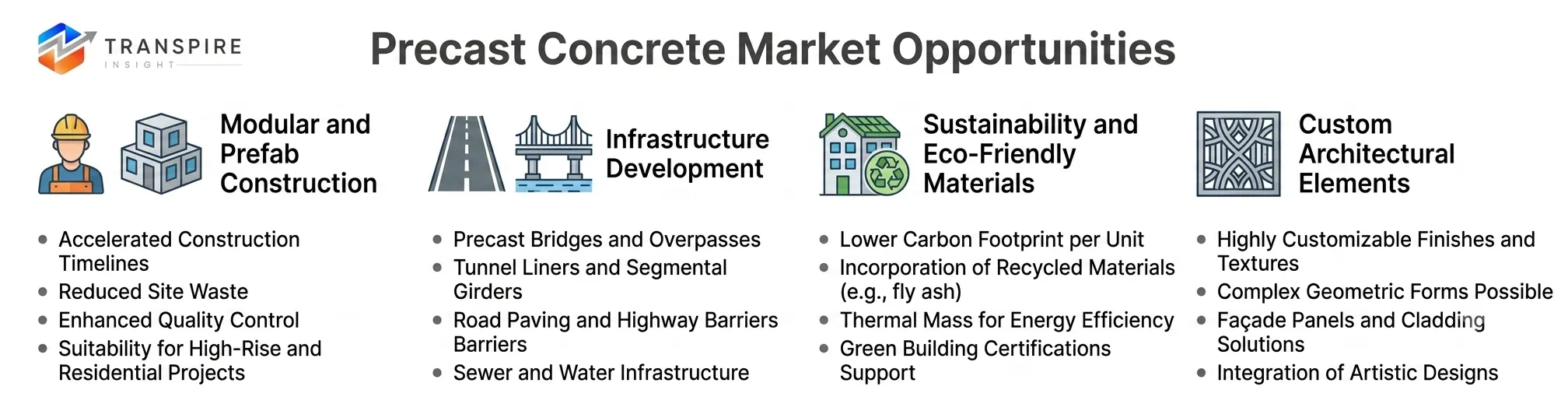
Rising adoption of modular and offsite construction
Contractors are increasingly shifting toward modular, offsite manufacturing to shorten project timelines, improve quality control, and reduce dependence on skilled on-site labor across major markets.
Government-backed housing programs accelerating precast demand
India's subsidized low-income housing initiatives and China's urban prefabrication mandates are channeling steady public-sector volume into precast concrete manufacturing capacity across emerging Asian economies broadly.
Rising infrastructure rehabilitation and bridge replacement projects
North America's aging infrastructure is driving highway bridge replacements and rehabilitation work, with precast components valued for faster installation and reduced traffic disruption during construction.
China's prefabrication quotas driving urban construction volume
China's mandate requiring roughly 30% of new urban buildings to use prefabrication is generating predictable, large-scale demand for precast concrete manufacturers nationwide across major cities.
Labor shortages pushing contractors toward precast solutions
Persistent skilled-labor shortages and rising on-site construction costs are prompting contractors to shift toward factory-made precast components for greater cost predictability and shorter project schedules.
Rising warehouse and logistics facility construction demand
Expanding e-commerce and distribution networks are fueling warehouse and logistics facility construction across North America, with precast structural components favored for speed and repeatable design.
List of Top 25 Companies Leading the Precast Concrete Market
1. CRH plc
CRH stands as a dominant force supplying diversified concrete and infrastructure materials worldwide.
Founded: 1970 | HQ: Dublin, Ireland.
Why It Ranks: Massive scale, acquisition strategy, and strong footprint across North America and Europe.
Regional Dominance: Strong leadership position across North America and Western Europe.
Product Line: Structural precast elements, architectural cladding, and stormwater management systems.
2. Cemex S.A.B. de C.V.
Cemex continuously integrates low-carbon materials into its vast concrete product line.
Founded: 1906 | HQ: Monterrey, Mexico.
Why It Ranks: industrial presence and continuous investments in sustainable concrete technologies.
Regional Dominance: Primary footprint in North America, Latin America, and Europe.
Product Line: Ready-mix concrete, precast structural elements, and civil infrastructure components.
3. Larsen & Toubro Construction
L&T drives large-scale precast construction for major infrastructure projects across Asia.
Founded: 1938 | HQ: Mumbai, India.
Why It Ranks: EPC dominance and massive internal precast manufacturing capacity for megaprojects.
Regional Dominance: Heavy dominance across South Asia and the Middle East.
Product Line: Precast bridge girders, elevated transit piers, and modular building panels.
4. Boral Limited
Boral delivers essential construction materials and precast solutions across key Australian infrastructure markets.
Founded: 1946 | HQ: Sydney, Australia.
Why It Ranks: Dominant market presence and integrated aggregate supply chain in Australasia.
Regional Dominance: Strong commercial and infrastructure leadership throughout Australia.
Product Line: Concrete pipes, precast sound walls, and structural masonry products.
5. Consolis Group
Consolis specializes in high-performance precast concrete solutions for modern European building projects.
Founded: 1925 | HQ: Paris, France.
Why It Ranks: Technical expertise in low-carbon precast elements and off-site modular design.
Regional Dominance: Widespread market leadership across Northern, Central, and Eastern Europe.
Product Line: Hollowcore floor slabs, precast wall panels, and civil infrastructure elements.
6. Balfour Beatty plc
Balfour Beatty delivers critical infrastructure components through specialized off-site precast manufacturing facilities.
Founded: 1909 | HQ: London, United Kingdom.
Why It Ranks: Major civil engineering footprint and advanced off-site fabrication expertise.
Regional Dominance: Strong market hold in the United Kingdom and North America.
Product Line: Precast railway ties, bridge decks, and heavy civil structural units.
7. Elematic Oyj
Elematic provides state-of-the-art precast production machinery and complete factory lines globally.
Founded: 1959 | HQ: Akaa, Finland
Why It Ranks: leadership in designing technology and automated plants for precast manufacturing.
Regional Dominance: reach spanning Europe, Asia, the Middle East, and the Americas.
Product Line: Precast production lines, extruder machinery, and automated mold technology.
8. Tindall Corporation
Tindall manufactures custom structural and architectural precast concrete components for heavy industrial applications.
Founded: 1963 | HQ: Spartanburg, South Carolina, USA.
Why It Ranks: Renowned engineering capabilities and high-volume precast manufacturing for complex structures.
Regional Dominance: Deep coverage throughout the Eastern and Southern United States.
Product Line: Precast parking structures, insulated wall panels, and heavy utility vaults.
9. Forterra Inc.
Forterra supplies critical drainage and structural precast components for water infrastructure networks.
Founded: 1989 | HQ: Irving, Texas, USA.
Why It Ranks: Extensive manufacturing footprint dedicated to pipe and water management infrastructure.
Regional Dominance: Strong operational presence across North America.
Product Line: Precast concrete pipes, box culverts, and specialized utility structures.
10. Spancrete (Wells)
Spancrete offers advanced hollowcore floor systems and precast structural building components.
Founded: 1946 | HQ: Albany, Minnesota, USA.
Why It Ranks: Pioneer in prestressed hollowcore technology with widespread commercial project integration.
Regional Dominance: Significant market penetration across the Midwestern United States.
Product Line: Precast hollowcore slabs, insulated wall systems, and structural columns.
Conclusion
The precast concrete sector continues to undergo a structural change and is becoming an integral part of modern and high-efficiency construction. With a shortage of labor, growing urban housing needs, and more demanding environmental requirements, the adoption of off-site precast solutions is increasingly gaining momentum around the world. To improve supply chains, industry leaders are becoming more active in implementing smart factory automation, digital twins, and ultra-low-carbon mix designs. With the continued investment in scalable infrastructure, precast concrete will continue driving resilient, rapid delivery of buildings around the world.


Send us a brief description of your challenge and we'll get back to you within 24 hours.

 inquiry@transpireinsight.com
 APAC:+91 7666513636
 Address


