
Sep 10, 2026
By Transpire Insight
Description
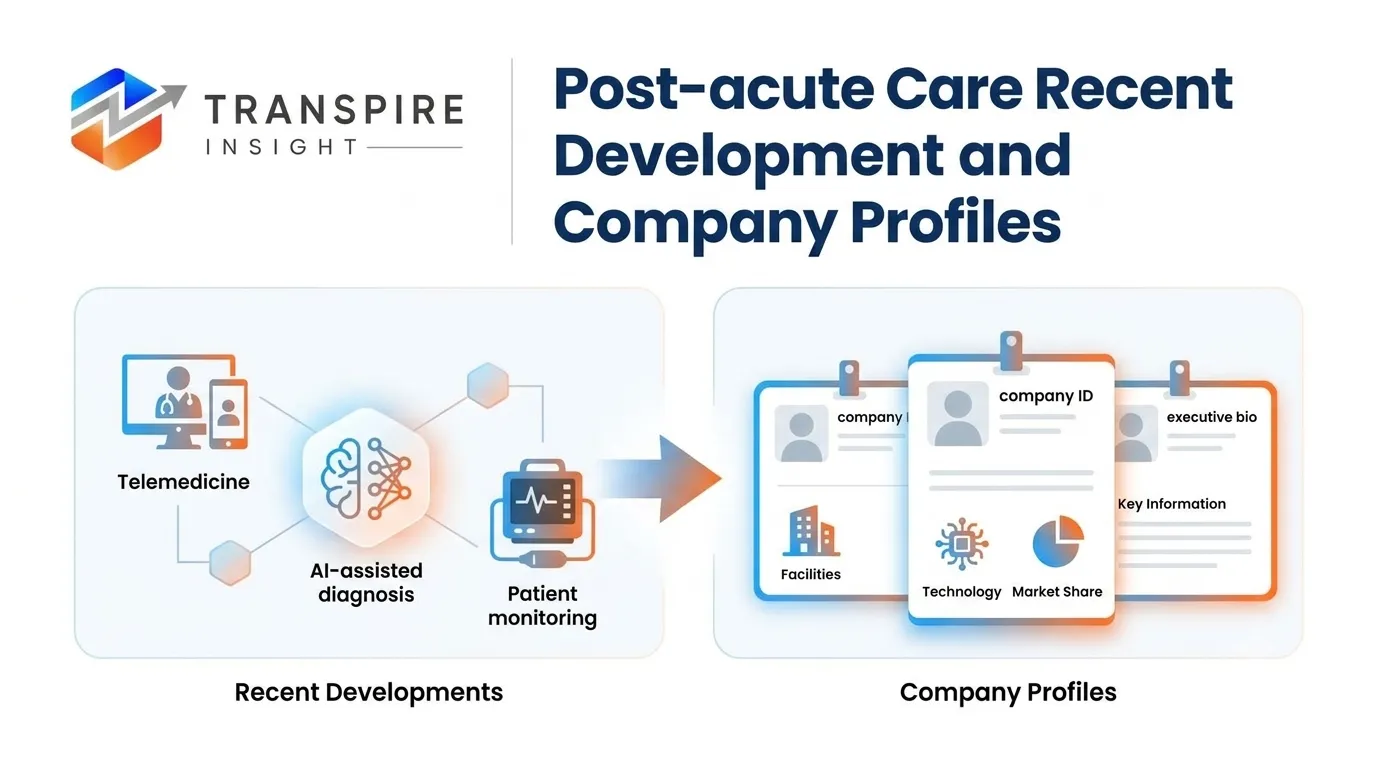
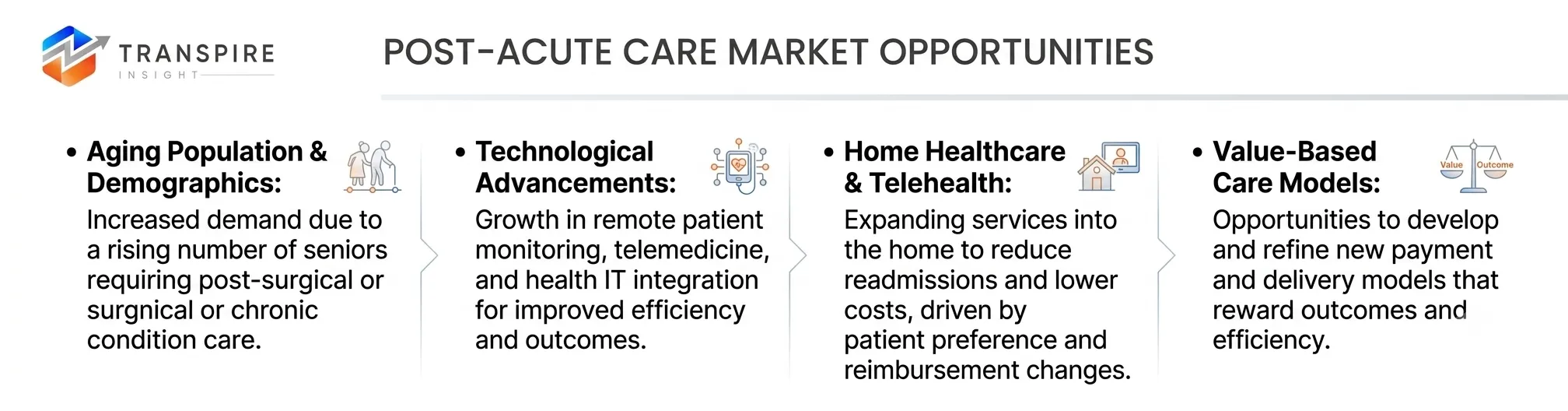
According to a research report published by Transpire Insight, the post-acute care market size is projected to grow from USD 989.16 billion in 2026 to USD 1549.23 billion by 2035, at a CAGR of 7.18% during the forecast period 2027-2035. Factors influencing the market are aging populations, the growing prevalence of chronic diseases, the push towards value-based care, the growth of home health services, innovations in remote patient monitoring and health system incentives to lower hospital readmission rates.
Introduction
Post-acute care (PAC) is vital medical and rehabilitation services administered to those recovering from significant surgery, illness or traumatic injury. PAC represents a vital link between acute hospital care and full recovery and encompasses skilled nursing, long-term care hospitals, inpatient rehabilitation and home health. Post-acute care is a critical component to reducing overall healthcare costs and hospital readmissions as healthcare systems transition to new reimbursement methods.
Recent Development News
Stay Ahead of Emerging Opportunities with Expert Market Insights by Transpire Insight
Transpire Insight provides comprehensive, data-driven market intelligence to support smarter business decisions. Our research is rooted in comprehensive analysis, authoritative predictions, and industry expertise, enabling organizations to make informed decisions in rapidly evolving markets. In-depth analysis of market segmentation, competitive positioning, regional trends, and emerging investment opportunities in high-growth areas. We blend accuracy with actionable intelligence, empowering companies to uncover new avenues for growth, bolster strategic decision-making, and stay ahead in a dynamic market.
Post-acute Care Market Size & Statistics
Regional Growth and Demand Analysis by Transpire Insight
North America's lead rests on advanced healthcare infrastructure paired with rising capital flowing into post-acute services, a combination that keeps the region ahead on absolute scale. North America dominated the market with the highest market share of 43.2% in 2025, supported by advanced healthcare infrastructure and increasing investments in post-acute care services. Within the US, the Northeast leads domestically with a 26.8% share, driven by a disproportionately older population and a dense cluster of leading hospitals and academic medical centres that make early discharge into skilled nursing, rehabilitation, and home healthcare routine. Northeast dominated the U.S. post-acute care market with the highest market share of 26.8% in 2025. The Northeast is characterized by a substantially larger percentage of people aged 65 and over, in comparison with other U.S. regions. The Northeast is home to several leading hospitals, academic medical centres, and specialized clinics. This advanced healthcare infrastructure facilitates early hospital discharges and seamless referrals to post-acute care providers. Policy is reinforcing this position too: a Medicare Advantage rate increase is incentivizing providers to further optimize their care networks, even as more than 100,000 unfilled caregiver roles push investment toward documentation automation and task-sharing. The Acute Hospital Care at Home waiver demonstrates viability for acute-level home episodes, and a 4.33% Medicare Advantage rate hike in 2026 incentivizes further network optimization. Yet the region wrestles with more than 100,000 unfilled caregiver roles, spurring investment in documentation automation and task-sharing to preserve quality scores.
Asia Pacific's outperformance is structural rather than cyclical. Rapid demographic aging and accelerating health-system modernization are pushing governments across the region to pilot bundled payment models and subsidize telehealth investment, offsetting persistent bed shortages. Asia-Pacific posts the fastest regional CAGR at 7.60%, underpinned by rapid demographic aging and accelerating health-system modernization. Governments pilot bundled payment models and subsidize telehealth investments to offset bed shortages. Urban middle-class populations across China, India, and Japan are embracing consumer health technology fast enough that agencies are able to leapfrog straight into virtual case management rather than building out legacy infrastructure first, even as workforce training gaps and fragmented regulation continue to complicate cross-border expansion. Urban middle-class populations embrace consumer health tech, enabling agencies to leapfrog straight to virtual case management. Nevertheless, workforce training variability and fragmented regulations can hamper cross-border expansion.
Top 15 Trends in the Post-acute Care Market
Home-based, community-based care models expanding
Patients increasingly prefer recovering at home, prompting providers to expand home health agencies and community-based rehabilitation services as alternatives to institutional post-acute settings.
Home health agencies growing fastest segment
Among post-acute care settings, home health agencies are expanding fastest, driven by patient preference, advances in remote monitoring, and payer incentives favoring community care.
Bundled payment models piloted in Asia Pacific
Governments across Asia Pacific are piloting bundled payment structures and subsidizing telehealth investment to offset bed shortages amid rapid demographic aging and modernization.
Consumer health tech leapfrogging legacy infrastructure
Fast-growing urban middle-class populations in China, India, and Japan are adopting consumer health technology quickly enough to skip straight to virtual case management.
Caregiver workforce shortages spurring automation
With over 100,000 unfilled caregiver roles in North America alone, providers are investing in documentation automation and task-sharing tools to preserve care quality.
Integrated care pathways reshaping Europe
Fragmented European health systems are converging on integrated care pathways, shifting patients from inpatient settings toward community-based rehabilitation with standardized, multidisciplinary care protocols.
List of Top 25 Companies Leading the Post-acute Care Market
1. Kindred Healthcare (ScionHealth)
Major operator of specialty hospitals and long-term acute care facilities nationwide.
Founded: 1985 | HQ: Louisville, Kentucky, USA.
Why It Ranks: High volume capacity in long-term acute recovery and complex medical management.
Regional Dominance: Strong nationwide presence across urban and suburban markets in North America.
Product Line: Long-term acute care, transitional care, respiratory therapy, and complex nursing.
2. Encompass Health Corporation
Industry-leading provider of inpatient rehabilitation services across the United States.
Founded: 1984 | HQ: Birmingham, Alabama, USA.
Why It Ranks: Market leadership in inpatient rehabilitation beds and nationwide facility footprint.
Regional Dominance: Strong presence across southern, midwestern, and eastern United States regions.
Product Line: Stroke recovery, brain injury rehab, spinal cord rehabilitation, physical therapy.
3. Amedisys, Inc.
Major provider of home health, hospice, and personal care services nationwide.
Founded: 1982 | HQ: Baton Rouge, Louisiana, USA.
Why It Ranks: Mass scale and extensive network of home health and hospice clinicians.
Regional Dominance: Extensive coverage spanning thirty-eight states across the United States market.
Product Line: Skilled home nursing, palliative care, hospice, disease management, physical therapy.
4. LHC Group (Optum)
Integrated post-acute provider delivering home-based care in partnership with hospitals.
Founded: 1994 | HQ: Lafayette, Louisiana, USA.
Why It Ranks: Deep joint-venture integration with large health systems and acute hospitals.
Regional Dominance: Dominant footprint across thirty-seven United States states and rural communities.
Product Line: Home health nursing, hospice care, community-based services, long-term acute care.
5. Genesis Healthcare
One of the nation’s largest skilled nursing and rehab therapy providers.
Founded: 1985 | HQ: Kennett Square, Pennsylvania, USA.
Why It Ranks: Expansive network of skilled nursing facilities and contract rehabilitation services.
Regional Dominance: Concentrated presence across eastern, mid-Atlantic, and central United States regions.
Product Line: Skilled nursing care, short-term rehabilitation, memory care, assisted living support.
6. Select Medical Corporation
Diversified healthcare provider operating specialty hospitals, outpatient clinics, and rehab facilities.
Founded: 1996 | HQ: Mechanicsburg, Pennsylvania, USA.
Why It Ranks: Comprehensive vertical coverage from long-term acute care to occupational medicine.
Regional Dominance: Robust national network operating across forty-six United States states.
Product Line: Critical illness recovery, inpatient rehabilitation, outpatient physical therapy, occupational health.
7. Brookdale Senior Living
Leading owner and operator of senior living and memory care communities.
Founded: 1978 | HQ: Brentwood, Tennessee, USA.
Why It Ranks: Largest market footprint in senior living, memory care, and assisted care.
Regional Dominance: Extensive footprint spanning nationwide communities across the United States market.
Product Line: Assisted living, Alzheimer's care, skilled nursing, home health, rehabilitation services.
8. PACS Group (Providence Administrative Consulting Services)
Rapidly growing post-acute platform managing skilled nursing and transitional facilities.
Founded: 2013 | HQ: Farmington, Utah, USA.
Why It Ranks: Fast organic expansion and acquisition strategy in skilled nursing facilities.
Regional Dominance: Leading presence across western and central United States healthcare markets.
Product Line: Skilled nursing management, post-stroke rehab, complex clinical care, occupational therapy.
9. The Ensemble Health Partners (Post-acute Analytics / Care Coordination)
Tech-enabled provider streamlining post-acute transition workflows and revenue cycle management.
Founded: 2014 | HQ: Cincinnati, Ohio, USA.
Why It Ranks: Strong health system integrations that reduce readmissions and manage care costs.
Regional Dominance: Broad footprint serving health systems across the entire United States.
Product Line: Patient transition management, revenue cycle solutions, post-acute care coordination tools.
10. Cornerstone Healthcare Group
Specialty health system focusing on long-term acute care and rehabilitation.
Founded: 1990 | HQ: Dallas, Texas, USA.
Why It Ranks: Specialized capabilities in managing medically complex, high-acuity post-surgical patients.
Regional Dominance: Strong market density in the southern and southwestern United States.
Product Line: Long-term acute care, senior living, behavioral health, ventilator weaning care.
Conclusion
The post acute care market is in a state of constant transformation due to demographic aging, technology and transitioning to value based care. Leading healthcare providers are aggressively growing home health networks, telehealth offerings and specialized long-term rehabilitation services to reduce hospital readmissions. Strategic partnerships and digital care platforms will continue to be key to maintaining competitive positioning and providing high quality, patient-centric post-acute outcomes in a cost-efficient path to recovery, worldwide.


Send us a brief description of your challenge and we'll get back to you within 24 hours.

 inquiry@transpireinsight.com
 APAC:+91 7666513636
 Address


