
Sep 04, 2026
By Transpire Insight
Description
According to a research report published by Transpire Insight, the polyacrylamide market size is projected to grow from USD 7.33 billion in 2026 to USD 12.8 billion by 2035, at a CAGR of 7.12% during the forecast period 2027-2035. Polyacrylamide market expansion is driven by accelerating municipal wastewater treatment mandates, expanding tertiary enhanced oil recovery (EOR) initiatives, rising demand for water-intensive mineral processing, and structural industrial zero-liquid-discharge (ZLD) sustainability regulations.
Introduction
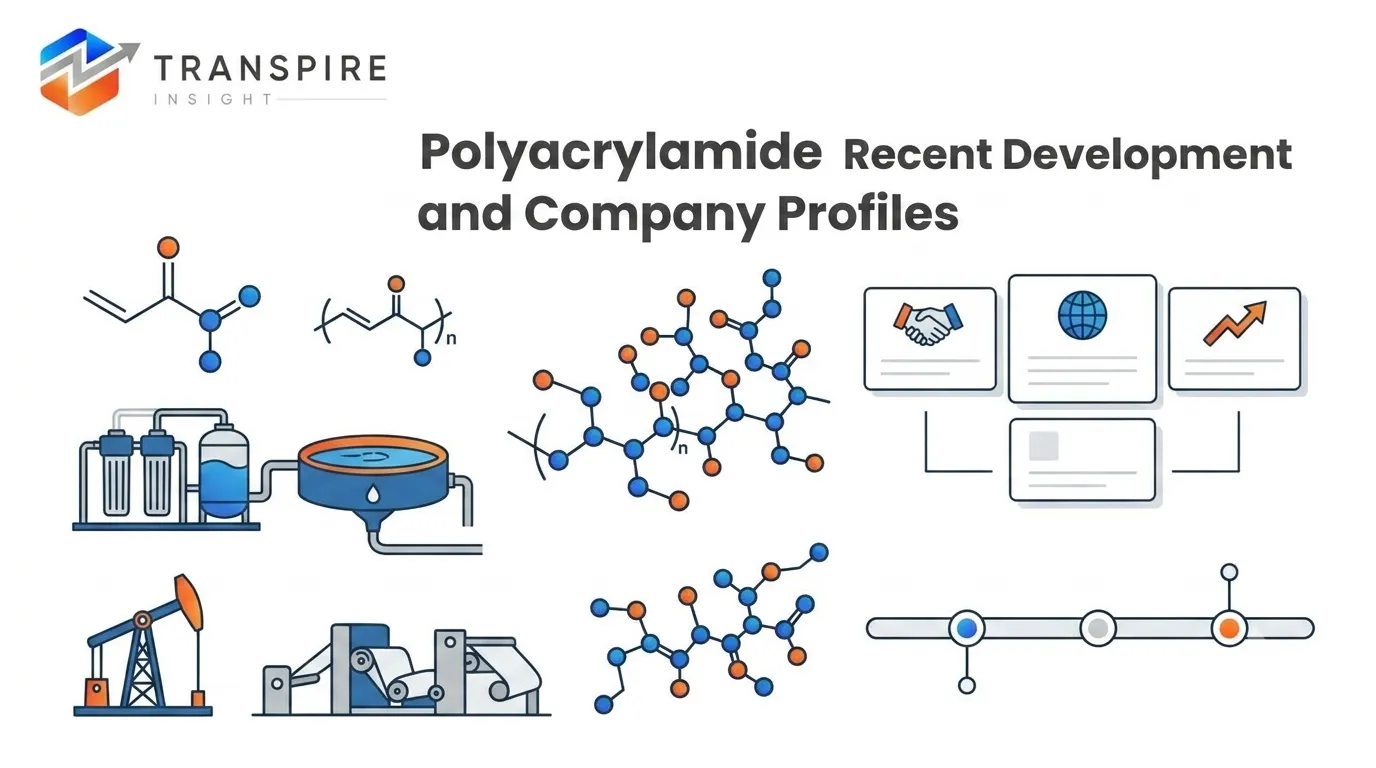
Polyacrylamide (PAM) is a versatile synthetic water-soluble polymer composed of acrylamide subunits. Valued for its strong flocculation, thickening, and friction-reduction properties, it is essential across municipal wastewater treatment, tertiary oil recovery, papermaking, and mining applications. Available in anionic, cationic, non-ionic, and amphoteric formulations, PAM accelerates solid-liquid separation and enhances fluid viscosity. Severe water stress, stringent industrial effluent policies, and continuous infrastructure investments primarily propel growth.
Recent Development News
Stay Ahead of Emerging Opportunities with Expert Market Insights by Transpire Insight
Transpire Insight provides comprehensive, data-driven market intelligence to support smarter business decisions. Our research is rooted in comprehensive analysis, authoritative predictions, and industry expertise, enabling organizations to make informed decisions in rapidly evolving markets. In-depth analysis of market segmentation, competitive positioning, regional trends, and emerging investment opportunities in high-growth areas. We blend accuracy with actionable intelligence, empowering companies to uncover new avenues for growth, bolster strategic decision-making, and stay ahead in a dynamic market.
Polyacrylamide Market Size & Statistics
Regional Growth and Demand Analysis by Transpire Insight
North America represents a mature and steadily expanding market for polyacrylamide, supported by its widespread use in municipal and industrial water treatment, oil and gas, mining, and pulp and paper applications. The U.S. remains the regional demand center because of its large-scale wastewater treatment infrastructure and continued investment in water reuse and treatment technologies. Demand is also supported by oilfield applications, where polyacrylamide is used in enhanced oil recovery and drilling operations. Canada contributes to regional growth through mining, oil sands, and municipal water treatment, while increasing environmental regulations are encouraging industries to adopt more efficient flocculation and water-management solutions.
Asia-Pacific is expected to remain the major growth engine for the polyacrylamide market, driven by rapid industrialization, urbanization, and expanding wastewater treatment capacity. China accounts for a significant share of regional demand because of its large mining, oil and gas, textile, paper, and municipal wastewater treatment industries. India is also emerging as a high-growth market as government initiatives focused on clean water, sewage treatment, industrial wastewater management, and water reuse are increasing the need for water-treatment chemicals. Meanwhile, Japan and South Korea are supporting regional demand through advanced wastewater-treatment infrastructure and stringent environmental standards, while Southeast Asian economies are creating additional opportunities as manufacturing and urban development accelerate.
List of Top 25 Companies Leading the Polyacrylamide Market
market leader producing extensive cationic, anionic, and non-ionic polymer portfolios.
Founded: 1978 | HQ: Andrézieux-Boutheon, France.
Why It Ranks: Holds over 18% market share in water-soluble polymers.
Regional Dominance: market leadership across Europe, North America, and Asia-Pacific.
Product Line: FLOPAM, FLOERGER, and AQUAPOL industrial polyacrylamide water treatment formulations.
Major supplier of water treatment chemicals for paper and municipal utilities.
Founded: 1920 | HQ: Helsinki, Finland.
Why It Ranks: Dominates pulp, paper, and municipal wastewater treatment polyacrylamide markets globally.
Regional Dominance: Europe and North America industrial process water treatment markets.
Product Line: Superfloc flocculants, Fennopol retention aids, and customized coagulant polymer solutions.
Multinational chemical giant providing high-performance polyacrylamide solutions across diverse end-use sectors.
Founded: 1865 | HQ: Ludwigshafen, Germany
Why It Ranks: Exceptional production capacity and integrated chemical chain value synergy.
Regional Dominance: Strong market position across Europe, North America, and Asia-Pacific.
Product Line: Alcomer friction reducers, Magnafloc flocculants, and Rheomax tailings management polymers.
Specialty chemical provider specializing in high-viscosity polyacrylamide and industrial additives.
Founded: 1924 | HQ: Wilmington, Delaware, USA.
Why It Ranks: Strong historical market position and extensive proprietary polymer formulation catalog.
Regional Dominance: North America and Latin America industrial manufacturing and oilfield operations.
Product Line: Drewfloc flocculants, Praestol sludge dewatering polymers, and cellulosic processing aids.
Prominent Asian manufacturer specializing in oilfield EOR and municipal polymer production.
Founded: 1998 | HQ: Beijing, China.
Why It Ranks: Top domestic Chinese supplier for massive enhanced oil recovery extraction programs.
Regional Dominance: China and broader Asia-Pacific regional oilfields and utility plants.
Product Line: Anionic PAM series, tertiary oil extraction polymers, and municipal flocculants.
Leading producer of specialty process chemicals and water management polymer systems.
Founded: 1907 | HQ: Wilmington, Delaware, USA.
Why It Ranks: Major player following extensive strategic acquisitions in water treatment.
Regional Dominance: Strong footprint across North America, Latin America, and Western Europe.
Product Line: Zetag cationic polymers, Praestol flocculants, and advanced retention performance systems.
Top-tier Chinese manufacturer of acrylamide monomers and downstream polyacrylamide polymers.
Founded: 1995 | HQ: Bengbu, Anhui, China.
Why It Ranks: High vertical integration capability from monomer precursor to polymer products.
Regional Dominance: Asia-Pacific region, with expanding export routes to markets.
Product Line: Tianrun granular polyacrylamide powder, liquid emulsion polymers, and bio-acrylamide.
Specialized chemical entity producing large volumes of high-molecular polyacrylamide powders.
Founded: 1996 | HQ: Puyang, Henan, China.
Why It Ranks: Mass production capabilities serving petroleum extraction and industrial effluent treatment.
Regional Dominance: Domestic Chinese markets and Middle Eastern enhanced oil recovery fields.
Product Line: EOR grade anionic polyacrylamide, drag reduction polymers, and coagulant aids.
advanced materials enterprise supplying technical polymers for mining and drilling.
Founded: 1863 | HQ: Brussels, Belgium.
Why It Ranks: Industry benchmark for advanced mineral extraction and alumina refining polymers.
Regional Dominance: Europe, North America, and key Latin American mining territories.
Product Line: Cyanamer polyacrylamides, Matrix drilling additives, and mineral processing chemical systems.
water technology leader supplying customized polyacrylamide programs for heavy industrial facilities.
Founded: 1923 | HQ: St. Paul, Minnesota, USA.
Why It Ranks: Massive direct-service network delivering tailored water clarification chemistry solutions.
Regional Dominance: North America, Europe, Middle East, and Asia-Pacific utility operations.
Product Line: OPTIMER flocculants, ULTIMER liquid emulsions, and automated chemical feeding systems.
Conclusion
The polyacrylamide market remains vital to modern wastewater infrastructure, mineral processing, and tertiary oil recovery operations worldwide. Driven by escalating regulatory pressures and water scarcity, demand for high-performance anionic and cationic polymers continues to accelerate. Leading players maintain market dominance through strategic technological innovation, vertical integration, and aggressive geographic expansion across high-growth emerging economies. Consequently, the polyacrylamide sector is firmly positioned for sustained, long-term expansion through 2037 and beyond.


Send us a brief description of your challenge and we'll get back to you within 24 hours.

 inquiry@transpireinsight.com
 APAC:+91 7666513636
 Address


