
Aug 28, 2026
By Transpire Insight
Description
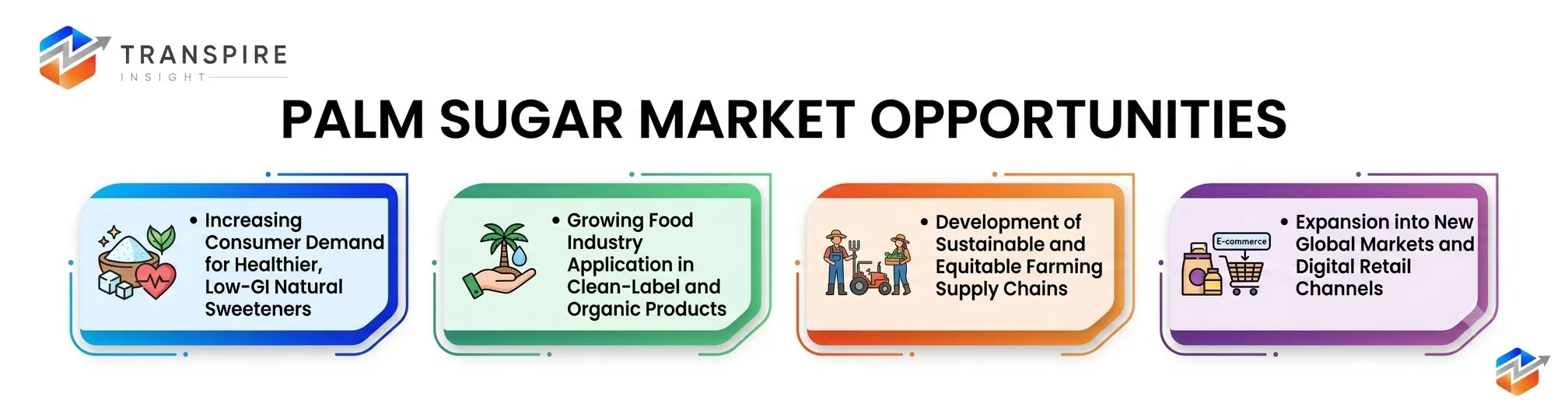
According to a research report published by Transpire Insight, the palm sugar market size is projected to grow from USD 2.23 billion in 2026 to USD 3.84 billion by 2035, at a CAGR of 7.30% during the forecast period 2027-2035. The natural and unrefined low glycemic sweetener category is seeing growing demand from consumers across the globe, thus contributing to the growth of the palm sugar market. The growing awareness of health, the growth of the organic food industry, clean-label dietary changes, and sustainable practices for smallholder farming all drive commercial uptake in the food and beverage industry.
Introduction
Palm sugar is a fast-growing natural sweetener market segment that is expected to reach a worldwide value of around USD 2.23 billion in 2026. Palm sugar is unrefined sugar that is extracted from the sap of coconut, date, and palmyra palm trees. Crafted for its exceptional caramel taste and its low glycemic index, it is a popular ingredient among food processors, bakeries, and health-conscious home cooks all over the world. The market is expected to have steady commercial growth globally with sustainable harvesting practices in Southeast Asia.
Recent Development News
Stay Ahead of Emerging Opportunities with Expert Market Insights by Transpire Insight
Transpire Insight provides comprehensive, data-driven market intelligence to support smarter business decisions. Our research is rooted in comprehensive analysis, authoritative predictions, and industry expertise, enabling organizations to make informed decisions in rapidly evolving markets. In-depth analysis of market segmentation, competitive positioning, regional trends, and emerging investment opportunities in high-growth areas. We blend accuracy with actionable intelligence, empowering companies to uncover new avenues for growth, bolster strategic decision-making, and stay ahead in a dynamic market.
Download the exclusive Palm Sugar Market sample report today to explore expert insights, key trends, and emerging opportunities shaping the future of the industry.
Palm Sugar Market Size & Statistics
Regional Growth and Demand Analysis by Transpire Insight
Asia Pacific's leadership is built on deep culinary tradition and a well-established production base spread across Java, Sumatra, Sulawesi, and Bali, where coconut palm producers continue to modernize processing without abandoning traditional extraction methods. Indonesia remains the single strongest growth story in the region, with domestic consumption climbing on the back of traditional and packaged food demand, while the Industry Ministry has actively pushed small and medium palm sugar producers toward exports, particularly into hospitality and premium retail channels. India's organic palm sugar segment is expanding quickly as well, supported by government incentives for organic farming conversion, positioning the country alongside Thailand as a key exporter feeding both regional and international demand. Companies like Big Tree Farms and Windmill Organics continue to source heavily from this belt, reinforcing Asia Pacific's dominance even as seasonal palm sap shortages during dry spells periodically constrain supply.
North America and Europe are where the category's next leg of growth is concentrated. In North America, adoption is shifting toward liquid and powdered formats that dissolve more easily into coffee, sauces, and baked goods, a shift led by specialty cafes and health-focused food manufacturers seeking alternatives to refined sugar. The region's food and beverage sector, along with a strong horeca and retail base, continues to pull organic and minimally processed palm sugar into mainstream grocery aisles. Europe, led by the UK, Germany, and France, is emerging as a smaller but fast-maturing market where stringent organic certification standards and rising fair-trade sourcing are pushing producers toward greater traceability, with online and retail sales both posting strong year-on-year gains.
Top 15 Trends in the Palm Sugar Market
Proceed to checkout to purchase the exclusive Palm Sugar Market report and get instant access to detailed market insights, strategic analysis, and future growth opportunities.
Rising demand for low-glycemic natural sweeteners
Health-conscious consumers are shifting away from refined sugar toward palm sugar, valuing its lower glycemic index and natural mineral content across bakery, beverage, and confectionery.
Organic certification adoption expanding across producers
Producers across Indonesia, Thailand, and India are pursuing organic certification to meet rising export requirements, supported by government incentives that reward sustainable, chemical-free palm sap.
Liquid and powdered formats gaining preference
North American and European buyers increasingly prefer liquid and powdered palm sugar formats over traditional blocks, since these dissolve faster and integrate more easily.
E-commerce and direct-to-consumer distribution growing
Online retail now represents a growing share of organic palm sugar sales, as smaller producers use e-commerce and direct-to-consumer channels to reach health-focused buyers.
India's organic palm sugar segment expanding.
India's organic palm sugar segment is expanding quickly, supported by government incentives for organic farming conversion and rising domestic demand for chemical-free, minimally processed traditional products.
Sustainable sourcing and fair-trade certifications are rising.
Buyers across food and beverage sectors are prioritizing sustainably sourced palm sugar with fair-trade certification, pushing producers toward traceable supply chains and better compensation.
List of Top 25 Companies Leading the Palm Sugar Market
Customize the exclusive Palm Sugar Market report to receive insights tailored to your needs, including country-specific analysis and business-focused market intelligence.
1. Big Tree Farms
Pioneered direct-trade organic palm sweetener production across Indonesian smallholder coconut farmer networks.
Founded: 2003 | HQ: Bali, Indonesia
Why It Ranks: Market leader in regenerative organic certification and ethical supply distribution.
Regional Dominance: Holds leading organic consumer market shares across North America and Europe.
Product Line: Organic granulated palm sugar, blonde coconut sugar, and liquid sap nectar.
2. Medikonda Nutrients
Major exporter specializing in high-purity botanical extracts and refined sugar alternatives.
Founded: 2012 | HQ: Andhra Pradesh, India.
Why It Ranks: Dominates wholesale industrial supply chains with advanced quality-controlled extraction technologies.
Regional Dominance: Strong commercial presence throughout South Asia, Middle East, and North America.
Product Line: Pure palm sugar powder, palm jaggery blocks, and botanical sweeteners.
3. PMA Organics (Lewi's Organics)
Premium natural food producer dedicated to traditional artisanal palm sap processing methods.
Founded: 2008 | HQ: Jakarta, Indonesia.
Why It Ranks: Renowned for unrefined single-origin palm sugars with high mineral nutrient profiles.
Regional Dominance: Controls substantial organic retail shelf space across Southeast Asia and Australia.
Product Line: Granulated organic palm sugar, sap syrup, and traditional sugar blocks.
4. Asia Palm Coco
Integrates palm plantation harvesting with high-volume industrial sap refining export operations.
Founded: 2010 | HQ: Bangkok, Thailand.
Why It Ranks: High processing capacity enables competitive bulk supply to commercial food manufacturers.
Regional Dominance: Major supplier across East Asia, Southeast Asia, and Pacific trade corridors.
Product Line: Industrial palm sugar granules, liquid coconut sap, and block sugar.
5. BetterBody Foods & Nutrition LLC
Fast-growing health food innovator offering clean-label organic alternatives for mainstream retail.
Founded: 2007 | HQ: Utah, United States.
Why It Ranks: Extensive retail distribution across major supermarket chains and e-commerce platforms.
Regional Dominance: Commands major market share throughout North America and Western European markets.
Product Line: Organic coconut palm sugar, low-glycemic sweeteners, and plant-based baking ingredients.
6. Mitr Phol Sugar Corporation
Asia's largest sugar producer expanding aggressively into sustainable natural palm alternatives.
Founded: 1946 | HQ: Bangkok, Thailand.
Why It Ranks: Unrivaled industrial distribution infrastructure and massive agricultural research and development capabilities.
Regional Dominance: Dominates the Asia-Pacific sugar sector while expanding exports to Europe.
Product Line: Refined palm sugar crystals, golden palm syrup, and specialty sweeteners.
7. Toufah Palm
Specialist producer delivering authentic palm jaggery and crystalline unrefined sap sweeteners.
Founded: 2015 | HQ: Kuala Lumpur, Malaysia.
Why It Ranks: Recognized for pure heritage sap processing standards without synthetic chemical additives.
Regional Dominance: Robust distribution networks across Southeast Asia and Gulf Cooperation Council countries.
Product Line: Crystalline palm sugar, solid palm blocks, and concentrated sap syrups.
8. Datu Puti (NutriAsia)
Iconic condiments manufacturer featuring traditional palm sugar syrups for Asian cuisine.
Founded: 1975 | HQ: Taguig, Philippines.
Why It Ranks: brand heritage with vast international grocery distribution network reaching diaspora.
Regional Dominance: Market leader in the Philippines with strong exports to North America.
Product Line: Palm sugar syrups, traditional sweetened sauces, and culinary dipping blends.
9. Organic Traditions
Superfood brand dedicated to sourcing wild-harvested low-glycemic natural plant sweeteners globally.
Founded: 2002 | HQ: Ontario, Canada.
Why It Ranks: Strong brand trust in organic certification and nutrient-dense functional food categories.
Regional Dominance: Holds extensive retail distribution across North America and Western European markets.
Product Line: Organic palm sugar, artisan coconut sweeteners, and dried superfood powders.
10. Kawan Food
Major Asian food manufacturer utilizing authentic palm sugar in commercial bakery products.
Founded: 1977 | HQ: Shah Alam, Malaysia.
Why It Ranks: High-capacity food processing facilities integrate palm sugar into mass consumer products.
Regional Dominance: Widespread retail footprint in Southeast Asia, North America, and Western Europe.
Product Line: Granulated palm sugar, Gula Melaka blocks, and traditional sweet delicacies.
Schedule a meeting with our market experts to discuss the exclusive Palm Sugar Market report and find the right research solution for your business.
Conclusion
As more and more commercial food producers and health-conscious consumers turn towards natural, low-glycemic sweeteners as substitutes for refined sugars, the palm sugar market is expected to achieve stable growth in the long run. The key market players are enhancing their competitive standing through the expansion of their smallholder supply chains, the adoption of blockchain traceability and the improvement of their sap processing facilities. Palm sugar is an essential ingredient in the future of sustainable food and beverage manufacturing in the market as the clean label dietary trend continues to grow in North America, Europe and Asia-Pacific.


Send us a brief description of your challenge and we'll get back to you within 24 hours.

 inquiry@transpireinsight.com
 APAC:+91 7666513636
 Address


