
Aug 28, 2026
By Transpire Insight
Description
According to a research report published by Transpire Insight, the organic wine market size is projected to grow from USD 15.4 billion in 2026 to USD 32.49 billion by 2035, at a CAGR of 11.12% during the forecast period 2026-2035. The market grows at a rapid pace with consumers placing greater emphasis on chemical-free health products, rising prevalence of certified sustainable viticulture, growing environmental awareness, and an increase in online availability for wine retailing.
Introduction
As consumer preferences increasingly shift to clean-label, health, and eco-friendly options, the organic wine market is on a strong growth trajectory. Organic wines are a sustainable shift in the world of winemaking, free from chemical pesticides, herbicides, and artificial ingredients. The sector remains strong compared to traditional wine areas around the world, fueled by growing eco-consciousness among younger generations, tough certification requirements, and increasingly sophisticated winemaking technologies. Grape growers are increasingly shifting to organic and biodynamic methods in response to ever-growing demand in restaurants and hospitality sectors as well as retail outlets.
Recent Development News
Stay Ahead of Emerging Opportunities with Expert Market Insights by Transpire Insight
Transpire Insight provides comprehensive, data-driven market intelligence to support smarter business decisions. Our research is rooted in comprehensive analysis, authoritative predictions, and industry expertise, enabling organizations to make informed decisions in rapidly evolving markets. In-depth analysis of market segmentation, competitive positioning, regional trends, and emerging investment opportunities in high-growth areas. We blend accuracy with actionable intelligence, empowering companies to uncover new avenues for growth, bolster strategic decision-making, and stay ahead in a dynamic market.
Download the exclusive Organic Wine Market sample report today to explore expert insights, key trends, and emerging opportunities shaping the future of the industry.
Organic Wine Market Size & Statistics
Regional Growth and Demand Analysis by Transpire Insight
The dominance of Europe is based on the support of organic agriculture provided over the last few decades by the EU, such as the Common Agriculture Policy for the conversion of conventional vineyards to certified organic ones. Together, Spain, Italy and France have about three-quarters of all certified organic vineyards in the world; and Germany ranks at almost one-third of the European organic wine market for its well-developed retail system and high level of consumer health consciousness. Events such as Millésime Bio have become an indicator of the direction of the trade: while the number of alcoholic drinks consumed by the under-35 buyers at the fair is declining, they were the ones who showed their preference for clear wines with transparent sourcing, rather than the traditional names. That's giving the opportunity to the smaller, estate-based winemaking operations, like Gérard Bertrand and Emiliana Organic Vineyards, to compete with the scale operations, which are typically the dominant players in conventional wine.
Outside of Europe's base, North America and Asia Pacific are the two regions driving demand growth. As the health-aware generation of adult drinkers grows, retailers and restaurants are expanding their organic wine selections and off-trade retail continues to be the most popular source for consumers to find and re-buy organic wines. In Asia Pacific, growing disposable incomes and a growing wine culture in some markets such as China, Japan and Australia are fueling their momentum as organic wine becomes available to a much wider first-time wine consumer base, including supermarkets, dedicated wine shops and online outlets. The two regions share one characteristic: declining purchases of bottles in some markets, despite rising average purchase prices, as consumers are more interested in provenance and certification than in price, which is raising average price points in the industry.
Top 15 Trends in the Organic Wine Market
Proceed to checkout to purchase the exclusive Organic Wine Market report and get instant access to detailed market insights, strategic analysis, and future growth opportunities.
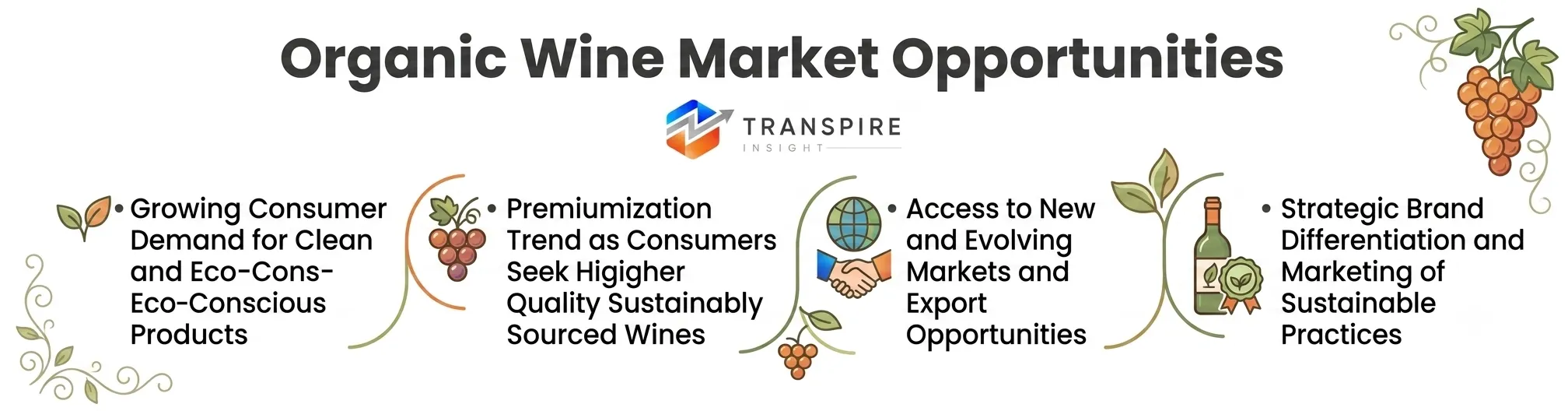
Premiumization Despite Lower Bottle Volumes
Consumers are buying fewer bottles overall but spending more per purchase, favoring provenance, quality, and certification over price, pushing average organic wine price points higher.
Younger Drinkers Demand Certified, Traceable Wines
Under-35 buyers increasingly choose wines with clear certification and transparent sourcing, showing less loyalty to legacy labels while total alcohol consumption among this group declines.
Recyclable, Lightweight Packaging Adoption Growing
More than two-thirds of leading organic wine producers have adopted recyclable packaging formats, reflecting growing pressure to cut carbon footprints across bottling, shipping, and retail.
Biodynamic and Regenerative Viticulture Expanding
Producers across Europe and emerging regions are converting vineyards to biodynamic and regenerative farming, strengthening soil health while meeting stricter certification standards demanded by buyers.
Direct-to-Consumer and Online Sales Growth
Wineries are expanding direct-to-consumer channels and online retail platforms, allowing smaller estate-led organic brands to reach health-conscious buyers without depending on traditional large-scale distribution networks.
Low-Intervention, Natural Winemaking Gaining Traction
Consumers increasingly favor low-intervention winemaking with minimal additives, viewing natural and organic labels as markers of authenticity, transparency, and reduced environmental impact compared to conventional.
List of Top 25 Companies Leading the Organic Wine Market
Customize the exclusive Organic Wine Market report to receive insights tailored to your needs, including country-specific analysis and business-focused market intelligence.
World’s largest organic and biodynamic vineyard producer operating extensive estate holdings.
Founded: 1986 | HQ: Santiago, Chile.
Why It Ranks: Sets the standard for large-scale certified biodynamic wine production.
Regional Dominance: Strong market presence across South America, North America, and Europe.
Product Line: Premium organic Cabernet Sauvignon, Carmenère, Sauvignon Blanc, and Syrah varieties.
Regenerative organic certified winery pioneering eco-friendly viticulture in North America.
Founded: 1987 | HQ: Hopland, California, USA.
Why It Ranks: Industry pioneer delivering mass-market accessible organic wines with top sustainability ratings.
Regional Dominance: Holds dominant market distribution leadership across North American retail channels.
Product Line: Organic Chardonnay, Cabernet Sauvignon, Pinot Noir, Zinfandel, and Rosé.
First certified organic and biodynamic winery established in the United States.
Founded: 1980 | HQ: Redwood Valley, California, USA.
Why It Ranks: Uncompromising commitment to non-sulfite-added, 100% natural and organic winemaking techniques.
Regional Dominance: Established nationwide retail presence and loyal direct-to-consumer base in America.
Product Line: Sulfite-free organic red blends, Pinot Grigio, Syrah, and Merlot.
Operates the largest contiguous organic vineyard estate in North America.
Founded: 1991 | HQ: Eugene, Oregon, USA.
Why It Ranks: Globally recognized for flagship organic Pinot Gris and sustainable estate stewardship.
Regional Dominance: Strong presence across the Pacific Northwest, national US, and export markets.
Product Line: Premium organic Pinot Gris, Pinot Noir, Sauvignon Blanc, and Rosé.
Tuscan estate renowned for 100% plant-based vegan and organic viticulture methods.
Founded: 1972 | HQ: Greve in Chianti, Italy.
Why It Ranks: World-class reputation for luxury organic Chianti Classico and Super Tuscan wines.
Regional Dominance: Dominates high-end luxury European organic wine distribution and export channels.
Product Line: Organic Chianti Classico, Camartina, Batàr, and fine red blends.
Italian leader producing certified organic and vegan Prosecco for generations.
Founded: 1981 | HQ: Villorba, Italy.
Why It Ranks: Leading innovator in organic sparkling wine and eco-designed sustainable packaging.
Regional Dominance: Leading exporter of organic Prosecco across Europe and North America.
Product Line: Organic Prosecco, Pinot Grigio, Cabernet, and zero-sulfite sparkling wines.
Iconic Loire Valley vineyard fully cultivated using strict biodynamic principles.
Founded: 1130 | HQ: Savennières, France.
Why It Ranks: Historical landmark producing some of the world's most sought-after organic whites.
Regional Dominance: Highly influential in French luxury viticulture and European fine dining markets.
Product Line: Exceptional single-estate organic Chenin Blanc and biodynamic aged white wines.
Historic Italian wine dynasty expanding certified organic vineyard footprints across regions.
Founded: 1385 | HQ: Florence, Italy.
Why It Ranks: Unmatched heritage combined with modern sustainable farming and high prestige.
Regional Dominance: Massive distribution dominance across Southern Europe, the Americas, and Asia.
Product Line: Premium organic Sangiovese, Chianti, Super Tuscans, and white varietals.
South African estate utilizing biological farming and natural pest-control ecosystems.
Founded: 1997 | HQ: Paarl, South Africa.
Why It Ranks: Pioneer in holistic sustainable viticulture and premium African organic exports.
Regional Dominance: Dominates the African continent while expanding rapidly across Western Europe.
Product Line: Organic Syrah, Chenin Blanc, Méthode Cap Classique, and Rhône blends.
One of Australia’s largest producers of certified organic and vegan wines.
Founded: 1966 | HQ: Pokolbin, Australia.
Why It Ranks: Pioneer in low-sulfur organic winemaking across the Hunter Valley region.
Regional Dominance: Strong market presence in Australia, New Zealand, and Asia-Pacific regions.
Product Line: Organic Shiraz, Cabernet Sauvignon, Sauvignon Blanc, and Preservative-Free wines.
Schedule a meeting with our market experts to discuss the exclusive Organic Wine Market report and find the right research solution for your business.
Conclusion
The organic wine industry is quickly moving from a specialty to a major business. Organic and biodynamic wines are gaining a foothold and have gained a permanent place on the world market, advanced by the evolution of consumer concerns about health, the environment, and sustainable agriculture, as well as through the increased availability of these wines in shops and restaurants. Competition will grow as big drinkers and small estates keep investing in sustainable farming practices and clean-label bottles. In the end, this development is a sign of a shifting cultural paradigm towards the environment, natural purity and high-quality winemaking.


Send us a brief description of your challenge and we'll get back to you within 24 hours.

 inquiry@transpireinsight.com
 APAC:+91 7666513636
 Address


