
Sep 07, 2026
By Transpire Insight
Description
According to a research report published by Transpire Insight, the non-alcoholic smart beverages machines market size is projected to grow from USD 32.5 billion in 2026 to USD 47.34 billion by 2035, at a CAGR of 21.13% during the forecast period 2027-2035. The increase in health awareness, smart kitchenization, desire for customized zero-proof drinks, and wellness programs in the workplace drive the growth of automated, app-enabled NABD systems in both residential and commercial markets worldwide.
Introduction
The non-alcoholic smart beverage machines market is revolutionizing households and commercial spaces all around the world. The dispensers are automated, connected to the internet, and feature precise dosing of ingredients and adjustable room temperature to create coffee, carbonated water, juice, and specialty zero-proof beverages with ease. Consumer trends of healthy living and homemade gourmet foods, and smart kitchen integration are fueling market growth. These intelligent creations are poised as key points in the current food and beverage environments because of their advanced personalization and real-time consumption data collection.
Recent Development News
Stay Ahead of Emerging Opportunities with Expert Market Insights by Transpire Insight
Transpire Insight provides comprehensive, data-driven market intelligence to support smarter business decisions. Our research is rooted in comprehensive analysis, authoritative predictions, and industry expertise, enabling organizations to make informed decisions in rapidly evolving markets. In-depth analysis of market segmentation, competitive positioning, regional trends, and emerging investment opportunities in high-growth areas. We blend accuracy with actionable intelligence, empowering companies to uncover new avenues for growth, bolster strategic decision-making, and stay ahead in a dynamic market.
Non-Alcoholic Smart Beverages Machines Market Size & Statistics
Regional Growth and Demand Analysis by Transpire Insight
North America's lead is anchored less in novelty and more in habit, like coffee culture here has simply gone digital. The energy-efficient machines built around the connectedness of app-driven customization and fewer standalone gadgets are where the region is going, as Lavazza launched its Smart Brew Pro machine for offices and hospitality counters. Offline retail remains the largest source of category revenue as consumers want to see the build quality and interface design with their own eyes and hands before they pay a premium for it, and the portable-machine segment alone generates well over 60% of unit sales, suggesting that for some consumers, it's as much about the small, apartment-friendly footprint as it is about the brewing process. While coffee and tea machines still dominate, the machines for juices, carbonated beverages and functional beverages are gradually gaining ground, as a growing health-conscious demand takes off.
The momentum in Asia-Pacific is different: Quarterly growth is accelerating on a smaller base, as a result of upgrades to kitchens by urban households but not the replacement of old machines. First-time buyers in China, India and Southeast Asia are being directly drawn by their rising disposable income into the smart appliance category as they bypass manual machines altogether. In the region, brands such as Breville, SharkNinja and SodaStream have been targeting this market with their IoT-infused product lines that are connected to smart-home solutions and mobile apps already popular throughout the region. Health-consciousness is playing a dual role as a driver as well; consumers don't just want their machines to make caffeinated drinks, they want their machines to make functional drinks, low-sugar drinks, and natural drinks, drivers that are pressuring manufacturers to implement nutrition-aware features in addition to convenience.
Top 15 Trends in the Non-Alcoholic Smart Beverages Machines Market
AI and IoT-Driven Beverage Personalization
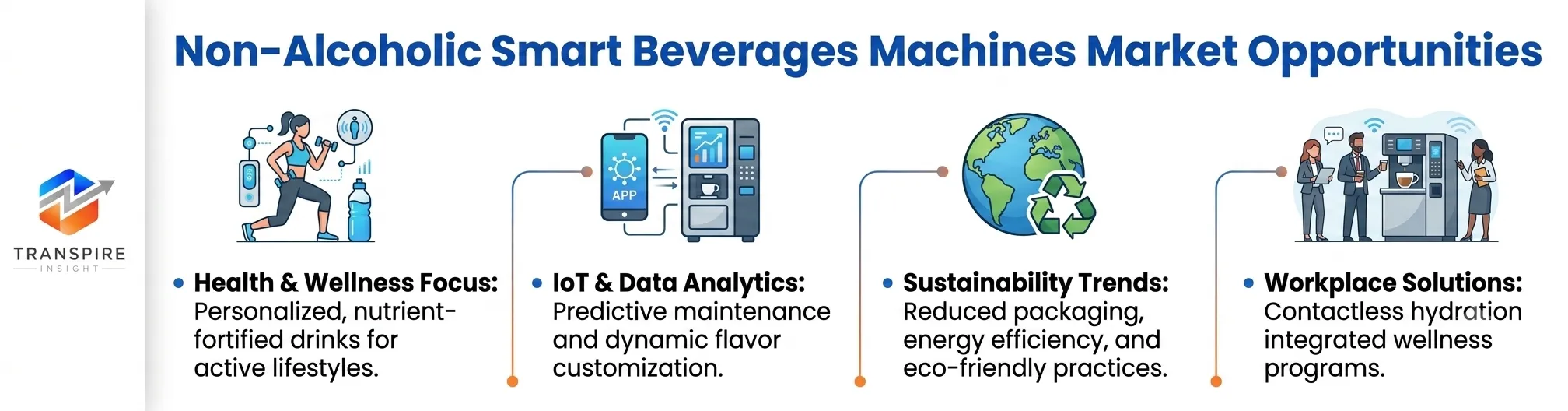
AI and IoT let smart machines learn taste preferences, auto-adjusting sweetness, strength, and temperature, turning routine drink-making into a personalized, predictive experience consumers increasingly expect.
Companion apps let users start brewing remotely, save custom recipes, and control multiple machines, a convenience office and hospitality buyers increasingly value for daily use.
Portable models already account for over 60% of sales, favoured by space-constrained urban households seeking flexible, easy-to-store machines without sacrificing brewing performance or key features.
Health-conscious buyers are increasingly pushing machines toward functional drinks, natural, organic ingredients, and reduced-sugar formulations, now prompting manufacturers to add nutrition-tracking features and wellness-focused presets.
Physical retail still generates the bulk of category revenue, since buyers prefer hands-on evaluation of build quality and features before committing to a premium-priced machine.
Manufacturers are prioritizing energy-efficient brewing cycles and recyclable components, aligning smart beverage machines with wider sustainability expectations from environmentally conscious urban consumers across markets.
Top 25 Companies Leading the Non-Alcoholic Smart Beverages Machines Market
leader in connected fully automatic bean-to-cup espresso systems and espresso technology.
Founded: 1902 | HQ: Treviso, Italy.
Why It Ranks: Holds the highest market share in connected premium espresso and coffee systems.
Regional Dominance: Strongest presence across Europe, North America, and expanding rapidly in Asia-Pacific.
Product Line: PrimaDonna Soul, Eletta Explore, Dinamica Plus smart connected coffee systems.
Engineering pioneer integrating smart touchscreens and precise temperature extraction technology.
Founded: 1932 | HQ: Sydney, Australia.
Why It Ranks: Industry-defining innovation in precision craft coffee and smart automated kitchen appliances.
Regional Dominance: Dominates high-end residential kitchen market segments across Australia and North America.
Product Line: Oracle Touch, Barista Touch Impress, Joule Oven & Beverage Ecosystems.
World leader in home water carbonation machines reducing single-use plastic reliance.
Founded: 1903 | HQ: Kfar Saba, Israel.
Why It Ranks: Dominates eco-conscious sparkling water dispensing with IoT and commercial flavor integrations.
Regional Dominance: Major market share in North America, Western Europe, and Latin America.
Product Line: SodaStream E-Duo, SodaStream Professional, Art & Enso digital soda makers.
Operates over 50,000 micro-dosing Freestyle smart dispensers globally, streaming real-time beverage preferences.
Founded: 1892 | HQ: Atlanta, Georgia, USA.
Why It Ranks: Unrivaled commercial scale, vast beverage portfolio, and proprietary micro-dispensing tech platform.
Regional Dominance: Massive market dominance across North American and Western European foodservice sectors.
Product Line: Coca-Cola Freestyle 9100, Freestyle 7000, Freestyle 8100 series dispensers.
Rapidly growing consumer hardware firm expanding into high-tech automated beverage preparation tools.
Founded: 1994 | HQ: Needham, Massachusetts, USA.
Why It Ranks: Top-tier market share due to accessible pricing and multi-functional beverage appliances.
Regional Dominance: High market saturation across North America and fast growth in Europe.
Product Line: Ninja Thirsti Drink System, Ninja Luxe Cafe, Ninja Coffee Bar.
Pioneer of single-serve pod systems, expanding heavily into smart app-controlled brewers.
Founded: 2018 (Merger) | HQ: Burlington, Massachusetts, USA.
Why It Ranks: Enormous footprint in single-serve non-alcoholic beverage brewing in North America.
Regional Dominance: Overwhelmingly dominates North American household and commercial office spaces.
Product Line: Keurig K-Supreme Plus SMART, K-Café SMART, Commercial K-Cycle systems.
Swiss commercial coffee machine maker specializing in modular IoT-connected workplace equipment.
Founded: 1911 | HQ: Aarburg, Switzerland.
Why It Ranks: Leading provider of high-volume, fully automated smart coffee platforms for commercial uses.
Regional Dominance: Strongest in Europe and North American corporate/hospitality sectors.
Product Line: Franke A600 Flex, A800, Speciality Beverage Station (S700).
Leading manufacturer of mid-tier smart home and commercial beverage dispensing gear.
Founded: 1910 | HQ: Glen Allen, Virginia, USA.
Why It Ranks: Holds significant market share in entry-level and mid-range smart dispensers.
Regional Dominance: Exceptional volume sales and distribution network across North and South America.
Product Line: Hamilton Beach Alexa Smart Coffee Maker, Smart Hydration Station, Programmable Brewers.
Pioneer in smart, eco-friendly, point-of-use commercial water dispensers that flavor and carbonate drinks.
Founded: 2013 | HQ: Boston, Massachusetts, USA.
Why It Ranks: Leading innovator in corporate eco-hydration, preventing hundreds of millions of plastic bottles.
Regional Dominance: Strong foothold in North American commercial offices and co-working environments.
Product Line: Standup Bevi 2, Countertop Bevi, Smart Water Dispensing Hub.
Exclusive developer and manufacturer of automated espresso machinery for chain accounts.
Founded: 1974 | HQ: Weggis, Switzerland.
Why It Ranks: Powers major international coffee chains with connected, ultra-reliable smart machines.
Regional Dominance: commercial distribution, led by Europe, North America, and East Asia.
Product Line: Mastrena II, Black&White4 compact series, Black&White3 CT2.
Conclusion
Non-alcoholic smart beverage machines are at the nexus of kitchen automation, custom nutrition, and IoT. Health-conscious consumers and corporate office environments are always searching for a customized hydration option that is eco-friendly and will become a standard need for connected dispensing. Any of the industry leaders that focus on having a seamless app connection, sustainable cartridge design, and data-driven deployment of flavours will get it right and drive the future of automated home and commercial beverage consumption globally.


Send us a brief description of your challenge and we'll get back to you within 24 hours.

 inquiry@transpireinsight.com
 APAC:+91 7666513636
 Address


