
Sep 01, 2026
By Transpire Insight
Description
According to a research report published by Transpire Insight, the LNG terminals market size is projected to grow from USD 56.3 billion in 2026 to USD 99.7 billion by 2035, at a CAGR of 11.2% during the forecast period 2026-2035. The market grows owing to the rising demand for natural gas worldwide, the targeted decarbonization strategies, and the quick deployment of Floating Storage Regasification Units. Moreover, energy security needs in Europe and in Asia trigger unprecedented investment in modern export liquefaction and import regasification projects all over the world.
Introduction
The terminals for LNG are an essential component of the energy transition, facilitating the safe liquefaction, transportation, and regasification of LNG across the globe. LNG infrastructure offers flexibility and energy security as economies transition from coal to low-carbon energy fuels. Floating Storage Reorganization Units and small-scale applications are advancing the technology in terminals, making them faster to deploy and more versatile. As a result, the development of LNG terminals continues to drive large capital investments in emerging economies in response to their growing energy needs.
Recent Development News
Stay Ahead of Emerging Opportunities with Expert Market Insights by Transpire Insight
Transpire Insight provides comprehensive, data-driven market intelligence to support smarter business decisions. Our research is rooted in comprehensive analysis, authoritative predictions, and industry expertise, enabling organizations to make informed decisions in rapidly evolving markets. In-depth analysis of market segmentation, competitive positioning, regional trends, and emerging investment opportunities in high-growth areas. We blend accuracy with actionable intelligence, empowering companies to uncover new avenues for growth, bolster strategic decision-making, and stay ahead in a dynamic market.
Download the exclusive LNG Terminals Market sample report today to explore expert insights, key trends, and emerging opportunities shaping the future of the industry.
LNG Terminals Market Size & Statistics
Regional Growth and Demand Analysis by Transpire Insight
Asia-Pacific's leadership rests on China's terminal footprint, which counts 29 active docks with 39 additional facilities planned, a build-out set to push regasification capacity well past 200 million tonnes per annum. Power generation remains the anchor end-use, drawing on rising electricity consumption across China, Japan, South Korea, and Southeast Asian markets, while limited pipeline connectivity in island and coastal geographies keeps floating storage and regasification units attractive for their shorter deployment timelines. Excelerate Energy's introduction of its FSRU "Excelerate Acadia" in South Korea illustrates how operators are expanding floating regasification capacity to meet this sustained regional appetite, reinforcing Asia-Pacific's dominant demand base even as new import terminals come online across Bangladesh, Pakistan, and Vietnam.
Europe's accelerated growth trajectory stems directly from the region's push to diversify away from piped Russian gas, prompting governments to fast-track import infrastructure through FSRU leasing and new onshore terminal financing. Germany's ongoing floating terminal program, which now handles a meaningful share of national gas imports through multiple commissioned units, exemplifies this emergency-driven build-out. Italy's OLT Offshore LNG Toscana has further expanded its floating terminal's role by launching small-scale LNG operations alongside its core regasification business, signaling how European operators are layering new revenue streams onto existing infrastructure. This combination of energy-security urgency and infrastructure flexibility is what keeps Europe ahead of every other region on growth rate, even as Asia-Pacific retains the larger absolute demand base.
Top 15 Trends in the LNG Terminals Market
Proceed to checkout to purchase the exclusive LNG Terminals Market report and get instant access to detailed market insights, strategic analysis, and future growth opportunities.
Rising FSRU Adoption
Floating storage and regasification units are replacing onshore terminals because they deploy faster, cost less upfront, and offer relocation flexibility for shifting energy demand.
Europe's Security-Driven Build-Out
European governments are fast-tracking LNG import infrastructure, prioritizing floating terminals and diversified supply financing to reduce dependence on piped Russian natural gas imports.
China's Capacity Expansion
China continues adding regasification docks aggressively, pushing national capacity well past 200 MTPA to diversify gas imports and support industrial and residential energy needs.
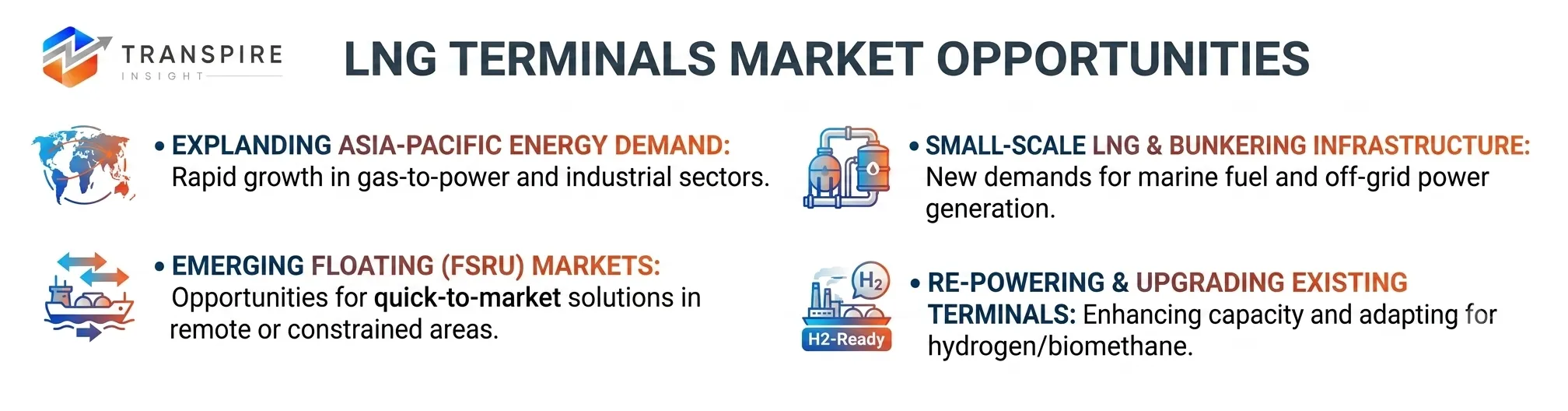
Small-Scale and Bunkering Growth
Small-scale LNG terminals and marine bunkering infrastructure are expanding rapidly, serving remote industrial clusters, island geographies, and shipping fleets transitioning toward cleaner marine fuel.
Power Generation Dominance
Power generation remains the largest end-use sector for LNG terminals, as utilities increasingly rely on gas-fired plants to meet rising electricity demand across import-dependent regions.
Hybrid Terminal Systems
Countries are increasingly combining floating and land-based terminal infrastructure, balancing rapid-deployment flexibility with long-term capacity needs as national LNG import strategies mature.
List of Top 25 Companies Leading the LNG Terminals Market
Customize the exclusive LNG Terminals Market report to receive insights tailored to your needs, including country-specific analysis and business-focused market intelligence.
1. Cheniere Energy, Inc.
Operates the largest liquefied natural gas export facilities located in North America.
Founded: 1996 | HQ: Houston, Texas, USA.
Why It Ranks: It holds industry leadership in high-volume LNG production and export operations.
Regional Dominance: Strong market control across North America with extensive export destination networks.
Product Line: Offers full-scale liquefaction, regasification terminals, and integrated energy transport services globally.
2. Shell plc
Manages an extensive LNG portfolio across key supply and import hubs.
Founded: 1907 | HQ: London, United Kingdom.
Why It Ranks: Leading international oil company with massive regasification and trading market share.
Regional Dominance: Dominates European, Asian, and American natural gas import and distribution networks.
Product Line: Provides LNG liquefaction, floating regasification, trading, and marine bunkering solutions.
3. TotalEnergies SE
Second-largest private LNG player with major import terminal equity stakes.
Founded: 1924 | HQ: Courbevoie, France.
Why It Ranks: Extensive participation across supply chains and floating terminal operations worldwide.
Regional Dominance: Maintained strong presence across Europe, Africa, and major Asian import markets.
Product Line: Delivers upstream gas processing, liquefaction, regasification terminals, and low-carbon gas solutions.
4. ExxonMobil Corporation
Major investor in mega-scale liquefaction plants across Qatar, Papua New Guinea, USA.
Founded: 1870 | HQ: Spring, Texas, USA.
Why It Ranks: Unrivaled financial capacity and technical execution in massive energy terminal projects.
Regional Dominance: Commands huge infrastructure influence in North America, Asia-Pacific, and the Middle East.
Product Line: Operates deepwater export terminals, gas liquefaction trains, and wholesale distribution infrastructure.
5. QatarEnergy
World leader in liquefaction terminal capacity through massive North Field expansions.
Founded: 1974 | HQ: Doha, Qatar.
Why It Ranks: Controls the largest single production and export terminal infrastructure on earth.
Regional Dominance: Dominates Middle Eastern energy exports with critical supply links to Asia.
Product Line: Produces LNG, supplies regasification capacity, and operates massive carrier terminal facilities.
6. Chevron Corporation
Operates major Australian liquefaction plants including Gorgon and Wheatstone LNG projects.
Founded: 1879 | HQ: San Ramon, California, USA.
Why It Ranks: Holds major production assets supplying prime Asian natural gas demand centers.
Regional Dominance: High operational influence across Australasia, Asia-Pacific, and North American energy basins.
Product Line: Delivers mega-project liquefaction terminals, offshore gas handling, and domestic gas processing.
7. BP p.l.c.
Pioneers floating LNG liquefaction development off the coast of West Africa.
Founded: 1909 | HQ: London, United Kingdom.
Why It Ranks: Integrates vast upstream gas assets directly into commercial import terminals.
Regional Dominance: Key player across Atlantic Basin trade, European imports, and Asian markets.
Product Line: Offers LNG terminal operations, floating liquefaction systems, and flexible delivery options.
8. Venture LNG
Rapidly expanded US export capacity with modular liquefaction terminal designs.
Founded: 2013 | HQ: Arlington, Virginia, USA.
Why It Ranks: Disruptive market growth using pre-fabricated modular trains for fast terminal construction.
Regional Dominance: Rapidly gaining significant export volume market share throughout the North American continent.
Product Line: Develops low-cost export terminals, modular liquefaction blocks, and long-term supply contracts.
9. Sempra Energy
Developing strategic Pacific and Gulf Coast LNG export terminals across North America.
Founded: 1998 | HQ: San Diego, California, USA.
Why It Ranks: Infrastructure leader connecting abundant North American shale gas to markets.
Regional Dominance: Strong operational footprint covering Western United States, Gulf Coast, and Mexico.
Product Line: Builds liquefaction terminals, regasification plants, natural gas pipelines, and storage hubs.
10. Freeport LNG
Operates one of North America's largest electric-motor-driven LNG export facilities.
Founded: 2002 | HQ: Houston, Texas, USA.
Why It Ranks: Top-tier US exporter providing clean electric-driven gas liquefaction services continuously.
Regional Dominance: Centered on North American Gulf Coast export trade to Europe and Asia.
Product Line: Supplies gas pre-treatment facilities, liquefaction trains, storage tanks, and export berths.
Schedule a meeting with our market experts to discuss the exclusive LNG Terminals Market report and find the right research solution for your business.
Conclusion
Overall, the LNG terminals market is a vital component in the energy landscape, balancing the demands of energy security and long-term decarbonization. There is a continuing rapid pace of investment, with liquefaction capability increasing in North America and the Middle East, and flexible FSRU regasification imports on the go all over Europe and Asia. In the future, technological advancements, like electric-driven liquefaction technology, floating LNG units, and carbon capture integration, will shape market leaders, making LNG terminals crucial, flexible hubs for clean energy supply.


Send us a brief description of your challenge and we'll get back to you within 24 hours.

 inquiry@transpireinsight.com
 APAC:+91 7666513636
 Address


