
Sep 11, 2026
By Transpire Insight
Description
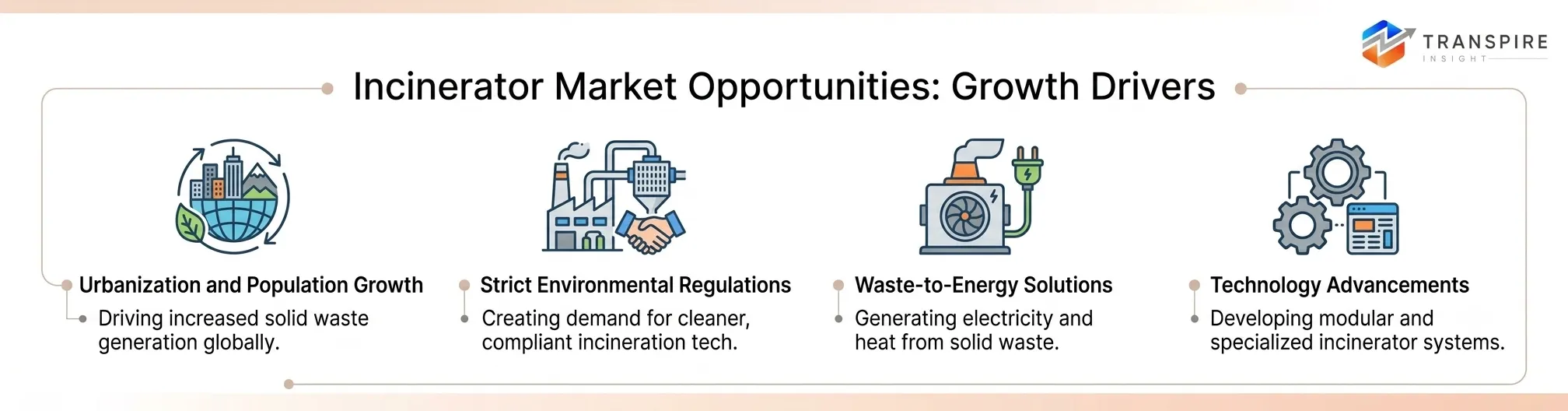
According to a research report published by Transpire Insight, the incinerator market size is projected to grow from USD 19.21 billion in 2026 to USD 24.27 billion by 2035, at a CAGR of 3.15% during the forecast period 2027-2035. Urban population growth, diminishing landfill space, stringent environmental regulations, and the expansion of waste-to-energy technologies collectively drive the growth of the incinerator market.
Introduction
The incinerator market plays a crucial role in modern solid waste management and energy recovery. Driven by rising industrial production, urbanization, and strict emissions controls, advanced incineration systems, such as rotary kilns, fluidized bed reactors, and moving grates, are replacing traditional landfills. These systems significantly reduce waste mass and volume while recovering valuable thermal energy for electricity or district heating, positioning incineration as a key component of sustainable waste management.
Recent Development News
Stay Ahead of Emerging Opportunities with Expert Market Insights by Transpire Insight
Transpire Insight provides comprehensive, data-driven market intelligence to support smarter business decisions. Our research is rooted in comprehensive analysis, authoritative predictions, and industry expertise, enabling organizations to make informed decisions in rapidly evolving markets. In-depth analysis of market segmentation, competitive positioning, regional trends, and emerging investment opportunities in high-growth areas. We blend accuracy with actionable intelligence, empowering companies to uncover new avenues for growth, bolster strategic decision-making, and stay ahead in a dynamic market.
Incinerator Market Size & Statistics
Regional Growth and Demand Analysis by Transpire Insight
Asia Pacific's dominance rests on China's sheer build-out of incineration capacity — the country now operates over a thousand large-scale plants with a combined daily processing capacity exceeding a million tonnes, led by projects like the Shenzhen East facility, envisioned as the world's largest waste-to-energy plant. Municipalities across the Yangtze River Delta and other coastal clusters continue procuring integrated incineration-and-power contracts, while cities like Shenzhen are now excavating decades-old landfills to feed existing furnaces, a sign of how deeply incineration has embedded itself into the region's waste infrastructure. India and Japan add further momentum through smart-city and industrial waste programs, reinforcing Asia Pacific's lead even as growth in China itself moderates.
Europe's momentum comes from regulatory pressure rather than sheer volume. Germany remains the anchor market, exemplified by ANDRITZ's contract to install advanced flue gas cleaning systems with catalytic denitrification at the Hamm waste incineration plant to meet strict emissions limits. Greece's government-backed investment in six new waste-to-energy plants, aligned with EU landfill-diversion targets, illustrates how member states are rapidly converting policy mandates into physical capacity. With rising landfill taxes and the EU's Waste Framework Directive pushing member states away from landfilling, Europe's incineration buildout is increasingly compliance-driven, giving the region its outsized growth rate despite a smaller base than Asia Pacific.
Top 15 Trends in the Incinerator Market
Rising adoption of waste-to-energy conversion technologies
Operators increasingly pair incineration with power and heat recovery, converting municipal and industrial waste into usable electricity while reducing landfill dependency and improving revenue economics.
Stricter emission control and flue gas treatment norms
Regulators worldwide are tightening dioxin, particulate, and nitrogen oxide limits, pushing operators to install advanced flue gas cleaning, catalytic denitrification, and continuous emissions monitoring systems.
Growth of modular, compact, decentralized incineration units
Smaller municipalities and remote industrial sites are adopting compact, prefabricated incinerators that require lower capital outlay, faster installation, and easier compliance with local emission standards.
Rising landfill taxes pushing thermal waste treatment
Governments across Europe and Asia are raising landfill taxes and imposing disposal bans, making thermal incineration a more economical and increasingly mandatory waste management alternative.
Consolidation through mergers and acquisitions among operators
Large environmental service providers are acquiring smaller incineration operators and technology firms, consolidating market share and accelerating deployment of modular, low-emission thermal conversion systems globally.
Growing focus on ash and slag resource recovery
Plant operators are recovering metals and minerals from bottom ash and fly ash residues, reducing landfill volumes while creating new secondary revenue streams for recyclers.
List of Top 25 Companies Leading the Incinerator Market
1. Babcock & Wilcox Enterprises
leader in municipal waste-to-energy boilers and advanced air pollution control systems.
Founded: 1867 | HQ: Akron, Ohio, United States.
Why It Ranks: Unmatched heritage in utility-scale thermal systems and clean energy generation.
Regional Dominance: North America and Europe.
Product Line: DynaGrate incinerators, water-tube boilers, and dry/wet flue gas scrubbers.
2. Covanta Holding Corporation
Premier North American owner-operator of large-scale waste-to-energy facilities processing municipal solid waste.
Founded: 1986 | HQ: Morristown, New Jersey, United States.
Why It Ranks: Dominates North American commercial waste incineration and sustainable power generation.
Regional Dominance: North America.
Product Line: Waste-to-energy plants, high-efficiency mass-burn combustors, and ash recycling services.
3. Hitachi Zosen Inova (HZI)
Pioneer in mass-burn incineration technology powering hundreds of municipal plants.
Founded: 1933 | HQ: Zurich, Switzerland.
Why It Ranks: World leader in turnkey waste-to-energy engineering, procurement, and construction services.
Regional Dominance: Europe and Asia-Pacific.
Product Line: Moving grate incinerators, flue gas treatment units, and biomethane recovery systems.
4. Mitsubishi Heavy Industries Environmental & Chemical Engineering (MHIEC)
Premier supplier of advanced incinerators engineered for high-density municipal waste streams.
Founded: 1976 | HQ: Yokohama, Japan.
Why It Ranks: Engineering leader in high-efficiency combustion and low-emission gas scrubbing technology.
Regional Dominance: Asia-Pacific.
Product Line: Stoker-type waste incinerators, rotary kiln systems, and catalytic denitrification systems.
5. Veolia Environment S.A.
World's largest environmental services company operating extensive hazardous and municipal incinerator networks.
Founded: 1853 | HQ: Paris, France.
Why It Ranks: Unrivaled footprint in hazardous waste destruction and industrial resource recovery.
Regional Dominance: Europe and Global.
Product Line: Hazardous waste incinerators, rotary kilns, and high-temperature thermal destruction plants.
6. Suez S.A.
Major player managing circular economy solutions and energy recovery incinerator facilities.
Founded: 1858 | HQ: Paris, France.
Why It Ranks: Exceptional integration of municipal sorting with state-of-the-art thermal treatment infrastructure.
Regional Dominance: Europe and Latin America.
Product Line: Waste-to-energy plants, co-incineration units, and advanced flue gas cleaning systems.
7. Thermax Limited
Leading provider of decentralized thermal treatment and industrial heating systems in Asia.
Founded: 1966 | HQ: Pune, India.
Why It Ranks: Dominates South Asian industrial solid and liquid waste incineration solution deployment.
Regional Dominance: South Asia and Middle East.
Product Line: Fluidized bed incinerators, liquid waste combustors, and heat recovery steam generators.
8. EEW Energy from Waste
Central Europe's leading practitioner in thermal waste conversion and eco-friendly municipal heating.
Founded: 1990 | HQ: Helmstedt, Germany.
Why It Ranks: Highest operational efficiency standards for thermal municipal solid waste utilization globally.
Regional Dominance: Western and Central Europe.
Product Line: High-capacity grate incinerators, district heating units, and steam generation boilers.
9. Doosan Lentjes GmbH
technology vendor specializing in proprietary grate incineration and flue gas scrubbers.
Founded: 1928 | HQ: Ratingen, Germany.
Why It Ranks: Superior engineering capabilities in clean combustion and strict atmospheric emissions compliance.
Regional Dominance: Europe and Asia.
Product Line: Reciprocating grate incinerators, circulating fluidized beds, and wet gas scrubbers.
10. Kawasaki Heavy Industries, Ltd.
Key innovator in industrial waste destruction and heavy-duty combustion system manufacturing.
Founded: 1896 | HQ: Tokyo, Japan.
Why It Ranks: Exceptional track record of building reliable high-temperature industrial incinerators globally.
Regional Dominance: Asia-Pacific.
Product Line: Stoker-fired incinerators, fluidized bed gasifiers, and heat recovery boiler systems.
Conclusion
The incinerator market continues to evolve from basic disposal toward high-efficiency waste-to-energy recovery and strict environmental protection. Technological innovations in flue gas cleaning, automated combustion controls, and modular designs allow key players to meet stringent international air-quality standards. As landfill availability decreases globally, advanced thermal incineration will remain an indispensable component of sustainable municipal, medical, and industrial waste management strategies.


Send us a brief description of your challenge and we'll get back to you within 24 hours.

 inquiry@transpireinsight.com
 APAC:+91 7666513636
 Address


