
Global Incinerator Market Size & Forecast
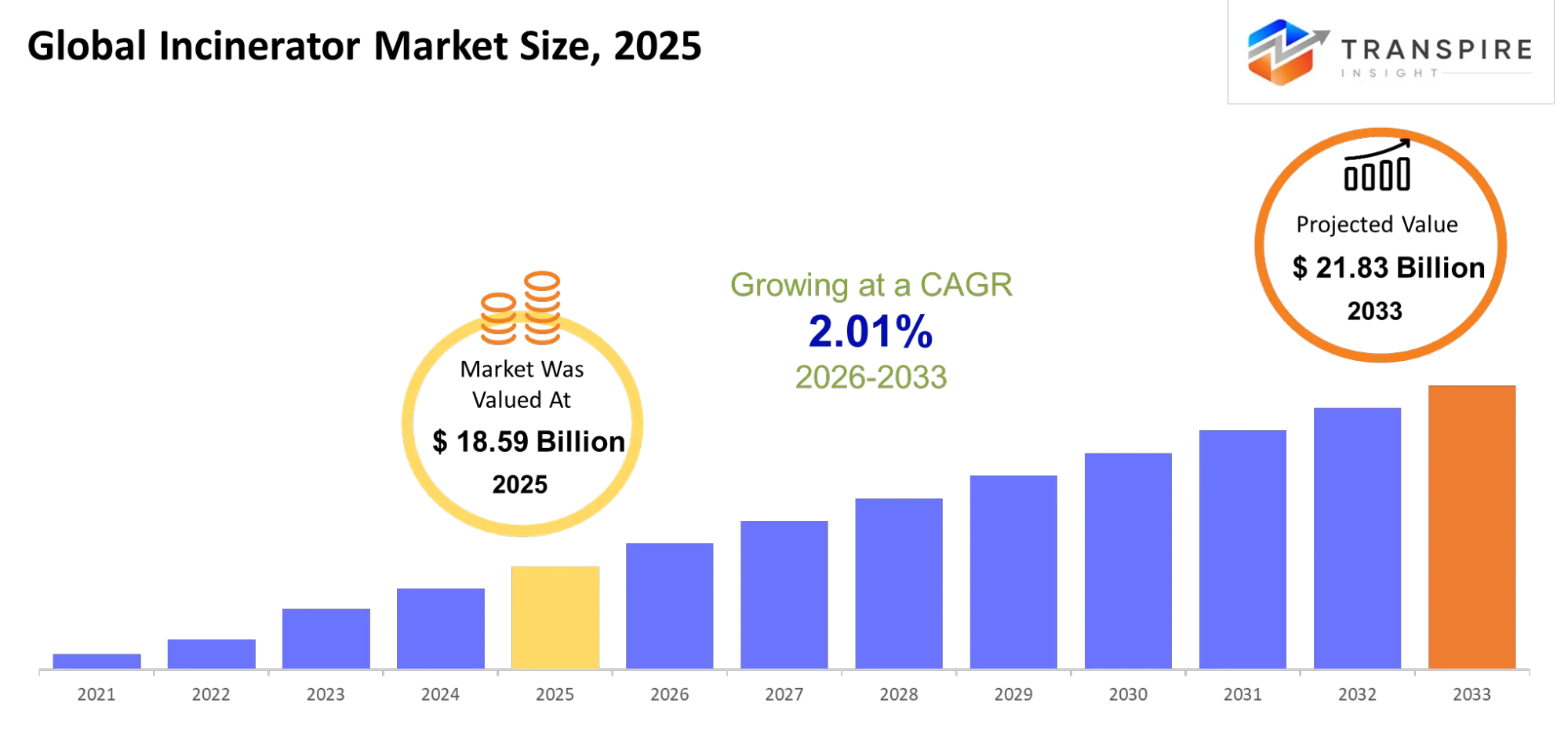
- Global Incinerator Market Size 2025: USD 18.59 Billion
- Global Incinerator Market Size 2033: USD 21.83 Billion
- Global Incinerator Market CAGR: 2.01%
- Global Incinerator Market Segments: By Type (Rotary Kiln Incinerator, Fluidized Bed Incinerator, Multiple Hearth Incinerator), By Application (Municipal Waste, Industrial Waste, Medical Waste), By End-User (Municipal Authorities, Hospitals, Industrial Facilities)
To learn more about this report,  Download Free Sample Report
Global Incinerator Market Summary
The Global Incinerator Market was valued at USD 18.59 Billion in 2025. It will reach USD 21.83 Billion by 2033. The CAGR over this period is 2.01%.
Incinerators are thermal treatment facilities that combust solid waste at very high temperatures - reducing waste volume by 85 to 95 percent whilst recovering energy through steam generation or electricity production. A modern incinerator facility accepts mixed municipal waste, medical waste, or even industrial hazardous materials - processes them through high-temperature combustion chambers, recovers thermal energy for district heating or power generation, and releases exhaust through air pollution control systems that capture particulates, heavy metals, and acid gases before venting to the atmosphere itself. The entire global incinerator market represents the installed base of operational facilities plus the annual capital expenditure on new facility construction, facility upgrades, and replacement of aging equipment all the time.
The very foundation of the incinerator market is set by regulatory mandates in developed countries - restricting landfill use and imposing waste diversion targets that incinerators really help achieve. The European Union's landfill directive demands that member states reduce the quantity of municipal waste deposited in landfills from 75 percent of total waste in 1995 to 10 percent or less by 2035 itself. Japan implemented a waste management hierarchy in 1991 that puts reduction, reuse, and incineration first, over landfill disposal always. These regulatory frameworks created a long-term need for incinerator capacity - a demand that continues even when commodity prices or energy market conditions fluctuate greatly, making it different from other cyclical industrial sectors completely.
Over the 2026 to 2033 forecast period, market growth at 2. 01% CAGR will actually reflect more mature market dynamics in developed regions and additional capacity additions in Southeast Asia, India, and Latin America, all caused by rapid urbanization and the adoption of more regulations. Capital projects announced in the pipeline by 2030 amount to approximately USD 45 Billion globally, with 38 percent going to new facility construction and 62 percent to modernizing and upgrading the air pollution control systems of existing facilities altogether.
Key Global Incinerator Market Insights
- Europe holds the largest incinerator market share at approximately 38% of global capacity, with over 480 operational incineration facilities serving municipal and commercial waste treatment in Germany, France, Italy, the Netherlands, and Scandinavia.
- Asia-Pacific is the fastest-growing regional market, with China operating over 400 incinerators and India, Southeast Asia, and Indonesia planning 150 new facility projects through 2030 to manage urban waste growth from rapid urbanization.
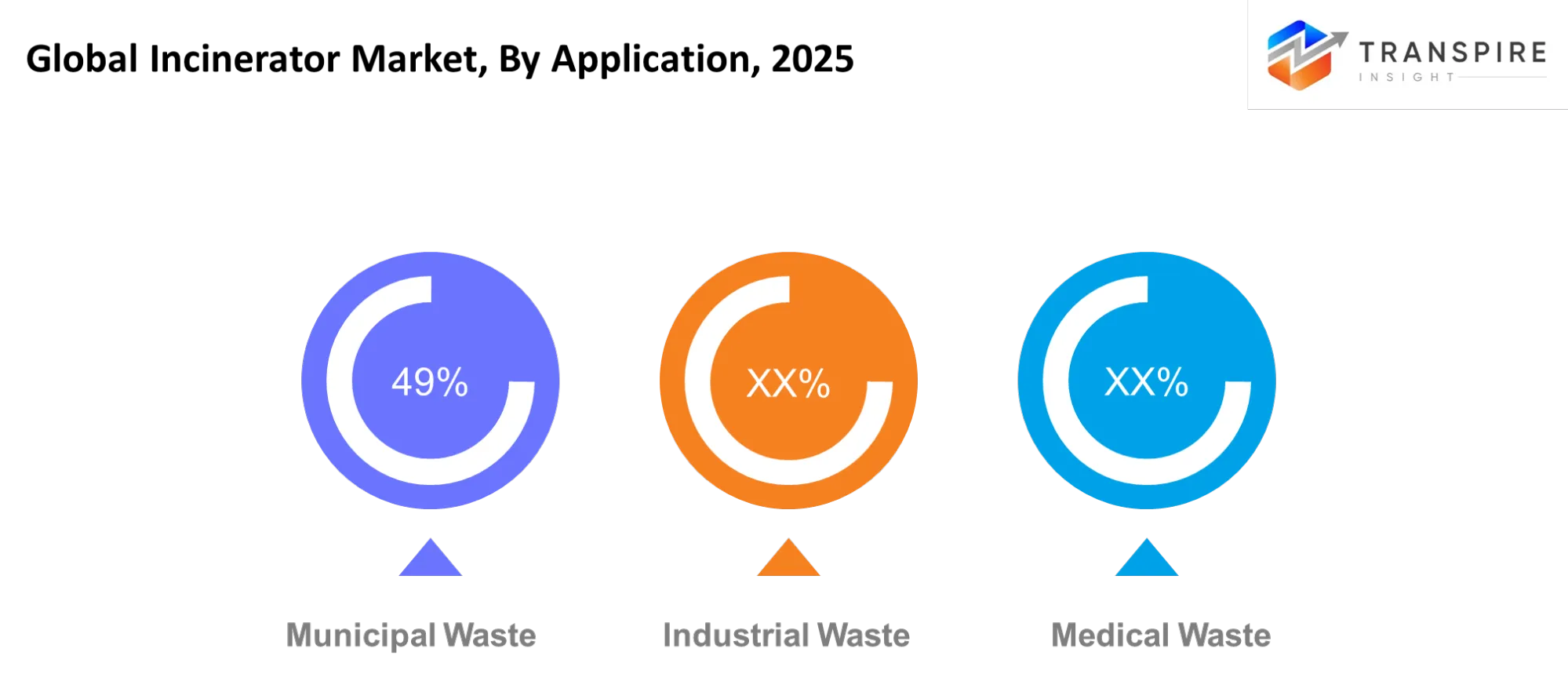
- Municipal waste incineration accounts for 49% of global incinerator market revenue in 2025, driven by regulatory landfill diversion mandates and the need for waste-to-energy infrastructure in cities with limited landfill capacity.
- Rotary kiln incinerators command approximately 44% of the global incinerator installed base, serving industrial and hazardous waste applications where the rotating drum design enables consistent combustion of heterogeneous feedstock.
- Fluidized bed incinerators are the fastest-growing technology segment, with 58 percent year-over-year growth in new facility orders in 2024 and 2025, driven by superior air quality compliance and thermal efficiency compared to rotary kiln designs.
- Energy recovery from incineration drives 65% of global incinerator revenue in developed markets, with district heating and combined heat and power generation offsetting 40 to 60 percent of facility operating costs through energy sales.
- Babcock & Wilcox Enterprises Inc., Hitachi Zosen Corporation, and Veolia Environnement S.A. together account for over 28% of global incinerator market share through new facility construction contracts and operation and maintenance service agreements.
- Medical waste incineration is the highest-margin application segment, generating 35 to 45 percent gross margins on dedicated facility construction because regulatory requirements mandate single-stream processing and continuous monitoring that justify premium pricing.
- Multiple Hearth incinerators are declining in global deployment at approximately 2 to 3% annually as existing multi-hearth facilities reach end-of-life and operators elect to replace them with higher-efficiency rotary kiln or fluidized bed designs.
- Air pollution control system upgrades represent the largest retrofit capital segment, with approximately USD 8 to 10 Billion in annual spending globally on SCR (Selective Catalytic Reduction) systems, baghouse fabric replacement, and activated carbon injection equipment retrofits.
What are the Key Drivers, Restraints, and Opportunities in the Global Incinerator Market?
The primary driver is regulatory mandates that severely restrict landfill disposal and impose waste diversion targets. The European Union's landfill directive, Germany's Circular Economy Act, and similar frameworks in Japan, South Korea, and increasingly in India and Southeast Asian countries create a structural demand for waste treatment capacity - often incinerated or processed through alternative means. These regulations are not discretionary policy preferences but binding legal requirements with enforcement mechanisms including facility closure orders and substantial fines. This regulatory foundation creates a highly predictable long-term demand for incinerator capacity that endures even through economic downturns and commodity price volatility, very much distinguishing incineration from sectors dependent on commodity prices or consumer discretionary spending.
Environmental and health concerns actually slow down market growth in more developed regions - where there is quite a lot of public opposition to new incinerator facilities. Worries about air quality impacts, dioxin emissions, and the proximity to residential areas have frequently delayed or blocked facility permits in North America, Western Europe, and Australia. Modern incinerator facilities with sophisticated air pollution control systems emit pollutants at levels far below the most stringent regulatory limits - and also recover energy that displaces fossil fuel generation, yet public perception usually lags behind regulatory science. This really constrains new facility development in developed markets to the replacement of existing capacity, limiting growth rates in more mature regions. Furthermore, rising interest rates increase capital costs for incinerator facility financing, since projects are very capital-intensive at USD 300 to 800 Million per facility depending on capacity and technology specifications.
The clearest opportunity for growth is integrating incinerator facilities into circular economy and waste-to-value infrastructure ecosystems in emerging markets. India has announced plans to set up 100 new waste-to-energy facilities through the Swachh Bharat Mission program, and Southeast Asian countries such as Vietnam, Thailand, and Indonesia are mandating waste diversion from rapidly filling landfills by using incineration or alternative processing methods. These capacity additions require approximately USD 12 to 15 Billion in new facility construction through 2030. Companies that set up local manufacturing, engineering, and service partnerships in these markets - and also finance facility development through public-private partnerships and government financing programs - will capture the major share of this emerging growth.
What Has the Impact of Artificial Intelligence Been on the Global Incinerator Market?
Artificial intelligence is changing incinerator operations through three key applications: predictive combustion optimization, equipment failure forecasting, and air quality compliance monitoring. Modern incinerators fitted with process sensors constantly measure furnace temperature, oxygen levels, the moisture content of incoming waste, and the composition of exhaust gases. Machine learning models trained on a large amount of historical combustion data predict the perfect furnace feed rate, primary air injection rate, and secondary air temperature for a very diverse feedstock so as to achieve the best possible combustion efficiency - and thereby reduce excess oxygen or fuel consumption to a minimum. Facilities using these systems report improvements of around 8 to 12 percent in thermal efficiency and cuts of 15 to 20 percent in auxiliary fuel consumption.
Predictive maintenance uses machine learning on vibration sensors, temperature differences, and bearing wear patterns on incinerator mechanical equipment - such as grates, scrapers, and fans. Models forecast the probability of bearing failure 30 to 60 days in advance, allowing scheduled maintenance that prevents costly emergency shutdowns that can cost USD 50,000 to 150,000 daily in lost energy revenue and waste processing fees. Air quality compliance monitoring now includes AI-powered real-time analysis of exhaust gas composition data constantly transmitted to regulatory dashboards, allowing operators to react at once to any parameter deviation that threatens to reach regulatory limits - rather than finding out about it from quarterly compliance reports.
Key Market Trends
- Europe holds approximately 38% of global incinerator capacity, concentrated in Germany, France, Italy, and Scandinavia where regulatory mandates and waste-to-energy tariffs support continued operations and facility upgrades.
- China operates over 400 incinerators and is adding approximately 30 to 40 new facilities annually through 2030, driven by government waste diversion mandates and the growth of urban waste streams from a population exceeding 1.4 billion.
- Municipal waste incineration accounts for 49% of global incinerator revenue in 2025, with approximately 2,100 operational facilities worldwide processing approximately 350 Million tonnes annually.
- Rotary kiln incinerators command 44% of global installed base, but fluidized bed technology is growing 58% year-over-year in new facility orders in 2024 and 2025 driven by superior air quality compliance and thermal efficiency.
- Energy recovery from incineration generates 65% of facility revenue in developed markets, with district heating and combined heat and power sales offsetting 40 to 60 percent of operating costs.
- Fluidized bed incinerators achieve NOx emissions 40 to 60 percent lower than rotary kiln designs and support combustion of lower-grade fuel including refuse-derived fuel, sewage sludge, and biomass waste.
- Industrial hazardous waste incineration is growing 2.8% annually as regulatory requirements for persistent organic pollutant destruction drive sustained capital spending on dedicated incinerator construction.
- Medical waste incineration margins are 35 to 45 percent gross profit on dedicated facility construction because single-stream processing requirements and continuous monitoring documentation justify premium facility specifications.
- Air pollution control system upgrades represent USD 8 to 10 Billion in annual capital spending globally on SCR catalyst replacement, activated carbon injection, and baghouse fabric maintenance retrofits.
- Public-private partnership financing is now the primary funding mechanism for new incinerator facility construction in emerging markets, with infrastructure investment funds allocating approximately USD 3 to 5 Billion annually to waste-to-energy projects.
Global Incinerator Market Segmentation
By Type
Rotary kiln incinerators make up roughly 44% of the world's installed incinerator base - they're used mostly in industrial and hazardous waste applications. The rotating drum style gives consistent combustion results across all sorts of waste streams - even if there's a lot of moisture, ash, or combustible materials. Rotary kilns run at slightly cooler temperatures than grate-based systems - this lets them handle waste with really high chloride levels that would cause way too much equipment corrosion at hotter temperatures. The technology has been set up all over the globe for 50 years now - it really benefits from a well-established supply chain for spare parts and lots of experienced service providers.
Fluidized bed incinerators are actually the fastest-growing technology group - with 58% year-over-year growth in new plant orders. The technology lifts waste particles up into a bed of inert sand using a rising flow of air, which allows for rapid, complete burning at much lower excess air levels. This really reduces NOx emissions by 40 to 60 percent compared to rotary kiln counterparts - and thermal efficiency is 5 to 8 percentage points higher. The fluidized bed design makes it easy to burn refuse-derived fuel, sewage sludge, and biomass waste right along with regular municipal waste - this lets operators process all sorts of different feedstocks in just one facility.
By Application
Municipal waste incineration makes up 49% of the global incinerator market's revenue, processing roughly 350 million tonnes per year at about 2,100 operational facilities all over the globe. This part gets regulated waste from households and businesses in cities that either have very little landfill space or quite a lot of restrictions on landfill use. Facilities usually run like local waste-to-energy utilities managed by city officials or hired out to private contractors for long-term services. The revenue comes from both tipping fees paid by waste collectors and energy sales through district heating networks or power purchase agreements.
Industrial waste incineration makes up 31% of the global market's revenue and serves manufacturing facilities, chemical plants, and refineries that produce flammable waste flows. This part really needs more flexibility in handling your feedstocks and even more rigid compliance records than municipal waste. Industrial operators frequently set up their incineration plants either right on their premises or in special waste processing parks so as to save on transport costs. Margins in this part are about 18 to 25 percent since customers are super price-sensitive and can send their waste to external hazardous waste processors if pricing gets too high.
Medical waste incineration makes up about 20% of the global incinerator market's revenue and produces the highest operating margins at about 35 to 45 percent. Regulatory requirements really call for separate single-stream processing without co-burning with other waste types, and continuous monitoring and compliance records requirements really justify top-of-the-line facility specifications and higher pricing. This part is mostly served by specialized private operators because local government authorities usually lack the expertise and the reputation risk they need to run medical waste facilities themselves.
To learn more about this report, Download Free Sample Report
By End-User
Municipal authorities are responsible for some 65% of the world's incinerator capacity - either directly or through contracted private operators under very long-term performance contracts. This part of the sector consists of city waste management departments and regional waste disposal bodies who really see incineration as an essential part of their infrastructure for achieving landfill diversion targets. Your revenue is quite stable really because municipal waste generation doesn't very much depend on the economy, and tipping fees are determined through regulatory processes that normally let you recover your costs plus a reasonable margin of profit.
Hospitals and healthcare facilities operate approximately 18% of global incinerator capacity, primarily in facilities for processing medical waste. This part of the sector generates the highest revenues per tonne, yet operates at very much smaller facility scales than those operated by municipalities, typically dealing with 500 to 2,000 tonnes each year - compared to 50,000 to 200,000 tonnes for municipal facilities. Healthcare facility operators prioritize compliance documentation and regulatory certainty much more than minimizing capital costs, enabling vendors to command higher prices for systems with even more advanced monitoring and regulatory reporting integration.
Industrial facilities like chemical plants, refineries, manufacturing centers, and processors of hazardous waste operate approximately 17% of global incinerator capacity. This end-user segment is extremely sensitive to price and may send its waste to external licensed hazardous waste incinerators if internal processing costs are higher than market prices. Industrial customers demand the greatest possible operational flexibility so they can adapt to variations in feedstock and respond very quickly to any equipment maintenance needs to keep production going all the time.
What are the Key Use Cases Driving the Global Incinerator Market?
The primary use case is regulatory compliance-driven municipal waste processing in countries and regions with landfill restrictions and waste diversion regulations. Cities in Germany, France, Japan, South Korea, and more and more in China and India must handle a specified percentage of municipal waste through high-energy-recovery methods to meet legal waste diversion requirements. This regulatory basis generates demand that is independent of commodity prices or energy markets - providing very stable long-term facility utilization and supporting facility financing and multi-decade operational agreements.
Energy recovery from industrial waste processing is also an expanding use case as industrial facilities look to cut costs through thermal self-sufficiency and gain revenue from waste processing. A big petroleum refinery or chemical plant generating 50,000 to 100,000 tonnes annually of combustible refinery residue, spent catalysts, or process-derived waste can set up a dedicated incinerator facility that burns internal waste streams whilst producing steam for process heating or electricity for facility use. This displaces external energy purchases and creates an internal cost centre that can accept external waste from third parties under tipping fee agreements.
Medical waste processing from hospital networks is also growing in emerging markets as healthcare systems grow and medical waste regulations require incineration or equivalent thermal treatment rather than landfill or uncontrolled dumping. India, Southeast Asia, and Latin America are experiencing rapid healthcare infrastructure development that is driving demand for dedicated medical waste incinerator capacity. Small-scale dedicated medical waste facilities processing 500 to 2,000 tonnes annually are economically viable in emerging markets where land costs are lower and regulatory oversight enables higher margins than municipal waste processing.
Report Overview Table
|
Report Metrics |
Details |
|
Market size value in 2025 |
USD 18.59 Billion |
|
Market size value in 2026 |
USD 18.99 Billion |
|
Revenue forecast in 2033 |
USD 21.83 Billion |
|
Growth rate |
CAGR of 2.01% from 2026 to 2033 |
|
Base year |
2025 |
|
Historical data |
2021 - 2024 |
|
Forecast period |
2026 - 2033 |
|
Report coverage |
Revenue forecast, competitive landscape, growth factors, and trends |
|
Regional scope |
United States; Canada; Mexico; United Kingdom; Germany; France; Italy; Spain; Netherlands; Sweden; China; Japan; India; Australia; South Korea; Thailand; Vietnam; Brazil; Argentina; South Africa; Saudi Arabia; United Arab Emirates |
|
Key companies profiled |
Babcock & Wilcox Enterprises Inc., Hitachi Zosen Corporation, Veolia Environnement S.A., Keppel Seghers Engineering Singapore Pte. Ltd., Mitsubishi Heavy Industries Ltd., Doosan Enerbility Co. Ltd., Martin GmbH, Covanta Holding Corporation, SUEZ Group, EEW Energy from Waste GmbH, Wheelabrator Technologies Inc., Ramboll Group A/S, Foster Wheeler AG, Andritz AG, CNIM Group |
|
Customization scope |
Free report customization (country, regional & segment scope). Avail customized purchase options to meet your exact research needs. |
|
Report Segmentation |
By Type (Rotary Kiln Incinerator, Fluidized Bed Incinerator, Multiple Hearth Incinerator), By Application (Municipal Waste, Industrial Waste, Medical Waste), By End-User (Municipal Authorities, Hospitals, Industrial Facilities) |
Which Regions are Driving the Global Incinerator Market Growth?
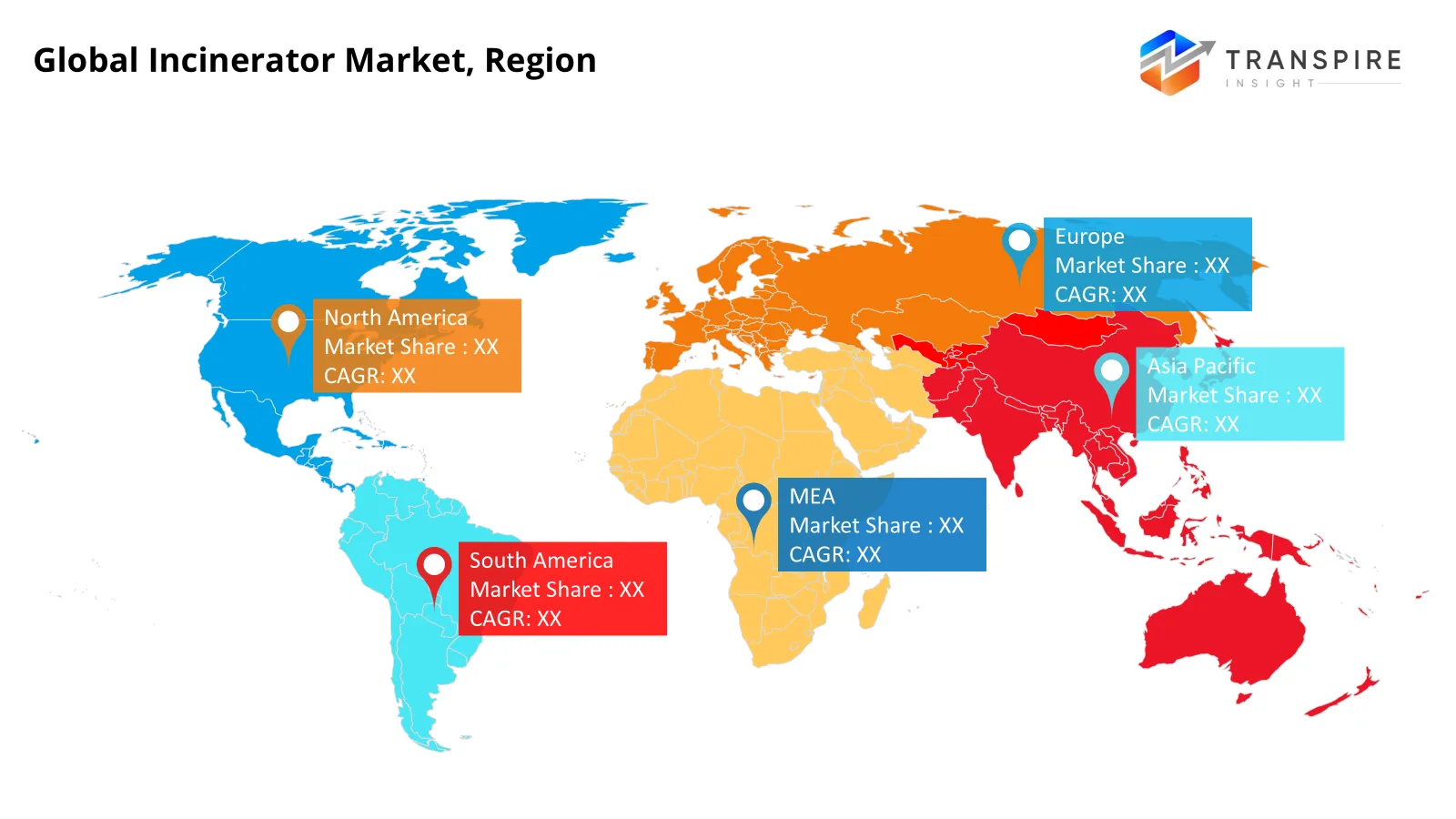
Europe contains the largest incinerator market share at roughly 38 per cent of global capacity - with more than 480 operational facilities located in Germany, France, Italy, the Netherlands, Denmark, and Scandinavia. The European Union's landfill directive that aims to limit landfill usage to 10 per cent of municipal waste by 2035 created the regulatory environment for incinerator development right back in the 1990s. Today, Europe runs the most efficient incinerator fleet anywhere in the world - with average energy recovery rates exceeding 80 per cent through district heating networks and combined heat and power systems. German cities get about 30 to 40 per cent of their district heating from incinerator waste-to-energy systems - and Denmark gets 60 per cent of Copenhagen's district heating from municipal waste incineration.
Asia-Pacific is actually the fastest-growing regional market - representing 28 per cent of global incinerator capacity - with approximately 550 operational facilities and even stronger pipeline growth. China operates over 400 incinerators - and is installing 30 to 40 new facilities each year up until 2030 because urbanisation causes waste generation to grow really fast - and government requirements set waste-to-energy priorities over landfill disposal. India has announced a goal of setting up 100 new waste-to-energy facilities through 2030 under the Swachh Bharat Mission program - which will require around USD 8 to 10 billion in capital investment. Southeast Asian countries like Vietnam, Thailand, and Indonesia are greatly increasing incinerator capacity very quickly as cities hit landfill capacity constraints and governments take on circular economy policies.
North America and Latin America put together represent 22 per cent of global incinerator capacity. The United States has around 70 municipal waste incinerators - with most concentrated in the Northeast and California where landfill capacity is limited. Canada and Mexico are also expanding waste-to-energy capacity in order to meet landfill diversion targets. Latin American countries like Brazil, Colombia, and Chile are examining incinerator development as a sustainable solution to waste management - because rapid urbanisation fills existing landfills quite fast - and regulatory frameworks are adopting waste diversion requirements similar to those in developed markets.
To learn more about this report, Download Free Sample Report
Who are the Key Players in the Global Incinerator Market and How Do They Compete?
The international incinerator market is highly fragmented - with Babcock & Wilcox Enterprises Inc., Hitachi Zosen Corporation, and Veolia Environnement S. A. collectively holding around 28 percent of market share. Unlike consumer goods products, with clear brand differentiation, incinerator competition focuses more on engineering expertise, regulatory knowledge, financing capability, and long-term service infrastructure itself. Vendors compete on multiple levels - including combustion technology efficiency, air pollution control system performance, energy recovery optimization, and the ability to manage extremely complex permitting and public approval processes in well-developed markets.
Babcock & Wilcox focuses on rotary kiln technology for industrial and hazardous waste applications, competing mainly on combustion performance and equipment durability for difficult feedstock. Hitachi Zosen specializes in fluidized bed incinerators - and has captured substantial market share in East Asia by way of technology partnerships and local manufacturing relationships. Veolia Environnement competes by offering integrated services - providing facility design, construction, financing, and long-term facility management, thus positioning incinerator infrastructure as a component of comprehensive waste management solutions itself.
Keppel Seghers, Mitsubishi Heavy Industries, and Martin GmbH compete through technology differentiation and established relationships in certain geographic markets. Covanta Holding and Wheelabrator Technologies operate as facility owners and operators in North America - competing for waste-to-energy project development contracts. Andritz AG and CNIM Group compete through engineering and construction services. Barriers to entry are very substantial - given the extreme capital intensity of facility construction, the need for regulatory expertise in many jurisdictions, and the multi-year development timelines for project permitting and construction itself.
Global Incinerator Market Companies
- Babcock & Wilcox Enterprises Inc.
- Hitachi Zosen Corporation
- Veolia Environnement S.A.
- Keppel Seghers Engineering Singapore Pte. Ltd.
- Mitsubishi Heavy Industries Ltd.
- Doosan Enerbility Co. Ltd.
- Martin GmbH
- Covanta Holding Corporation
- SUEZ Group
- EEW Energy from Waste GmbH
- Wheelabrator Technologies Inc.
- Ramboll Group A/S
- Foster Wheeler AG
- Andritz AG
- CNIM Group
Recent Developments
In March 2026, Veolia Environnement S.A. announced the completion of a fluidized bed incinerator facility in India with a capacity of 500 tonnes per day, the largest waste-to-energy facility in South Asia. The facility incorporates fluidized bed combustion technology, waste-derived heat recovery for district heating, and advanced air pollution control systems exceeding Indian emission standards. https://www.veolia.com/news
In February 2026, Hitachi Zosen Corporation received a contract to design and construct a 400-tonne-per-day municipal waste incinerator facility in Vietnam with combined heat and power capability, bringing the company's total project pipeline in Southeast Asia to approximately USD 2.5 Billion through 2030. The contract includes a 10-year facility operations and maintenance agreement. https://www.hitachizosen.co.jp
What Strategic Insights Define the Future of the Global Incinerator Market?
Over the next five to seven years, the incinerator market will consolidate around fluidized bed and advanced rotary kiln technologies as vendors exit multiple-hearth designs and municipal authorities replace older facilities with higher-efficiency systems. This technology shift reflects both regulatory requirements for lower air emissions and economic drivers that favor thermal efficiency improvements offsetting rising equipment costs. The rate of technology transition depends on regulatory tightening and energy price levels, which remain stable enough that facility operators can justify retrofit investments through energy savings.
The clearest growth opportunity is the expansion of incinerator capacity in emerging markets, particularly India and Southeast Asia. These regions face the dual drivers of rapid urbanization increasing waste volumes and regulatory adoption of waste diversion requirements that restrict landfill use. Vendors that establish local manufacturing capabilities, engineering partnerships, and workforce training programs in these markets will capture proportionally larger market share than global competitors who approach emerging markets as export destinations from developed-market production centers.
The strategic risk that is not visible in growth rate projections is the long-term impact of circular economy and source reduction programs that could reduce the volume of waste requiring incineration. While regulatory mandates ensure sustained demand for incineration infrastructure, aggressive source reduction and reuse programs could slow waste volume growth or shift waste composition in ways that reduce incinerator facility utilization rates. Vendors are responding by developing flexibility into facility design to accommodate multiple feedstock types including refuse-derived fuel, biomass, and sewage sludge, which expands addressable markets beyond conventional municipal and industrial waste.
Global Incinerator Market Report Segmentation
By Type
- Rotary Kiln Incinerator
- Fluidized Bed Incinerator
- Multiple Hearth Incinerator
By Application
- Municipal Waste
- Industrial Waste
- Medical Waste
By End-User
- Municipal Authorities
- Hospitals
- Industrial Facilities
Frequently Asked Questions
Find quick answers to common questions.
The Global Incinerator Market size is expected to reach USD 21.83 Billion by 2033.
The key segments are By Type (Rotary Kiln Incinerator, Fluidized Bed Incinerator, Multiple Hearth Incinerator), By Application (Municipal Waste, Industrial Waste, Medical Waste), and By End-User (Municipal Authorities, Hospitals, Industrial Facilities).
Major players include Babcock & Wilcox Enterprises Inc., Hitachi Zosen Corporation, Veolia Environnement S.A., Keppel Seghers Engineering Singapore Pte. Ltd., Mitsubishi Heavy Industries Ltd., Doosan Enerbility Co. Ltd., Martin GmbH, Covanta Holding Corporation, SUEZ Group, EEW Energy from Waste GmbH, Wheelabrator Technologies Inc., Ramboll Group A/S, Foster Wheeler AG, Andritz AG, and CNIM Group.
The Global Incinerator Market size is USD 18.59 Billion in 2025.
The Global Incinerator Market CAGR is 2.01% from 2026 to 2033.
- Babcock & Wilcox Enterprises Inc.
- Hitachi Zosen Corporation
- Veolia Environnement S.A.
- Keppel Seghers Engineering Singapore Pte. Ltd.
- Mitsubishi Heavy Industries Ltd.
- Doosan Enerbility Co. Ltd.
- Martin GmbH
- Covanta Holding Corporation
- SUEZ Group
- EEW Energy from Waste GmbH
- Wheelabrator Technologies Inc.
- Ramboll Group A/S
- Foster Wheeler AG
- Andritz AG
- CNIM Group
Recently Published Reports
-
Apr 2026
Active Power Filter Market
Active Power Filter Market Size, Share & Analysis Report By Type (Shunt Active Power Filters, Series Active Power Filter, Hybrid Active Power Filter), By Application (Harmonics Mitigation, Reactive Power Compensation, Voltage Regulation, Power Factor Correction), By Phase (Single Phase, Three Phase), By End-User Industry (Manufacturing, Healthcare, Commercial, Automotive, Oil and Gas, Others), and Geography (North America, Europe, Asia-Pacific, Middle East and Africa, South and Central America), 2021 - 2031
-
Apr 2026
Electrical Transformer Market
Electrical Transformer Market Size, Share & Analysis Report By Core (Closed, Shell, and Berry), By Insulation (Gas, Oil, Solid, Air, and Other), By Phase (Single, and Three), By Rating (100 MVA to 500 MVA, 501 MVA to 800 MVA, and 801 MVA to 1200 MVA), and Geography (North America, Europe, Asia-Pacific, Middle East and Africa, South and Central America), 2021 – 2031
-
Apr 2026
Hydraulic Piston Pumps Market
Hydraulic Piston Pumps Market Size, Share & Analysis Report By Type (Axial Piston Pumps, Radial Piston Pumps), By Operating Pressure (Low Pressure, Medium Pressure, High Pressure), By Application (Construction, Mining, Agriculture, Automotive, Oil & Gas, Industrial Machinery, Others), By End-User (OEMs, Aftermarket), and Geography (North America, Europe, Asia-Pacific, Middle East and Africa, South and Central America), 2021 – 2031
-
Apr 2026
Laboratory Gas Generators Market
Laboratory Gas Generators Market Size, Share & Analysis Report By Product (Nitrogen Gas Generator, Hydrogen Gas Generator, Zero Air Gas Generator, Purge Gas Generator, TOC Gas Generators, Others), By Application (Gas Chromatography, Liquid Chromatography-mass Spectrometry (LC-MS), Gas Analyzers, Others), By End-user (Life Science, Chemical & Petrochemical, Food & Beverage, Others), and Geography (North America, Europe, Asia-Pacific, Middle East and Africa, South and Central America), 2021 – 2031