
Sep 10, 2026
By Transpire Insight
Description
According to a research report published by Transpire Insight, the glass tableware market size is projected to grow from USD 13.39 billion in 2026 to USD 24.9 billion by 2035, at a CAGR of 9.13% during the forecast period 2027-2035. The glass tableware market is fueled by the growing hospitality industry, increasing demand for eco-friendly and non-toxic options to single-use plastics, growing home entertaining, and technological advancements of durable, break-resistant tempered glass.
Introduction
Glass tableware is all of the glass table service items that are used in the home or commercial environment, such as beakers, drinking vessels, dinnerware, and serveware. Owing to increasing preference for changing lifestyles, urbanization, and the rising trend of modern eating-out experiences. Glass tableware is an essential part of the housewares and food services industry, and is equally versatile in style and sustainable for food use.
Recent Development News
Stay Ahead of Emerging Opportunities with Expert Market Insights by Transpire Insight
Transpire Insight provides comprehensive, data-driven market intelligence to support smarter business decisions. Our research is rooted in comprehensive analysis, authoritative predictions, and industry expertise, enabling organizations to make informed decisions in rapidly evolving markets. In-depth analysis of market segmentation, competitive positioning, regional trends, and emerging investment opportunities in high-growth areas. We blend accuracy with actionable intelligence, empowering companies to uncover new avenues for growth, bolster strategic decision-making, and stay ahead in a dynamic market.
Glass Tableware Market Size & Statistics
Regional Growth and Demand Analysis by Transpire Insight
Asia Pacific's dominance is not solely due to a single big headline launch, but it is a manufacturing ecosystem that provides low costs and high production, which is driven by Arc International at the top of the market, with a scale advantage achieved partly because of the distribution of capacity across low-cost production sites in China and India rather than any one home market. As urbanisation grows, the number of hotels and restaurants is increasing, and demand for out-of-home dining has increased, this has driven households and hospitality operators to consider glass over plastic or ceramic options, as these are more expensive to manufacture in volume but appear higher value to the consumer. The combination of low cost, local manufacturing and continued growth in discretionary spending has always been the reason why forecasts have kept the region outstripping North America and Europe in terms of both current share and growth rate, despite the increased competition among local manufacturers and established international brands.
Latin America's growth story looks different. It is coming off a smaller base but is compounding quickly as hospitality chains expand and retail formats modernise, a pattern visible in how mainstream retailers are refreshing their glassware ranges to meet this shift, illustrated by Aldi introducing a 4-pack of fluted highball glasses under its Crofton brand as part of a broader wave of accessible, design-forward glassware entering supermarket and discount channels. Dinnerware is the standout category within the region, growing faster than drinkware or serveware as households upgrade everyday tableware alongside the broader premiumisation trend.
Top 15 Trends in the Glass Tableware Market
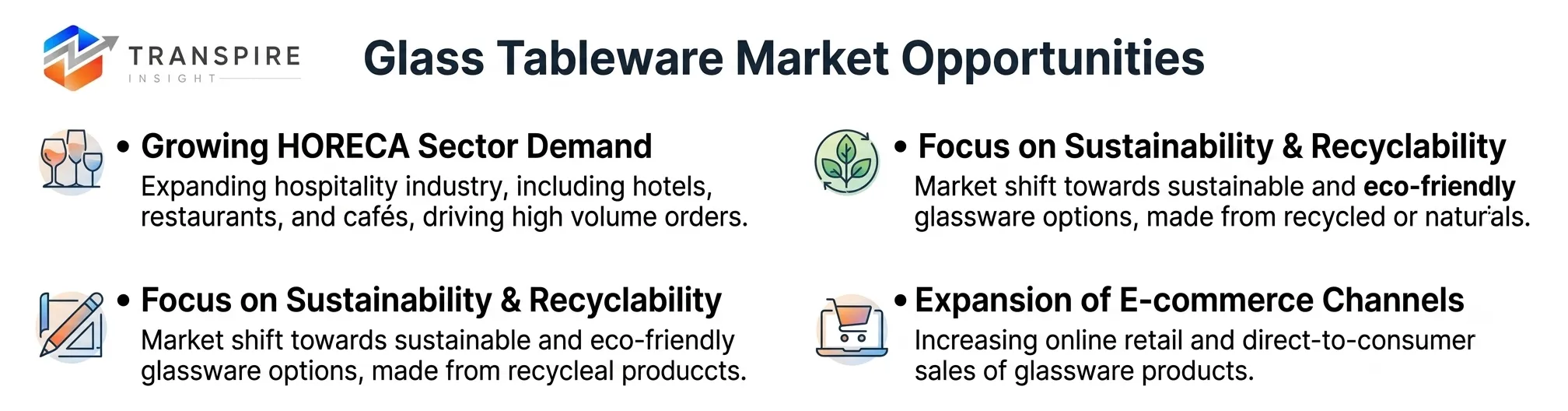
Sustainable, Recycled Glassware
Manufacturers are steadily adopting recycled cullet and energy-efficient furnaces to cut carbon footprint, as regulators and eco-conscious consumers push brands away from single-use plastics today.
Borosilicate Glass Growth
Borosilicate glass is gaining traction for its heat resistance, shock durability, and clarity, making it a preferred choice across bakeware, drinkware, and laboratory-inspired dining collections.
Premiumization and Artisanal Demand
Consumers increasingly and consistently seek artisanal, handcrafted, and mouth-blown glass pieces that signal exclusivity, prompting brands to expand limited-edition, designer, and heritage-inspired premium glass collections.
E-commerce and D2C Expansion
Online and direct-to-consumer glassware sales are surging as brands leverage social platforms, live shopping, and subscription boxes to reach younger, design-conscious buyers globally without middlemen.
Smart, Multifunctional Innovations
Manufacturers are introducing multifunctional glassware with stackable, modular, and convertible designs, alongside temperature-indicating and self-cooling innovations, catering to compact urban kitchens and versatile entertaining needs.
Social Media Influence
Instagram and Pinterest-driven aesthetics are shaping purchase decisions, as influencers showcase tablescapes and styled glassware, pushing brands to design visually distinctive, shareable, photogenic tableware collections.
Top 25 Companies Leading the Glass Tableware Market
1. Arc International
pioneer in high-volume, break-resistant fully tempered opal glass dinnerware production.
Founded: 1825 | HQ: Arques, France.
Why It Ranks: World-leading production capacity across mass retail and professional commercial foodservice channels.
Regional Dominance: Europe and North America, with strong penetration across Asia-Pacific.
Product Line: Tempered drinkware, opal glass dinnerware, dessert bowls, and food containers.
2. Libbey Inc.
Premier American glassware giant manufacturing heavy-duty commercial and home drinkware products.
Founded: 1818 | HQ: Toledo, Ohio, USA.
Why It Ranks: Dominates North American barware, restaurant, and hotel supply chains effortlessly.
Regional Dominance: North America, with extensive distribution throughout Latin America and Asia.
Product Line: Tumblers, stemware, beer mugs, serveware, and specialized bar equipment.
3. Şişecam Group (Paşabahçe)
Massive industrial powerhouse producing versatile glass collections for world markets daily.
Founded: 1935 | HQ: Istanbul, Turkey.
Why It Ranks: Top exporter recognized for balance of quality, scale, and pricing.
Regional Dominance: Europe, Middle East, North Africa, and growing Asian markets.
Product Line: Turkish tea sets, casual drinkware, glass plates, and storage jars.
4. Bormioli Rocco S.p.A.
Italian manufacturer combining artistic glass tradition with advanced modern technical manufacturing.
Founded: 1825 | HQ: Fidenza, Italy.
Why It Ranks: Master of high-clarity soda-lime stemware and durable tempered storage solutions.
Regional Dominance: Europe, with major import shares in the United States.
Product Line: Wine glasses, preserve jars, modern tumblers, and decorative carafes.
5. Riedel Crystal
Renowned luxury glassmaker famous for creating grape varietal-specific functional wine glasses.
Founded: 1756 | HQ: Kufstein, Austria.
Why It Ranks: Undisputed standard for fine dining, sommeliers, and wine enthusiasts.
Regional Dominance: Europe and North America, with strong Asian luxury presence.
Product Line: Varietal-specific stemware, hand-blown decanters, and luxury spirits tasting glasses.
6. Villeroy & Boch AG
Heritage lifestyle brand engineering premium crystal and glass complements for dining.
Founded: 1748 | HQ: Mettlach, Germany.
Why It Ranks: Exceptionally strong prestige brand identity across luxury retail and hospitality.
Regional Dominance: Western Europe, with prominent growth across North American retail.
Product Line: Lead-free crystal stemware, glass chargers, tumblers, and decorative vases.
7. Anchor Hocking, LLC
Historic American manufacturer specializing in durable everyday glassware and bakeware items.
Founded: 1905 | HQ: Lancaster, Ohio, USA.
Why It Ranks: Key player in North American mass-market retail and consumer kitchenware.
Regional Dominance: North America, with selective distribution in South American markets.
Product Line: Tempered glass bakeware, measuring cups, drinkware, and pantry storage.
8. Ocean Glass Public Company Limited
Leading Asian manufacturer producing high-quality everyday glassware for international hospitality clients.
Founded: 1979 | HQ: Bangkok, Thailand.
Why It Ranks: Essential operational supplier for rapid hotel and restaurant growth worldwide.
Regional Dominance: Southeast Asia, South Asia, and expanding Middle Eastern channels.
Product Line: Restaurant tumblers, cocktail glasses, water carafes, and dessert coupes.
9. Borosil Limited
India's leading brand known for heat-resistant borosilicate glass kitchenware and tableware.
Founded: 1962 | HQ: Mumbai, India.
Why It Ranks: Household name in India dominating flame-proof, oven-safe glass dining products.
Regional Dominance: South Asia, with growing exports to the Middle East and US.
Product Line: Microwave-safe cookware, borosilicate tumblers, glass carafes, and serving dishes.
10. Zwiesel Kristallglas AG (Schott Zwiesel)
Pioneer of Triton crystal technology delivering extreme scratch- and break-resistant stemware.
Founded: 1872 | HQ: Zwiesel, Germany.
Why It Ranks: Industry benchmark for durability in professional luxury hotels and restaurants.
Regional Dominance: Europe and North America, with strong high-end Asian hospitality.
Product Line: Tritan crystal wine stems, cocktail tumblers, decanters, and barware.
Conclusion
Glass tableware is continuing to be strong as it's poised for five trends: The growth of hospitality businesses, a new generation of materials for tableware, automation advancements for making glass, and a host of emerging products. Dominant legacy players keep on innovating by means of break-resistant technologies and sustainable production processes. Manufacturers who can deliver flexibility in customisation, high-volume consistency, and premium aesthetics will have the opportunity to be the market leaders, as consumer tastes shift toward health-safe and sophisticated dining experiences through 2026 and beyond.


Send us a brief description of your challenge and we'll get back to you within 24 hours.

 inquiry@transpireinsight.com
 APAC:+91 7666513636
 Address


