

Global Glass Tableware Market Size & Forecast:
Global Glass Tableware Market Size 2025: USD 12.27 Billion
Global Glass Tableware Market Size 2033: USD 22.75 Billion
Global Glass Tableware Market CAGR: 8.05%
Global Glass Tableware Market Segments: By Product Type (Drinking Glasses, Dinnerware, Serveware), By Material Type (Soda-Lime Glass, Borosilicate Glass, Crystal Glass), By Distribution Channel (Online Retail, Supermarkets & Hypermarkets, Specialty Stores), By End-User (Residential, Commercial).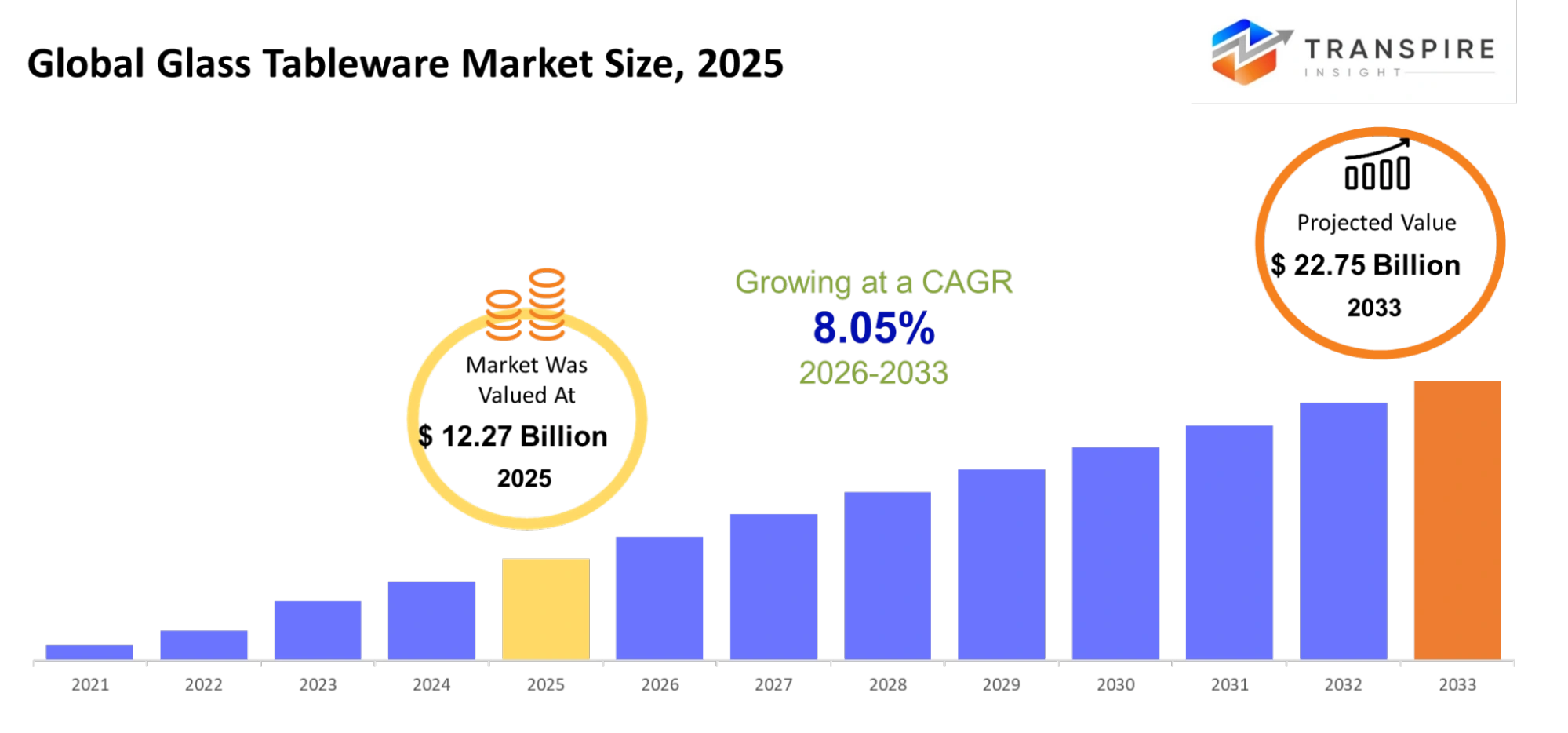 To learn more about this report,
  Download Free Sample Report
Global Glass Tableware Market Summary:
The Global Glass Tableware Market reached an estimated value of USD 12.27 billion in 2025 and is projected to grow to USD 22.75 billion by 2033, expanding at a CAGR of 8.05% from 2026 to 2033. Glass tableware covers a wide range of products used in households and food service settings, from everyday drinking glasses and mugs to formal dinnerware and decorative serveware. Demand holds steady because glassware remains a preferred material in both home and commercial settings due to its clean look, food-safe properties, and recyclability.
Residential consumers continue to drive volume, but the commercial segment is picking up pace. Restaurants, hotels, catering companies, and corporate cafeterias consistently replace and upgrade their glassware, keeping steady order flows going to mid-range and premium manufacturers. The shift toward aesthetically considered dining experiences has pushed operators to move away from generic options toward glassware with more defined design identities.
On the material side, soda-lime glass still makes up the bulk of units sold, given its low cost and wide availability. Borosilicate glass is gaining ground, particularly in drinkware categories where thermal resistance and durability matter. Crystal glass remains a niche but high-value segment, holding its position in premium gifting, formal dining, and hospitality.
Distribution is shifting. Online retail has grown into a serious channel, especially for brands that can show their products well through photography and reviews. Specialty stores still perform in the premium and gifting segments. Supermarkets and hypermarkets remain the dominant volume channel for everyday glassware.
Key Market Trends & Insights:
- The Global Glass Tableware Market is expanding as dining culture evolves and consumers invest more in home entertaining.
- Online retail is reshaping distribution, with direct-to-consumer and marketplace models growing across all price points.
- Borosilicate glass is seeing increased adoption in drinkware, driven by durability and temperature resistance.
- Hospitality and food service operators are upgrading their tableware programs, supporting commercial segment growth.
- Sustainability considerations, including recyclability and reduced packaging, are influencing purchasing decisions across both consumer and institutional buyers.
Global Glass Tableware Market Segmentation
By Product Type
- Drinking Glasses: Drinking Glasses account for the largest share of the Global Glass Tableware Market, representing approximately 41% of total revenue. This segment covers tumblers, stemware, highball glasses, mugs, and specialty beverage glasses. High replacement rates in both residential and commercial channels support consistent demand. The category benefits from wide price accessibility and strong gifting appeal, particularly in stemware.
- Dinnerware: Glass dinnerware includes plates, bowls, and serving dishes made from tempered or specialty glass. This segment appeals to consumers looking for a modern, minimalist table setting. Commercial buyers in the hotel and restaurant sector use glass dinnerware to create a clean, upscale presentation. Growth in this segment is tied to rising interest in contemporary table aesthetics.
- Serveware: Glass serveware covers pitchers, serving bowls, platters, and decorative display pieces. It performs well in both premium retail and gifting contexts. Consumers and hospitality operators choose glass serveware for its visual clarity, which allows the food being presented to remain the focal point. Growth is supported by increased home entertaining and the popularity of open-kitchen restaurant formats.

To learn more about this report, Download Free Sample Report
By Material Type
- Soda-Lime Glass: Soda-lime glass is the most widely used material in the Global Glass Tableware Market. It is cost-effective, easy to produce at scale, and compatible with most tableware applications. This material dominates the mass-market segment and continues to perform strongly in supermarket and hypermarket channels. Most everyday glassware sold globally uses soda-lime glass.
- Borosilicate Glass: Borosilicate glass is growing faster than the overall market, driven by demand for durable, thermal-shock-resistant products. It is commonly used in mugs, tea glasses, and kitchenware where temperature changes occur frequently. Consumers are increasingly aware of its properties and willing to pay a premium for products made from it. The material also performs well in microwave-safe and oven-to-table product categories.
- Crystal Glass: Crystal glass remains a premium material category within the Global Glass Tableware Market. It is used primarily for formal stemware, decanters, and high-end decorative pieces. The segment holds steady in gifting and luxury retail, though volume growth is more limited than in other material categories. Brands in this segment compete on design, craftsmanship, and heritage.
By Distribution Channel
- Online Retail: Online retail is the fastest-growing distribution channel in the Global Glass Tableware Market. E-commerce platforms allow brands to reach consumers directly and present products through detailed imagery and reviews. The channel works particularly well for mid-range and premium products where visuals drive purchase decisions. Subscription boxes and curated gifting platforms have also created new online demand for glassware.
- Supermarkets & Hypermarkets: Supermarkets and hypermarkets remain the largest distribution channel by volume. These outlets carry a wide range of everyday glassware at accessible price points. High foot traffic and in-store visibility drive impulse purchases, and the channel benefits from seasonal promotional events. Mass-market brands rely heavily on this channel to maintain shelf presence and volume.
- Specialty Stores: Specialty stores serve the premium and gift segments of the Global Glass Tableware Market. Kitchenware stores, homeware boutiques, and department stores carry curated selections that skew toward design-conscious and higher-value products. Consumers visiting specialty stores tend to have higher purchase intent and willingness to spend, making this channel important for brand positioning even when unit volumes are lower.
By End-User
- Residential: The residential segment is the primary driver of the Global Glass Tableware Market. Household purchases account for the largest portion of unit sales, with consumers buying glassware for daily use, entertaining, and gifting. Growth is supported by rising urbanization, expanding middle-income populations in emerging markets, and a broader consumer interest in home aesthetics and dining culture.
- Commercial: The commercial segment includes restaurants, hotels, catering firms, bars, and institutional food service operations. This segment tends to purchase at higher volumes and replaces inventory more frequently than households. Premium hospitality operators have been upgrading their glassware programs, which has opened space for brand-name and design-led manufacturers to compete alongside commodity suppliers.
Country Insights
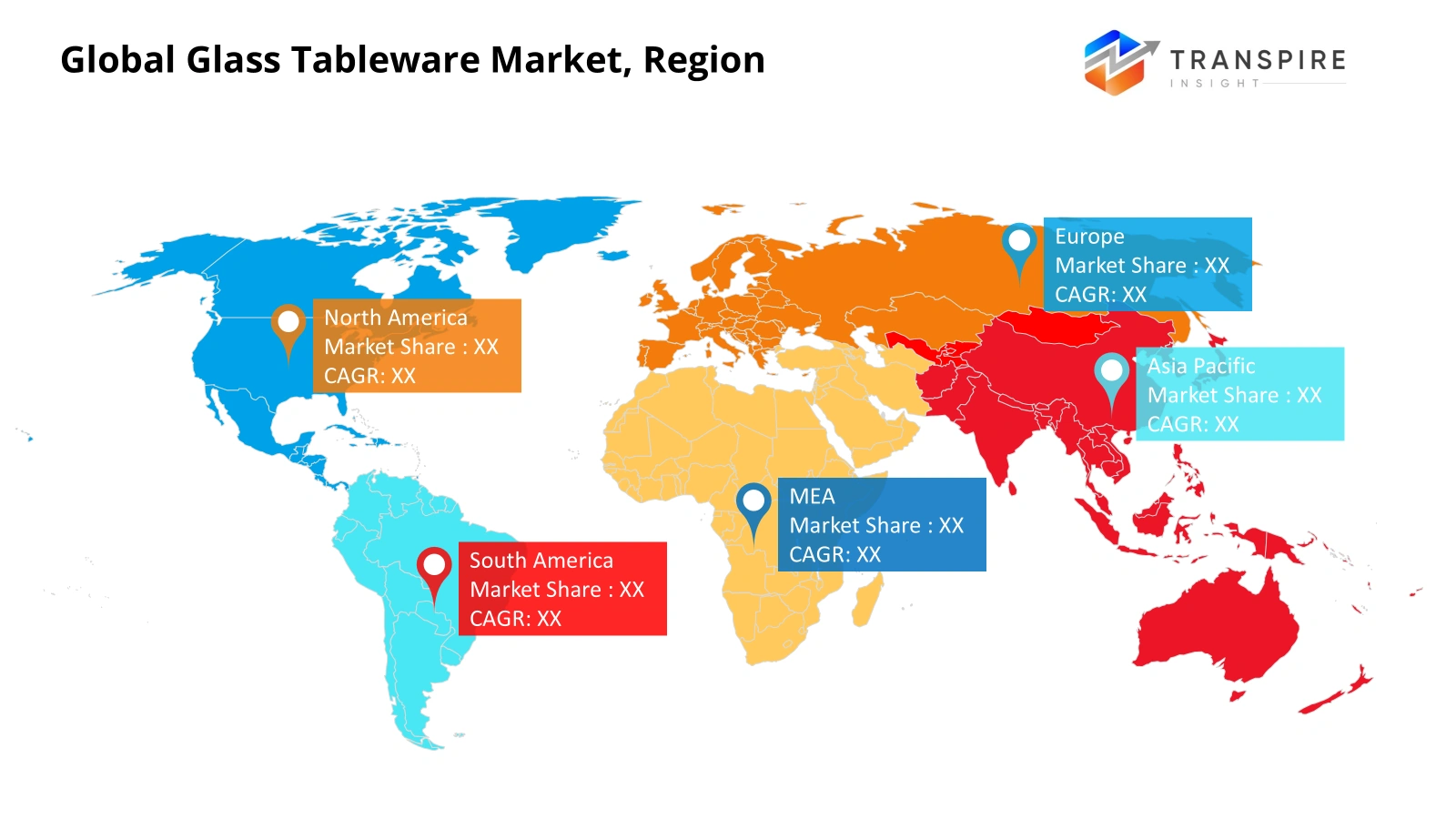
The Global Glass Tableware Market reflects different dynamics depending on the region. North America is a mature but active market. The United States shows consistent demand across both residential and commercial channels, with growing interest in premium and designed glassware products. The restaurant and hospitality recovery has supported commercial segment purchases, and direct-to-consumer brands have found a receptive audience online.
Europe remains one of the most developed markets for glass tableware. Countries like Germany, France, Italy, and the United Kingdom have long-established consumer cultures around quality table goods. Premium and crystal glass brands with strong European heritage maintain loyal customer bases, and the gifting market performs well during key seasonal periods. Environmental regulations and sustainability expectations also influence product development in this region.
The Asia-Pacific region is growing fastest within the Global Glass Tableware Market. China and India are both expanding middle-income consumer bases with rising disposable incomes and changing dining habits. Japan and South Korea have well-developed retail environments for quality tableware, and demand for both domestic brands and imported premium products is solid. E-commerce penetration in the region is high, which is accelerating the online channel.
Latin America and the Middle East represent smaller but growing markets. Hospitality investment in the Middle East, particularly in the UAE and Saudi Arabia, is generating commercial demand for quality glassware. In Latin America, Brazil and Mexico show the most activity as urbanization and food service growth support the category.
To learn more about this report, Download Free Sample Report
Recent Development News
Several manufacturers in the Global Glass Tableware Market have been expanding their borosilicate product lines to meet growing demand for durable, thermally resistant drinkware. Companies are also introducing recycled glass content into standard soda-lime products in response to retailer and consumer sustainability requirements.
Premium brands have been investing in design collaborations and limited-edition collections to maintain interest and drive gifting revenue. Distribution-side, a number of manufacturers have built out their own e-commerce channels to reduce dependence on traditional retail and capture more margin on direct sales.
Report Metrics
|
Report Metrics |
Details |
|
Market size value in 2025 |
USD 12.27 Billion |
|
Market size value in 2026 |
USD 13.23 Billion |
|
Revenue forecast in 2033 |
USD 22.75 Billion |
|
Growth rate |
CAGR of 8.05% from 2026 to 2033 |
|
Base year |
2025 |
|
Historical data |
2021 - 2024 |
|
Forecast period |
2026 - 2033 |
|
Report coverage |
Revenue forecast, competitive landscape, growth factors, and trends |
|
Country scope |
Global |
|
Key company profiled |
Arc International S.A., Libbey Inc., Bormioli Rocco S.p.A., Pasabahce (Sisecam Group), Anchor Hocking LLC, Ocean Glass Public Company Ltd., Lenox Corporation, Riedel Glass Works, Dartington Crystal Ltd., Waterford Crystal Ltd., Luminarc, Luigi Bormioli Corp., Fiskars Group, Noritake Co. Ltd., Krosno Glass S.A. |
|
Customization scope |
Free report customization (country, regional & segment scope). Avail customized purchase options to meet your exact research needs. |
|
Report Segmentation |
By Product Type (Drinking Glasses, Dinnerware, Serveware), By Material Type (Soda-Lime Glass, Borosilicate Glass, Crystal Glass), By Distribution Channel (Online Retail, Supermarkets & Hypermarkets, Specialty Stores), By End-User (Residential, Commercial). |
Key Global Glass Tableware Company Insights
The Global Glass Tableware Market includes a mix of large multinational producers, regional specialists, and premium heritage brands. Leading companies maintain scale advantages in soda-lime glass production while also investing in product design and brand positioning to defend market share in the mid-to-premium tiers. Research and development efforts have focused on material innovation, particularly around borosilicate formulations and lead-free crystal alternatives.
Several companies have restructured their distribution strategies, scaling up direct-to-consumer and e-commerce capabilities while also strengthening relationships with major retail chains. Competitive pressure from lower-cost Asian manufacturers has pushed established brands to differentiate on design, sustainability credentials, and portfolio breadth rather than price alone.
Company List
- Arc International S.A.
- Libbey Inc.
- Bormioli Rocco S.p.A.
- Pasabahce (Sisecam Group)
- Anchor Hocking LLC
- Ocean Glass Public Company Ltd.
- Lenox Corporation
- Riedel Glass Works
- Dartington Crystal Ltd.
- Waterford Crystal Ltd.
- Luminarc
- Luigi Bormioli Corp.
- Fiskars Group
- Noritake Co. Ltd.
- Krosno Glass S.A.
Global Glass Tableware Market Report Segmentation
By Product Type
- Drinking Glasses
- Dinnerware
- Serveware
By Material Type
- Soda-Lime Glass
- Borosilicate Glass
- Crystal Glass
By Distribution Channel
- Online Retail
- Supermarkets & Hypermarkets
- Specialty Stores
By End-User
- Residential
- Commercial
Frequently Asked Questions
Find quick answers to common questions.
The Global Glass Tableware Market is expected to reach approximately USD 22.75 billion by 2033.
Key segments include Product Type (Drinking Glasses, Dinnerware, Serveware), Material Type (Soda-Lime Glass, Borosilicate Glass, Crystal Glass), Distribution Channel (Online Retail, Supermarkets & Hypermarkets, Specialty Stores), and End-User (Residential, Commercial).
Major players include Arc International S.A., Libbey Inc., Bormioli Rocco S.p.A., Pasabahce (Sisecam Group), Anchor Hocking LLC, Ocean Glass Public Company Ltd., Lenox Corporation, Riedel Glass Works, Dartington Crystal Ltd., Waterford Crystal Ltd., Luminarc, Luigi Bormioli Corp., Fiskars Group, Noritake Co. Ltd., and Krosno Glass S.A.
The Global Glass Tableware Market size is approximately USD 12.27 billion in 2025.
The Global Glass Tableware Market is expected to grow at a CAGR of 8.05% from 2026 to 2033.
- Arc International S.A.
- Libbey Inc.
- Bormioli Rocco S.p.A.
- Pasabahce (Sisecam Group)
- Anchor Hocking LLC
- Ocean Glass Public Company Ltd.
- Lenox Corporation
- Riedel Glass Works
- Dartington Crystal Ltd.
- Waterford Crystal Ltd.
- Luminarc
- Luigi Bormioli Corp.
- Fiskars Group
- Noritake Co. Ltd.
- Krosno Glass S.A.
Recently Published Reports
-
Apr 2026
Bottled Water Market
Bottled Water Market Size, Share & Analysis Report By Product Type (Still Bottled Water, Carbonated Bottled Water, Functional Bottled Water, and Others), By Packaging (PET, Cans, and Others), By Sales Channel (Supermarkets/Hypermarkets, Convenience Stores/Drug Stores, Grocery Stores/Club Stores, Foodservice, and Others) and Geography (North America, Europe, Asia-Pacific, Middle East and Africa, South and Central America), 2021 - 2032
-
Apr 2026
Color Cosmetic Packaging Market
Color Cosmetic Packaging Market Size, Share & Analysis Report By Application (Mascara Packaging, Liquid Packaging, and Liquid Face), By Type (Tubes & Bottles, Pens & Markers, Compacts & Containers, and Droppers & Pumps), and Geography (North America, Europe, Asia-Pacific, Middle East and Africa, South and Central America), 2021 - 2031
-
Apr 2026
External Microphone For Camera Market
External Microphone For Camera Market Size, Share & Analysis Report By Type (Shotgun Microphone, Lavalier Microphone, and Others), By Application (Digital Camera, Professional Video Camera, and Others), and Geography (North America, Europe, Asia-Pacific, Middle East and Africa, South and Central America), 2021 - 2031
-
Apr 2026
Foot Orthotic Insoles Market
Foot Orthotic Insoles Market Size, Share & Analysis Report By Type (Pre-fabricated, and Custom-made), By Material (Thermoplastic, Composite Carbon Fiber, and Others), By Distribution Channel (Drug Stores, Hospitals & Clinics, and Others), and Geography (North America, Europe, Asia-Pacific, Middle East and Africa, South and Central America), 2021 - 2031