
Aug 19, 2026
By Transpire Insight
Description
According to a research report published by Transpire Insight, The Gastrointestinal Endoscopy Market Size is projected to Grow from USD 13.22 Billion in 2025 to USD 21.78 Billion by 2035, at a CAGR of 6.90% during the forecast period 2026-2035. The Gastrointestinal Endoscopy Market is expected to grow at a steady rate because of the rise in the occurrence of gastrointestinal diseases, colorectal cancer, and other such diseases. Some factors driving the market include the increased demand for minimally invasive diagnostic and therapeutic procedures, increased screenings for colorectal cancer, advancements in high-definition imaging, capsule endoscopy, robotics, and artificial intelligence used in the diagnosis through endoscopy. Increased healthcare expenditure, availability of diagnostic centers, and an increase in the geriatric population are also driving the market.
Introduction
The Gastrointestinal Endoscopy Market consists of medical devices, visualization systems, endoscopes, and special accessories for diagnosing, treating, monitoring, and examining diseases that affect the digestive tract such as the esophagus, stomach, small intestine, colon, and rectum. The industry is advancing from simple visual examinations to more complex and less invasive procedures that involve high definition imaging, narrow-band visualization, capsule-based examination, endoscopic ultrasound, treatment, and artificial intelligence-powered disease detection. The rising prevalence of gastrointestinal conditions and colorectal cancer and the increased need for procedures that help detect and even correct abnormalities during the same process have led healthcare institutions to embrace more complex endoscopic technologies. In addition, improvements in visualization, image processing, disposability, and clinical decision support through artificial intelligence are opening up new avenues in gastrointestinal care.
Recent Development News
Stay Ahead of Emerging Opportunities with Expert Market Insights by Transpire Insight
The insights that have been shared through this blog are based on intensive market research carried out by Transpire Insight, an advisor that works with many organizations. Thanks to the analysis of extensive data, forecasts made by our specialists, and industry intelligence, our reports allow clients to find strategic growth opportunities in dynamically developing industries. For all those who would like to get more detailed information regarding market segmentation, competitive analysis, regional outlooks, and future investment tendencies, there is no doubt that our full report will be of great value.
Download the exclusive Gastrointestinal Endoscopy Market sample report today to uncover expert insights, emerging trends, and the opportunities defining the future of the industry.
Gastrointestinal Endoscopy Market Size & Statistics
Regional Growth and Demand Analysis by Transpire Insight:
North America dominates the Gastrointestinal Endoscopy Market, generating about 38–42% of total market revenues based on market definition and source. The dominance of North America is due to the well-developed healthcare infrastructure, use of colonoscopy and other GI procedures, colorectal cancer screening programs, adoption of minimally invasive technologies, advanced imaging, and AI-assisted endoscopy investments. It is primarily due to the presence of the United States, which leads due to its high volumes of procedures performed, hospitals, ambulatory surgery centers, favorable reimbursement scenario, and presence of major medical device players.
Why does North America rank first? This region has high screening demand, use of endoscopic technology, high healthcare expenditure, mature clinical infrastructure, and early adoption of AI-assisted diagnostic systems, resulting in a higher market base compared to other regions. On the other hand, Asia-Pacific is projected to grow faster due to increased healthcare investments, rising burden of gastrointestinal diseases, growing screening awareness, increased access to specialty facilities, and technologization in China, Japan, and India.
Top 15 Trends in the Gastrointestinal Endoscopy Market
Proceed to Checkout to purchase the exclusive Gastrointestinal Endoscopy Market report and gain instant access to in-depth market intelligence, strategic analysis, and future growth opportunities.
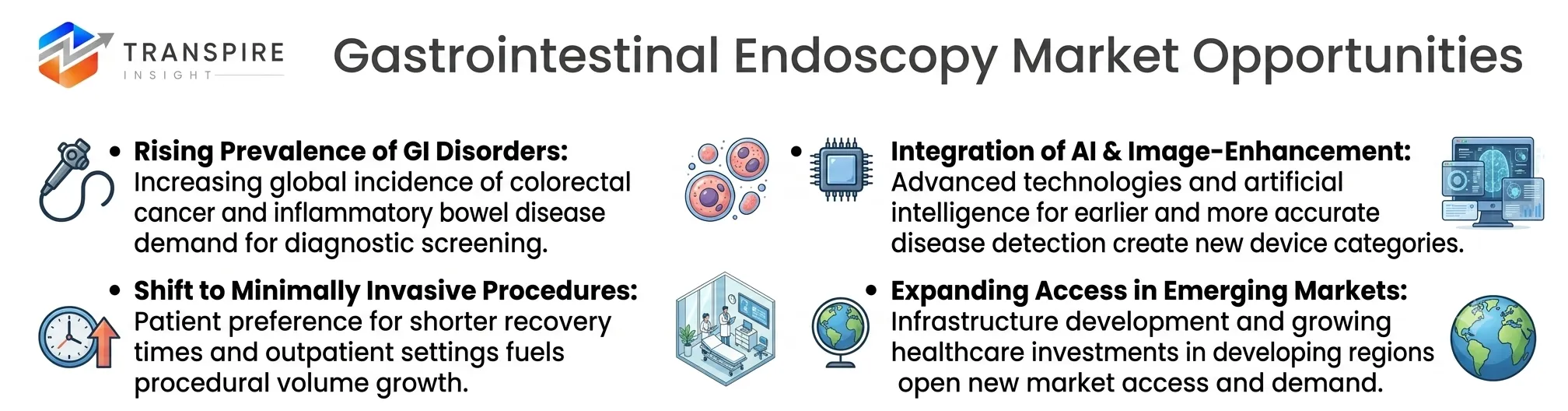
AI is gradually gaining its significance as an instrument used in gastrointestinal endoscopy for assisting health care specialists to detect polyps, lesions, bleeding spots, and other lesions during endoscopy. Computer-aided detection based on AI principles allows analyzing the images taken during endoscopy and marking areas which require additional attention but may be unnoticed otherwise. With the growing development of algorithms, AI systems are gradually shifting from being experimental instruments to being applied in daily practice.
Advanced technologies such as high definition and 4K imaging technology have helped to improve visualization during gastrointestinal operations through the provision of sharp images and better visualization of mucosal surfaces. Improved visualization will assist physicians to identify any subtle anomalies or diagnose any lesions effectively. This has prompted the development of advanced technology in monitors, cameras, image processors and endoscopic devices.
In recent years, patients and medical practitioners are opting for minimal invasive gastrointestinal interventions because of their ability to lower trauma, shorten recovery period, and even reduce hospital stays compared to open surgeries where feasible. Endoscopic technology is not only used for diagnosing, but it is also being utilized in therapy in terms of removing lesions, stopping bleeding, dilating, and taking samples.
EUS is becoming more significant due to its ability to combine endoscopy with ultrasound to give detailed images of the GI tract walls and adjacent organs. The use of EUS has been increasing in the assessment of the abnormalities of the pancreas, biliary, and GI tract as well as assisting in minimal tissue extraction and treatment procedures.
There is increasing importance in the use of capsule endoscopy in viewing regions of the GI tract that may be hard to reach using traditional endoscopy, especially in the small intestine. The patient swallows a capsule with an imager that takes pictures as it passes through the GI tract. This provides for a noninvasive examination procedure. There have been advancements in imaging quality, battery life, navigation and artificial intelligence analysis of the images.
The creation of single-use endoscopes is becoming increasingly popular since such a technology has the potential to solve many problems linked to cross-contamination, complicated cleaning processes, and availability of equipment. Single-use endoscopes appear especially appealing when it comes to some specific procedures in medicine. With advancements in the areas of picture clarity, maneuverability, ergonomics, and cost effectiveness, single-use solutions become increasingly relevant within the larger context of endoscopic devices.
Top 25 Companies Leading the Gastrointestinal Endoscopy Market
Customize the exclusive Gastrointestinal Endoscopy Market report today to receive tailored insights, country-specific analysis, and business-focused market intelligence.
1. Olympus Corporation
Olympus Corporation is a Japanese medical technology company and one of the world's leading providers of endoscopy-enabled healthcare solutions. Its GI business covers diagnostic imaging, therapeutic endoscopy, endoscopic ultrasound, and related devices.
Founded: 1919 | Headquarters: Tokyo, Japan
Why It Ranks: Olympus ranks first because of its extensive gastrointestinal endoscopy portfolio, strong installed base, broad endotherapy offering, and continued investment in advanced imaging, AI, EUS, and minimally invasive technologies. Its GI Endoscopy business recorded 20% year-on-year growth in FY2026 Q4, with double-digit growth across North America, Europe, and Asia-Pacific.
Regional Dominance: Olympus has a strong presence, with particularly significant markets in North America, Europe, and Asia-Pacific.
Product Line: Its portfolio includes EVIS X1 endoscopy systems, gastrointestinal endoscopes, video processors, endoscopic ultrasound systems, 4K monitors, biopsy devices, biliary stents, and other EndoTherapy products.
Recent Development: In June 2026, Olympus launched new 4K LCD monitors featuring Mini-LED backlighting and anti-reflection/anti-glare technology to enhance visualization during endoscopic diagnosis and therapy.
2. Boston Scientific Corporation
Boston Scientific is a major U.S. medical technology company developing minimally invasive devices across gastroenterology, cardiology, urology, and other specialties.
Founded: 1979 | Headquarters: Marlborough, Massachusetts, USA
Why It Ranks: Boston Scientific has a strong position in GI endoscopy because of its extensive portfolio of therapeutic endoscopy devices, particularly products used for stone management, tissue sampling, hemostasis, dilation, stenting, and other interventional procedures.
Regional Dominance: North America is its key market, complemented by substantial operations across Europe, Asia-Pacific, Latin America, and other international regions. The company operates across six continents.
Product Line: Its GI portfolio includes EXALT Model D single-use duodenoscope, SpyGlass DS II Direct Visualization System, biliary stents, endoscopic ultrasound devices, biopsy tools, hemostasis products, dilation devices, and stone-management technologies.
Recent Development: In July 2026, Boston Scientific announced a company-wide restructuring program intended to reduce costs and position the business for future growth, highlighting its continuing focus on operational efficiency and long-term competitiveness.
3. Medtronic plc
Medtronic is a medical technology company with a broad portfolio spanning surgical technologies, cardiovascular devices, diabetes technologies, and gastrointestinal diagnostics.
Founded: 1949 | Headquarters: Galway, Ireland
Why It Ranks: Medtronic is a major participant in gastrointestinal endoscopy through its GI Genius platform and AI-assisted colonoscopy technologies, which support real-time detection and characterization of colorectal lesions.
Regional Dominance: Medtronic has a broad footprint across North America, Europe, Asia-Pacific, and other international markets.
Product Line: Its GI portfolio includes GI Genius intelligent endoscopy modules, ColonPRO software, AI-assisted colonoscopy solutions, and related gastrointestinal diagnostic technologies.
Recent Development: In February 2026, Medtronic received CE Mark approval for ColonPRO, its fourth-generation AI-assisted colonoscopy software. The technology uses deep-learning algorithms to provide real-time polyp-size estimation and procedural insights.
4. Fujifilm Holdings Corporation
Fujifilm is a Japanese technology and healthcare company with a major medical systems business focused on endoscopy, diagnostic imaging, ultrasound, and related healthcare technologies.
Founded: 1934 | Headquarters: Tokyo, Japan
Why It Ranks: Fujifilm ranks highly because of its advanced endoscopic imaging technologies, broad scope portfolio, therapeutic endoscopy solutions, and strong presence in gastrointestinal care.
Regional Dominance: Fujifilm has extensive operations across Japan, North America, Europe, Asia-Pacific, and other markets.
Product Line: Its endoscopy portfolio includes ELUXEO endoscopic imaging systems, 800-series endoscopes, therapeutic gastroscopes, colonoscopes, EUS systems, processors, and digital endoscopy solutions.
Recent Development: In May 2026, Fujifilm's ELUXEO 8000 Endoscopic Imaging System with the 840TP gastroscope won the 2026 MedTech Breakthrough Award for Best New Endoscopy Technology Solution.
5. KARL STORZ SE & Co. KG
KARL STORZ is a German medical technology company recognized globally for endoscopic and minimally invasive surgical systems. Its technologies are widely used across multiple surgical specialties.
Founded: 1945 | Headquarters: Tuttlingen, Germany
Why It Ranks: KARL STORZ has historically been an important endoscopy technology provider because of its expertise in visualization systems, rigid and flexible endoscopic technologies, and minimally invasive surgery.
Regional Dominance: The company has a strong presence across Europe, North America, Asia-Pacific, and other international markets.
Product Line: Its broader portfolio includes endoscopic imaging systems, cameras, light sources, visualization technologies, laparoscopic instruments, surgical equipment, and general/visceral surgery solutions.
Recent Development: An important current consideration is that KARL STORZ discontinued new sales of its human gastroenterology product portfolio from January 1, 2023, although repair services are maintained through December 31, 2027. Its current business focus is therefore more concentrated on other endoscopic and surgical specialties.
6. Stryker Corporation
Stryker is a leading U.S. medical technology company offering products across MedSurg, neurotechnology, orthopaedics, and surgical visualization.
Founded: 1941 | Headquarters: Portage, Michigan, USA
Why It Ranks: Stryker's strength comes from its extensive surgical technology portfolio, advanced visualization capabilities, healthcare relationships, and broad presence in minimally invasive procedures.
Regional Dominance: North America is a major market, while Stryker operates in more than 60 countries and maintains a substantial international presence.
Product Line: Its relevant technology portfolio includes surgical visualization systems, cameras, monitors, endoscopic instruments, operating-room equipment, and minimally invasive surgical solutions.
Recent Development: In March 2026, Stryker experienced a cyberattack that caused disruptions to certain systems. The company reported no evidence of ransomware or malware at the time, while operations continued to be assessed and restored.
7. CONMED Corporation
CONMED is a U.S.-based medical technology company focused on minimally invasive surgical products and equipment used by healthcare professionals in hospitals and surgical centers.
Founded: 1970 | Headquarters: Largo, Florida, USA
Why It Ranks: CONMED is included among leading companies because of its expertise in minimally invasive procedures and its portfolio of GI endoscopic accessories and therapeutic technologies.
Regional Dominance: North America represents a major market, with products distributed across Europe, Asia-Pacific, Latin America, and other international regions.
Product Line: Its portfolio includes GI endoscopy accessories, endoscopic snares, biopsy forceps, injection needles, hemostasis devices, electrosurgical technologies, and other minimally invasive procedure products.
Recent Development: CONMED continues to expand and refine its minimally invasive technology portfolio, with ongoing emphasis on GI endotherapy, electrosurgery, procedural efficiency, and single-use accessories.
8. Johnson & Johnson
Johnson & Johnson is a healthcare company with extensive medical technology operations. Through its MedTech businesses, it develops surgical and minimally invasive technologies used across multiple specialties.
Founded: 1886 | Headquarters: New Brunswick, New Jersey, USA
Why It Ranks: Johnson & Johnson has a strong position in minimally invasive healthcare through its broad medical-device expertise, distribution network, surgical technologies, and extensive healthcare relationships.
Regional Dominance: The company has substantial operations across North America, Europe, Asia-Pacific, Latin America, and other markets.
Product Line: Its MedTech portfolio includes surgical systems, endoscopic and minimally invasive instruments, energy devices, wound-closure technologies, and other procedural solutions.
Recent Development: Johnson & Johnson continues to strengthen its MedTech business through investments in robotic surgery, digital surgery, advanced visualization, and minimally invasive technologies, supporting the broader shift toward less invasive procedures.
9. HOYA Corporation
HOYA is a Japanese med-tech company with expertise in advanced optics and medical technologies. It is the parent company of PENTAX Medical, a major endoscopy business.
Founded: 1941 | Headquarters: Tokyo, Japan
Why It Ranks: HOYA ranks strongly through PENTAX Medical's established expertise in gastrointestinal endoscopy, endoscopic imaging, EUS, therapeutic procedures, and clinical workflow solutions.
Regional Dominance: HOYA/PENTAX Medical has a presence spanning Japan, North America, Europe, Asia-Pacific, and other international markets.
Product Line: Through PENTAX Medical, its portfolio includes GI video endoscopes, colonoscopes, gastroscopes, video processors, EUS systems, duodenoscopes, endoscopic accessories, and digital imaging technologies.
Recent Development: In June 2026, PENTAX Medical and Fujifilm renewed their ultrasound diagnostic business collaboration agreement, supporting continued development and availability of ultrasound-related technologies.
10. PENTAX Medical
PENTAX Medical is the healthcare division of HOYA Corporation specializing in endoscopic imaging and solutions for gastrointestinal and other clinical applications. It has R&D, manufacturing, sales, and service capabilities across multiple regions.
Founded: 1919 | Headquarters: Tokyo, Japan
Why It Ranks: PENTAX Medical ranks among the leading GI endoscopy companies because of its established endoscope portfolio, imaging expertise, therapeutic endoscopy solutions, EUS capabilities, and focus on improving clinical workflow and ergonomics.
Regional Dominance: The company maintains a network across Japan, North America, Europe, Asia-Pacific, and other markets, allowing it to provide localized endoscopy solutions and clinical support.
Product Line: Its products include gastroscopes, colonoscopes, video processors, EUS systems, duodenoscopes, endoscopic imaging solutions, and GI therapeutic accessories.
Recent Development: In June 2026, PENTAX Medical renewed its collaboration agreement with FUJIFILM Corporation for ultrasound diagnostic technologies. The company has also been emphasizing endoscopy ergonomics, EUS training, clinical education, and advanced imaging during 2026.
Schedule a meeting with our market experts to discuss the exclusive Gastrointestinal Endoscopy Market report and identify the best research solution for your organization.
Conclusion
The Gastrointestinal Endoscopy Market is moving quickly ahead due to the preference for early diagnostics, less invasive treatments, and accurate procedures. The biggest players like Olympus Corporation, Boston Scientific, Medtronic, Fujifilm, KARL STORZ, Stryker, CONMED, Johnson & Johnson, HOYA, and PENTAX Medical have been helping the market grow through high definition imaging, endoscopic ultrasound, therapeutic tools, AI-powered diagnosis, and advanced visualization technology. North America at present is the largest region for the market with its advanced healthcare systems, well-established colorectal cancer screening programs, and higher use of advanced endoscopy techniques, and the Asia-Pacific region is set to experience tremendous growth in the future because of growing healthcare investments and increased access to advanced diagnostic procedures. The future trends in the industry will revolve around AI-assisted endoscopy, 4K imaging, capsule endoscopy, robotic-assisted procedure, single use tools, improved imaging, and digital workflows.


Send us a brief description of your challenge and we'll get back to you within 24 hours.

 inquiry@transpireinsight.com
 APAC:+91 7666513636
 Address


