
Aug 20, 2026
By Transpire Insight
Description
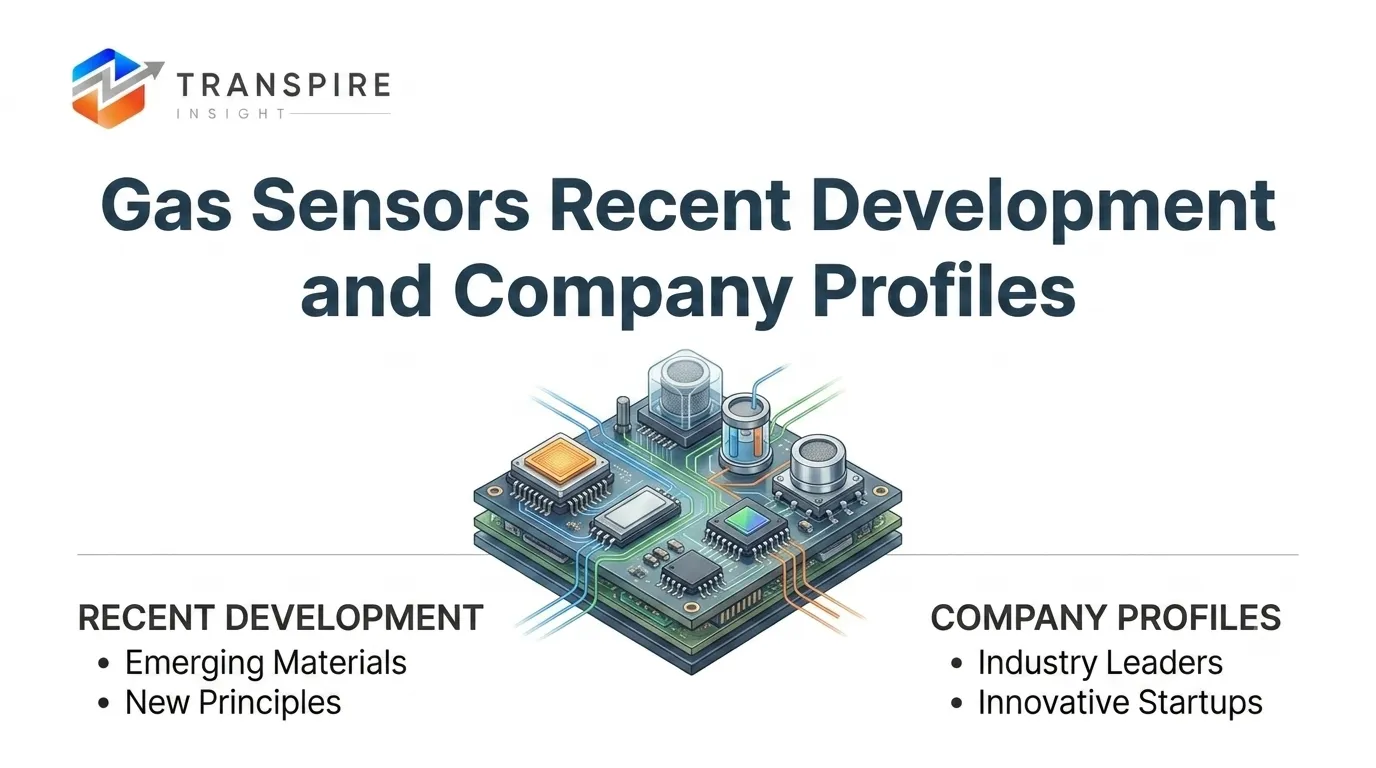
According to a research report published by Transpire Insight, The Gas Sensors Market size is projected to Grow from USD 4.5 Billion in 2025 to USD 7.02 Billion by 2035, at a CAGR of 4.55 % during the forecast period 2026-2035. The growth will be enabled by stringent environmental regulations and occupational safety regulations, monitoring of processes within industries, increased concerns about air pollution, demand for vehicle emissions testing, and the use of gas detection systems that are interconnected. Developments in technology such as electrochemical sensing, infrared sensing, semiconductor sensing, catalytic sensing, photo ionization, and optical sensing have enhanced sensor characteristics. Gas sensing technologies integrated into Internet of Things (IoT), smart building systems, industrial automation systems, healthcare systems, and environmental monitoring systems will create future growth opportunities.
Introduction
The Gas Sensors Market revolves around sensing mechanisms that are capable of sensing gases present in the environment. This market is important as it helps in identifying toxic or hazardous gases along with measuring the same, and is used for air quality measurement, process control, and increased safety. Some of the gases which can be detected using gas sensors include carbon monoxide, methane, hydrogen, oxygen, carbon dioxide, nitrogen oxides, and volatile organic compounds in industries like oil and gas, chemicals, automotive, healthcare, manufacturing, mining, environmental monitoring, and smart buildings. The development of the market has been shaped by factors like stringent emission standards, industrial automation, increasing awareness of indoor/outdoor air pollution, and requirement of constant real-time monitoring. Technologically, advancements in electrochemical, infrared, semiconductor, catalytic, photoionization, and optical sensors have been witnessed in addition to miniaturization and IoT-based monitoring.
Recent Development News
Stay Ahead of Emerging Opportunities with Expert Market Insights by Transpire Insight
The insights that have been shared through this blog are based on intensive market research carried out by Transpire Insight, an advisor that works with many organizations. Thanks to the analysis of extensive data, forecasts made by our specialists, and industry intelligence, our reports allow clients to find strategic growth opportunities in dynamically developing industries. For all those who would like to get more detailed information regarding market segmentation, competitive analysis, regional outlooks, and future investment tendencies, there is no doubt that our full report will be of great value.
Download the exclusive Gas Sensors Market sample report today to uncover expert insights, emerging trends, and the opportunities defining the future of the industry.
Gas Sensors Market Size & Statistics
Regional Growth and Demand Analysis by Transpire Insight:
North America dominates the market for Gas Sensors owing to its well-developed infrastructure in industries, safety regulations in workplaces, environmental monitoring systems, and adoption of smart sensing technologies. The United States and Canada experience high demand for gas sensors in oil and gas, chemicals, automotive, healthcare, manufacturing, mining, and building automation sectors, where the gas monitoring process is critical for safety and operational efficiency.
Industrial safety standards, increasing investments in emission control technology and adoption of IoT-enabled and wireless detection systems in the region drive its market performance. High concerns about air pollution, greenhouse gas emissions, and indoor air quality increase the deployment of gas monitoring systems among companies and government institutions. In addition, the presence of leading technology providers in the region adds competitive advantage to it.
It is predicted that the Asia-Pacific region will see the fastest rate of market growth due to its fast industrialization, establishment of new manufacturing plants, urban pollution monitoring needs, smart cities projects and high adoption of automation technologies in China, India, Japan and South Korea. The region's attention to industrial safety and environmental protection creates numerous opportunities for gas sensor manufacturers.
Top 15 Trends in the Gas Sensors Market
Proceed to Checkout to purchase the exclusive Gas Sensors Market report and gain instant access to in-depth market intelligence, strategic analysis, and future growth opportunities.
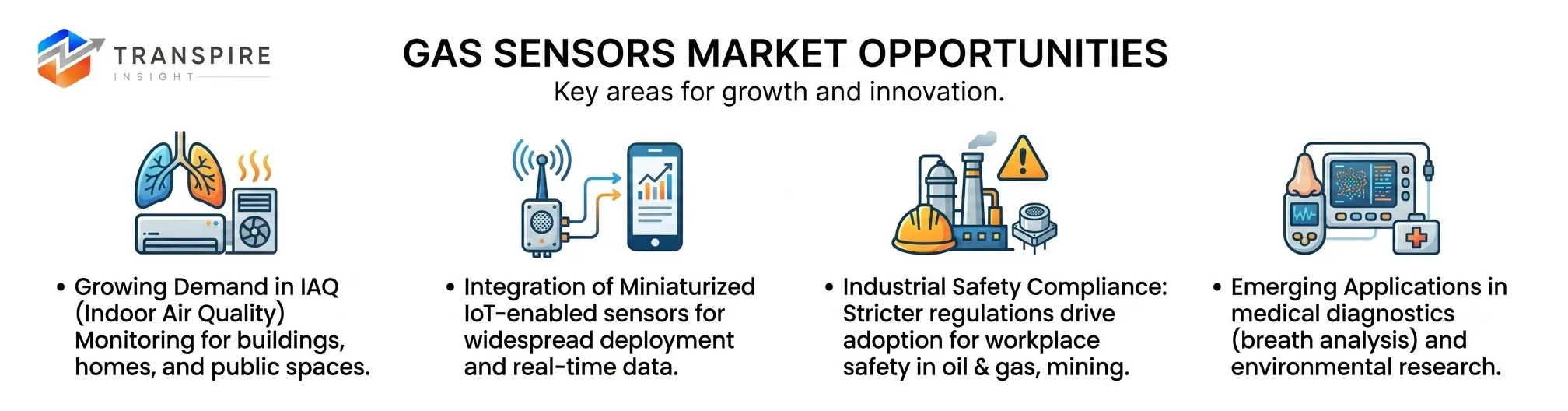
IoT-based gas sensors are becoming more common in use in platforms where it becomes possible to monitor, access remotely, receive alerts automatically and perform data analysis all in real-time. Gas leakages and abnormal gas concentrations can be detected in industrial facilities, smart buildings and environment monitoring systems by using IoT sensors, which do not require a full manual checkup process for their operation.
The growing apprehensions regarding indoor and outdoor pollution are driving the need for devices that can provide continuous monitoring of gases and various parameters associated with air quality. The application areas of such devices have extended to smart buildings, work places, transport hubs, healthcare facilities, and urban surveillance systems. Real time data allows operators to detect pollution incidents in time and make appropriate control settings.
The use of AI and machine learning with gas sensors is becoming more common in order to make sense of sensor data and be able to differentiate between various gases through pattern recognition. Algorithms can help mitigate issues such as sensor drift, interference from the environment, and cross-sensitivity, as well as increase the ability to predict.
The manufacturers are working on reducing the size of the sensors while ensuring that they use lower amounts of energy. The reduction in size has led to an increase in the applications of gas sensors in such things as hand-held devices, wearables, smart home products, mobile environmental sensors, and miniaturized industrial devices.
There is a growing tendency for smart buildings to integrate gas sensors into overall building management systems for monitoring the air quality inside buildings, combustion gases, refrigerants, and other dangerous substances. These connected sensors will activate the ventilation system or issue an alarm in case the concentration of the gas reaches a predetermined level.
The oil and gas, chemical processing, mining, manufacturing, and other industrial settings remain in need of gas detection that can offer protection both to people and equipment. The use of sensors for constant monitoring of toxic, flammable, and oxygen-deficient atmospheres is becoming more and more common. Industrial safety regulations and the desire to reduce the number of industrial accidents have made it necessary for companies to move beyond basic detection systems.
Top 25 Companies Leading the Gas Sensors Market
Customize the exclusive Gas Sensors Market report today to receive tailored insights, country-specific analysis, and business-focused market intelligence.
1. Honeywell International Inc.
Honeywell is a diversified technology and industrial company offering gas detection and sensing technologies for industrial safety, environmental monitoring, process automation, and connected operations.
Founded: 1906 | Headquarters: Charlotte, North Carolina, USA
Why It Ranks: Honeywell ranks among the leading gas sensor companies because of its broad portfolio of fixed and portable gas detection technologies and strong presence across hazardous industrial environments.
Regional Dominance: North America, Europe, Asia-Pacific, and the Middle East.
Product Line: Gas detection sensors, portable gas detectors, fixed gas detection systems, infrared sensors, combustible-gas sensors, oxygen sensors, and connected safety monitoring solutions.
Recent Development: Honeywell has continued expanding its gas-sensing portfolio, including its 4-Series NDIR Hydrocarbon Gas Sensor, designed for reliable detection of combustible gases in demanding industrial environments.
2. Siemens AG
Siemens is a technology company providing industrial automation, electrification, building technologies, and digital solutions that incorporate sensing and monitoring technologies.
Founded: 1847 | Headquarters: Munich, Germany
Why It Ranks: Siemens benefits from its extensive industrial automation and building technology ecosystem, where gas monitoring can be integrated with broader safety and process-control systems.
Regional Dominance: Europe, North America, and Asia-Pacific.
Product Line: Gas detection systems, environmental sensors, building automation sensors, industrial monitoring systems, process instrumentation, and automation solutions.
Recent Development: Siemens continues strengthening its connected industrial and smart-building platforms, supporting greater integration of sensing, automation, analytics, and safety monitoring.
3. ABB Ltd.
ABB is a technology company specializing in electrification, automation, motion, and industrial digitalization, with sensing and measurement technologies used across industrial applications.
Founded: 1988 | Headquarters: Zurich, Switzerland
Why It Ranks: ABB's strong industrial automation presence and measurement portfolio make it an important participant in applications requiring continuous process and gas monitoring.
Regional Dominance: Europe, North America, Asia-Pacific, and the Middle East.
Product Line: Gas analyzers, process measurement systems, industrial sensors, automation platforms, analytical instrumentation, and digital monitoring solutions.
Recent Development: ABB continues advancing industrial measurement and analytical technologies, with increasing emphasis on digital connectivity, process optimization, and emissions monitoring.
4. Drägerwerk AG & Co. KGaA
Dräger is a German safety and medical technology company widely recognized for gas detection, respiratory protection, and workplace safety equipment.
Founded: 1889 | Headquarters: Lübeck, Germany
Why It Ranks: Dräger has a strong reputation in hazardous-environment gas detection and offers extensive solutions for industrial workers, emergency responders, and confined-space applications.
Regional Dominance: Europe, North America, Asia-Pacific, and other international industrial markets.
Product Line: Portable gas detectors, multi-gas detection instruments, fixed gas detection systems, gas sensors, respiratory protection, and workplace safety equipment.
Recent Development: Dräger continues developing connected gas detection and worker-safety technologies designed to improve real-time monitoring and support digital safety management.
5. MSA Safety Incorporated
MSA Safety develops equipment and technologies designed to protect workers in hazardous environments, including gas detection and monitoring systems.
Founded: 1914 | Headquarters: Cranberry Township, Pennsylvania, USA
Why It Ranks: MSA ranks highly because of its long-standing expertise in industrial safety and broad range of portable and fixed gas detection solutions.
Regional Dominance: North America, Europe, Asia-Pacific, and Latin America.
Product Line: Portable gas detectors, fixed gas detection systems, multi-gas monitors, gas sensors, personal protective equipment, and connected safety solutions.
Recent Development: MSA continues enhancing connected safety technologies and gas detection platforms with improved monitoring, worker connectivity, and data-management capabilities.
6. Teledyne Technologies Incorporated
Teledyne Technologies develops sophisticated instrumentation, sensing, imaging, and digital technologies serving industrial, environmental, aerospace, and scientific applications.
Founded: 1960 | Headquarters: Thousand Oaks, California, USA
Why It Ranks: Teledyne's advanced instrumentation capabilities and sensing technologies support applications requiring accurate gas analysis and environmental measurement.
Regional Dominance: North America, Europe, and Asia-Pacific.
Product Line: Gas analyzers, environmental sensors, instrumentation systems, optical sensing technologies, measurement equipment, and analytical solutions.
Recent Development: Teledyne continues investing in advanced instrumentation and analytical technologies that support environmental monitoring, industrial process control, and emissions measurement.
7. Amphenol Corporation
Amphenol is a major provider of interconnect, sensor, and electronic technologies serving automotive, industrial, aerospace, communications, and other markets.
Founded: 1932 | Headquarters: Wallingford, Connecticut, USA
Why It Ranks: Its broad sensor portfolio and extensive industrial and automotive customer base give Amphenol a strong position in sensing applications, including gas and environmental monitoring.
Regional Dominance: North America, Europe, and Asia-Pacific.
Product Line: Gas sensors, environmental sensors, pressure sensors, temperature sensors, automotive sensors, connectors, and sensor modules.
Recent Development: Amphenol continues expanding its sensing capabilities through product development and portfolio expansion across industrial, automotive, and environmental applications.
8. Sensirion AG
Sensirion is a Swiss sensor technology company specializing in digital micro-sensors for environmental, industrial, automotive, healthcare, and consumer applications.
Founded: 1998 | Headquarters: Stäfa, Switzerland
Why It Ranks: Sensirion is recognized for its miniaturized, low-power sensing technologies and expertise in environmental and air-quality measurement.
Regional Dominance: Europe, North America, and Asia-Pacific.
Product Line: Gas sensors, environmental sensors, particulate-matter sensors, humidity sensors, temperature sensors, flow sensors, and air-quality monitoring solutions.
Recent Development: Sensirion continues developing compact and energy-efficient environmental sensing technologies, with increasing emphasis on connected air-quality and smart-building applications.
9. Figaro Engineering Inc.
Figaro Engineering is a Japanese sensor manufacturer specializing in gas detection and gas-sensing technologies for safety, environmental, automotive, and consumer applications.
Founded: 1969 | Headquarters: Osaka, Japan
Why It Ranks: Figaro is a recognized specialist in gas sensing, with extensive expertise in semiconductor gas sensors and a broad range of target-gas detection technologies.
Regional Dominance: Japan and Asia-Pacific, with international distribution across North America and Europe.
Product Line: Semiconductor gas sensors, oxygen sensors, carbon monoxide sensors, methane sensors, hydrogen sensors, VOC sensors, and gas sensor modules.
Recent Development: Figaro continues developing compact semiconductor gas sensors and modules designed to improve detection performance across domestic, automotive, industrial, and environmental applications.
10. Amphenol Advanced Sensors
Amphenol Advanced Sensors develops sensing and measurement technologies for industrial, automotive, medical, environmental, and building applications.
Founded: 2014 | Headquarters: St. Marys, Pennsylvania, USA
Why It Ranks: The company combines gas-sensing expertise with a broad environmental and industrial sensor portfolio, enabling integrated monitoring solutions for demanding applications.
Regional Dominance: North America, Europe, and Asia-Pacific.
Product Line: Gas sensors, oxygen sensors, CO₂ sensors, environmental sensors, pressure sensors, temperature sensors, humidity sensors, and sensor assemblies.
Recent Development: Amphenol Advanced Sensors continues expanding its portfolio of environmental and gas-sensing solutions, focusing on higher sensitivity, compact designs, connectivity, and applications in industrial automation, automotive systems, and air-quality monitoring.
Schedule a meeting with our market experts to discuss the exclusive Gas Sensors Market report and identify the best research solution for your organization.
Conclusion
The Gas Sensors Market stands on the brink of steady growth due to the rising focus on safety at the workplace, emission reduction, air quality monitoring, and real-time process control. The increased use of IoT-enabled gas sensors, wireless monitoring, AI-based gas sensor analytics, compactness, and multiplex gas sensors is redefining traditional gas sensors into connected and intelligent sensors. Some of the leading players involved in the growth of the market include Honeywell International, Siemens, ABB, Drägerwerk, MSA Safety, Teledyne Technologies, Amphenol, Sensirion, Figaro Engineering, and Amphenol Advanced Sensors. The future prospects are expected to be in the areas of industrial automation, oil & gas industry, automotive industry, health care, smart buildings, environment monitoring, hydrogen infrastructure, and consumer electronics.


Send us a brief description of your challenge and we'll get back to you within 24 hours.

 inquiry@transpireinsight.com
 APAC:+91 7666513636
 Address


