
Sep 12, 2026
By Transpire Insight
Description
According to a research report published by Transpire Insight, the gaming merchandise market size is projected to grow from USD 48.24 billion in 2026 to USD 198.12 billion by 2035, at a CAGR of 21.52% during the forecast period 2027-2035. The market is expanding rapidly, driven by the increase in the number of gamers around the world, cross-industry fashion tie-ups, high engagement of fans, direct-to-consumer digital outlets, and the rising demand for exclusive licensed collectibles.
Introduction
The gaming merchandise market is a rapidly growing sector of the interactive entertainment industry, including clothing, physical collectibles, lifestyle items, and high-grade gaming gear. Video game merchandise brings the digital realm and the identities of fans into one real-world space, through iconic Intellectual Property (IP), cross-platform franchises, and the burgeoning community of 3.7 billion players. With gaming gaining huge traction in popular culture, those who enjoy the game, want to create content, or are just playing games are all now craving authentic gaming products.
Recent Development News
Stay Ahead of Emerging Opportunities with Expert Market Insights by Transpire Insight
Transpire Insight provides comprehensive, data-driven market intelligence to support smarter business decisions. Our research is rooted in comprehensive analysis, authoritative predictions, and industry expertise, enabling organizations to make informed decisions in rapidly evolving markets. In-depth analysis of market segmentation, competitive positioning, regional trends, and emerging investment opportunities in high-growth areas. We blend accuracy with actionable intelligence, empowering companies to uncover new avenues for growth, bolster strategic decision-making, and stay ahead in a dynamic market.
Gaming Merchandise Market Size & Statistics
Regional Growth and Demand Analysis by Transpire Insight
North America continues to lead the gaming merchandise market on the back of a mature licensing ecosystem and deep-rooted gaming culture built over three decades. Game developers such as Nintendo, Activision Blizzard, Electronic Arts and Riot Games have highly managed royalty and licensing systems which allow for franchise characters to seamlessly move into apparel, collectibles and accessories. The Nintendo New York store, the Microsoft Store retail network, and the general presence of esports fans and events in the United States and Canada ensure that the brand remains prominent in the minds of gamers, which translates to regular in-store purchases of physical goods related to their favorite games and teams.
The region boasts the fastest growth rate in the world, driven by China, Japan, and South Korea's passion for games and a surge in anime-game crossover products. Nowadays, companies like Tencent, NetEase, Bandai Namco, and Krafton are eagerly bringing their beloved games into the real world, while platforms like Bilibili Goods and Animate provide fans with dedicated stores to go and buy character-based merchandise. India is becoming a major growth area in the region, with the rise of mobile and online games and measures taken by local marketplaces like Flipkart acquiring the IP of Mech Mocha's gaming studio, a sign of the increasing interest in the region to monetize gaming IP through merchandise.
Top 15 Trends in the Gaming Merchandise Market
Anime-Game Crossover Merchandise
Publishers increasingly pair popular game franchises with anime studios, producing co-branded figurines, apparel, and accessories that attract crossover fan bases across Japan, China, and Korea.
Limited-Edition Collectible Figurines
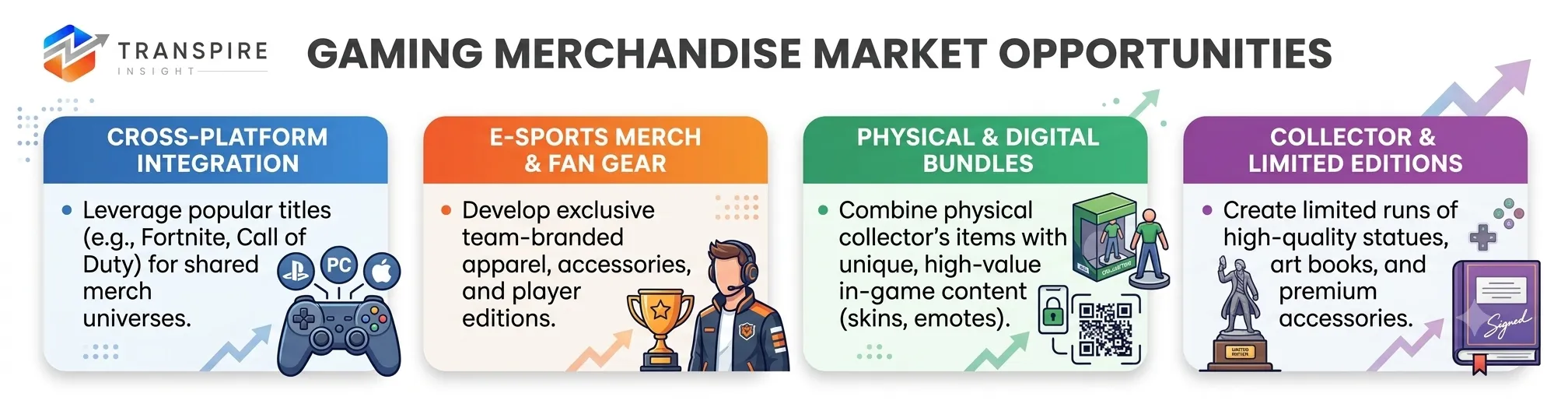
Limited-edition figurines and premium statues tied to franchises like Pokemon and Zelda command strong resale value, driving collector demand and repeat purchases among gaming fans.
Direct-to-Consumer Sales
Game publishers now sell merchandise directly through their own branded online stores, bypassing retail, capturing higher margins, and gathering first-party data on fan purchasing behavior.
AR Virtual Try-On
Augmented reality tools let fans virtually try on licensed apparel before buying, reducing returns while boosting online conversion rates for gaming brands' own digital storefronts.
Mobile-Gaming Merchandise in Emerging Markets
Rising smartphone penetration across India, Southeast Asia, and Latin America is expanding mobile gamer populations, creating fresh demand for affordable branded merchandise tied to titles.
Blind-Box and Mystery Packaging
Blind-box and mystery packaging formats, popularized by brands like Pop Mart, drive impulse purchases and repeat collecting behavior among younger gaming fans seeking surprise-driven merchandise.
List of Top 25 Companies Leading the Gaming Merchandise Market
1. Sony Interactive Entertainment
Dominates physical console memorabilia via official PlayStation Gear storefronts and studio merchandise.
Founded: 1993 | HQ: San Mateo, California, USA.
Why It Ranks: Leverages massive PlayStation brand equity and exclusive IP blockbusters like The Last of Us and God of War.
Regional Dominance: North America and Europe.
Product Line: Apparel, limited-edition statues, collectibles, and gaming lifestyle accessories.
2. Nintendo Co., Ltd.
Operates massive direct-to-consumer official Nintendo Tokyo, Kyoto, and Osaka retail outlets.
Founded: 1889 | HQ: Kyoto, Japan.
Why It Ranks: Commands unequaled, multi-generational physical merchandise demand for world-renowned franchises like Mario, Pokemon, and Zelda.
Regional Dominance: Asia-Pacific and North America.
Product Line: Plush toys, high-end figurines, apparel, household decor, and novelty gifts.
3. Bandai Namco Holdings Inc.
World-renowned pioneer in precision anime-style gaming figures and model kits.
Founded: 2005 | HQ: Tokyo, Japan.
Why It Ranks: Synthesizes massive toy manufacturing infrastructure with dominant gaming intellectual properties like Elden Ring and Tekken.
Regional Dominance: Asia-Pacific.
Product Line: Scale figurines, model kits, capsule toys, and collectible card accessories.
4. Square Enix Holdings Co., Ltd.
Produces premium, hyper-detailed collector figures through its dedicated Play Arts Kai merchandise arm.
Founded: 1975 | HQ: Tokyo, Japan
Why It Ranks: Monetises deeply devoted RPG fanbases with high-end merchandise from Final Fantasy and Kingdom Hearts.
Regional Dominance: Asia-Pacific and North America.
Product Line: Premium action figures, plush toys, jewelry, and orchestral music box physical sets.
5. Hasbro, Inc.
Translates major video game licenses into massive retail toy and board game lines.
Founded: 1923 | HQ: Pawtucket, Rhode Island, USA.
Why It Ranks: Possesses world-class distribution channels and top-tier licensing agreements with premier video game studios.
Regional Dominance: North America.
Product Line: Blaster replicas, action figure series, crossover board games, and roleplay gear.
6. Funko, LLC
Famous for vinyl Pop! figures spanning thousands of licensed video game characters worldwide.
Founded: 1998 | HQ: Everett, Washington, USA.
Why It Ranks: High product velocity and affordable collectibility capture both casual gamers and serious pop-culture collectors.
Regional Dominance: North America and Europe.
Product Line: Stylized vinyl figures, enamel pins, keychains, and Loungefly branded bags.
7. Good Smile Company, Inc.
Renowned globally for chibi-style Nendoroid figures featuring fully interchangeable faces and accessories.
Founded: 2001 | HQ: Tokyo, Japan.
Why It Ranks: Unrivaled craftsmanship and extensive licensing of PC, console, and mobile gaming franchises.
Regional Dominance: Asia-Pacific.
Product Line: Nendoroid figures, POP UP PARADE statues, and scale display figures.
8. Hot Topic, Inc.
Mainstream brick-and-mortar retail hub for trendy video game apparel and pop-culture merchandise.
Founded: 1988 | HQ: City of Industry, California, USA.
Why It Ranks: Captures youth culture through strategic fast-fashion partnerships with indie and AAA game publishers.
Regional Dominance: North America.
Product Line: Graphic tees, hoodies, themed jewelry, bedroom decor, and novelty gifts.
9. JINX (J!NX)
Pioneered authentic, community-focused core gaming lifestyle apparel design in the early digital era.
Founded: 1899 | HQ: San Diego, California, USA.
Why It Ranks: Established long-running exclusive apparel licenses for massive esports, MMO, and competitive gaming titles.
Regional Dominance: North America.
Product Line: Custom outerwear, graphic t-shirts, caps, plushies, and lifestyle bags.
10. Numskull Designs
Creator of the world-famous "TUBBZ" range of cosplaying rubber duck collectibles.
Founded: 2012 | HQ: Attleborough, United Kingdom.
Why It Ranks: Specialises in creative, quirky, high-quality official retro and modern gaming merchandise ranges.
Regional Dominance: Europe.
Product Line: Cosplaying ducks, Christmas jumpers, pin badge sets, and gaming lockers.
Conclusion
The gaming merchandise market has transformed into a critical pillar of modern pop culture and interactive entertainment monetization. Driven by expansive esports communities, iconic franchise loyalties, and seamless direct-to-consumer e-commerce, top companies continue to redefine how fans connect with digital IPs. As physical collectibles, luxury fashion, and digital-physical integrations deepen, the gaming merchandise sector remains positioned for sustainable, high-margin expansion throughout the decade.


Send us a brief description of your challenge and we'll get back to you within 24 hours.

 inquiry@transpireinsight.com
 APAC:+91 7666513636
 Address


