
Sep 03, 2026
By Transpire Insight
Description
According to a research report published by Transpire Insight, the furniture, fixture, and equipment market size is projected to grow from USD 845.25 billion in 2026 to USD 1190.32 billion by 2035, at a CAGR of 5.8% during the forecast period 2027-2035. Rising commercial construction, rapid hospitality industry renovation, widespread adoption of hybrid workplace models, and surging institutional demand for ergonomic, sustainable, and smart IoT-integrated assets are strongly accelerating FF&E market expansion.
Introduction
The Furniture, Fixture, and Equipment (FF&E) market plays a foundational role across corporate, hospitality, healthcare, and educational real estate ecosystems. Comprising movable furniture, custom built-in fixtures, and essential operational equipment, the sector caters heavily to project-based interior fit-outs. Surging urban infrastructure, accelerated property renovations, and heightened emphasis on ergonomic design continue to expand market value. As organizations embrace flexible layouts and sustainable procurement standards, FF&E vendors are integrating advanced 3D visualization, eco-certified materials, and smart technology to capture long-term institutional investment worldwide.
Recent Development News
Stay Ahead of Emerging Opportunities with Expert Market Insights by Transpire Insight
Transpire Insight provides comprehensive, data-driven market intelligence to support smarter business decisions. Our research is rooted in comprehensive analysis, authoritative predictions, and industry expertise, enabling organizations to make informed decisions in rapidly evolving markets. In-depth analysis of market segmentation, competitive positioning, regional trends, and emerging investment opportunities in high-growth areas. We blend accuracy with actionable intelligence, empowering companies to uncover new avenues for growth, bolster strategic decision-making, and stay ahead in a dynamic market.
Furniture, Fixtures, and Equipment Market Size & Statistics
Regional Growth and Demand Analysis by Transpire Insight
North America continues to anchor the FF&E market on the strength of its mature hospitality and corporate real estate sectors. Chain hotel operators are running steady renovation cycles across guest rooms and lobbies to keep pace with rising traveler expectations around comfort and design, while independent and boutique properties are investing in customized fixtures to stand out in a crowded market. At the same time, the return-to-office push among US corporates is fueling demand for ergonomic seating, height-adjustable desks, and acoustic furniture as companies redesign workplaces around collaboration and employee wellbeing. Healthcare providers across the US and Canada are also expanding facility footprints, adding to replacement demand for durable, infection-control-ready furnishings.
Asia Pacific's growth is being driven by rapid urbanization and a construction boom across hospitality, retail, and healthcare infrastructure. China, India, and Southeast Asian markets are seeing a wave of new hotel openings alongside refurbishment of existing chain and independent properties, pushing up demand for furniture, lighting, and casegoods. Rising disposable incomes and the modernization of offices and retail spaces in cities like Shanghai, Bengaluru, and Jakarta are further lifting demand for flexible, technology-integrated FF&E solutions. Expanding hospital networks across the region, particularly in India and China, are adding another layer of sustained demand for functional, easy-to-maintain furniture and fixtures.
Top 15 Trends in the Furniture, Fixture and Equipment Market
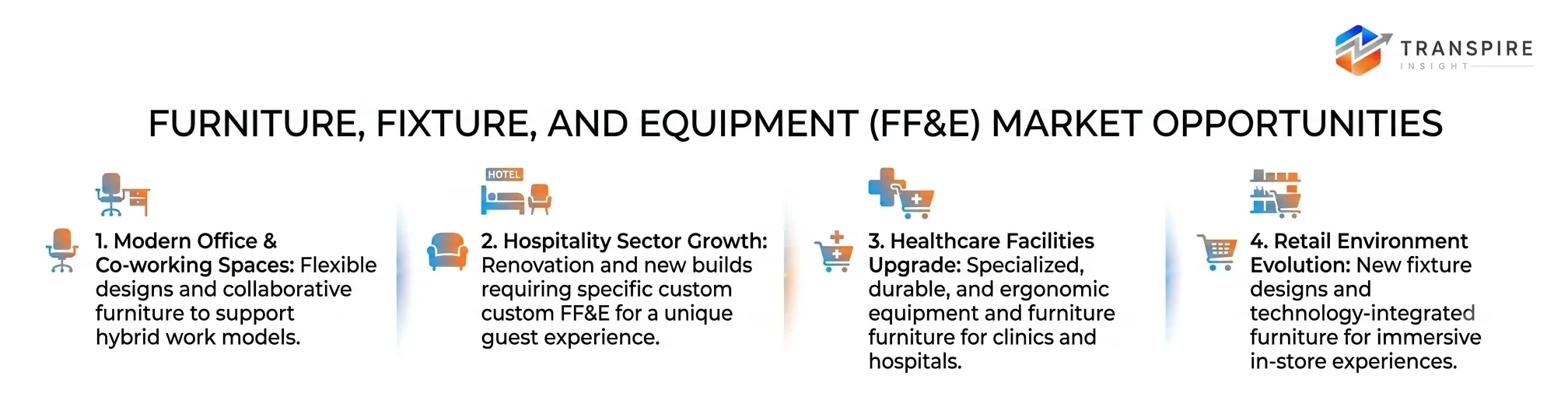
Modular and Flexible Furniture for Hybrid Workspaces
Companies are investing in modular, adaptable furniture that supports collaborative work environments, allowing offices to reconfigure layouts quickly as hybrid work patterns still keep evolving.
Rising Demand for Sustainable, Eco-Friendly Materials
Manufacturers are shifting toward composite, recycled, and low-emission materials, responding to stricter building certifications and growing buyer preference for environmentally responsible furniture and fixtures overall.
Smart, Technology-Integrated Furniture and Equipment Adoption
Smart appliances, sensor-enabled lighting, and energy-efficient kitchen systems are being installed across hotels and offices, improving operational efficiency while enhancing guest and employee comfort daily.
Growth of Boutique and Luxury Hotel Refurbishments
Chain and boutique hotels are accelerating renovation cycles to modernize guest rooms and public areas, driving steady replacement demand for furniture, fixtures, and lighting worldwide.
Increasing Preference for Ergonomic Office Furniture
Corporate offices are prioritizing ergonomic seating, height-adjustable desks, and acoustic furniture as employee wellbeing and productivity become central to workplace design and real estate investment.
Expansion of Healthcare Facility Furniture and Fixtures
Expanding hospital and clinic infrastructure, especially across emerging economies, is fueling demand for durable, easy-to-clean furniture and fixtures designed for infection control and patient comfort.
List of Top 25 Companies Leading the Furniture, Fixture and Equipment Market
1. MillerKnoll
Formed by an iconic merger, creating an influential commercial design pioneer.
Founded: 1923 | HQ: Zeeland, Michigan, USA.
Why It Ranks: Commands extensive corporate contracts through high-end ergonomic design and brand legacy.
Regional Dominance: Dominates North American corporate workplace markets while expanding across Western Europe.
Product Line: Ergonomic seating, architectural walls, modular systems, and premium lounge furnishings.
2. Steelcase
Holds extensive international patents for groundbreaking ergonomic office seating design innovations.
Founded: 1912 | HQ: Grand Rapids, Michigan, USA.
Why It Ranks: Maintains massive market share through extensive corporate research and institutional distribution.
Regional Dominance: Leads North American commercial sectors with strong enterprise penetration in Europe.
Product Line: High-performance task chairs, adaptable desks, collaborative pods, and technology infrastructure.
3. Haworth
Operates as a family-owned leader driving organic commercial workplace innovation.
Founded: 1948 | HQ: Holland, Michigan, USA.
Why It Ranks: Delivers massive customizable workspace infrastructure and sustainable interior commercial furniture solutions.
Regional Dominance: Strong presence across North America, Asia-Pacific, and key European commercial markets.
Product Line: Raised access flooring, moveable walls, systems furniture, and executive seating.
4. HNI Corporation
Manufactures wide-ranging office furniture brands alongside commercial hearth product operations globally.
Founded: 1944 | HQ: Muscatine, Iowa, USA.
Why It Ranks: Captures mid-market commercial segments with highly efficient manufacturing and distribution networks.
Regional Dominance: Dominates North American middle-market enterprise, educational, and government interior sectors.
Product Line: Office desks, filing systems, panel workspaces, and institutional educational furniture.
5. IKEA (Inter IKEA Group)
Operates massive contract furniture arms serving commercial real estate developers.
Founded: 1943 | HQ: Delft, Netherlands.
Why It Ranks: Provides ultra-scalable, affordable modular furniture solutions for commercial and residential sectors.
Regional Dominance: Holds unmatched consumer and commercial market footprint across Europe and Asia.
Product Line: Modular storage units, office desks, hospitality tables, and lighting fixtures.
6. Okamura Corporation
Leads Japanese office furniture engineering through human-centered ergonomic design research methodologies.
Founded: 1945 | HQ: Yokohama, Japan.
Why It Ranks: Sets engineering standards for premium ergonomic seating in Asian commercial spaces.
Regional Dominance: Controls primary market share in Japan and expands rapidly across Asia-Pacific.
Product Line: Ergonomic task seating, partition screens, public space benches, and desks.
7. Kokuyo
Combines Japanese workspace furniture manufacturing with comprehensive commercial interior design services.
Founded: 1905 | HQ: Osaka, Japan
Why It Ranks: Drives Asian commercial workplace modernization with flexible and modular space solutions.
Regional Dominance: Holds dominant position in East Asia and rapidly growing Southeast Asian markets.
Product Line: Workstations, acoustic pods, filing cabinets, and flexible seminar room furniture.
8. Kinnarps
Prioritizes sustainable forestry and eco-certified interior furniture solutions across markets.
Founded: 1942 | HQ: Kinnarp, Sweden.
Why It Ranks: Champions Scandinavian minimalist design combined with eco-friendly corporate procurement standards.
Regional Dominance: Leads commercial workplace furniture market share throughout Northern and Western Europe.
Product Line: Ergonomic workstations, acoustic partition screens, conference tables, and office chairs.
9. Furniture Group
Supplies comprehensive contract furniture solutions tailored for healthcare, education, and business.
Founded: 1966 | HQ: Toronto, Canada.
Why It Ranks: Delivers versatile, cost-effective commercial furniture packages backed by deep distribution channels.
Regional Dominance: Enjoys widespread market coverage across Canadian and American institutional real estate.
Product Line: Healthcare seating, modular office desks, executive tables, and reception counters.
10. Teknion
Focuses on architecturally integrated furniture systems designed for dynamic modern workplaces.
Founded: 1981 | HQ: Toronto, Canada.
Why It Ranks: Excels in sophisticated architectural wall systems and adaptable flexible office layouts.
Regional Dominance: Maintains robust commercial installation base across North America and South Asia.
Product Line: Demountable glass walls, collaborative tables, ergonomic seating, and storage units.
Conclusion
The Furniture, Fixture, and Equipment (FF&E) market is undergoing a structural evolution driven by digital configuration tools, health-conscious materials, and flexible workplace architectures. As commercial real estate and hospitality operators prioritize experiential design and operational efficiency, leading manufacturers are merging sustainable production with smart building technology. Moving forward, long-term market dominance will belong to vendors capable of delivering eco-certified, highly modular, and tech-integrated FF&E packages that seamlessly fulfill stringent architectural specifications while accelerating turnkey project completion across dynamic markets.


Send us a brief description of your challenge and we'll get back to you within 24 hours.

 inquiry@transpireinsight.com
 APAC:+91 7666513636
 Address


