
Sep 11, 2026
By Transpire Insight
Description
According to a research report published by Transpire Insight, the electric two-wheeler market size is projected to grow from USD 5.9 billion in 2026 to USD 10.23 billion by 2035, at a CAGR of 8.47% during the forecast period 2027-2035. Growth is fueled by rapid urban population growth, rising fuel prices, stringent environmental emission standards, a growing charging network, decreasing lithium-ion battery costs, government incentives, and consumer demand for zero-emission daily transportation options.
Introduction
The world of electric two-wheelers is booming, ushering in a new era of sustainable mobility in cities. New significant progress in battery efficiency, electric powertrain performance, and connectivity functions is driving consumer uptake. Older car manufacturers are aggressively expanding their manufacturing capabilities, while EV startups are doing the same. In the wake of worldwide favorable regulatory requirements and an increasing awareness of the environment, electric two-wheelers are slowly but surely moving from their niche status to becoming a major product for commercial mobility.
Recent Development News
Stay Ahead of Emerging Opportunities with Expert Market Insights by Transpire Insight
Transpire Insight provides comprehensive, data-driven market intelligence to support smarter business decisions. Our research is rooted in comprehensive analysis, authoritative predictions, and industry expertise, enabling organizations to make informed decisions in rapidly evolving markets. In-depth analysis of market segmentation, competitive positioning, regional trends, and emerging investment opportunities in high-growth areas. We blend accuracy with actionable intelligence, empowering companies to uncover new avenues for growth, bolster strategic decision-making, and stay ahead in a dynamic market.
Electric Two-wheeler Market Size & Statistics
Regional Growth and Demand Analysis by Transpire Insight
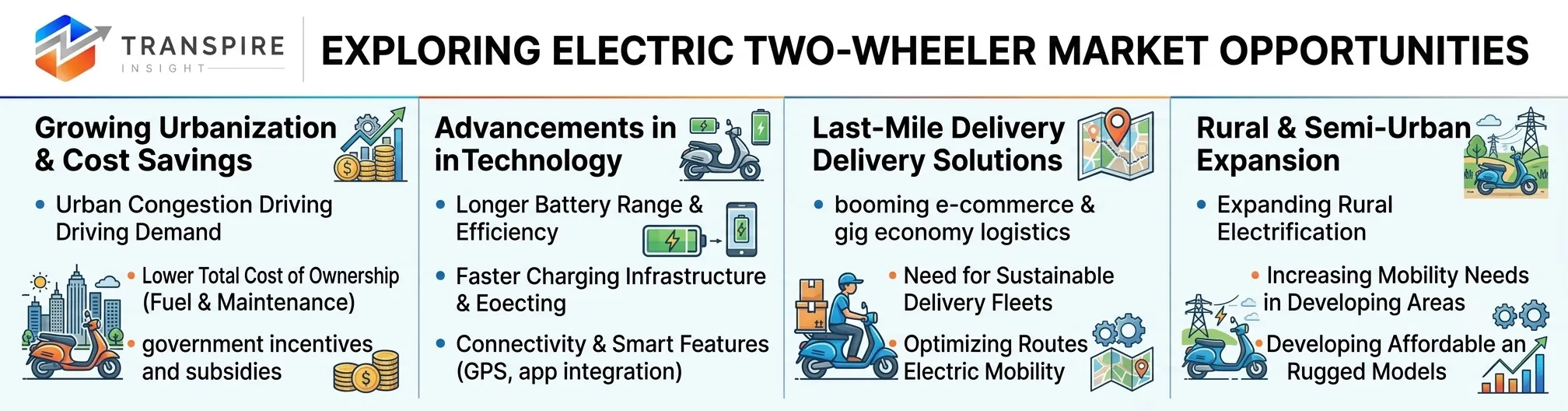
Asia Pacific's dominance is anchored in dense urban populations, rising fuel costs, and aggressive infrastructure build-out led by domestic and regional players. In the same way, companies like Bajaj Auto, Yadea, Ola Electric, and Gogoro have achieved scale by building battery-swapping infrastructure and licensing battery technology to local OEMs. This momentum was demonstrated by a recent collaboration between Indofast Energy and e-Sprinto involving thousands of electric two-wheelers and an expanding network of battery-swap stations that will be available for gig-economy and last-mile delivery riders. New players such as SRIVARU Motors are now launching scooter ranges with LiFePO4 batteries and regenerative braking, too, which is in line with the overall trend of feature-packed, city-friendly electric vehicles in the crowded metros of the region.
The growth in Europe is not as much, but it is faster, driven by regulatory pressures and changing norms in urban mobility. Low-emission zones currently prohibit combustion engine cars in hundreds of cities throughout the EU, incentivising drivers and delivery services to switch to electric vehicles. Policy frameworks are, however, not uniform throughout the bloc, with Italy's ecobonus being in place despite France's national purchase subsidy being discontinued, leading to divergent adoption momentum between neighbouring markets. Meanwhile, Chinese manufacturers are setting up production bases in other nations such as Hungary and seeking to avoid the tariffs in order to step up to premium and mid-range competitors including Piaggio, BMW Motorrad and Yamaha in the area's premium and mid-range markets.
Top 15 Trends in the Electric Two-Wheeler Market
Battery-swapping networks scaling across Indian and Chinese cities
Companies like Indofast Energy and Gogoro are deploying swap stations across dense cities, letting riders exchange depleted batteries instantly, cutting downtime for delivery fleets and daily commuters.
Government-backed EV subsidies and scrappage schemes expanding
State agencies across India, Italy, and the Netherlands are running purchase subsidies and scrappage schemes, though support stays uneven as France recently withdrew its national purchase incentive.
Lithium-ion batteries replacing lead-acid across new models
Manufacturers are shifting new scooter and motorcycle lineups from lead-acid to lithium-ion packs, valued for lighter weight, faster charging, and longer cycle life across daily riding.
Last-mile delivery fleets driving commercial electric adoption
E-commerce growth and gig-economy delivery work are pushing fleet operators like Indofast's commercial partners toward electric scooters, valued for low running costs and easier urban maneuverability.
Chinese OEMs localizing production inside European manufacturing hubs
Chinese brands are building localized manufacturing hubs, including sites in Hungary, to bypass tariffs, shorten supply chains, and compete directly with Piaggio, Yamaha, and BMW Motorrad.
Connected features and smart dashboards becoming standard
Newer models from Ather and SRIVARU increasingly include GPS tracking, smartphone connectivity, and digital dashboards, giving riders navigation, theft protection, and real-time diagnostics as standard equipment.
List of Top 25 Companies Leading the Electric Two-wheeler Market
Pioneer in combining legacy automotive manufacturing excellence with advanced electric scooter technology.
Founded: 1978 | HQ: Chennai, India
Why It Ranks: Dominates mass-market sales through trusted legacy engineering and widespread dealership networks.
Regional Dominance: South Asia and growing footprint in Europe and Africa.
Product Line: TVS iQube series, TVS X.
Legacy manufacturer rapidly expanding its electric portfolio through iconic revived model badges.
Founded: 1945 | HQ: Pune, India.
Why It Ranks: Rapid volume growth leveraging established supply chains and premium metal builds.
Regional Dominance: India, Latin America, Southeast Asia, and Africa.
Product Line: Bajaj Chetak EV series.
Pure-play EV innovator recognized for smart features and connected vehicle software ecosystems.
Founded: 2013 | HQ: Bengaluru, India.
Why It Ranks: Strong brand loyalty built on high-performance scooters and proprietary fast-charging networks.
Regional Dominance: India and expanding into Southeast Asian markets.
Product Line: Ather 450X, 450S, Rizta, Konarc.
World's largest two-wheeler maker scaling electric operations under its dedicated Vida brand.
Founded: 1984 | HQ: New Delhi, India.
Why It Ranks: Massive distribution reach backed by heavy investments in charging tech partnerships.
Regional Dominance: footprint across Asia, Europe, and Latin America.
Product Line: Vida V1 Plus, Vida V1 Pro.
Massive-scale electric vehicle manufacturer operating one of the world's largest automated gigafactories.
Founded: 2017 | HQ: Bengaluru, India.
Why It Ranks: High-volume manufacturing capacity and aggressive market penetration strategies.
Regional Dominance: India and expanding to international export markets.
Product Line: S1 Pro, S1 Air, S1 X series, Roadster series.
giant dominating the world market in total electric two-wheeler unit production.
Founded: 2001 | HQ: Wuxi, China.
Why It Ranks: Unmatched production volume, broad product catalogue, and dominant market share.
Regional Dominance: China, Southeast Asia, Europe, and North America.
Product Line: G5 series, C1S, VF F200, Fierider.
Pioneer in smart, lithium-ion-powered urban mobility devices with app-connected smart features.
Founded: 2014 | HQ: Beijing, China.
Why It Ranks: leader in smart connected scooters with comprehensive IoT system integration.
Regional Dominance: China, Europe, and North America.
Product Line: NQi Series, MQi+ Series, KQi Kickscooters.
Innovator famed for pioneering commercialized battery-swapping ecosystems for urban two-wheel vehicles.
Founded: 2011 | HQ: Taoyuan, Taiwan.
Why It Ranks: Worldwide leader in scalable battery-swap infrastructure technology and modular urban scooters.
Regional Dominance: Taiwan, with expansions in India, Indonesia, and the Philippines.
Product Line: Gogoro SuperSport, 2 Series, Viva Mix, CrossOver.
Automotive titan accelerating transition to electric mobility via mobile swappable battery systems.
Founded: 1948 | HQ: Tokyo, Japan.
Why It Ranks: Unrivaled distribution networks, vehicle reliability, and standardized battery swap systems.
Regional Dominance: presence across Asia, Europe, and the Americas.
Product Line: Honda EM1 e:, Activa E, QC1.
Premium motorcycle brand introducing sophisticated electric concepts and joint battery platforms.
Founded: 1955 | HQ: Iwata, Japan.
Why It Ranks: Deep engineering expertise and strategic industry alliances in battery swapping consortiums.
Regional Dominance: Japan, Europe, Southeast Asia, and North America.
Product Line: Yamaha E-Vino, Neo's, EC06.
Conclusion
The electric two-wheel vehicle industry is evolving into a new category, moving from gaining traction to virtually taking over the personal transportation market. However, key market drivers are continuing to drive the transition towards zero-emission mobility amongst consumers around the world, including the declining cost of batteries, government environmental targets and expanding infrastructure. Electric two-wheelers will continue to be the main power source for sustainable, efficient and intelligent urban mobility in key international markets, confidently supported by disruptive start-ups and existing manufacturers with competitive innovations.


Send us a brief description of your challenge and we'll get back to you within 24 hours.

 inquiry@transpireinsight.com
 APAC:+91 7666513636
 Address


