Global Electric Two-wheeler Market Size & Forecast:
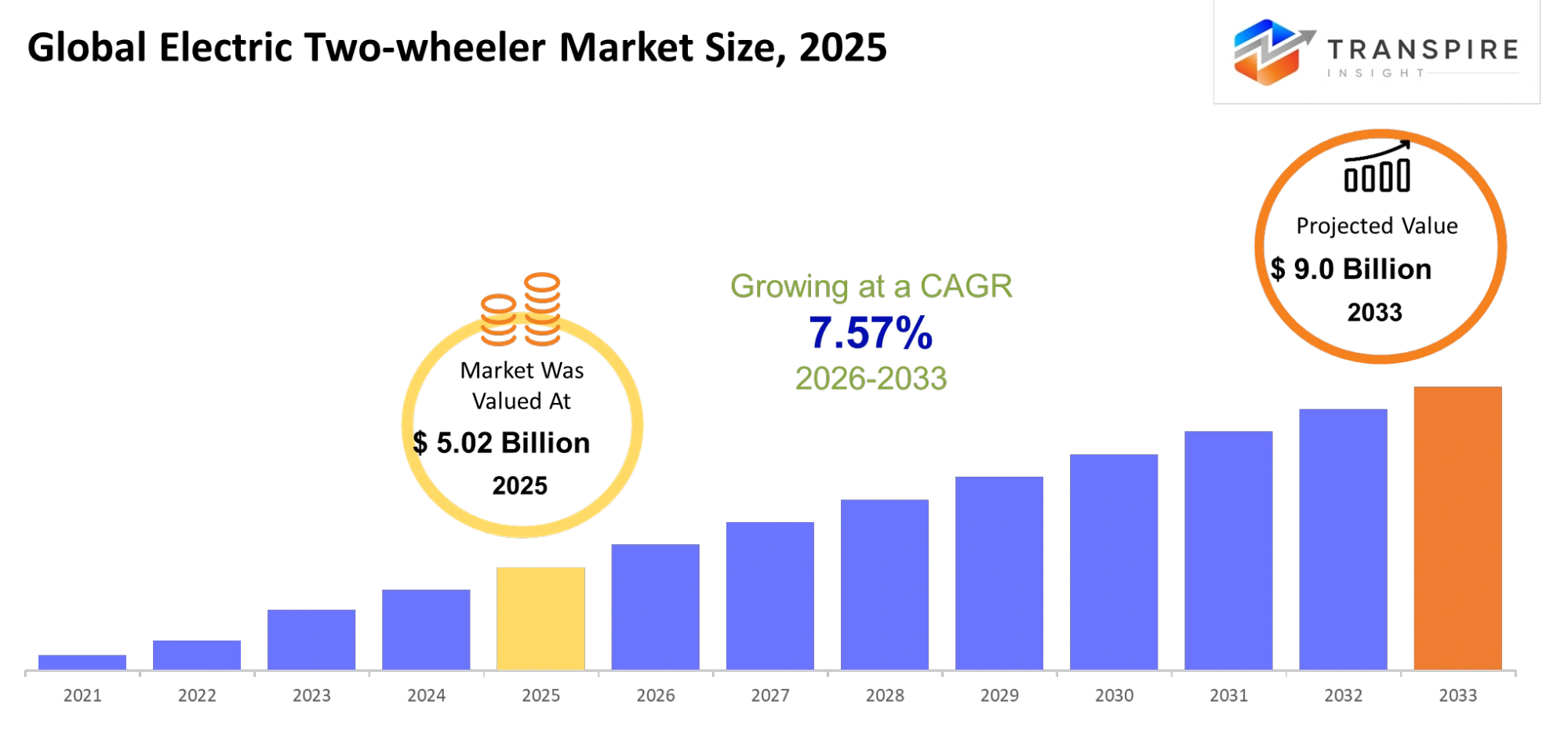
Global Electric Two-wheeler Market Size 2025: USD 5.02 Billion
Global Electric Two-wheeler Market Size 2033: USD 9.0 Billion
Global Electric Two-wheeler Market CAGR: 7.57%
Global Electric Two-wheeler Market Segments: By Vehicle Type (Electric Scooters, Electric Motorcycles), By Battery Type (Lithium-ion Battery, Lead-acid Battery), By Voltage (Below 48V, 48-60V, Above 60V).
To learn more about this report,  Download Free Sample Report
Global Electric Two-wheeler Market Summary:
The Global Electric Two-wheeler Market was valued at USD 5.02 billion in 2025. It is forecast to reach USD 9.0 billion by 2033. That is a CAGR of 7.57% over the period.
Two-wheelers are really the most popular way of getting around in Asia. They're affordable to buy - and it doesn't cost much to keep going. Millions of households in India, China, Vietnam, and Indonesia rely on them every day. The move from petrol to electric in this class is just one of the biggest changes happening with consumers pretty much anywhere.
The numbers are actually in the electric's corner. Fuel savings over a petrol scooter are very real - and immediate. In India, running an electric scooter costs roughly a fifth of what you'd pay for the fuel on a similar petrol model. That difference is really quite persuasive to cost-conscious buyers. It doesn't need a subsidy to make complete sense.
Battery cost is really the number one thing affecting the purchase price. Lithium-ion packs have fallen dramatically in price over the last decade. They haven't stopped dropping either. Each little percentage decrease in battery cost opens up the market even more for electric two-wheelers. More buyers can afford the initial price tag. The whole total cost of ownership argument becomes a lot easier to make.
Government policy has actually really helped along this process. India's FAME II scheme gave subsidies directly to people buying electric two-wheeler scooters. China has had EV support programs running for over ten years now. A few Southeast Asian governments are now setting EV targets that include two-wheelers. Policy isn't the only driving force here, but it's moved markets a lot faster than they would have on their own.
Urban air quality is yet another really big issue. Many Asian cities have quite severe pollution problems. Two-stroke petrol scooters are a major part of the problem. Switching out the two-wheeler fleet to electric really cuts down on emissions right at the source. City governments really do have a direct interest in that result. Some have started setting up zone restrictions on petrol two-wheelers to speed up the shift even further.
What Has the Impact of Artificial Intelligence Been on the Global Electric Two-wheeler Market?
Artificial intelligence is very rapidly changing the Global Electric Two-wheeler Market, reshaping how manufacturers, suppliers, and stakeholders work in an ever more data-driven ecosystem all the time. The incorporation of AI into the global electric two-wheeler market has greatly improved market research and data analysis through the use of machine learning algorithms to process massive amounts of data, find out consumer behaviour patterns, and discover new market trends emerging.
What's more, artificial intelligence in the global electric two-wheeler market really plays a very important part in demand forecasting and production optimisation. AI-powered systems look at historical sales data, weather patterns, changes in fuel prices, and urban traffic patterns to very accurately forecast future demand. This allows manufacturers to adjust their production plans, reduce waste, and improve stock management much better. Smart automation further improves operational efficiency even more by setting up robotic production lines, quality control systems, and live monitoring, ultimately reducing manufacturing costs all while maintaining very high standards.
Furthermore, AI-driven supply chain optimisation is revolutionising logistics and delivery within the global electric two-wheeler market. Intelligent systems really improve route planning, picking suppliers, and inventory tracking, greatly decreasing delays and operational costs. AI also sparks innovation by enabling custom-made products, such as intelligent connectivity features and adaptable performance systems tailored to users' personal preferences.
Key Market Trends & Insights:
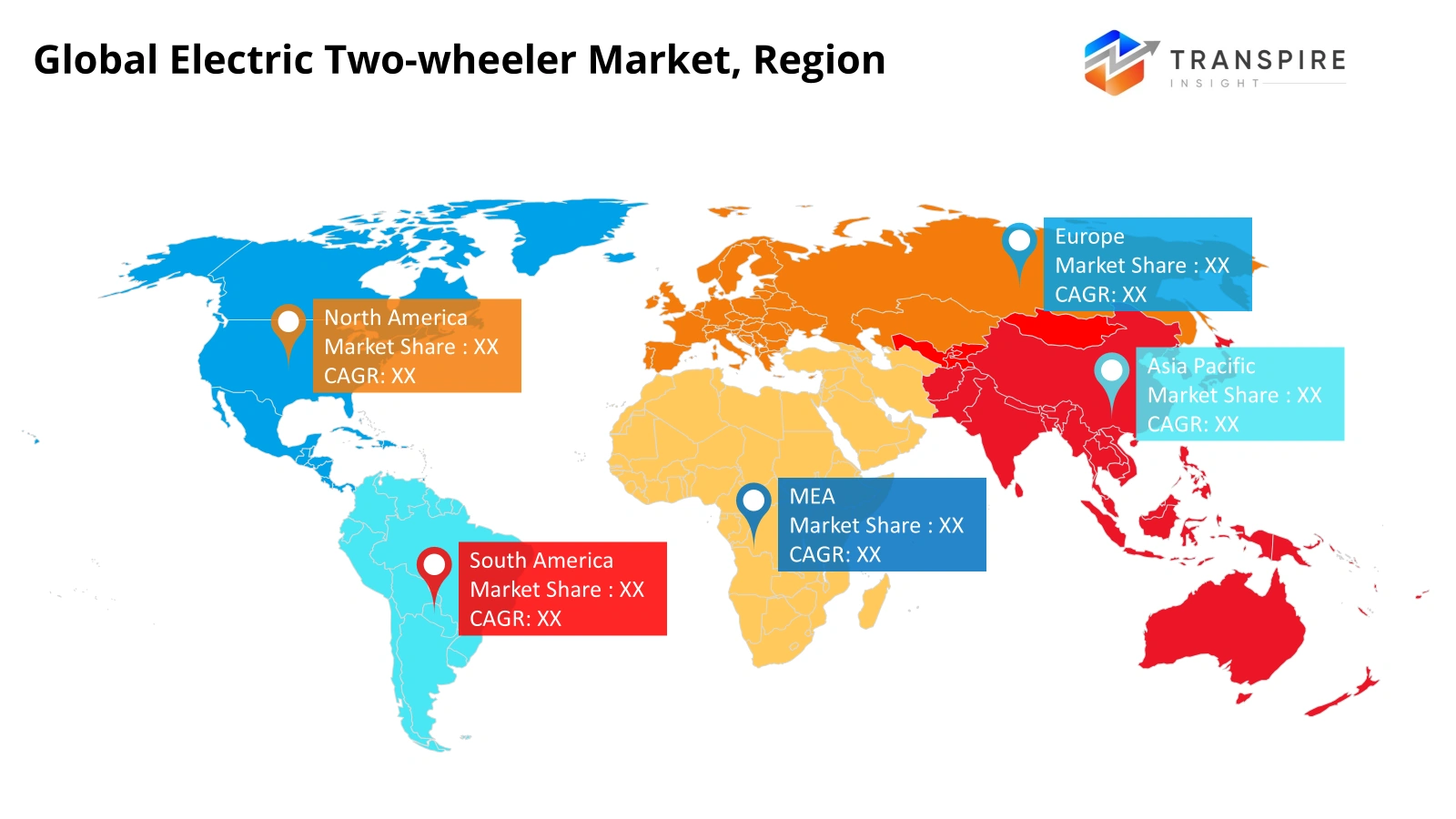
- Asia-Pacific really stands out as the biggest player in the worldwide electric two-wheeler market - it's holding more than 70% market share by 2024 - because of incredibly strong demand in China and India.
- Europe actually represents the fastest-growing region, expected to expand at a compound annual growth rate (CAGR) over 12% during our 2025-2030 forecast period.
- Electric scooters hold the largest share - they make up nearly 55% of the worldwide electric two-wheeler market because they're so affordable and easy to use in urban settings.
- Electric motorcycles represent the second-largest segment - they're gaining traction among consumers who really value performance and also among some high-end buyers.
- Battery-as-a-service (BaaS) is the fastest-growing segment - it's still expected to grow very rapidly by 2030 because of both its cost efficiency and its really convenient charging setup.
- Personal mobility dominates - it holds an approximate 65% share in 2024 - thanks to people's daily commuting needs and rising global fuel prices everywhere.
- Fleet and last-mile delivery applications are growing the fastest - they're being driven by online shopping's rapid expansion and the need for more sustainable logistics solutions all over the place.
- Companies are really focusing on product innovation - they're integrating artificial intelligence into their solutions for the global electric two-wheeler market - including smart connectivity and predictive maintenance techniques.
- Strategic partnerships and regional expansion initiatives enable firms to strengthen their market presence and capture emerging demand wherever it arises.
- Advanced battery technology, machine learning integration, and cost optimization strategies help companies gain a much bigger competitive edge altogether.
Global Electric Two-wheeler Market Segmentation
By Vehicle Type:
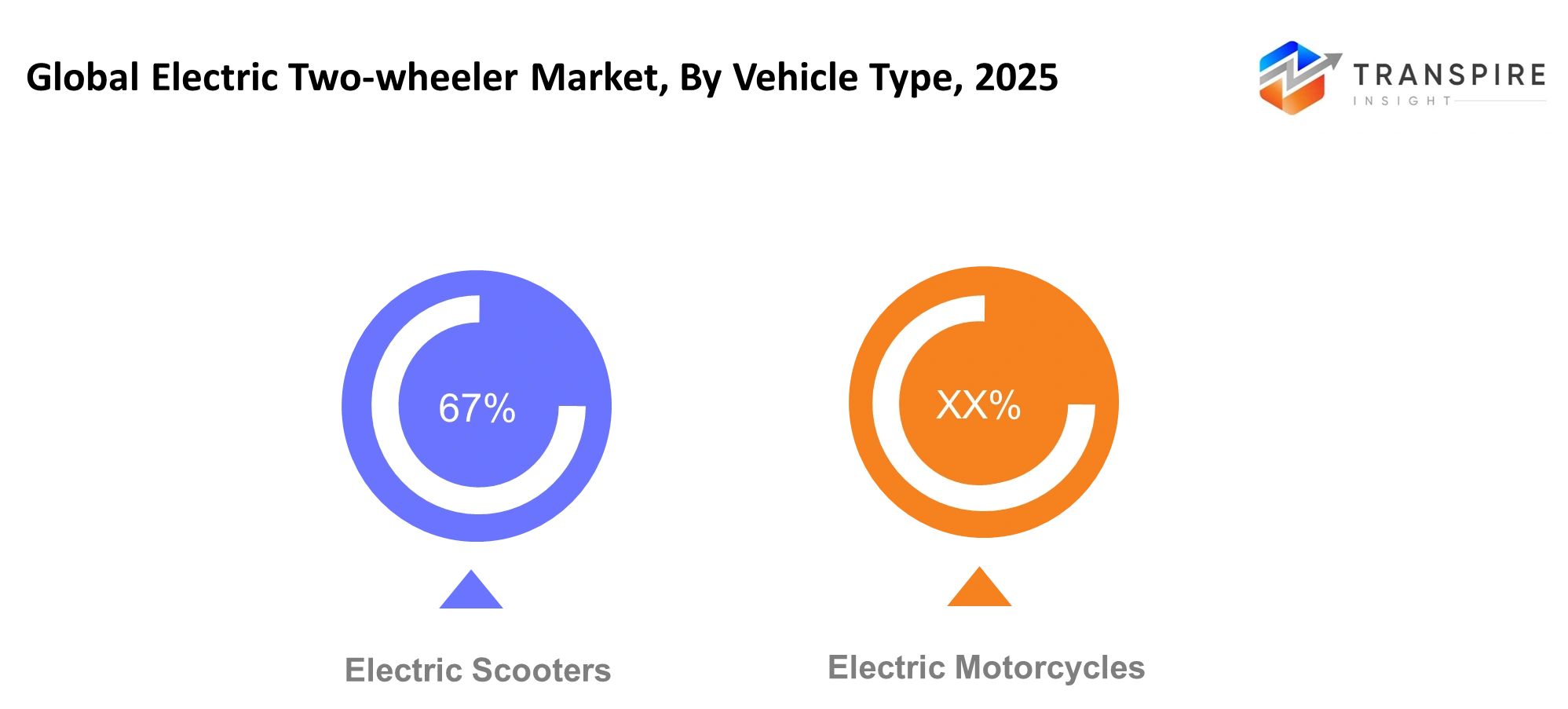
Electric scooters represent the biggest part of the international electric two-wheeler market - approximately 67%. Their huge market share really reflects just how much two-wheeled vehicles are used in real life. Urban commuters in Asia require affordable, simple parking vehicles for short trips of less than 30 kilometers. Electric scooters fit this profile perfectly. They are also relatively easier to manufacture at a low cost than electric motorcycles, which makes a very big difference at scale when it comes to price-sensitive markets.
Electric motorcycles make up the second major vehicle type category. They cater to a completely different type of buyer - commuters and performance enthusiasts who want more range, higher top speeds, and the classic feel of a traditional motorcycle. Brands such as Energica Motor Company target the high-performance end, whereas mass-market players like Bajaj and TVS are developing electric motorcycle platforms that are highly accessible - directly competing with 150cc to 200cc petrol alternatives.
The line of distinction between scooters and motorcycles is getting very blurry in the electric segment. Platforms like Ola's Roadster and TVS's iQube MAX really sit in the middle of these categories in terms of performance. This overlap is creating quite a few new product niches that did not exist at all in the petrol two-wheeler world. Manufacturers that design their product lines across both categories are actually much better placed to serve the entire array of consumer needs in the international electric two-wheeler market.
To learn more about this report, Download Free Sample Report
By Battery Type:
Lithium-ion batteries dominate because of their superior energy density and declining cost. A Lithium-ion batteries really dominate due to their superior energy density - and costs keep going down. A lithium-ion pack gives you even more usable range per kilogram of battery weight compared to lead-acid can ever match. For an electric scooter where range anxiety is a genuine purchase barrier, this actually counts a lot. The cost gap between lithium-ion and lead-acid has narrowed very sharply over the past five years. At our current price levels, lead-acid really holds on mainly in the lowest-cost section of the market.
Lead-acid batteries still keep their share in the super-budget-friendly part of the worldwide electric two-wheeler market. In markets where the lowest possible upfront price is your number one purchase motivator, lead-acid battery scooters really remain relevant. They cost less to manufacture and are much easier to service in markets that don't have a lot of technical infrastructure. Countries in Sub-Saharan Africa, parts of Southeast Asia, and lower-income groups in South Asia continue to absorb lead-acid powered models that larger manufacturers have pulled away from.
Battery-as-a-Service is seriously disrupting both battery sectors. When the battery isn't owned by the customer, its chemistry becomes less important to your purchasing decision. BaaS operators choose your battery based on total cost of fleet operation rather than how affordable it is for consumers. This fundamental shift is gradually decreasing the lead-acid segment's commercial relevance - and also changing how lithium-ion battery economics are calculated in the market.
By Voltage:
Below 48V systems really cater to the entry-level market. These lower-voltage platforms drive extremely lightweight, quite slow scooters meant for some very short city rides. You see them quite often in China's local market, where regulations set out a particular category for low-speed electric two-wheelers - something that doesn't need a motorcycle license. Such a regulatory framework has really created a huge market for below-48V vehicles - something you don't really see in the same way elsewhere.
The 48-60V segment covers most of the mass-market electric scooter category. Almost all very popular urban electric scooters in India and Southeast Asia run in this voltage range. It balances motor performance, battery cost, and charging infrastructure compatibility at price points quite accessible to the mass market itself. The TVS iQube and Bajaj Chetak both operate within this range - and together they account for a very big share of India's monthly electric scooter sales every month.
Above 60V systems power the high-performance end of the world's electric two-wheeler market. Electric motorcycles and top-end electric scooters built for higher speeds and much longer ranges use these systems. As manufacturers keep developing electric platforms to replace 150cc to 250cc petrol motorcycles, the above-60V voltage architecture really becomes the technical foundation. Growth in this voltage segment really tracks closely the growth of the electric motorcycle category - and the expanding appetite for performance-oriented electric two-wheelers itself.
What are the Main Challenges for the Global Electric Two-wheeler Market Growth?
The world-wide electric two-wheeler market has quite a few technical and operational problems holding back its growth path. Battery performance issues - such as limited range, quite long recharging times, and further degradation over time - stay major concerns really affecting product dependability. Furthermore, supply chain disruptions - particularly in sourcing lithium, cobalt, and semiconductors - cause manufacturing roadblocks and cost volatility. These challenges in the world-wide electric two-wheeler market hinder scalability - and also slow down innovation cycles - especially for new manufacturers entering the industry.
Manufacturing and commercialization barriers actually further limit expansion in the world-wide electric two-wheeler market. Very high production costs linked with advanced battery technologies and electronic components put lots of pressure on profit margins. Regulatory compliance, safety standards, and certification requirements vary all over the globe, resulting in delays in product releases and increased operational complexity. What's more, limited economies of scale in some markets really make it difficult for companies to achieve cost competitiveness - posing significant growth barriers indeed.
Adoption challenges really do play a very crucial role in shaping the world-wide electric two-wheeler market. Insufficient charging infrastructure - especially in less developed regions - severely restricts wider usage - and therefore consumer trust. Rather expensive upfront costs compared to traditional vehicles - plus limited knowledge and financing options - further really slow down adoption rates. Also, the lack of highly skilled workers for maintenance and battery management creates long-term service concerns - really highlighting key market limitations.
Greater competition from internal combustion engine vehicles - and also alternative mobility solutions - adds even more pressure. Pricing competition, quite rapid technological advancements, and evolving regulatory policies create a lot of uncertainty, making steady growth in the world-wide electric two-wheeler market even harder indeed.
Regional Insights
Technical and operational hurdles really do continue to hold back fairly steady growth. Battery efficiency is still a major problem due to range limits, charging delays, and overall degradation over its lifetime. Issues with the supply chain - tied to essential materials like lithium and semiconductors - add a lot more uncertainty. Barriers to scalability persist because production systems really struggle with consistency and controlling costs. Regional Insights: Asia-Pacific is really under a lot of pressure with supplies because it relies so heavily on raw materials, while Europe focuses on improving performance standards for batteries.
Manufacturing and commercializing hurdles really create delays in our expansion plans. Very high production costs - caused by super advanced battery systems and lots of electronic integration - make pricing much less flexible. Differences in regulations across different regions make compliance way more complicated and slow down approvals even further. Limited economies of scale in emerging markets really restrict cost advantages and affect our profit margins a lot. Regional Insights: North America really emphasizes regulatory compliance, while emerging economies face manufacturing challenges that are very sensitive to cost and slower industrial adoption rates.
Adoption challenges are still quite significant due to gaps in our infrastructure and affordability concerns. Limitations in our charging networks decrease consumer confidence, especially in rural and semi-urban areas. Very high upfront costs compared to conventional vehicles really limit mass adoption itself. Shortages of skilled workers in maintenance and battery servicing will create long-term operational risks. Regional Insights: Urban regions in Asia actually show much stronger adoption rates, while African and Latin American markets experience slower development of their infrastructure.
To learn more about this report, Download Free Sample Report
Recent Development News
In April 2026, Ola Electric reported strong stock performance. Shares surged 17% amid an improved demand outlook, progress on construction of the gigafactory, and positive sales momentum. https://m.economictimes.com
In April 2026, TVS Motor Company reported a market leadership shift. The company overtook competitors in electric two-wheeler sales, recording 14 lakh units in FY2026, reflecting strong growth momentum. https://brandequity.economictimes.indiatimes.com
Report Metrics
|
Report Metrics |
Details |
|
Market size value in 2025 |
USD 5.02 Billion |
|
Market size value in 2026 |
USD 5.4 Billion |
|
Revenue forecast in 2033 |
USD 9.0 Billion |
|
Growth rate |
CAGR of 7.57% from 2026 to 2033 |
|
Base year |
2025 |
|
Historical data |
2021 - 2024 |
|
Forecast period |
2026 - 2033 |
|
Report coverage |
Revenue forecast, competitive landscape, growth factors, and trends |
|
Regional scope |
United States; Canada; Mexico; United Kingdom; Germany; France; Italy; Spain; Denmark; Sweden; Norway; China; Japan; India; Australia; South Korea; Thailand; Brazil; Argentina; South Africa; Saudi Arabia; United Arab Emirates |
|
Key company profiled |
Yadea Group Holdings Ltd., NIU Technologies, Gogoro Inc., Hero Electric Vehicles Pvt. Ltd., Ather Energy Pvt. Ltd., Ola Electric Mobility Pvt. Ltd., Bajaj Auto Ltd., TVS Motor Company Ltd., Honda Motor Co. Ltd., Yamaha Motor Co. Ltd., Vmoto Limited, Energica Motor Company S.p.A., Piaggio & C. S.p.A., Zhejiang Luyuan Electric Vehicle Co. Ltd., Sunra Electric Vehicle Co. Ltd. |
|
Customization scope |
Free report customization (country, regional & segment scope). Avail customized purchase options to meet your exact research needs. |
|
Report Segmentation |
By Vehicle Type (Electric Scooters, Electric Motorcycles), By Battery Type (Lithium-ion Battery, Lead-acid Battery), By Voltage (Below 48V, 48-60V, Above 60V). |
How Can New Companies Establish a Strong Foothold in the Global Electric Two-wheeler Market?
New companies can establish a strong foothold in the keyword by focusing on niche targeting and identifying underserved segments with clear demand gaps. Instead of competing broadly, startups will benefit from addressing specific industry needs such as healthcare analytics, smart manufacturing systems, or urban infrastructure optimization. This targeted approach aligns with current market growth and evolving industry trends, allowing emerging players to deliver specialized value and gain early traction.
Innovation strategies will play a critical role in differentiating offerings in the keyword. Companies that leverage advanced technologies such as artificial intelligence, automation, or data-driven platforms can create scalable and efficient solutions. For instance, startups similar to Notion in productivity software or UiPath in automation have demonstrated how focused innovation can disrupt established markets. Such examples highlight how technology-led differentiation can position new entrants competitively.
Strategic partnerships are equally important for expansion within the keyword. Collaborating with established enterprises, cloud providers, or regional distributors will help startups reduce operational costs and accelerate market entry. These alliances also provide access to existing customer bases, improving credibility and supporting faster adoption across multiple regions.
Finally, solving real-world pain points will determine long-term success in the keyword. Companies that prioritize user-centric design, cost efficiency, and seamless integration will build stronger customer relationships. By aligning innovation with practical applications and maintaining agility, new entrants can secure a sustainable position and capitalize on emerging opportunities.
Key Global Electric Two-wheeler Market Company Insights
Strong foothold development will depend on niche targeting and clear value positioning. Focus on specific demand areas such as healthcare connectivity, smart manufacturing systems, and urban mobility solutions will create early traction. Market growth opportunities will increase through alignment with industry trends and localized service offerings.
Innovation strategies will drive competitive positioning through adoption of advanced technologies such as artificial intelligence, edge computing, and automation. Technology differentiation will support scalable and efficient solutions tailored to enterprise needs. Emerging players will gain advantage by offering flexible and cost-efficient platforms that address performance and reliability gaps.
Strategic partnerships will support faster expansion and reduce infrastructure costs. Collaboration with telecom operators, cloud providers, and system integrators will improve deployment speed and market access. Regional alliances will strengthen distribution networks and enhance credibility among enterprise clients.
Solving industry-specific challenges will ensure long-term success through customer-focused solutions. Focus on security, scalability, and seamless integration will increase adoption across sectors such as logistics, healthcare, and smart cities. Continuous improvement in service quality will strengthen competitive advantage.
Company List
- Yadea Group Holdings Ltd.
- NIU Technologies
- Gogoro Inc.
- Hero Electric Vehicles Pvt. Ltd.
- Ather Energy Pvt. Ltd.
- Ola Electric Mobility Pvt. Ltd.
- Bajaj Auto Ltd.
- TVS Motor Company Ltd.
- Honda Motor Co. Ltd.
- Yamaha Motor Co. Ltd.
- Vmoto Limited
- Energica Motor Company S.p.A.
- Piaggio & C. S.p.A.
- Zhejiang Luyuan Electric Vehicle Co. Ltd.
- Sunra Electric Vehicle Co. Ltd.
What are the Key Use-Cases Driving the Growth of the Global Electric Two-wheeler Market?
The global electric two-wheeler market is gaining strong momentum due to its widespread use in urban commuting. Rising fuel costs and traffic congestion have increased demand for efficient and low-cost mobility solutions. Electric scooters and bikes offer convenient short-distance travel, making them ideal for daily commuters. This practical use-case continues to drive consistent growth in the global electric two-wheeler market across densely populated cities.
Another key use-case supporting the global electric two-wheeler market is last-mile delivery and logistics. E-commerce platforms and food delivery services are increasingly adopting electric two-wheelers to reduce operational costs and meet sustainability goals. These vehicles provide lower maintenance expenses and improved energy efficiency, helping companies scale delivery operations while reducing carbon emissions.
Shared mobility services also contribute significantly to the expansion of the global electric two-wheeler market. Ride-sharing and rental platforms are integrating electric fleets to offer affordable and eco-friendly transportation options. This trend is particularly strong in urban areas where users prefer flexible mobility without ownership costs, further boosting market adoption.
Additionally, government and enterprise applications are creating new growth opportunities in the global electric two-wheeler market. Public sector initiatives promoting clean energy and corporate fleet electrification programs are accelerating adoption. Continuous innovation in battery technology and smart connectivity will further enhance performance and scalability, supporting long-term market expansion.
Global Electric Two-wheeler Market Report Segmentation
By Vehicle Type
- Electric Scooters
- Electric Motorcycles
By Battery Type
- Lithium-ion Battery
- Lead-acid Battery
By Voltage
- Below 48V
- 48-60V
- Above 60V
By Regional Outlook
- North America
- U.S.
- Canada
- Mexico
- Europe
- UK
- Germany
- France
- Italy
- Spain
- Denmark
- Sweden
- Norway
- Asia Pacific
- Japan
- China
- India
- Australia
- South Korea
- Thailand
- Latin America
- Brazil
- Argentina
- Middle East & Africa
- South Africa
- Saudi Arabia
- UAE
- Kuwait
Frequently Asked Questions
Find quick answers to common questions.
The Global Electric Two-wheeler Market is expected to reach approximately USD 9.0 Billion by 2033.
Key segments include Vehicle Type (Electric Scooters, Electric Motorcycles), Battery Type (Lithium-ion Battery, Lead-acid Battery), and Voltage (Below 48V, 48-60V, Above 60V).
Major players include Yadea Group Holdings Ltd., NIU Technologies, Gogoro Inc., Hero Electric Vehicles Pvt. Ltd., Ather Energy Pvt. Ltd., Ola Electric Mobility Pvt. Ltd., Bajaj Auto Ltd., TVS Motor Company Ltd., Honda Motor Co. Ltd., Yamaha Motor Co. Ltd., Vmoto Limited, Energica Motor Company S.p.A., Piaggio & C. S.p.A., Zhejiang Luyuan Electric Vehicle Co. Ltd., and Sunra Electric Vehicle Co. Ltd.
The Global Electric Two-wheeler Market size is approximately USD 5.02 Billion in 2025.
The Global Electric Two-wheeler Market is expected to grow at a CAGR of 7.57% from 2026 to 2033.
- Yadea Group Holdings Ltd.
- NIU Technologies
- Gogoro Inc.
- Hero Electric Vehicles Pvt. Ltd.
- Ather Energy Pvt. Ltd.
- Ola Electric Mobility Pvt. Ltd.
- Bajaj Auto Ltd.
- TVS Motor Company Ltd.
- Honda Motor Co. Ltd.
- Yamaha Motor Co. Ltd.
- Vmoto Limited
- Energica Motor Company S.p.A.
- Piaggio & C. S.p.A.
- Zhejiang Luyuan Electric Vehicle Co. Ltd.
- Sunra Electric Vehicle Co. Ltd.
Recently Published Reports
-
Dec 2024
ATV & UTV Market
ATV & UTV Market Size, Share & Analysis Report By Type (ATV, and UTV), By Variants (Less Than 400 CC, 400 CC To 800 CC, and More Than 800 CC), and Geography (North America, Europe, Asia-Pacific, Middle East and Africa, South and Central America), 2021 - 2031
-
Jan 2025
Automotive Central Gateway Module Market
Automotive Central Gateway Module Market Size, Share & Analysis Report By Type (Ethernet Central Gateway Module, CAN Central Gateway Module, LIN Central Gateway Module, and FlexRay), By Application (Powertrain Control, Body Control, Infotainment System, Advanced Driver Assistance Systems (ADAS), and Others), By End User (Passenger Vehicles, and Commercial Vehicles), and Geography (North America, Europe, Asia-Pacific, Middle East and Africa, South and Central America), 2021 - 2031
-
Jan 2025
Automotive Engine Oil Filter Market
Automotive Engine Oil Filter Market Size, Share & Analysis Report By Filter Type (Fuel Filter, Engine Oil Filter, Hydraulic Oil Filter, and Others), By Filter Media (Cellulose, Synthetic, and Micro), By Sales Channel (OEMs, and Aftermarket), By Vehicle Type (Passenger Cars, Light Commercial Vehicles, Heavy Duty Trucks, Buses and Coaches, and Off-road Vehicles), and Geography (North America, Europe, Asia-Pacific, Middle East and Africa, South and Central America), 2021 - 2031
-
Jan 2025
Automotive Parts Aluminium Die Casting Market
Automotive Parts Aluminium Die Casting Market Size, Share & Analysis Report By Production Process (Pressure Die Casting, Vacuum Die Casting, Squeeze Die Casting, Gravity Die Casting), By Application (Body Parts, Engine Parts, Transmission Parts, Battery And Related Components, Other Application Types), and Geography (North America, Europe, Asia-Pacific, Middle East and Africa, South and Central America), 2021 - 2031
Our Clients