
Sep 11, 2026
By Transpire Insight
Description
According to a research report published by Transpire Insight, the dry marine scrubber systems market size is projected to grow from USD 1.47 billion in 2026 to USD 2.24 billion by 2035, at a CAGR of 8.39% during the forecast period 2027-2035. Strict IMO MARPOL Annex VI regulations, higher price spreads for HFOs compared to heavy fuel oil, increasing seaborne trade, and the prohibition of wet scrubber discharges are encouraging the adoption of zero-discharge dry fuel are considered key growth drivers.
Introduction
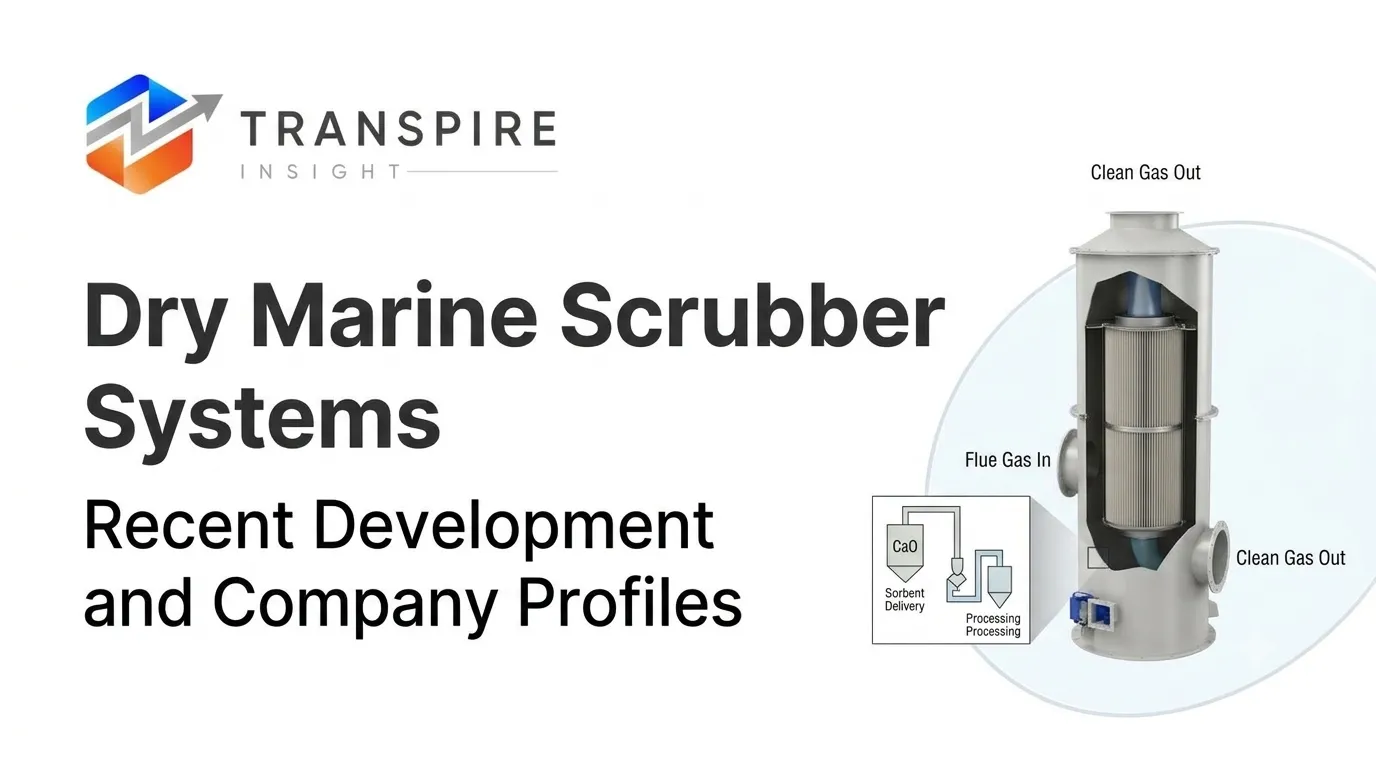
Dry marine scrubber systems are witnessing swift growth all over the world because of the need for commercial fleets to have efficient scrubber systems that do not have any washwater discharge problems. Dry scrubbers effectively neutralize sulfur oxides (SO x ), provide low maintenance, and eliminate marine discharges using solid reactants such as calcium hydroxide. This report examines market drivers, recent regulatory updates, the key companies, product lines, and strategic insights that are impacting the sustainable maritime ecosystem.
Recent Development News
Stay Ahead of Emerging Opportunities with Expert Market Insights by Transpire Insight
Transpire Insight provides comprehensive, data-driven market intelligence to support smarter business decisions. Our research is rooted in comprehensive analysis, authoritative predictions, and industry expertise, enabling organizations to make informed decisions in rapidly evolving markets. In-depth analysis of market segmentation, competitive positioning, regional trends, and emerging investment opportunities in high-growth areas. We blend accuracy with actionable intelligence, empowering companies to uncover new avenues for growth, bolster strategic decision-making, and stay ahead in a dynamic market.
Dry Marine Scrubber Systems Market Size & Statistics
Regional Growth and Demand Analysis by Transpire Insight
North America continues to lead the Dry Marine Scrubber Systems Market, supported by stringent EPA sulfur-emission standards, port-level compliance requirements, and a dense concentration of major shipping operators and engineering service providers. Innovation in compact, energy-efficient scrubber design has been spurred by import tariffs on pumps, fans, corrosion-resistant steel structures, and control systems, as some fleet operators and component suppliers are now making the switch to local manufacturing and regional sourcing. As the region's maritime infrastructure is well-developed with the key trade routes connecting Asia and Europe, and as existing retrofit programmes in the ageing commercial and offshore fleets continue to drive steady demand for dry scrubber installations, demand for these systems remains strong.
The region of Asia Pacific is experiencing the highest regional growth and is seeing a growing capacity to build ships, with Chinese, South Korean and Japanese shipyards incorporating scrubber systems as an integral part of newbuilds, rather than as an afterthought. Increasing port regulations against open-loop scrubber discharge in Singapore and China (among others) are pushing operators to port scrubbers dry and hybrid systems without washwater discharge. In an increasingly regulated China, India and Southeast Asia, plus fast-paced growth in mega ports and maritime trade, many shipowners are now forced to retrofit their aging vessels and implement scalable and compliant exhaust-cleaning solutions in a timely fashion.
Top 15 Trends in the Dry Marine Scrubber Systems Market
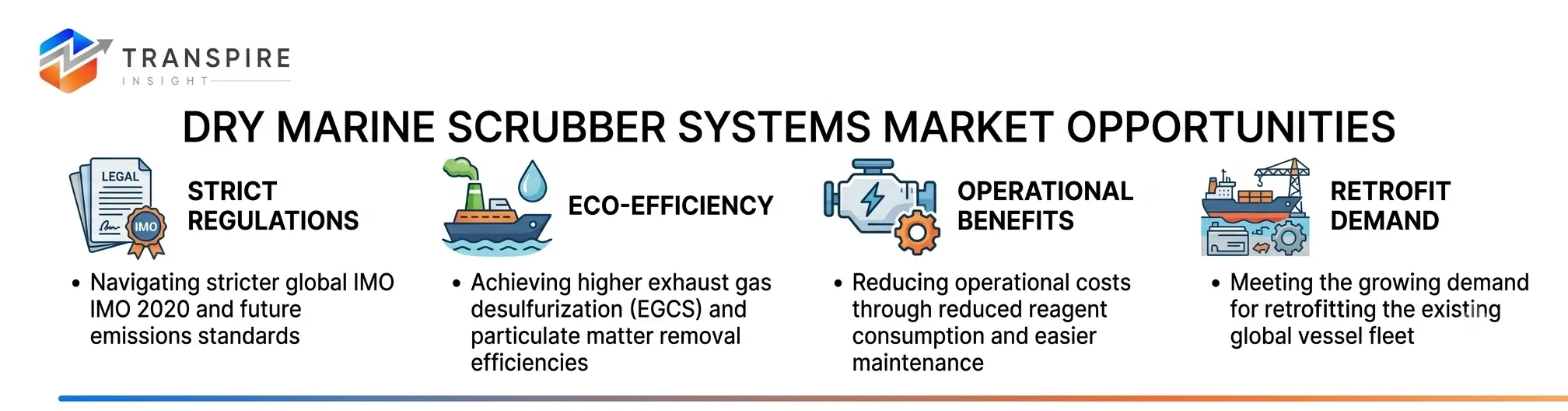
Hybrid scrubber systems are gaining traction as operators seek flexibility to switch between open-loop and closed-loop modes, balancing compliance, cost, and regional discharge restrictions effectively.
Dry scrubbers eliminate washwater discharge, making them attractive where ports enforce strict environmental controls, reducing regulatory risk while avoiding costly onboard water treatment systems.
Tightening sulfur-emission mandates from the IMO and national regulators are pressuring shipowners worldwide to adopt compliant exhaust-cleaning technologies, accelerating dry scrubber installations across commercial fleets.
Rising bans on open-loop scrubber discharge in ports such as Singapore and China are favoring dry systems, which eliminate washwater release and regulatory penalty risk.
Shipbuilders in China, South Korea, and Japan increasingly integrate scrubber systems during vessel construction, embedding emission compliance directly into newbuild designs rather than later retrofits.
Manufacturers are developing carbon-capture-ready scrubber systems that let shipowners meet current sulfur rules while preparing for future carbon-capture and storage integration across existing vessel fleets.
List of Top 25 Companies Leading the Dry Marine Scrubber Systems Market
leader pioneering integrated eco-friendly exhaust treatment solutions for ocean-going vessels.
Founded: 1834 | HQ: Helsinki, Finland.
Why It Ranks: High installation volume and comprehensive maritime decarbonization tech portfolio.
Regional Dominance: Europe and Asia-Pacific.
Product Line: Dry exhaust cleaning, hybrid scrubbers, selective catalytic reduction systems.
Top-tier provider of heat transfer, separation, and advanced marine gas cleaning.
Founded: 1883 | HQ: Lund, Sweden.
Why It Ranks: Dominates European retrofit markets with high-efficiency maritime exhaust treatment systems.
Regional Dominance: Europe and North America.
Product Line: PureSOx systems, dry desulfurization units, gas-absorber technologies.
Specializes in cutting-edge green technologies for reducing ship atmospheric emissions globally.
Founded: 2014 | HQ: Oslo, Norway.
Why It Ranks: Leading market share in Scandinavian green shipping and retrofit scrubber projects.
Regional Dominance: Northern Europe.
Product Line: Dry scrubbers, inline scrubber systems, dual-fuel emissions abatement.
Innovative developer of extremely compact, lightweight cyclone-based marine desulfurization scrubbers.
Founded: 1923 | HQ: Tokyo, Japan.
Why It Ranks: Technological leadership in ultra-compact exhaust systems for limited-space commercial vessels.
Regional Dominance: East Asia and Pacific.
Product Line: Cyclone dry scrubbers, gas analyzers, power electronics control units.
US-based engineering firm delivering custom air pollution control for marine fleets.
Founded: 1917 | HQ: Parsippany, New Jersey, USA.
Why It Ranks: Dominates North American commercial maritime compliance and ship retrofit contracts.
Regional Dominance: North America.
Product Line: Dry exhaust scrubbers, packed tower absorbers, multi-pollutant systems.
Specialized exhaust gas cleaning developer offering versatile multi-stream marine scrubber designs.
Founded: 2006 | HQ: Oslo, Norway.
Why It Ranks: Innovation pioneer in single-unit cleaning for multiple onboard engine exhausts.
Regional Dominance: Europe.
Product Line: Multi-stream dry scrubbers, all-in-one exhaust cleaning architectures.
Prominent combustion engine specialist providing robust marine exhaust gas cleaning plants.
Founded: 1931 | HQ: Bremen, Germany.
Why It Ranks: Superior engineering legacy in high-temperature marine burner and scrubber integrations.
Regional Dominance: Central Europe.
Product Line: CMB dry scrubbers, marine burners, boiler exhaust gas treatment.
Shipowner-led designer crafting pragmatic, operator-friendly marine exhaust gas cleaning units.
Founded: 2014 | HQ: Piikkiö, Finland.
Why It Ranks: Unrivaled practical operational insights built into durable dry/closed-loop systems.
Regional Dominance: Baltic Sea and Northern Europe.
Product Line: Dry scrubber modules, water treatment units, multi-engine exhaust systems.
veteran delivering heavy-duty air pollution control and desulfurization equipment worldwide.
Founded: 1938 | HQ: Farmingdale, New York, USA.
Why It Ranks: Deep industrial expertise extended into highly reliable dry marine scrubbers.
Regional Dominance: Americas and Middle East.
Product Line: Dry chemical scrubbers, baghouse filters, particulate control units.
Major developer of process technologies, automation, and emissions control systems globally.
Founded: 1951 | HQ: Espoo, Finland.
Why It Ranks: Strong integration of automated digital monitoring with marine scrubber hardware.
Regional Dominance: Global.
Product Line: Valmet EGCS, dry desulfurization units, automated emission monitoring.
Conclusion
International shipping is moving towards environmental compliance of zero discharge, which is expected to drive the market growth of dry marine scrubber systems. With no washwater discharge restrictions at port, and high return on investment from the use of high-sulfur fuel spreads, dry desulfurization is an effective and environmentally friendly method. European and Asian engineering firms, among them, are leading the way in continuous advancements of smaller designs and integration of carbon capture, preserving the essential role of dry scrubbers in maritime sustainability worldwide.


Send us a brief description of your challenge and we'll get back to you within 24 hours.

 inquiry@transpireinsight.com
 APAC:+91 7666513636
 Address


