
Sep 28, 2026
By Transpire Insight
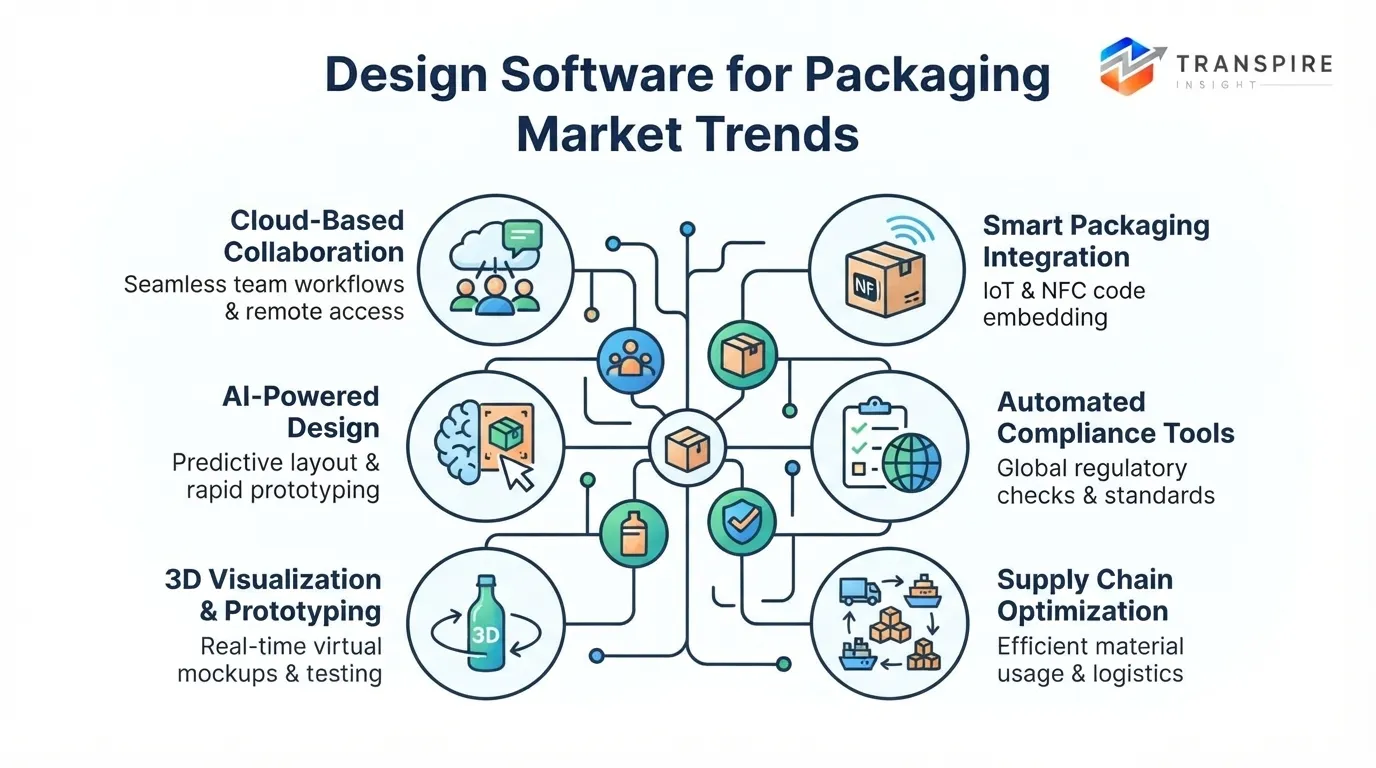
Description
According to a research report published by Transpire Insight, the Design Software for Packaging market size is projected to grow from USD 2.724 billion in 2026 to USD 5.43 billion by 2035, at a CAGR of 10.45% during the forecast period 2027-2035. Rising e-commerce demands, sustainability mandates, rapid prototyping needs, and the integration of AI-driven generative artwork and structural layout optimizations continue to drive packaging design software adoption.
Introduction
The Design Software for Packaging Market enables brand owners, converters, and design agencies to digitize structural engineering, 2D visual artwork, and 3D virtual prototyping. By moving traditional physical sampling to photorealistic digital environments, these platforms reduce prepress errors, cut waste, and accelerate time-to-market across consumer packaged goods (CPG), pharmaceutical, and retail sectors. Modern workflows heavily rely on end-to-end cloud integration, automated CAD dielines, and real-time supply chain simulation.
Recent Development News
February 2026: Comet Software completed the strategic acquisition of specialized structural packaging CAD assets to accelerate its international expansion and integrate end-to-end PLM and ERP platforms.
April 2026: Esko deployed updated agentic generative AI modules across its packaging design software suite to automate dieline layouts, print imposition, and pre-production waste optimization.
Stay Ahead of Emerging Opportunities with Expert Market Insights by Transpire Insight
Transpire Insight provides comprehensive, data-driven market intelligence to support smarter business decisions. Our research is rooted in comprehensive analysis, authoritative predictions, and industry expertise, enabling organizations to make informed decisions in rapidly evolving markets. We provide in-depth analysis of market segmentation, competitive positioning, regional trends, and emerging investment opportunities in high-growth areas. We blend accuracy with actionable intelligence, helping companies uncover new growth avenues, strengthen strategic decision-making, and stay ahead in a dynamic market.
Design Software for Packaging Market Size & Statistics
The Market Size for Design Software for Packaging Was Estimated to be Worth USD 2.724 Billion in 2026.
The Market Size is Going to Expand at a CAGR of 10.45% between 2026 and 2035.
The Design Software for Packaging Market Size is anticipated to reach USD 5.43 Billion by 2035.
North America is projected to drive the highest demand during the forecast period, accounting for 38% of the design software for packaging market.
Asia-Pacific is projected to grow the fastest during the forecast period at a CAGR of 11.2% in the design software for packaging market.
Regional Growth and Demand Analysis by Transpire Insight
North America's lead is anchored by early, deep adoption of AI-driven design tools among established CPG brands and a dense concentration of packaging software vendors. Hybrid Software's rollout of AI-driven enhancements to its Artflow workflow platform, unveiled at Interpack, reflects this push toward automating packaging production and compressing design-to-print cycles. The region's mature consumer goods sector, strong emphasis on brand differentiation, and stringent regulatory standards keep reinforcing its position, even as sustainability rules add new evaluation layers to established design workflows.
Asia-Pacific's outsized growth is driven by rapid industrialization, an expanding e-commerce base, and rising disposable incomes across China, India, and Southeast Asia. Packaging design platform Pacdora's rollout of AI-powered text-to-design capabilities, letting users generate production-ready packaging from simple prompts, shows how vendors are chasing the region's fast-growing base of small and mid-sized brands needing rapid, low-cost design iteration. As regional manufacturers scale direct-to-consumer channels and shift to cloud-based platforms, demand for accessible, AI-assisted design tools is set to keep outpacing more mature markets.
Top 15 Trends in the Design Software for Packaging Market
Generative AI-Powered Creative Concepting
Generative AI models draft multiple packaging concepts from simple prompts, letting designers explore variations quickly and cutting early-stage ideation time across food and beverage brands.
AI-Driven Structural Optimization
AI-driven structural optimization tools simulate packaging strength, material usage, and durability, helping converters reduce waste, cut costs, and shorten costly testing cycles before production begins.
Text-to-Design AI Packaging Generation
Platforms like Pacdora now convert simple text prompts into production-ready packaging mockups, letting brands generate structural designs and artwork concepts without deep specialized design expertise.
Digital Twin Simulation
Digital twin simulation lets teams test packaging performance, shelf appearance, and structural behavior virtually, reducing physical sample runs and helping brands cut prototyping costs significantly.
Rising Demand for Short-Run Customizable Packaging
Brands increasingly favor short-run, customizable packaging over large batch production, using design software to quickly adapt SKUs for regional markets, seasonal campaigns and personalized editions.
Mass Personalization Through AI-Driven Design Automation
AI-driven design automation enables mass personalization at scale, letting brands generate thousands of SKU-level packaging variants automatically while maintaining consistent branding, compliance, and visual standards.
List of Top 25 Companies Leading the Design Software for Packaging Market
Conclusion
The packaging design software market is rapidly evolving into a unified ecosystem of structural CAD, real-time 3D rendering, and AI-driven prepress automation. By streamlining workflows from concept dielines to final manufacturing, these platforms significantly reduce physical prototyping costs and material waste. As sustainability metrics, e-commerce demands, and smart packaging technologies reshape industry expectations, advanced design software remains critical for brand differentiation and supply chain agility.


Send us a brief description of your challenge and we'll get back to you within 24 hours.

 inquiry@transpireinsight.com
 APAC:+91 7666513636
 Address


