
Sep 28, 2026
By Transpire Insight
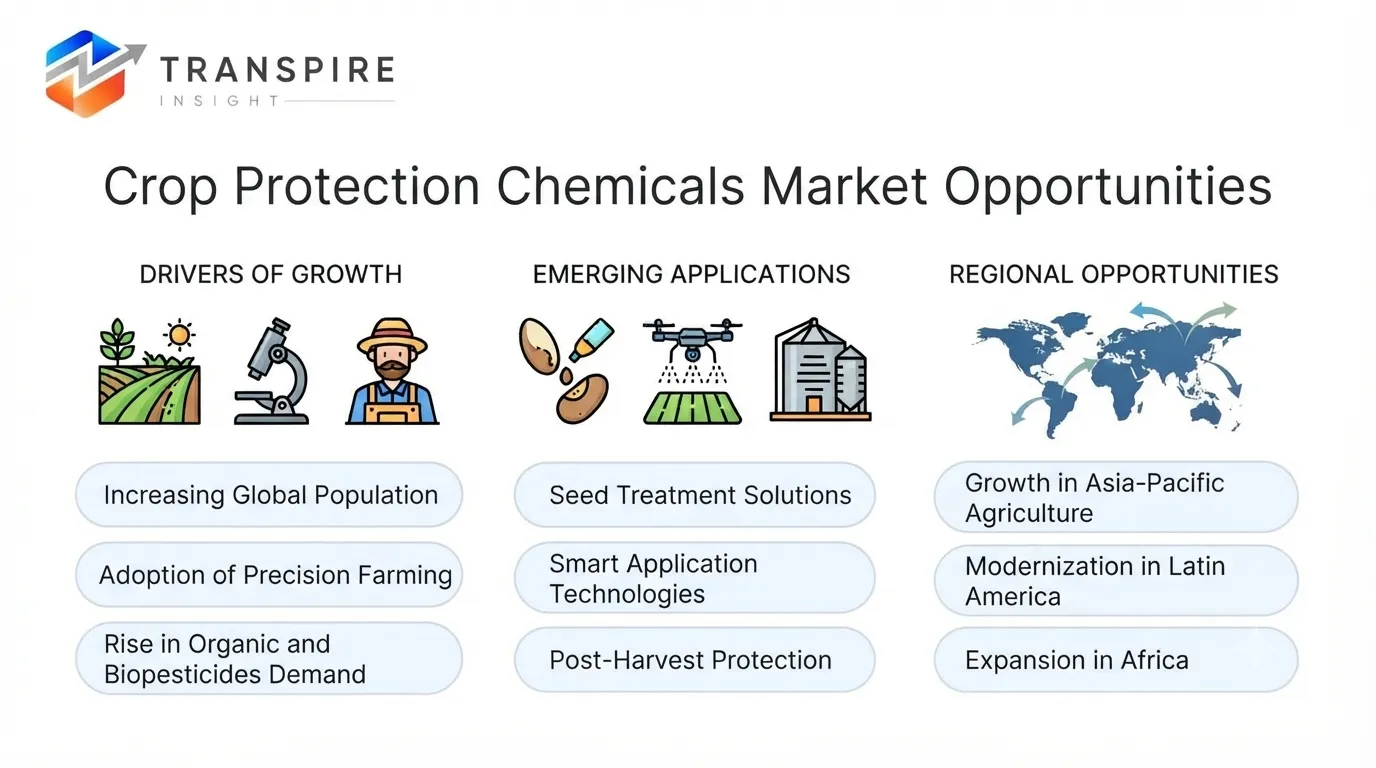
Description
According to a research report published by Transpire Insight, the crop protection chemicals market size is projected to grow from USD 52929.4 billion in 2026 to USD 77009.5 billion by 2035, at a CAGR of 5.58% during the forecast period 2027-2035. Food security demands, shrinking arable land, advancing climate-driven pest threats, and adoption of modern precision agriculture propel crop protection market growth worldwide.
Introduction
The crop protection chemicals market plays a critical role in safeguarding crop yields and securing food production for an expanding population. Encompassing synthetic and biological herbicides, insecticides, and fungicides, this sector addresses growing pressures from climate change, pest resistance, and agricultural land degradation. Continuous innovation in chemical synthesis, eco-friendly formulations, and sustainable integrated pest management solutions drives modern agricultural productivity across diverse regions worldwide.
Recent Development News
May 2026: India's Registration Committee approved 12 advanced combination crop protection formulations to combat complex pest resistance.
June 2026: BASF Agricultural Solutions launched its Melyra fungicide and Inveris Gold insecticide formulations designed to boost productivity.
Stay Ahead of Emerging Opportunities with Expert Market Insights by Transpire Insight
Transpire Insight provides comprehensive, data-driven market intelligence to support smarter business decisions. Our research is rooted in comprehensive analysis, authoritative predictions, and industry expertise, enabling organizations to make informed decisions in rapidly evolving markets. We provide in-depth analysis of market segmentation, competitive positioning, regional trends, and emerging investment opportunities in high-growth areas. We blend accuracy with actionable intelligence, helping companies uncover new growth avenues, strengthen strategic decision-making, and stay ahead in a dynamic market.
Crop Protection Chemicals Market Size & Statistics
The Market Size for Crop Protection Chemicals Was Estimated to be Worth USD 52929.4 Billion in 2026.
The Market Size is Going to Expand at a CAGR of 5.28% between 2026 and 2035.
The Crop Protection Chemicals Market Size is anticipated to reach USD 77009.5 Billion by 2035.
North America is projected to drive the highest demand during the forecast period, accounting for 38.1% of the crop protection chemicals market.
Asia-Pacific is projected to grow the fastest during the forecast period at a CAGR of 4.73% in the crop protection chemicals market.
Regional Growth and Demand Analysis by Transpire Insight
North America's lead rests on the scale of its row-crop farming: herbicides alone generate over 51% of regional revenue, reflecting heavy reliance on chemical weed control across roughly 180 million corn and soybean acres. Innovation is a constant undercurrent — Corteva Agriscience's encapsulated preemergent herbicide for soybean, followed by its multi-mode postemergence herbicides offering extended residual control, illustrate how manufacturers are racing to stay ahead of resistant weed populations. Syngenta's combined fungicide-insecticide seed treatment and FMC's fungicide-technology partnership with Corteva point to a broader push toward integrated, multi-active solutions. Climate change compounds this demand, with pests like the corn earworm migrating northward into previously unaffected farming regions, opening new markets for both conventional and biological products.
Asia-Pacific's rapid ascent is being shaped by land consolidation, growing mechanization, and active government subsidy programs across its major agricultural economies. Product innovation is visible here too: Godrej Agrovet's launch of Ashitaka, a herbicide targeting resistant broadleaf and grassy weeds in maize, shows how regional players are tailoring chemistries to local resistance challenges. Established multinationals continue expanding their fungicide and herbicide portfolios to serve the region's grain- and cereal-heavy cultivation base, while rising biopesticide adoption and precision-agriculture tools further reshape demand as regulators tighten residue and safety standards.
Top 15 Trends in the Crop Protection Chemicals Market
Herbicide resistance in weeds like Palmer amaranth and Conyza is pushing growers toward stacked, multi-site formulations, favoring premium-priced products over traditional single-mode glyphosate-based herbicide treatments.
Biopesticide adoption is expected to expand rapidly, gaining share within origin-based segmentation as farmers reduce synthetic chemical dependence while regulators tighten pesticide residue standards globally.
Precision agriculture tools, including GPS-guided sprayers and variable-rate technology, are enabling more targeted chemical application, reducing waste, cutting costs, and improving overall crop protection efficiency.
Asia-Pacific's crop protection demand is rising fastest, propelled by rapid land consolidation, expanding mechanization, and government subsidies across India, China, and Southeast Asian agricultural economies.
Climate-driven pest migration and shifting weather patterns are expanding insecticide demand, as growers face new pest pressures and resistance requiring more frequent chemical intervention cycles.
Herbicides generate over half of North American revenue, reflecting widespread chemical weed control across corn and soybean acreage, with continued growth expected from resistance management needs.
List of Top 10 Companies Leading the Crop Protection Chemicals Market
leader delivering high-performance crop protection chemicals, seeds, and biological solutions.
Founded: 2000 | HQ: Basel, Switzerland.
Why It Ranks: Top position worldwide due to massive R&D expenditure and scale.
Regional Dominance: Exceptional presence across North America, Europe, Asia-Pacific, and Latin America.
Product Line: Broad spectrum insecticides, selective herbicides, biologicals, and seed treatment products.
Pioneer in synthetic plant protection chemistry and integrated digital agricultural systems.
Founded: 1863 | HQ: Monheim am Rhein, Germany.
Why It Ranks: Strong revenue backed by deep market penetration and innovation.
Regional Dominance: Leading market share across the Americas, Europe, and Asia-Pacific regions.
Product Line: Proprietary herbicides, fungicides, seed protection treatments, and digital farming solutions.
Chemical giant offering highly effective agricultural crop protection and soil management.
Founded: 1865 | HQ: Ludwigshafen, Germany.
Why It Ranks: Outstanding chemical infrastructure and high-value proprietary crop active ingredients.
Regional Dominance: Core dominance in Europe with expansive growth across Latin America.
Product Line: Premium fungicides, broad-spectrum insecticides, weed management formulations, and seed treatments.
Pure-play agricultural leader dedicated to advancing yield performance and farmer profitability.
Founded: 2019 | HQ: Indianapolis, Indiana, USA.
Why It Ranks: Deep market penetration combined with dominant seed and chemical integration.
Regional Dominance: Major presence in North America, Latin America, and European markets.
Product Line: Selective herbicides, targeted insecticides, biological products, and disease management tools.
agrochemical provider focused on sustainable bio-solutions and affordable crop care.
Founded: 1969 | HQ: Mumbai, India.
Why It Ranks: Top five producer with unmatched post-patent active ingredient distribution.
Regional Dominance: Strong footprint across Latin America, India, Europe, and North America.
Product Line: Post-patent herbicides, fungicides, biostimulants, and eco-friendly crop protection inputs.
Specialist in delivering broad-spectrum, high-efficiency, off-patent crop protection products worldwide.
Founded: 1945 | HQ: Airport City, Israel
Why It Ranks: Flexible portfolio model and extensive product registration regulatory capabilities.
Regional Dominance: Substantial market penetration in Europe, Latin America, and Asia-Pacific regions.
Product Line: Post-patent herbicides, fungicides, insecticides, and specialty plant growth regulators.
Japanese chemical leader providing innovative chemical solutions and botanical protection options.
Founded: 1913 | HQ: Tokyo, Japan
Why It Ranks: Proven track record in developing sustainable chemical and biorational solutions.
Regional Dominance: Established control in Asia-Pacific with rising growth in South America.
Product Line: Novel insecticides, biopesticides, post-harvest crop protection, and environmental health products.
Research-driven agricultural company delivering specialized crop protection active ingredients globally.
Founded: 1883 | HQ: Philadelphia, Pennsylvania, USA.
Why It Ranks: Market leader in high-performance synthetic diamide insecticides and patent assets.
Regional Dominance: High market share across North America, Latin America, and Asia.
Product Line: Synthetic insecticides, selective herbicides, plant health products, and biological inputs.
Leading developer and manufacturer of crop protection inputs and seed treatments.
Founded: 1957 | HQ: Melbourne, Australia.
Why It Ranks: Top regional producer expanding off-patent active formulation capacity across continents.
Regional Dominance: Dominates Australasia while maintaining major operations in North America.
Product Line: Phenoxy herbicides, broad-spectrum fungicides, seed treatments, and turf management formulas.
Innovator in highly effective active ingredients for rice, cereals, and vegetables.
Founded: 1949 | HQ: Tokyo, Japan.
Why It Ranks: success driven by its flagship pyroxasulfone herbicide active chemistry.
Regional Dominance: Leading position in Japan, expanding rapidly across the Americas.
Product Line: Selective herbicides, agricultural fungicides, pest control chemicals, and plant regulators.
Conclusion
The crop protection chemicals market remains essential to modern agricultural stability, helping growers address severe pest pressures and land constraints. Led by conglomerates and agile technical manufacturers, the industry is transitioning toward eco-friendly combination chemistries, custom synthesis, and biologicals. As regulatory demands and environmental challenges evolve, continuous active ingredient innovation will remain paramount to achieving sustainable food security worldwide.


Send us a brief description of your challenge and we'll get back to you within 24 hours.

 [email protected]
 APAC:+91 7666513636
 Address


