
Sep 03, 2026
By Transpire Insight
Description
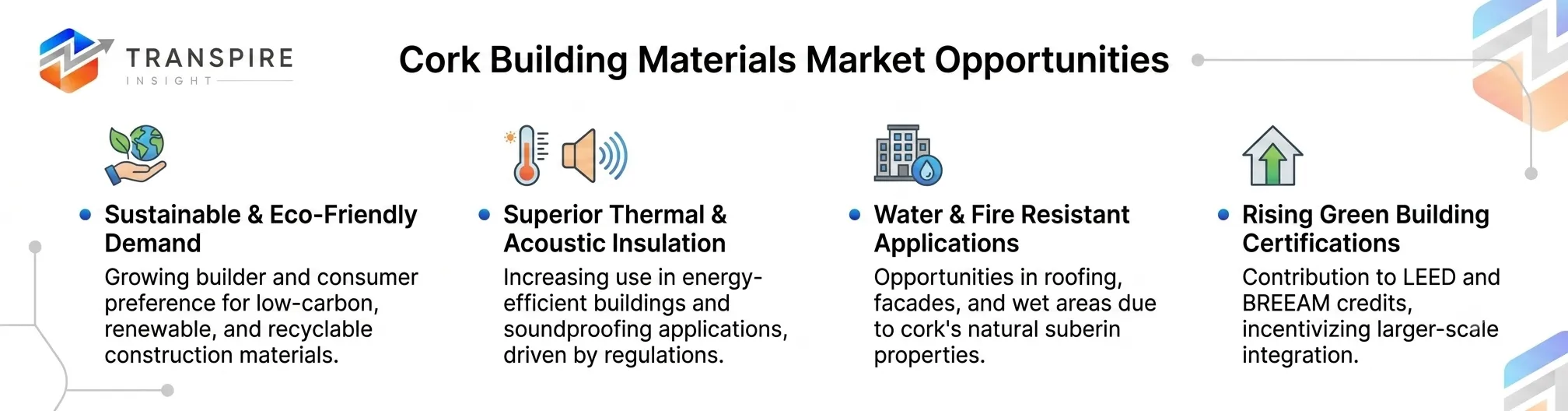
According to a research report published by Transpire Insight, the cork building materials market size is projected to grow from USD 10.08 billion in 2026 to USD 18.19 billion by 2035, at a CAGR of 10.22% during the forecast period 2027-2035. The market is driven by the increasing demand for sustainable and carbon-negative construction. The development of stricter building energy efficiency standards and increased green building certification leads to the faster uptake of green buildings worldwide. In addition, thanks to its excellent thermal insulation properties, acoustic absorption, and resistance to fire, builders are forced to prefer Bio products over synthetic foams.
Introduction
The transition towards eco-friendly buildings and circular construction principles is driving the growth of the cork building materials market. Cork is harvested from the renewable bark of the Quercus suber tree, without felled trees, and provides outstanding bio-based properties, such as high thermal insulation, enhanced sound absorption and dampening, low water absorption, and carbon negativity. International standards on the environment increasingly seem to hold high-carbon synthetic materials accountable, and architects and developers start making cork flooring, acoustic wall panelling, and expanded insulation boards their choices, making cork the basis of contemporary sustainable green building design solutions.
Recent Development News
Stay Ahead of Emerging Opportunities with Expert Market Insights by Transpire Insight
Transpire Insight provides comprehensive, data-driven market intelligence to support smarter business decisions. Our research is rooted in comprehensive analysis, authoritative predictions, and industry expertise, enabling organizations to make informed decisions in rapidly evolving markets. In-depth analysis of market segmentation, competitive positioning, regional trends, and emerging investment opportunities in high-growth areas. We blend accuracy with actionable intelligence, empowering companies to uncover new avenues for growth, bolster strategic decision-making, and stay ahead in a dynamic market.
Cork Building Materials Market Size & Statistics
Regional Growth and Demand Analysis by Transpire Insight
Asia Pacific's dominance rests on China, which alone accounts for close to 42% of the region's cork building materials revenue, driven by massive infrastructure programs and commercial retrofit activity tied to national carbon-reduction goals and green building policy. Manufacturers such as Amorim Cork Solutions have expanded composite and structural cork offerings to serve this pipeline, while India's construction boom, fueled by rising disposable incomes and rapid urban housing development, has pushed the country toward the fastest country-level growth rate within the region. Southeast Asia is emerging as a secondary growth pocket, where coastal infrastructure and marine engineering projects are boosting demand for cork's damping and expansion-control properties. Cork insulation boards have gained particular traction across the region, capturing a leading share of Asia Pacific demand as urban retrofits prioritize thermal efficiency over cheaper synthetic substitutes.
Europe continues to anchor the supply chain, with Portugal and Spain supplying the majority of the world's raw cork even as regional consumption growth trails Asia Pacific. Germany stands out within Europe, registering the region's highest growth rate as its Energy Efficiency Strategy for Buildings pushes developers toward low-carbon insulation materials, directly benefiting cork adoption in renovation projects. North America, meanwhile, is expanding quickly on the back of LEED and WELL certification requirements becoming standard for premium residential and commercial developments, with the United States leading demand through home renovation cycles and commercial green-building retrofits. Companies like Wicanders and Jelinek Cork Group have leaned into this trend, introducing digitally printed and modular cork panel systems aimed at architects seeking both sustainability credentials and design flexibility.
Top 15 Trends in the Cork Building Materials Market
Rising Adoption of Cork Insulation in Green Retrofits
Building owners are retrofitting older structures with cork insulation boards to meet stricter energy codes, cutting heating costs while supporting carbon-neutral renovation goals across regions.
Growing Preference for Natural, Non-Toxic Flooring Materials
Homeowners increasingly favor cork flooring over synthetic alternatives for its non-toxic composition, natural warmth, and ability to maintain healthier indoor air quality over time.
Stricter Energy-Efficiency Codes Boosting Insulation Demand
Germany's Energy Efficiency Strategy for Buildings promotes low-carbon insulation materials that minimize heat loss, directly benefiting cork insulation adoption across residential and commercial renovation projects.
China's Carbon-Reduction Policies Driving Construction Demand
China's government support for sustainable development, including carbon-reduction goals and green building policies, continues to accelerate large-scale infrastructure and commercial retrofit projects using cork materials.
Portugal and Spain Dominate Raw Cork Supply
Europe's cork oak forests, concentrated in Portugal and Spain, continue supplying the majority of natural cork feedstock used globally in flooring, insulation, and wall panels.
Rising LEED and WELL Certification Requirements
Developers pursuing LEED and WELL certifications for high-end residential and commercial projects increasingly specify cork materials, valued for their renewable sourcing and wellness benefits overall.
List of Top 25 Companies Leading the Cork Building Materials Market
1. Corticeira Amorim
It operates as the largest producer and exporter of cork products.
Founded: 1870 | HQ: Mozelos, Portugal.
Why It Ranks: Holds unmatched market share with extensive vertically integrated cork processing capabilities.
Regional Dominance: Europe leads operations while maintaining distribution across over one hundred countries globally.
Product Line: Expanded cork insulation, acoustic underlayments, sustainable wall panels, and premium flooring.
2. Wicanders
Recognized worldwide as a pioneer in ergonomic, eco-friendly cork flooring solutions.
Founded: 1868 | HQ: Mozelos, Portugal.
Why It Ranks: Dominates high-end interior residential design with proprietary cork comfort layer technology.
Regional Dominance: Strong presence across Europe, North America, and growing Asian architectural markets.
Product Line: Acoustic flooring tiles, floating cork floors, glue-down planks, and decorative walls.
3. Granorte
Innovated the incorporation of Microban antimicrobial technology directly into cork flooring.
Founded: 1972 | HQ: Rio Meão, Portugal.
Why It Ranks: Renowned for recycling cork waste into cutting-edge architectural wall coverings.
Regional Dominance: Dominates the European market and exports heavily to North American commercial distributors.
Product Line: 3D wall tiles, acoustic subfloor underlayments, floating planks, and design rolls.
4. Sedacor
Specializes in versatile cork composite materials engineered for diverse building uses.
Founded: 1924 | HQ: São Paio de Oleiros, Portugal.
Why It Ranks: Leading innovator in manufacturing expanded black cork insulation for passive structures.
Regional Dominance: High market share across Southern Europe and expanding Latin American export channels.
Product Line: Expanded cork boards, natural cork rolls, acoustic underlayment sheets, and exterior cladding.
5. Jelinek Cork Group
Maintains one of the oldest active continuous cork manufacturing networks operating worldwide.
Founded: 1855 | HQ: Oakville, Canada.
Why It Ranks: Industry authority in custom cork architectural insulation and specialized eco-friendly building supplies.
Regional Dominance: Maintains strong strategic presence across North America, Europe, and Asia-Pacific regional hubs.
Product Line: Cork mosaic tiles, industrial insulation blocks, acoustic rolls, and decorative wall panels.
6. Manton Cork
Leading North American manufacturer and provider of high-density cork sheets and boards.
Founded: 1921 | HQ: Farmingdale, New York, USA.
Why It Ranks: Is widely trusted by architectural specifiers for reliable acoustic and thermal insulation.
Regional Dominance: Dominates the Eastern United States commercial building and educational institution supply chains.
Product Line: Bulletin board cork, expansion joint fillers, underlayment rolls, and structural cork insulation.
7. Sustainable Materials
A premier distributor focusing exclusively on sustainable, bio-based interior cork building products.
Founded: 2007 | HQ: Boulder, Colorado, USA.
Why It Ranks: Is highly regarded for introducing decorative textured cork wall cladding across America.
Regional Dominance: Maintains strong dominance in North American commercial green building and residential sectors.
Product Line: Textured cork tiles, acoustic wall panels, cork flooring, and soundproof underlayments.
8. iCork Floor
A direct distributor supplying eco-friendly factory-direct cork flooring to residential markets.
Founded: 2004 | HQ: Cancale, Canada.
Why It Ranks: Offers an extensive range of affordable, high-density residential and commercial cork floors.
Regional Dominance: Holds a deep footprint throughout Canadian and North American residential renovation markets.
Product Line: Floating cork floors, glue-down cork tiles, underlayments, and acoustic wall coverings.
9. Green Building Supply
It focuses on non-toxic, zero-VOC natural cork building materials for healthier homes.
Founded: 1991 | HQ: Fairfield, Iowa, USA.
Why It Ranks: A leading specialist retailer for verified chemical-free cork underlayments and resilient surfaces.
Regional Dominance: Exerts strong influence across the United States eco-conscious residential and commercial construction markets.
Product Line: Floating cork planks, soundproof underlayment rolls, natural bio-based adhesives, and surface sealants.
10. Capri Collections
Crafts high-design commercial cork and rubber flooring systems for modern architectural spaces.
Founded: 2006 | HQ: Lancaster, Pennsylvania, USA.
Why It Ranks: A preferred specification choice among interior designers for commercial acoustic cork flooring.
Regional Dominance: Dominates North American commercial healthcare, corporate office space, and educational flooring sectors.
Product Line: Cork rubber tile, acoustic cork planks, decorative wall tiles, and acoustic underlayment.
Conclusion
The cork building materials market is expected to continue to grow globally, driven by new regulations that require the development of carbon-neutral buildings. The properties of being renewable, outstanding acoustic transmission, and excellent thermal resistance have made cork reach the status of a structural material. Cork's extensive range of applications will grow significantly as leading manufacturers focus on digital printing, the development of advanced bio-composites, and spray-applied thermal technology for both residential and commercial applications. Therefore, cork construction products will continue to be a vital part of resilient, energy-efficient, and sustainable construction worldwide until 2035.


Send us a brief description of your challenge and we'll get back to you within 24 hours.

 inquiry@transpireinsight.com
 APAC:+91 7666513636
 Address


