
Oct 22, 2026
By Transpire Insight
Description
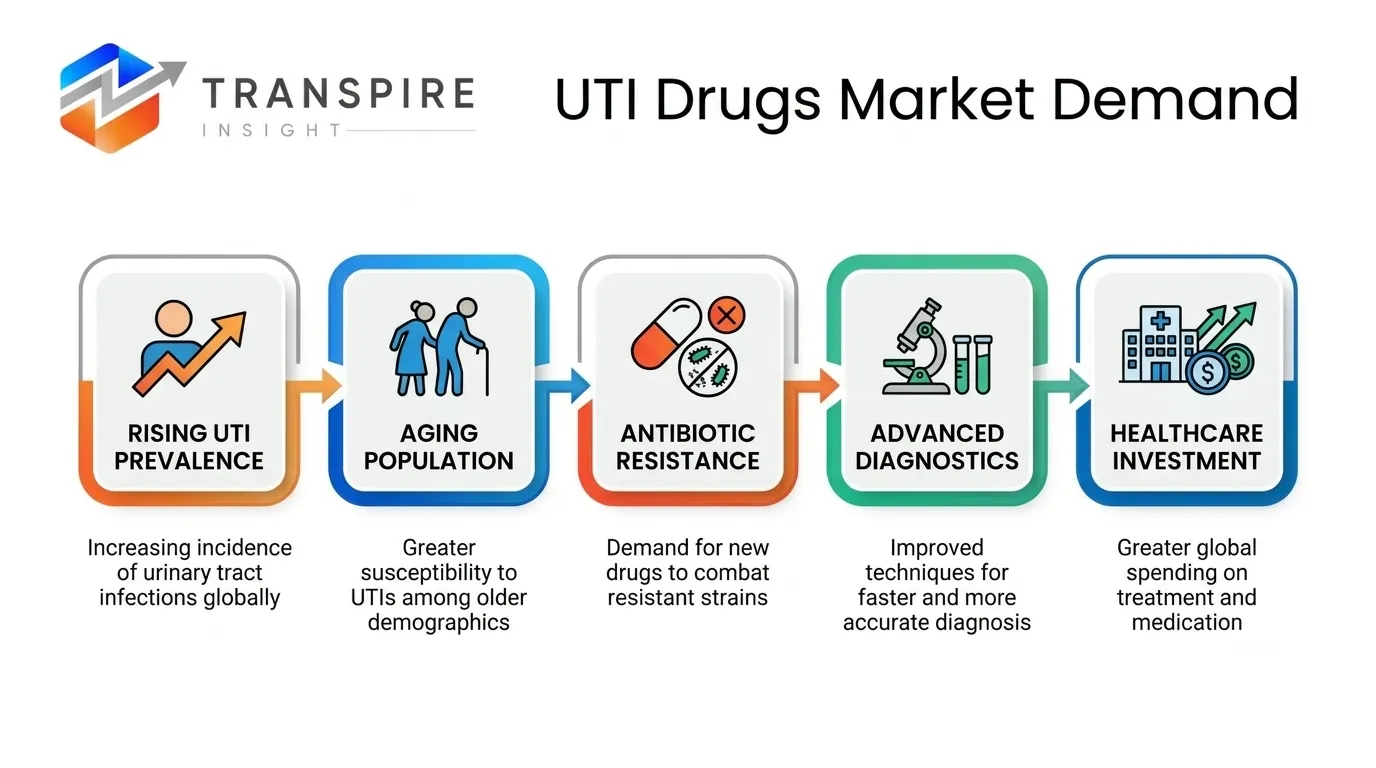
According to a research report published by Transpire Insight, the UTI drugs market size is projected to grow from USD 5.8 billion in 2026 to USD 10.16 billion by 2035, at a 6.35% CAGR during the 2027-2035 forecast period. The prevalence of recurrent UTI, growing geriatric population, growing number of hospitalizations, improved diagnostic tools, and growing bacterial resistance to traditional antibiotics are expected to catalyze the market growth for novel UTI therapeutics.
Introduction
Urinary tract infection (UTI) is one of the most prevalent bacterial disorders worldwide, and the urinary tract infection (UTI) drugs market focuses on treating it. The high rate of recurrence in females, the growing older population, and the increased use of catheterization among hospital patients are fueling continued demand for effective therapeutic options. The healthcare market is making a concerted shift to new-generation, broad-spectrum antibiotics, new non-antibiotic options, and improved targeted formulations, as widespread antimicrobial resistance to traditional antibiotics has become a major concern.
Recent Development News
September 2026: Clinova Solutions introduced its longitudinal telehealth platform to provide targeted at-home bladder instillation therapies for adult patients with recurring and complicated UTIs. This launch is an outpatient care linkage and offers better long-term infection management without frequent clinic visits.
October 2026: Market research showed that the industry had taken a dramatic turn towards non-antibiotic prophylaxis, such as D-mannose formulations, targeted vaccines, and urinary antiseptics. These are developed in response to increasing guidelines for antimicrobial stewardship and are designed to reduce the overuse of antibiotics and reduce recurrence rates worldwide.
Stay Ahead of Emerging Opportunities with Expert Market Insights by Transpire Insight
Transpire Insight provides comprehensive, data-driven market intelligence to support smarter business decisions. Our research is rooted in comprehensive analysis, authoritative predictions, and industry expertise, enabling organizations to make informed decisions in rapidly evolving markets. We provide in-depth analysis of market segmentation, competitive positioning, regional trends, and emerging investment opportunities in high-growth areas. We blend accuracy with actionable intelligence, helping companies uncover new growth avenues, strengthen strategic decision-making, and stay ahead in a dynamic market.
UTI Drugs Market Size & Statistics
The Market Size for UTI Drugs Was Estimated to be Worth USD 5.8 Billion in 2026.
The Market Size is Going to Expand at a CAGR of 6.35% between 2026 and 2035.
The UTI Drugs Market Size is anticipated to reach USD 10.16 Billion by 2035.
North America is projected to drive the highest demand during the forecast period, accounting for 33.6% of the UTI drugs market.
Asia-Pacific is projected to grow the fastest during the forecast period at a CAGR of 11.7% in the UTI drugs market.
Regional Growth and Demand Analysis by Transpire Insight
North America has the biggest regional market for UTI drugs due to its high prevalence of UTI, advanced healthcare infrastructure, and reimbursement policies. The momentum is with recent launches. Orlynvah is the first commercially available oral penem antibiotic in the country and the first new brand to treat uncomplicated UTIs after 25 years. Pfizer and Merck are also investing in next-generation antibiotics and vaccines for resistant strains and in a new class of rapid point-of-care diagnostics and telehealth access to streamline the patient journey from diagnosis to prescription.
Asia-Pacific is projected to see the highest growth as population base, rapid urbanisation, ageing population and increased investments in healthcare services in the region are creating a growth opportunity for the region's market. Asia-Pacific is projected to see the highest growth due to a large population base, rapid urbanisation, an ageing population, and growing investments in healthcare services, expanding access to diagnosis and treatment services in the region. China is the key player in the regional supply side as it controls active pharmaceutical ingredients (APIs) production, such as raw materials like amoxicillin, enabling companies to produce antibiotics for substantially reduced costs. Affordable treatments are available from formulation companies like Sun Pharmaceutical, Cipla, Dr. Reddy's, and Glenmark, and demand for fluoroquinolones and other over-the-counter drugs keeps volumes going.
Top 15 Trends in the UTI Drugs Market
Multidrug-resistant E. coli is steadily weakening older antibiotics, pushing manufacturers to invest in new mechanisms and combination therapies that can reliably treat resistant urinary pathogens.
New oral antibiotics such as Orlynvah and Blujepa give women fresh options for uncomplicated infections, easing reliance on older first-line drugs that are losing effectiveness.
Faster urine testing identifies pathogens and resistance profiles early, letting clinicians prescribe narrow-spectrum antibiotics instead of broad-spectrum drugs, which improves outcomes and slows resistance spread.
Patients with recurrent infections increasingly choose D-mannose, cranberry extracts, and methenamine to cut antibiotic exposure, supporting prevention-focused care and creating new demand beyond antibiotic prescriptions.
Carbapenems remain the last line of defense against multidrug-resistant Gram-negative bacteria; hospitals increasingly rely on them for severe, catheter-associated infections, driving a projected 6.2% CAGR.
Discreet home delivery, round-the-clock ordering, and bundled telemedicine consultations suit busy patients with recurrent infections, helping online pharmacies grow rapidly at a projected 7.9% CAGR.
List of Top 25 Leading Companies in the UTI Drugs Market
1. Pfizer Inc.
Pfizer manufactures broad-spectrum antimicrobials used globally for severe and complicated urological infections.
Founded: 1849 | HQ: New York, USA.
Why It Ranks: High revenue share and extensive distribution network for infectious disease therapies.
Regional Dominance: North America and Europe lead sales, supported by strong institutional commercialization networks.
Product Line: Unasyn, Zithromax, and an expansive generic portfolio of systemic fluoroquinolones.
2. Merck & Co., Inc.
Merck produces advanced antibacterial treatments designed specifically for resistant and hospital-acquired infections.
Founded: 1891 | HQ: Rahway, New Jersey, USA.
Why It Ranks: Comprehensive portfolio of targeted hospital-grade antibiotics targeting complex Gram-negative bacteria.
Regional Dominance: Strong commercial presence in North America, Western Europe, and key Asian markets.
Product Line: Zerbaxa, Primaxin, and specialized carbapenem formulations for complicated UTIs.
3. AbbVie Inc.
AbbVie offers novel combination therapies targeting multi-drug resistant urinary tract and intra-abdominal pathogens.
Founded: 2013 | HQ: North Chicago, Illinois, USA.
Why It Ranks: Strong market share in acute hospital care and specialized anti-infective segments.
Regional Dominance: Dominates North American inpatient demand, expanding throughout European medical institutions.
Product Line: Avycaz, Teflaro, and additional critical-care anti-infective formulations for inpatient care.
4. GlaxoSmithKline plc (GSK)
GSK is a leader in developing targeted antibiotics and preventative bacterial vaccines.
Founded: 2000 | HQ: London, United Kingdom.
Why It Ranks: leader in outpatient primary care infectious disease management and R&D.
Regional Dominance: Strong market footprint across Europe, Latin America, and Asia-Pacific healthcare systems.
Product Line: Augmentin, generic cephalosporins, and pipeline candidates targeting uropathogenic Escherichia coli.
5. AstraZeneca plc
AstraZeneca delivers critical acute-care anti-infectives for severe multidrug-resistant urinary infections worldwide.
Founded: 1999 | HQ: Cambridge, United Kingdom.
Why It Ranks: Strong presence in hospital pharmaceuticals and innovative infectious disease research and development.
Regional Dominance: Major market strength across European, North American, and emerging Asian markets.
Product Line: Zavicefta, Merrem, and various broad-spectrum injectable antimicrobial formulations for hospitals.
6. Bayer AG
Bayer manufactures foundational fluoroquinolone antibiotics widely prescribed for uncomplicated and complicated UTIs.
Founded: 1863 | HQ: Leverkusen, Germany.
Why It Ranks: Long-standing brand reputation and heavy outpatient prescription adoption for urology.
Regional Dominance: Powerful market penetration across Western Europe, Latin America, and North America.
Product Line: Cipro (ciprofloxacin), Avelox, and generic broad-spectrum urinary anti-infective formulations.
7. Sanofi S.A.
Sanofi supplies essential anti-infective medications across retail pharmacies and hospital channels globally.
Founded: 1973 | HQ: Paris, France.
Why It Ranks: manufacturing capacity and dominant distribution channels in emerging pharmaceutical markets.
Regional Dominance: Strong presence in Europe, Africa, Latin America, and South Asia.
Product Line: Targocid, generic nitrofuran treatments, and oral anti-infectives for outpatient care.
8. Novartis AG
Novartis delivers high-volume generic and biosimilar anti-infectives through its specialized divisions worldwide.
Founded: 1996 | HQ: Basel, Switzerland.
Why It Ranks: Industry leadership in accessible, high-volume generic antibiotic production and distribution.
Regional Dominance: Extensive coverage across Europe, North America, and high-growth Asian healthcare markets.
Product Line: Generic amoxicillin-clavulanate, ciprofloxacin, trimethoprim-sulfamethoxazole, and cephalosporins.
9. Viatris Inc.
Viatris supplies critical generic urinary anti-infectives to retail and hospital distribution networks.
Founded: 2020 | HQ: Canonsburg, Pennsylvania, USA.
Why It Ranks: One of the world's largest suppliers of essential generic medications.
Regional Dominance: Massive distribution presence across North America, Europe, and Asia-Pacific markets.
Product Line: Generic nitrofurantoin, sulfamethoxazole-trimethoprim, and ciprofloxacin formulations for urology.
10. Teva Pharmaceutical Industries Ltd.
Teva produces high-volume affordable generic antibiotics essential for primary care UTI treatment.
Founded: 1901 | HQ: Tel Aviv, Israel.
Why It Ranks: Broadest portfolio of generic outpatient oral anti-infectives in urology.
Regional Dominance: Widespread supply footprint across North America, Europe, and Latin America.
Product Line: Generic cephalexin, nitrofurantoin monohydrate, trimethoprim, and fluoroquinolone tablets.
Conclusion
The urinary tract infections market is experiencing a structural shift as there is a rising trend towards taking a more targeted and convenient approach to treating the condition, as well as a growing trend of antimicrobial resistance. Oral carbapenems, combination beta-lactamase inhibitors, and non-antibiotic preventive tools are all fast-tracked research and development efforts for major pharmaceutical companies and biotechs. Together with increased telehealth access and improved diagnostic technologies, the innovations will drive sustainable market growth and improved clinical outcomes across the globe.


Send us a brief description of your challenge and we'll get back to you within 24 hours.

 inquiry@transpireinsight.com
 APAC:+91 7666513636
 Address


