
Oct 26, 2026
By Transpire Insight
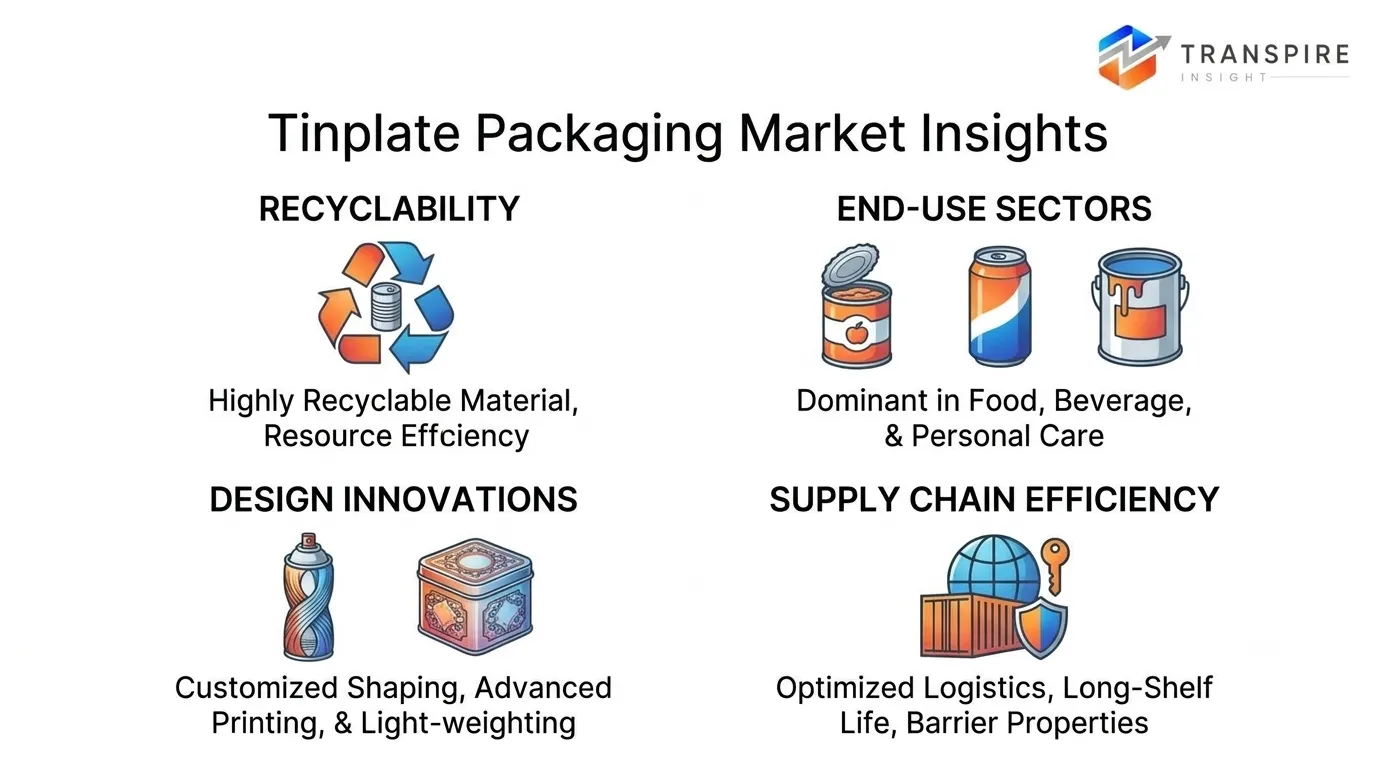
Description
According to a research report published by Transpire Insight, the tinplate packaging market size is projected to grow from USD 3.87 billion in 2026 to USD 5.29 billion by 2035, at a 4.57% CAGR during the 2027-2035 forecast period. Rising demand for eco-friendly, infinitely recyclable packaging materials and expanding processed food and beverage sectors globally drive significant market growth across industrial and consumer applications.
Introduction
The tinplate packaging market plays a pivotal role in protecting and preserving food, beverages, aerosols, and industrial chemicals. Valued for its structural integrity, high thermal tolerance, light barrier properties, and infinite recyclability, tinplate remains a preferred substrate over single-use plastics. As consumer preferences shift toward sustainable, long-shelf-life packaging, manufacturers continue innovating to offer lightweight, corrosion-resistant, and aesthetically decorated tinplate containers.
Recent Development News
March 2026: U.S. Steel upgraded its tinplate coating lines to bolster supply capabilities for canned goods and preserved food packaging applications.
May 2026: The METPACK Innovation Awards recognized major technological advances in metal packaging, including eco-friendly exterior coatings and automated quality control systems.
Stay Ahead of Emerging Opportunities with Expert Market Insights by Transpire Insight
Transpire Insight provides comprehensive, data-driven market intelligence to support smarter business decisions. Our research is rooted in comprehensive analysis, authoritative predictions, and industry expertise, enabling organizations to make informed decisions in rapidly evolving markets. We provide in-depth analysis of market segmentation, competitive positioning, regional trends, and emerging investment opportunities in high-growth areas. We blend accuracy with actionable intelligence, helping companies uncover new growth avenues, strengthen strategic decision-making, and stay ahead in a dynamic market.
Tinplate Packaging Market Size & Statistics
The Market Size for Tinplate Packaging and Safety Was Estimated to be Worth USD 3.87 Billion in 2026.
The Market Size is Going to Expand at a CAGR of 4.57% between 2026 and 2035.
The Tinplate Packaging Market Size is anticipated to reach USD 5.29 Billion by 2035.
Asia-Pacific is projected to drive the highest demand during the forecast period, accounting for 63.33% of the tinplate packaging market.
North America is projected to grow the fastest during the forecast period at a CAGR of 8.23% in the tinplate packaging market.
Regional Growth and Demand Analysis by Transpire Insight
Asia Pacific leads on the back of dense can-making capacity in China, Japan, Indonesia and India, where growing urban populations are consuming more packaged food, beverages, personal care products and household goods. Government pressure to reduce plastic use is also nudging brand owners toward recyclable tinplate. Capacity additions reflect this pull: Rizhao Yulan New Material opened a RMB 3.3 billion mill near the port of Qingdao, aiming to lead packaging steel production, while China Baowu Steel Group received approval to acquire metal packaging major CPMC Holdings, tying steel supply closer to canning demand. In India, Tata Steel partnered with its subsidiary Tinplate Company of India to recycle used tin cans, reinforcing tinplate’s circular credentials with domestic food and beverage buyers.
North America is the fastest-growing region as rising demand for preserved food and a large base of food and beverage companies in the United States and Canada keep canned volumes firm. New coatings and surface treatments are improving the durability and efficiency of tinplate, while sustainability goals push brands toward a recyclable steel pack over plastic. Consolidation and local investment underline the momentum. Sonoco acquired Swiss metal packaging manufacturer Eviosys for about USD 3.8 billion to build a larger metal packaging platform, and it set up a Metal Packaging Technical & Engineering Center in Columbus, Ohio, to bring can makers and brand owners closer on design and technical support.
Top 15 Trends in the Tinplate Packaging Market
Brands are switching from plastic to tinplate because steel is endlessly recyclable, helping companies meet sustainability targets and respond to tightening single-use plastic regulations.
Manufacturers are adopting thinner tinplate gauges below 0.15 mm, cutting steel use and lowering transport costs while retaining strength for snack and confectionery food cans.
Aerosol cans are a high-growth application, as personal care, household cleaning and paint products rely on tinplate’s strong pressure resistance, corrosion protection and printable surface.
Brands increasingly specify BPA-free lacquers on tinplate, protecting food flavor, extending shelf life and easing consumer health concerns without sacrificing the metal’s strong barrier performance.
Collection and recycling programs for tin cans, such as Tata Steel’s tie-up with Tinplate Company of India, strengthen tinplate’s circular credentials and secure recovered steel.
AI-enabled monitoring predicts component wear, inspects can quality in real time, and optimizes material flow, raising accuracy and uniformity in can-making while reducing labor costs.
List of Top 25 Companies Leading the Tinplate Packaging Market
1. Crown Holdings
World leader in metal packaging, producing billions of beverage and food cans annually.
Founded: 1892 | HQ: Tampa, Florida, USA.
Why It Ranks: Exceptional presence, extensive product innovation, and strong sustainability initiatives across continents.
Regional Dominance: Strong market share across North America, Europe, Asia-Pacific, and Latin America.
Product Line: Food cans, beverage cans, aerosol packaging, metal closures, and promotional tins.
2. Ball Corporation
Premier supplier of sustainable aluminum and metal packaging solutions worldwide.
Founded: 1880 | HQ: Westminster, Colorado, USA.
Why It Ranks: Unmatched supply network, high technical innovation, and circular economic scale.
Regional Dominance: Dominates key regional packaging markets throughout North America, Europe, and South America.
Product Line: Aluminum and tinplate cans, aerosol containers, regional beverage packaging, and closures.
3. Trivium Packaging
leader formed via merger of Ardagh Metal Packaging and Exal Corporation.
Founded: 2019 | HQ: Schiphol, Netherlands.
Why It Ranks: Market leader in infinitely recyclable metal packaging with award-winning design capabilities.
Regional Dominance: Maintains extensive customer distribution networks across European and North American consumer markets.
Product Line: Seafood cans, nutrition tins, aerosol cans, specialty metal tins, and closures.
4. Silgan Containers
Largest provider of metal food packaging containers across the North American region.
Founded: 1987 | HQ: Stamford, Connecticut, USA.
Why It Ranks: Long-term supply contracts with major consumer goods companies and huge production scale.
Regional Dominance: Holds dominant supply positions across the North American food and container markets.
Product Line: Steel and tinplate food containers, general line cans, and plastic closures.
5. Ardagh Group
Major international producer of sustainable, infinitely recyclable metal and glass packaging.
Founded: 1932 | HQ: Luxembourg City, Luxembourg.
Why It Ranks: Mass production capacity, extensive operational footprint, and leading sustainability standard implementations.
Regional Dominance: Operates strong packaging production footprints across European and North American industrial hubs.
Product Line: Food tins, beverage cans, custom metal containers, and specialty engineered closures.
6. Toyo Seikan Group
Japan's largest packaging manufacturer operating advanced metal processing and canning facilities.
Founded: 1917 | HQ: Tokyo, Japan.
Why It Ranks: Deep technological innovation, advanced coating technologies, and dominance in Asian markets.
Regional Dominance: Commands primary market presence across Japan and major Asia-Pacific commercial sectors.
Product Line: Tinplate food cans, beverage containers, general line industrial packaging, and machinery.
7. Eviosys
European leader in smart, sustainable metal packaging solutions for consumer goods.
Founded: 2021 | HQ: Zug, Switzerland.
Why It Ranks: High commitment to zero-carbon packaging, premium decoration capabilities, and localized service.
Regional Dominance: Operates extensive manufacturing networks across European, Middle Eastern, and African markets.
Product Line: Preserved food cans, decorative tins, aerosol cans, and easy-open metal ends.
8. Can-Pack S.A.
Rapidly growing manufacturer specializing in high-quality metal packaging products.
Founded: 1992 | HQ: Krakow, Poland.
Why It Ranks: Modern production facilities, footprint expansion, and flexible manufacturing capabilities.
Regional Dominance: Captures major supply shares across Central, Eastern, and Western European markets.
Product Line: Food cans, beverage cans, general line tins, and custom decorative packaging.
9. CPMC Holdings
Major state-backed Chinese metal packaging enterprise delivering comprehensive packaging solutions.
Founded: 1997 | HQ: Hangzhou, China.
Why It Ranks: Dominant domestic Chinese market share and huge output across multiple container formats.
Regional Dominance: Dominates domestic Chinese metal packaging supply while expanding exports into East Asia.
Product Line: Three-piece tinplate cans, aerosol cans, steel barrels, and decorative tins.
10. Massilly Group
Family-owned international producer specializing in metal packaging and easy-open closures.
Founded: 1911 | HQ: Cluny, France
Why It Ranks: network of manufacturing sites, strong customer relationships, and flexible production.
Regional Dominance: Maintains significant presence across Western Europe, North America, and African regions.
Product Line: Food tins, twist caps, industrial tinplate containers, and decorative metal boxes.
Conclusion
The tinplate packaging market continues its steady expansion, propelled by structural shifts toward circular economies, strict plastic regulations, and increasing demand for shelf-stable food products. Leading manufacturers are capitalizing on advanced coating, lightweighting, and high-definition lithography technologies to deliver durable, sustainable containers. As sustainability mandates intensify, tinplate remains a foundational substrate, ensuring safe, recyclable, and efficient packaging across diverse food, beverage, and industrial applications.


Send us a brief description of your challenge and we'll get back to you within 24 hours.

 inquiry@transpireinsight.com
 APAC:+91 7666513636
 Address


