
Oct 29, 2026
By Transpire Insight
Description
According to a research report published by Transpire Insight, the telecom tower power system market size is projected to grow from USD 6.65 billion in 2026 to USD 12.34 billion by 2035, at a 10.24% CAGR during the 2027-2035 forecast period. Accelerated 5G densification, surging mobile data traffic, expanding off-grid telecom towers, and rapid deployment of energy-efficient hybrid solar-lithium battery power systems worldwide propel overall market growth.
Introduction
The Telecom Tower Power System Market provides critical electrical infrastructure to maintain uninterrupted wireless network connectivity across macro towers, small cells, and remote off-grid sites. As telecom operators expand 5G coverage and transition toward sustainable operations, advanced DC power architectures, intelligent rectifiers, high-capacity energy storage, and renewable hybrid systems have become mandatory. These innovations ensure network reliability, reduce operating costs, and minimize carbon footprints significantly.
Recent Development News
March 2026: Huawei received Frost & Sullivan's Best Practices Award for its innovative Virtual Power Plant (VPP) telecom power solution, converting backup batteries into grid-balancing revenue assets.
July 2026: Vietnam deployed over 11,000 new 5G base stations, driving massive regional adoption of high-efficiency DC power systems and smart battery backup infrastructure.
Stay Ahead of Emerging Opportunities with Expert Market Insights by Transpire Insight
Transpire Insight provides comprehensive, data-driven market intelligence to support smarter business decisions. Our research is rooted in comprehensive analysis, authoritative predictions, and industry expertise, enabling organizations to make informed decisions in rapidly evolving markets. We provide in-depth analysis of market segmentation, competitive positioning, regional trends, and emerging investment opportunities in high-growth areas. We blend accuracy with actionable intelligence, empowering companies to uncover new avenues for growth, bolster strategic decision-making, and stay ahead in a dynamic market.
Telecom Tower Power System Market Size & Statistics
The Market Size for Telecom Tower Power System Was Estimated to be Worth USD 6.65 Billion in 2026.
The Market Size is Going to Expand at a CAGR of 10.24% between 2026 and 2035.
The Telecom Tower Power System Market Size is anticipated to reach USD 12.34 Billion by 2035.
Asia Pacific is projected to drive the highest demand during the forecast period, accounting for 38.7% of the telecom tower power system market.
Asia Pacific is projected to grow the fastest during the forecast period at a CAGR of 9.1% in the telecom tower power system market.
Regional Growth and Demand Analysis by Transpire Insight
Asia Pacific leads because China and India run enormous tower networks and keep adding 5G sites in areas with weak grid supply. China Tower alone manages over 2.1 million tower sites, and carbon-neutrality mandates are pushing operators toward smart, low-carbon sites. Huawei’s Site VPP distributed energy storage solution lets operators aggregate and schedule tower battery power as an energy asset. In Japan, JTOWER introduced 5G infra-sharing equipment that cuts power consumption by around 35% while serving four mobile operators. This shows how shared infrastructure is lowering per-site energy demand across the region.
Growth is strongest where connectivity is still expanding. India shows this clearly, with internet subscribers reaching 1,092.79 million. Operators there are adopting outdoor power shelves and high-capacity lithium-ion batteries to handle frequent grid instability. Amara Raja Energy & Mobility crossed 1 GWh of cumulative lithium energy storage deployment across 50,000 telecom sites in India and secured more than 35% share of the telecom battery segment. Indonesia and Vietnam are also emerging markets, where rural coverage expansion keeps demand rising for hybrid and off-grid power systems.
Top 15 Trends in the Telecom Tower Power System Market
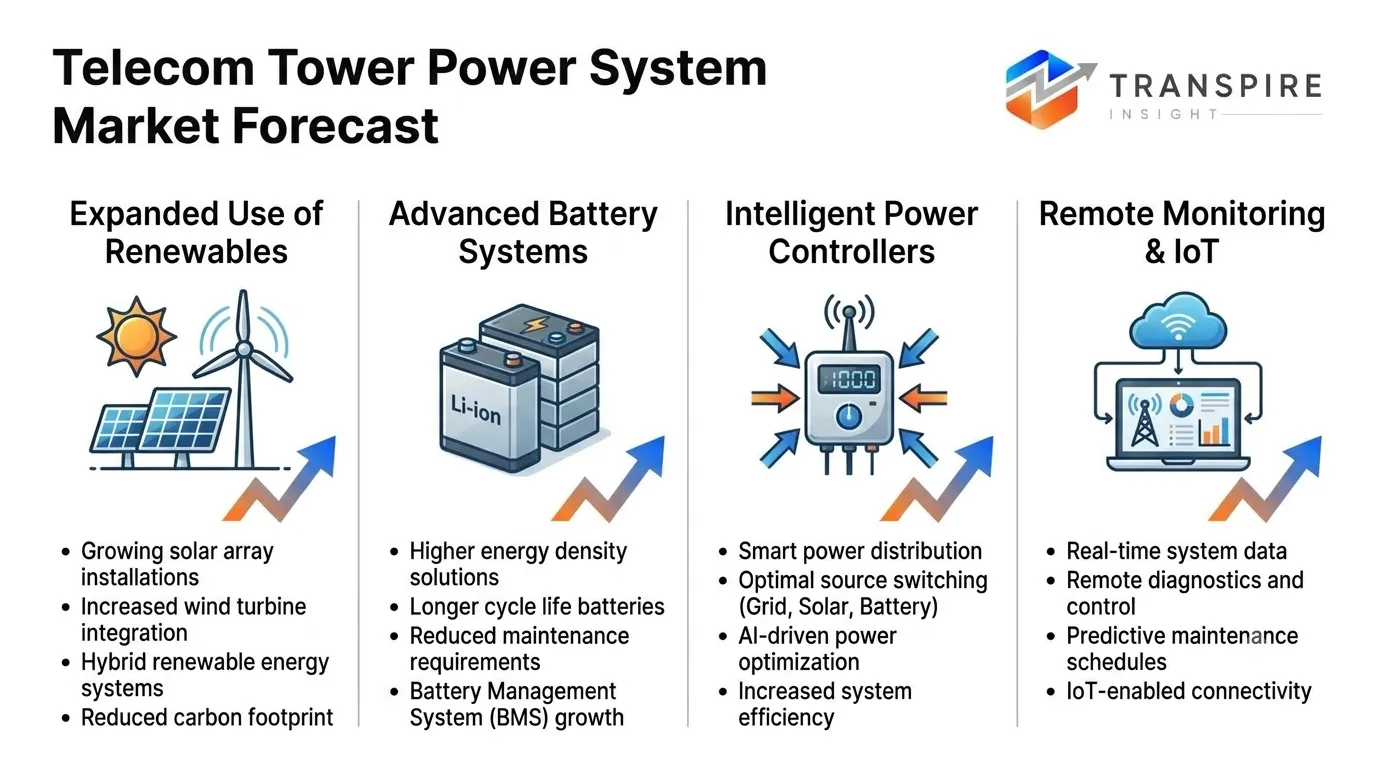
Operators combine solar, wind, and batteries with generators to cut fuel consumption, reduce operating costs, and keep towers running continuously where grid supply remains unreliable.
Tower operators are shifting from lead-acid to lithium-ion storage because it offers higher energy density, longer lifecycles, lower maintenance, and better performance in extreme temperatures.
AI platforms adjust radio sleep modes, battery charging, and generator use in real time, helping operators cut energy use across portfolios without service loss.
Towers extending into remote and rural areas lack dependable grid access, so operators install self-sufficient solar, battery, and generator systems that ensure reliable, uninterrupted connectivity.
Higher-capacity 5G radios and denser site grids draw considerably more electricity than earlier networks, pushing operators to upgrade rectifiers, batteries and cooling to sustain uptime.
Virtual power plant platforms aggregate tower batteries and sell flexibility to the grid, turning backup storage from a cost center into a valuable revenue-generating asset.
List of Top 25 Companies Leading the Telecom Tower Power System Market
1. Huawei Technologies Co., Ltd.
Leading provider of smart, digitalized power infrastructure for telecommunications operators.
Founded: 1987 | HQ: Shenzhen, China.
Why It Ranks: Market leadership in digital power solutions and intelligent VPP technology integration.
Regional Dominance: Strong dominant presence across Asia-Pacific, Middle East, Africa, and Latin America.
Product Line: SmartLi UPS, iPower rectifiers, outdoor cabinets, and solar hybrid conversion modules.
2. Vertiv Holdings Co
leader in critical digital infrastructure, uninterrupted power supply, and thermal management.
Founded: 1965 | HQ: Westerville, Ohio, United States.
Why It Ranks: Key player delivering highly reliable NetSure DC power platforms for telecom.
Regional Dominance: Extensive footprint and supply network across North America, Europe, and Asia.
Product Line: NetSure DC power systems, high-efficiency rectifiers, and hybrid site controllers.
3. Delta Electronics, Inc.
Pioneer in switching power supplies, thermal management solutions, and green energy products.
Founded: 1971 | HQ: Taipei, Taiwan.
Why It Ranks: High market share in high-efficiency telecom rectifiers and controllers.
Regional Dominance: Widespread dominance in Asia-Pacific, Europe, and expanding North American presence.
Product Line: OutD cabinet systems, CellD DC power systems, and renewable hybrid systems.
4. Eaton Corporation plc
Major intelligent power management enterprise with broad medium and low voltage solutions.
Founded: 1911 | HQ: Dublin, Ireland.
Why It Ranks: World-class industrial reliability, advanced power distribution, and widespread deployment capabilities.
Regional Dominance: Dominant enterprise operations in North America, Europe, and Latin American markets.
Product Line: Enterprise DC power systems, enclosures, power distribution units, and rectifiers.
5. Schneider Electric SE
specialist in energy management, digital automation, and sustainable power infrastructure solutions.
Founded: 1836 | HQ: Rueil-Malmaison, France.
Why It Ranks: Extensive portfolio combining smart eco-design power software with robust hardware systems.
Regional Dominance: Strong established stronghold across European, North American, and Asia-Pacific markets.
Product Line: EcoStruxure microgrid software, DC rectifiers, secure power cabinets, and UPS.
6. ABB Ltd.
Technology leader in electrification, automation, robotics, and industrial continuous power grid solutions.
Founded: 1988 | HQ: Zurich, Switzerland.
Why It Ranks: Unmatched engineering heritage in high-reliability industrial power electronics and grid integration.
Regional Dominance: Preeminent market force in Europe, Middle East, and Asia-Pacific industrial sectors.
Product Line: Lineage power DC systems, rectifiers, power panels, and modular UPS solutions.
7. Cummins Inc.
Renowned manufacturer of diesel engines, power generation systems, and hybrid components.
Founded: 1919 | HQ: Columbus, Indiana, United States.
Why It Ranks: Unrivaled power generation technology for critical telecom backup generator tower deployments.
Regional Dominance: Heavy footprint in North America, Latin America, Africa, and South Asia.
Product Line: Diesel generator sets, hybrid power generation units, and microgrid control units.
8. EnerSys
leader in stored energy solutions for industrial and communication network applications.
Founded: 1999 | HQ: Reading, Pennsylvania, United States.
Why It Ranks: Total energy ecosystem control featuring premier batteries combined with advanced power conversion.
Regional Dominance: Leading market presence throughout North America, Europe, and key Asian territories.
Product Line: PowerSafe batteries, Cordex DC power systems, enclosures, and hybrid controllers.
9. Eltek AS (A Delta Group Company)
Specialist developer of high-efficiency telecom power conversion modules and energy platforms.
Founded: 1971 | HQ: Drammen, Norway.
Why It Ranks: Industry standard setter for Super High Efficiency (SHE) telecom power conversion.
Regional Dominance: Widespread adoption across Europe, South America, and Asia-Pacific mobile operator networks.
Product Line: Flatpack2 rectifiers, Rectiverter systems, Smartpack controllers, and solar chargers.
10. ZTE Corporation
Major Chinese telecommunications vendor supplying end-to-end network infrastructure and site power.
Founded: 1985 | HQ: Shenzhen, China.
Why It Ranks: Comprehensive integrated green site power solutions optimized for 5G network expansion.
Regional Dominance: Dominant power deployment footprint in China, South Asia, Africa, and Eastern Europe.
Product Line: UniPower DC power systems, green site hybrid solar platforms, and smart lithium batteries.
Conclusion
The Telecom Tower Power System Market is undergoing a rapid transformation driven by 5G expansion, hybrid energy integration, and smart digital monitoring platforms. Leading companies are continuously innovating with high-efficiency rectifiers, lithium-ion energy storage, and AI-driven virtual power management to dramatically cut operational expenses and carbon emissions. As data usage escalates, intelligent and sustainable power systems remain essential for securing uninterrupted connectivity.


Send us a brief description of your challenge and we'll get back to you within 24 hours.

 inquiry@transpireinsight.com
 APAC:+91 7666513636
 Address


