
Sep 24, 2026
By Transpire Insight
Description
According to a research report published by Transpire Insight, the synthetic fur market size is projected to grow from USD 549.3 million in 2026 to USD 918.5 billion by 2035, at a CAGR of 9.97% during the forecast period 2027-2035. The synthetic fur industry is expanding due to the growing awareness of animal welfare issues worldwide, the progressive fur ban by some of the world's biggest brand names, the cost-efficiency and the advancement in anti-static textiles and the increased demand for luxury outerwear that is not tested on animals.
Introduction
As high fashion and consumer textile industries become more conscious of alternative, ethical fur, a wholesale revolution in the synthetic fur industry is underway. Today, high-tech textile technology can generate synthetic furs that closely replicate the feel, insulation and drape of real animal fur. From luxury fashion to home furnishings, car interior fabrics to toys, synthetic fur is a sustainable, eco-friendly option that complies with rigorous welfare requirements around the world without compromising on looks or longevity.
Recent Development News
By May 2026, advanced bio-engineered synthetic furs with a dense low friction backing provided up to 60% greater shedding resistance, enhancing their use in pet home decor and everyday garments.
September 2026: The Council of Fashion Designers of America officially enforced its animal fur ban for New York Fashion Week, compelling fashion houses to adopt high-grade synthetic fur alternatives exclusively.
Stay Ahead of Emerging Opportunities with Expert Market Insights by Transpire Insight
Transpire Insight provides comprehensive, data-driven market intelligence to support smarter business decisions. Our research is rooted in comprehensive analysis, authoritative predictions, and industry expertise, enabling organizations to make informed decisions in rapidly evolving markets. We provide in-depth analysis of market segmentation, competitive positioning, regional trends, and emerging investment opportunities in high-growth areas. We blend accuracy with actionable intelligence, helping companies uncover new growth avenues, strengthen strategic decision-making, and stay ahead in a dynamic market.
Synthetic Fur Market Size & Statistics
The Market Size for Synthetic Fur Was Estimated to be Worth USD 549.3 Billion in 2026.
The Market Size is Going to Expand at a CAGR of 9.97% between 2026 and 2035.
The Synthetic Fur Market Size is anticipated to reach USD 918.5 Billion by 2035.
Europe is projected to drive the highest demand during the forecast period, accounting for 35% of the synthetic fur market.
Asia-Pacific is projected to grow the fastest during the forecast period at a CAGR of 17% in the synthetic fur market.
Regional Growth and Demand Analysis by Transpire Insight
Europe's dominance rests on a combination of policy pressure and brand-level commitment. Some countries, like the UK and Germany, have set strict limits on real fur farming and trade, making the choice of faux fur the more common option over real fur. Such a change has been enabled at the very top of the fashion industry: big luxury corporations, such as Kering, have enacted fur-free transitions across brands like Gucci and Saint Laurent, communicating to the rest of the industry that high-end faux fur is now an acceptable alternative to animal fur in luxury outerwear. Material innovation has been right on its heels, with fibre manufacturers like ECOPEL getting in on recycled synthetic fur lines, which are targeted directly at boosting sales in Europe, where regulatory tailwinds are present.
A different set of forces are driving Asia-Pacific's growth path, including the growing purchasing power of the region's middle class, a fashion culture that's coming into its own, and the depth of manufacturing here. Much of this activity is driven by China, which has a long history of textile manufacturing, and growing domestic demand for budget and luxury faux fur products, and India, where incomes have been improving. Materials innovation also comes into this picture: companies such as BioFluff are developing natural fibre faux fur as a substitute for a purely plastic-based construction, which is attractive to the young, digitally savvy consumer, who demands cruelty-free sourcing as a minimum requirement, not as a luxury.
Top 15 Trends in the Synthetic Fur Market
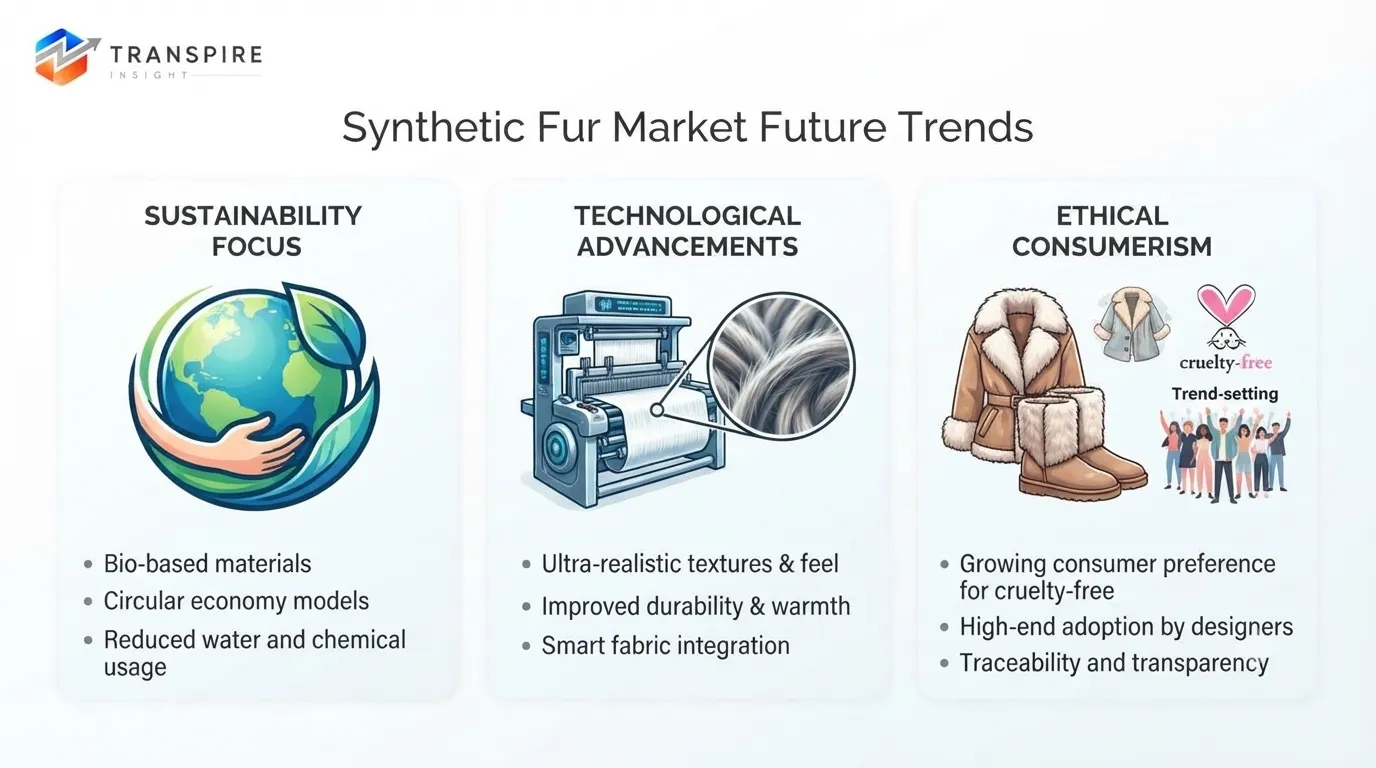
Manufacturers now blend recycled ocean plastics and plant-based polymers into synthetic fur, cutting petroleum reliance and boosting sustainability credentials for eco-conscious, cruelty-free fashion consumers worldwide.
Major luxury groups, including Kering's Gucci and Saint Laurent, have ended real fur usage entirely, pushing high-end brands toward premium faux fur alternatives for outerwear.
Governments across California and several European nations have enacted legislation banning real fur farming and sales, accelerating brand and consumer shifts toward synthetic fur substitutes.
China's established textile manufacturing base, combined with rising domestic fashion consumption, positions it as the primary production and export hub for synthetic fur supply.
Vegan fashion values now shape mainstream apparel design, as brands integrate faux fur trims and linings to attract ethically minded shoppers seeking animal-free clothing options.
Recycled ocean-plastic fibers, known as rPET, are increasingly woven into synthetic fur products, offering brands a marine-waste-reducing, sustainability-focused alternative to conventional acrylic and polyester materials.
List of Top 25 Companies Leading the Synthetic Fur Market
Premier French manufacturer widely regarded as the gold standard for luxurious synthetic fur.
Founded: 1953 | HQ: France.
Why It Ranks: Unmatched quality in dense, silk-like modacrylic pile engineering for high fashion.
Regional Dominance: Europe and North America driving high-end luxury fashion demand.
Product Line: Premium modacrylic faux pelts, high-pile woven plush, and outerwear textiles.
Fact: World pioneer in developing specialized flame-retardant modacrylic fibers for artificial furs.
Founded: 1949 | HQ: Tokyo, Japan.
Why It Ranks: market dominance in raw fiber supply for synthetic fur production.
Regional Dominance: Asia-Pacific, supplying textile mills across China, Japan, and Southeast Asia.
Product Line: Kanecaron modacrylic fibers, flame-resistant synthetic yarns, and specialty polymers.
Fact: Leading Chinese exporter producing immense annual volumes of knitted artificial fur textiles.
Founded: 1988 | HQ: Ningbo, China
Why It Ranks: Massive production scaling and supply chain reach across international export markets.
Regional Dominance: East Asia with broad export networks across North America and Europe.
Product Line: Jacquard faux fur, sherpa fleece, plush toy fabrics, and faux suede.
Renowned European technical textile brand specializing in high-performance fake fur fabrics.
Founded: 1956 | HQ: Vosges, France.
Why It Ranks: Pioneer in technical faux furs for military outerwear, fashion, and acoustics.
Regional Dominance: Western Europe with strong industrial supply networks across the continent.
Product Line: High-pile fake fur, technical fleece lining, lining materials, and home fabrics.
Major Indian manufacturer of high-density acrylic plush and synthetic fur rolls.
Founded: 1992 | HQ: Surat, India.
Why It Ranks: Key supplier of affordable, diverse pile textiles for apparel manufacturers.
Regional Dominance: South Asia with growing exports to the Middle East and Africa.
Product Line: Acrylic faux fur, poly-fill plush, patterned faux shearling, and soft linings.
Fact: Sustainable faux fur creator pioneering plant-based and recycled bio-fiber synthetic pelts.
Founded: 2004 | HQ: Paris, France
Why It Ranks: Industry leader in eco-friendly synthetic fur innovations for top luxury houses.
Regional Dominance: Europe and North America, partnering with top eco-conscious fashion brands.
Product Line: KOBA bio-based fur, recycled polyester faux fur, and sustainable pile linings.
Key North American mill producing high-grade synthetic fur for automotive and fashion.
Founded: 1981 | HQ: North Carolina, USA.
Why It Ranks: Leading domestic supplier of custom heavy-pile plush and specialty technical synthetics.
Regional Dominance: North America with primary market dominance in the US and Canada.
Product Line: Heavy knit faux fur, interior lining plush, automotive seat textiles, and throws.
Prominent supplier specializing in long-pile synthetic fur for garments and home goods.
Founded: 2005 | HQ: Dongguan, China.
Why It Ranks: Comprehensive R&D facilities delivering custom-dyed and printed artificial fur patterns.
Regional Dominance: East Asia with widespread distribution across retail consumer markets.
Product Line: Long-pile fake fur, printed faux animal pelts, rabbit-fur plush, and fleece.
Leading South Korean textile innovator specializing in ultra-soft micro-fiber synthetic pelts.
Founded: 1997 | HQ: Seoul, South Korea.
Why It Ranks: Advanced micro-denier knitting technology replicating natural mammal coat gradients precisely.
Regional Dominance: East Asia with strong market presence in North America and Europe.
Product Line: Premium micro-fiber faux fur, synthetic mink, faux fox pelts, and trims.
Ethical luxury fashion house developing circular, non-toxic, and biodegradable faux furs.
Founded: 2017 | HQ: New York, USA.
Why It Ranks: Prominent trendsetter shifting high fashion consumers toward completely bio-based synthetic furs.
Regional Dominance: North America with significant brand recognition across European fashion hubs.
Product Line: Bio-based fur coats, cruelty-free plush jackets, and vegan leather accessories.
Conclusion
The synthetic fur business has shifted from being a cheap alternative to a major force in the ethical luxury fashion and technical home textiles business. Fueled by groundbreaking polymer advancements, bio-fibers, and pivotal steps toward phasing out animal fur from fashion runs, leading brands are quickly expanding their sustainable manufacturing efforts. The industry will continue to grow with eco-certified high-performance synthetics that meet consumer demand for "cruelty-free" elegance in the future.


Send us a brief description of your challenge and we'll get back to you within 24 hours.

 inquiry@transpireinsight.com
 APAC:+91 7666513636
 Address


