
Oct 24, 2026
By Transpire Insight
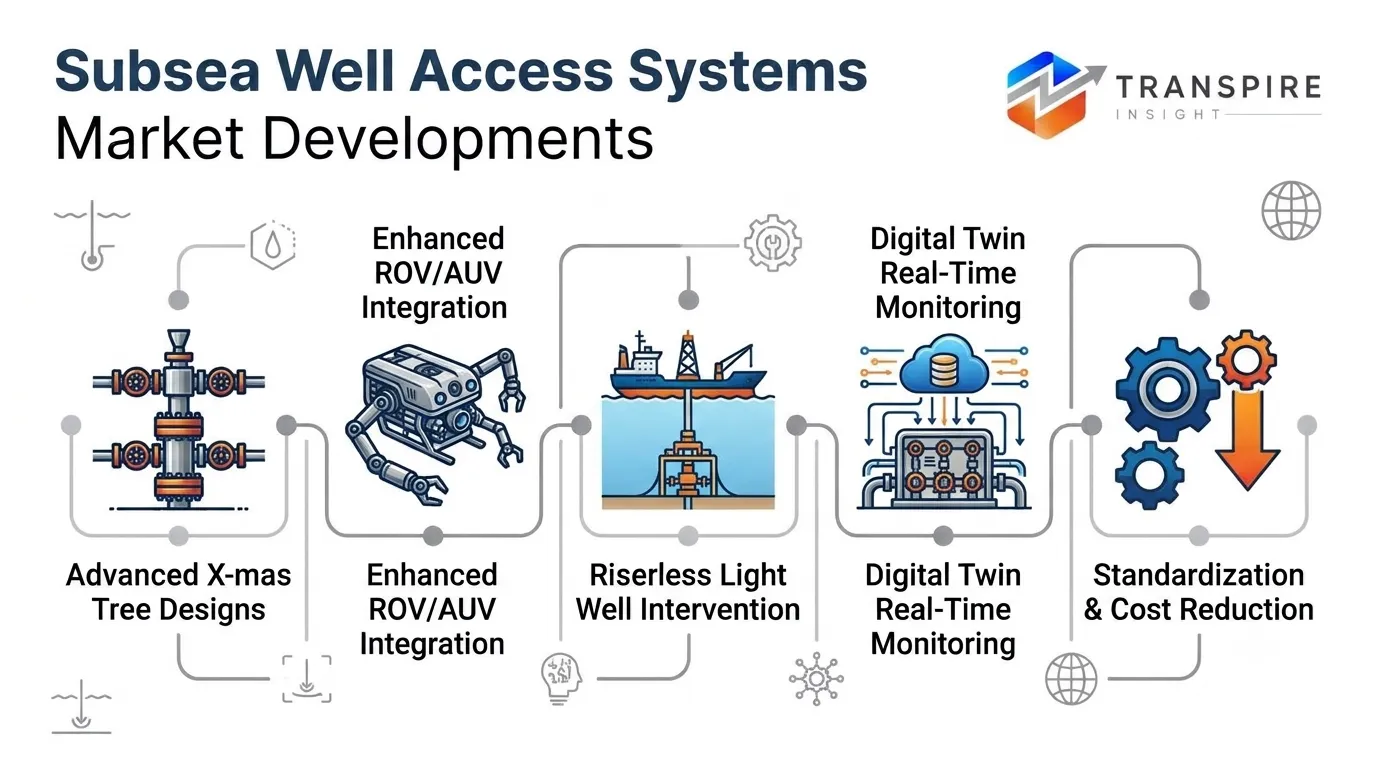
Description
According to a research report published by Transpire Insight, the subsea well access systems market size is projected to grow from USD 4.98 billion in 2026 to USD 7.21 billion by 2035, at a 5.12% CAGR during the 2027-2035 forecast period. Rising deepwater oil and gas developments, deepwater recovery optimization, aging offshore subsea wells, and growth in rigless light-well interventions drive subsea well access systems market expansion.
Introduction
The Subsea Well Access Systems Market encompasses specialized engineering equipment, including landing strings, subsea test trees, riserless light well intervention (RLWI) systems, and intervention risers, essential for safe offshore intervention, completion, and maintenance. Growth is propelled by accelerating ultra-deepwater projects and the imperative to maximize field recovery rates. Furthermore, rapid integration of real-time digital monitoring, robotics, and subsea automation enhances operational safety while significantly lowering field development expenditure.
Recent Development News
January 2026: SLB announced a major contract award for deepwater subsea intervention and landing string trees in the Gulf of Mexico, focusing on high-pressure, high-temperature (HPHT) subsea reservoir access.
May 2026: TechnipFMC successfully deployed its next-generation Riserless Light Well Intervention (RLWI) system in the North Sea, setting an operational milestone for reduced-emission, vessel-based subsea well workovers.
Stay Ahead of Emerging Opportunities with Expert Market Insights by Transpire Insight
Transpire Insight provides comprehensive, data-driven market intelligence to support smarter business decisions. Our research is rooted in comprehensive analysis, authoritative predictions, and industry expertise, enabling organizations to make informed decisions in rapidly evolving markets. We provide in-depth analysis of market segmentation, competitive positioning, regional trends, and emerging investment opportunities in high-growth areas. We blend accuracy with actionable intelligence, helping companies uncover new growth avenues, strengthen strategic decision-making, and stay ahead in a dynamic market.
Subsea Well Access Systems Market Size & Statistics
The Market Size for Subsea Well Access Systems Was Estimated to be Worth USD 4.98 Billion in 2026.
The Market Size is Going to Expand at a CAGR of 5.12% between 2026 and 2035.
The Subsea Well Access Systems Market Size is anticipated to reach USD 7.21 Billion by 2035.
North America is projected to drive the highest demand during the forecast period, accounting for 34.9% of the subsea well access systems market.
Asia-Pacific is projected to grow the fastest during the forecast period at a CAGR of 4.63% in the subsea well access systems market.
Regional Growth and Demand Analysis by Transpire Insight
North America leads because the US Gulf of Mexico has the densest base of producing deepwater wells in the world, and those wells need constant intervention to hold output. Operators such as Shell, Chevron, and bp run large subsea tieback networks there. Service providers like Helix Energy Solutions deploy purpose-built well intervention vessels such as the Q7000 to reach those wells without a drilling rig. Strict well control and safety rules from US offshore regulators also push operators toward certified, high-reliability access equipment. Together, mature fields, strong operator spending and a rigorous regulatory framework keep demand steady, with intervention and production enhancement work taking priority over new drilling.
Asia-Pacific is moving faster from a smaller base, driven by state-backed deep-sea exploration and new offshore infrastructure. Discoveries in the South China Sea, particularly in Vietnamese, Malaysian and Thai waters, are pulling capital into subsea development and the access systems that support it. National oil companies such as CNOOC and Petronas continue to push into deeper acreage, creating fresh demand for rig-based and vessel-based access equipment. Domestic manufacturing in China, South Korea, and Singapore is also strengthening regional supply chains and lowering lead times. As more of these fields mature, the region will need well access systems for routine intervention as well as new completions.
Top 15 Trends in the Subsea Well Access Systems Market
Riserless light well intervention systems let operators access subsea wells from lightweight vessels, cutting mobilization time and cost compared with rig-based campaigns, enabling flexible interventions.
Vessel-based well access platforms are gaining share because operators want cost-efficient, flexible alternatives to drilling rigs for routine intervention, inspection, and maintenance across offshore fields.
Operators are pushing into deepwater basins like the Gulf of Mexico and Brazil’s pre-salt, requiring robust well access systems rated for extreme depths and pressures.
Aging offshore wells need intervention to sustain output, so operators favor access systems that restore flow, replace components, and extend field life without new drilling.
Digital twins and real-time monitoring let operators predict equipment wear, plan interventions precisely, and shorten offshore campaigns, improving safety and reducing costly unplanned equipment downtime.
Aging fields are entering plug-and-abandonment phases, especially in the North Sea, driving demand for well access systems that reach, isolate, and permanently seal subsea wells.
List of Top 25 Companies Leading the Subsea Well Access Systems Market
1. TechnipFMC
offshore engineering leader delivering advanced integrated subsea well access and processing solutions.
Founded: 2017 | HQ: Newcastle upon Tyne, UK.
Why It Ranks: Holds major market share through integrated subsea equipment and vessel-based interventions.
Regional Dominance: Strong market presence across the North Sea, Gulf of Mexico, and Brazil.
Product Line: Riserless Light Well Intervention (RLWI) systems, subsea trees, and controls.
2. SLB (Schlumberger)
World's largest oilfield services enterprise providing cutting-edge subsea access and reservoir digital diagnostics.
Founded: 1926 | HQ: Houston, Texas, USA.
Why It Ranks: Unmatched technological breadth in high-pressure, high-temperature subsea well control systems.
Regional Dominance: Extensive operations spanning North America, the Middle East, West Africa, and Latin America.
Product Line: Subsea test trees, landing string assembly systems, and digital completion.
3. Baker Hughes Company
Energy technology company engineering reliable deepwater well access systems and subsea instrumentation.
Founded: 1987 | HQ: Houston, Texas, USA.
Why It Ranks: High reputation for reliable blowout preventers, subsea trees, and controls.
Regional Dominance: Robust presence across the Americas, Europe, North Sea, and Asia-Pacific.
Product Line: Subsea trees, intervention riser systems, subsea wellhead access tools, and controls.
4. Halliburton
Major oilfield service provider offering end-to-end well completion and subsea intervention solutions.
Founded: 1919 | HQ: Houston, Texas, USA.
Why It Ranks: Leading market position in subsea deepwater completions and intervention engineering solutions.
Regional Dominance: Dominant footprint in North America, Latin America, the Middle East, and Africa.
Product Line: Subsea safety systems, landing strings, tubing hangers, and intervention tools.
5. Aker Solutions
Norwegian engineering powerhouse pioneering low-carbon subsea intervention technologies and deepwater well architecture.
Founded: 1841 | HQ: Fornebu, Norway.
Why It Ranks: Dominates North Sea deepwater well operations with state-of-the-art subsea technology.
Regional Dominance: Market leader in Northern Europe and expanding across Brazil and West Africa.
Product Line: Subsea well access trees, workover control systems, and RLWI equipment.
6. NOV Inc. (National Oilwell Varco)
equipment manufacturer designing robust subsea pressure control and well access handling units.
Founded: 1841 | HQ: Houston, Texas, USA.
Why It Ranks: Key equipment supplier for blowout preventers and subsea riser control systems.
Regional Dominance: Strong presence across North America, Middle East, and Asia-Pacific offshore basins.
Product Line: Subsea landing strings, BOP stacks, subsea riser systems, and connectors.
7. Oceaneering International
Specialized provider of subsea robotics, ROV intervention, and deepwater access tooling systems.
Founded: 1964 | HQ: Houston, Texas, USA.
Why It Ranks: Industry standard for ROV-assisted subsea well intervention and robotic tooling execution.
Regional Dominance: Deepwater leadership in the US Gulf of Mexico, Brazil, and North Sea.
Product Line: Subsea intervention hardware, ROV tooling packages, subsea control skids, umbilical systems.
8. Trendsetter Engineering
Innovative subsea engineering firm specializing in customized subsea response equipment and intervention hardware.
Founded: 1996 | HQ: Houston, Texas, USA.
Why It Ranks: Renowned globally for quick-deployment subsea capping stacks and specialized access manifolds.
Regional Dominance: High penetration in the Gulf of Mexico, West Africa, and the Mediterranean.
Product Line: Subsea well access skids, capping stacks, source control, and intervention manifolds.
9. Expro Group
International well flow management specialist offering lightweight riserless and open-water subsea intervention.
Founded: 1973 | HQ: Reading, United Kingdom.
Why It Ranks: leadership in electro-hydraulic landing strings and subsea safety valve systems.
Regional Dominance: Extensive offshore footprint in the UK, Norway, West Africa, and Asia-Pacific.
Product Line: Subsea landing strings, intervention riser systems, subsea test tree safety valves.
10. Dril-Quip (Noble Corporation / Weatherford)
Manufacturer of offshore drilling and production equipment designed for extreme deepwater environments.
Founded: 1981 | HQ: Houston, Texas, USA.
Why It Ranks: Highly trusted for robust subsea wellhead systems and specialized running tools.
Regional Dominance: Strong influence across North America, South America, Asia-Pacific, and Europe.
Product Line: Subsea wellhead systems, subsea intervention trees, tubing head assemblies, template systems.
Conclusion
The Subsea Well Access Systems Market is vital for sustaining offshore production and enabling safe deepwater interventions. Driven by aging subsea infrastructure and the shift toward cost-efficient, vessel-based riserless technologies, key players continue to innovate through digital monitoring and robotics. As operators expand deeper into harsh offshore basins, advanced well access systems will remain essential for maximizing ultimate recovery while ensuring rigorous environmental and operational safety standards.


Send us a brief description of your challenge and we'll get back to you within 24 hours.

 inquiry@transpireinsight.com
 APAC:+91 7666513636
 Address


